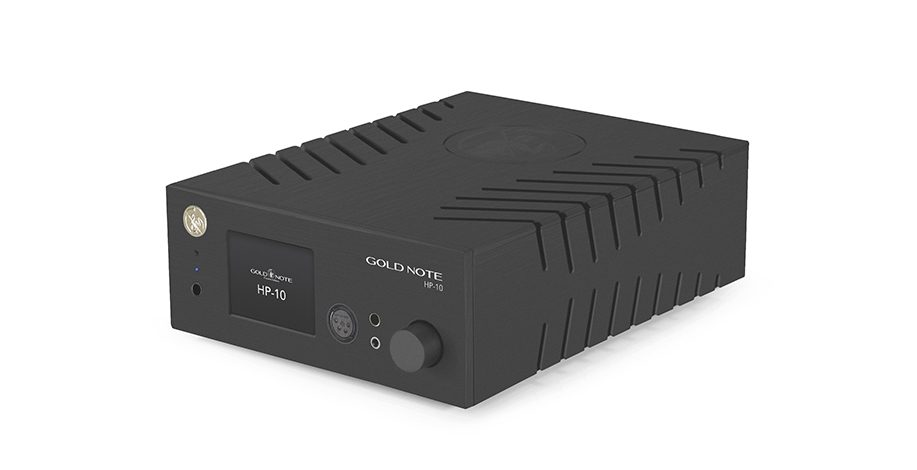
Companies that make complete systems from source to speaker are always a rarer thing than those that specialise in a smaller collection of components. Even amongst this smaller group of companies, Gold Note is more unusual still. Not only will the company build you a system that goes from the tip of the stylus on a turntable to the cone of a speaker driver, but they can also do the same with digital. Although electronics is only one of the areas that Gold Note focuses on, they produce some extremely sophisticated devices. The Gold Note HP-10 Deluxe headphone amplifier is a prime example.
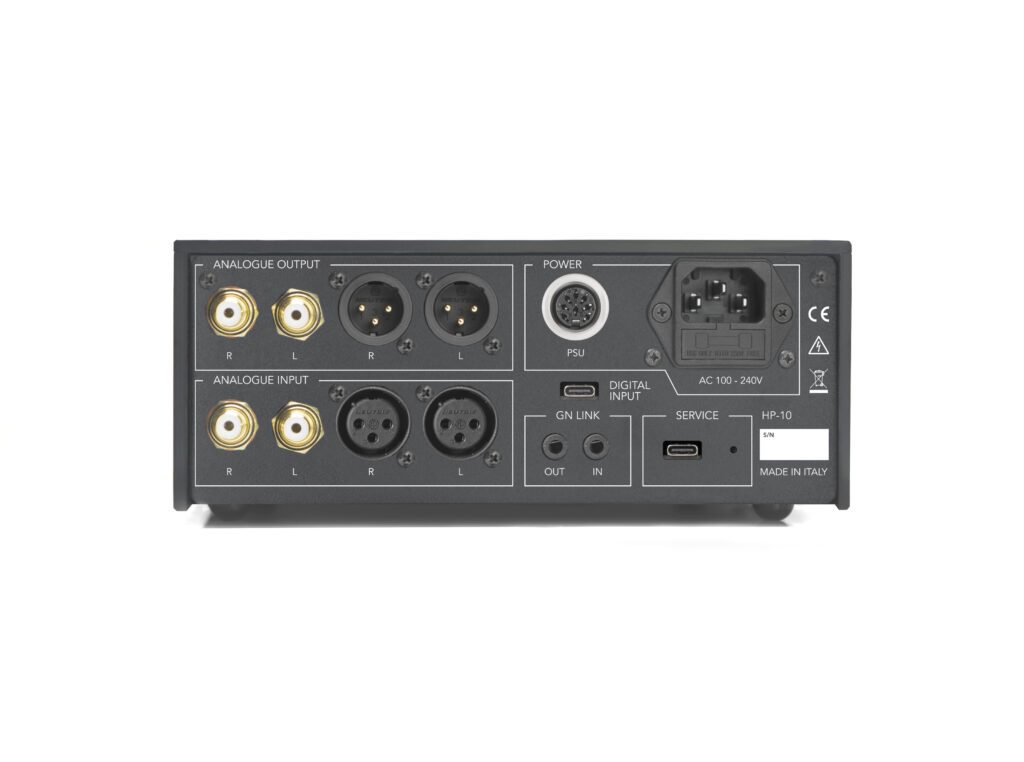
Taken at face value, the Gold Note HP-10 Deluxe is a relatively conventional headphone amplifier. At the back, you will find inputs to receive an audio signal, and at the front, a selection of headphone connections – 3.5mm and 6.35mm single-ended, and 4.4mm and four-pin XLR balanced – to utilise them. What goes on between those two points is more notable, though, and marks the HP-10 as an uncommonly flexible bit of kit. For starters, there are three different versions: a ‘classic’ version featuring exclusively analogue inputs (HP-10), a version that adds Bluetooth (HP-10 BT), and the version here, which adds a USB audio input (HP-10 Deluxe).
Not simple
Even the ‘simple’ Gold Note HP-10 Deluxe isn’t anything of the sort. At the front of the unit is a touchscreen display, which might seem overkill for a device with a single function, but is somewhat necessary when you start to realise how many different parameters you can adjust. Some of these are pretty predictable; you can choose the input on the rear panel and output on the front and adjust the balance to handle any irregularities in your hearing.
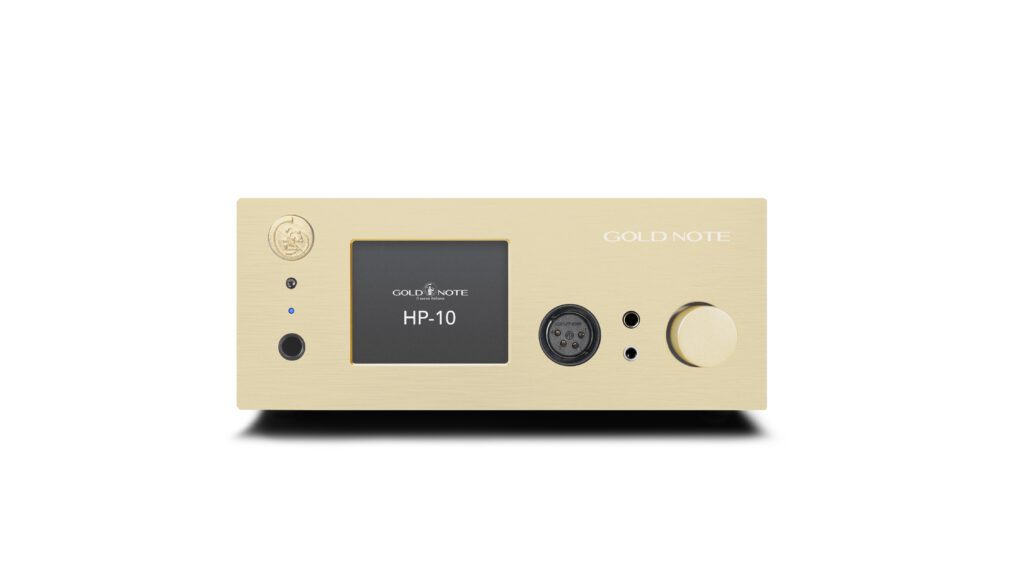
From here, though, things become rather more sophisticated. There are mono options; you can choose to listen to the sum of the channels (L+R), or just one of the channels (L or R) and reverse the stereo channels should you need to. There is then a complete suite of functions that Gold Note refers to as Studio. This provides four different crossfeed settings (a feature I consider highly beneficial for headphone listening), ranging from none to effectively dual mono. There are also adjustment options around the Harman curve of headphone equalisation, along with a damping factor and a ‘Superflat’ setting that linearises the response of the headphones. For good measure, you can then assemble different profiles, either for various pairs of headphones, other user preferences or even for different styles of music. Even the standard HP-10 is a highly sophisticated thing.
Standard inputs and outputs
As standard, the Gold Note HP-10 Deluxe features RCA and XLR inputs, along with a matching set of outputs. These can run as a bypass if the source outputs are required by more than one device. The HP-10 BT adds an ESS Sabre DAC to handle a suite of Bluetooth, including Apt-X. The HP-10 Deluxe retains Bluetooth connectivity and adds a USB input via a USB-C connector, which is dealt with by an AKM4493 DAC chip. This enables the HP-10 to handle PCM up to 768kHz and DSD 512, which means it can also be used as a single-input DAC if needed.
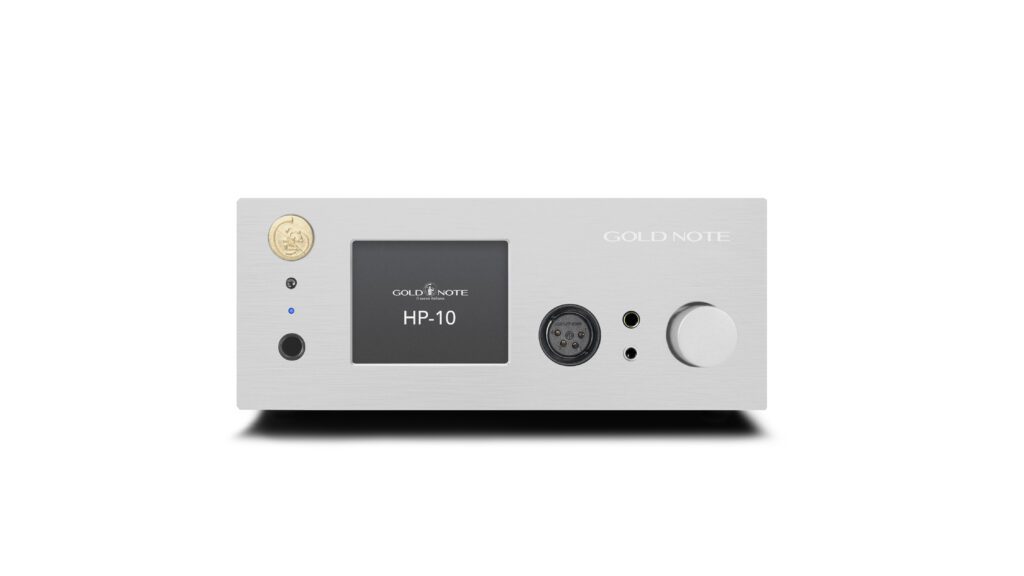
This extensive feature set is packed into a half-width chassis used by several devices in the Gold Note range. I will happily admit that with some members of the range, I’m not sure the aesthetic is compelling, but here I think it’s effective. There is a combination of compactness and businesslike qualities in the HP-10 that’s hard not to admire. The casework is finished to a very high standard, and you also get a remote control. The remote can be used to fully control the unit, including the Studio menu with all its features, which means that the level can be adjusted without constant trips to the unit itself.
Power up!
One last feature of the Gold Note HP-10 Deluxe wasn’t supplied for testing, but is still potentially interesting. As standard, the Gold Note receives power via an IEC socket on the rear panel. Still, an upgrade is available in the form of the PSU-10 EVO power supply, which offers four transformers, three of which are entirely dedicated to the power supply and 1 to the inductive filter. At an extra £1,200, it’s a significant additional cost, but it provides further scope for upgrade.
There is a degree of trepidation in delving into the sonic section of this review, as the actual sonic properties of the HP-10 are enormously variable, thanks to the sheer number of adjustable increments. The review sample arrived with a selection of gain and Harman EQ adjustments that had been working for someone. Still, it resulted in the resident pair of Focal Clear MGs sounding overblown and lacking in the refinement and subtlety that I know they are capable of.
All off
Switching everything ‘off’ and working from there allowed me to apply ‘Crossfeed 2’ and activate the ‘Damping’ setting, while leaving everything else unchanged. The Focal is not a tricky headphone to drive, and even without the gain boost, I never exceeded 45 on the 99-step volume control. The suggestion is that, with the gain boost still in reserve, the HP-10 should be able to drive most headphones to the point of detonation.
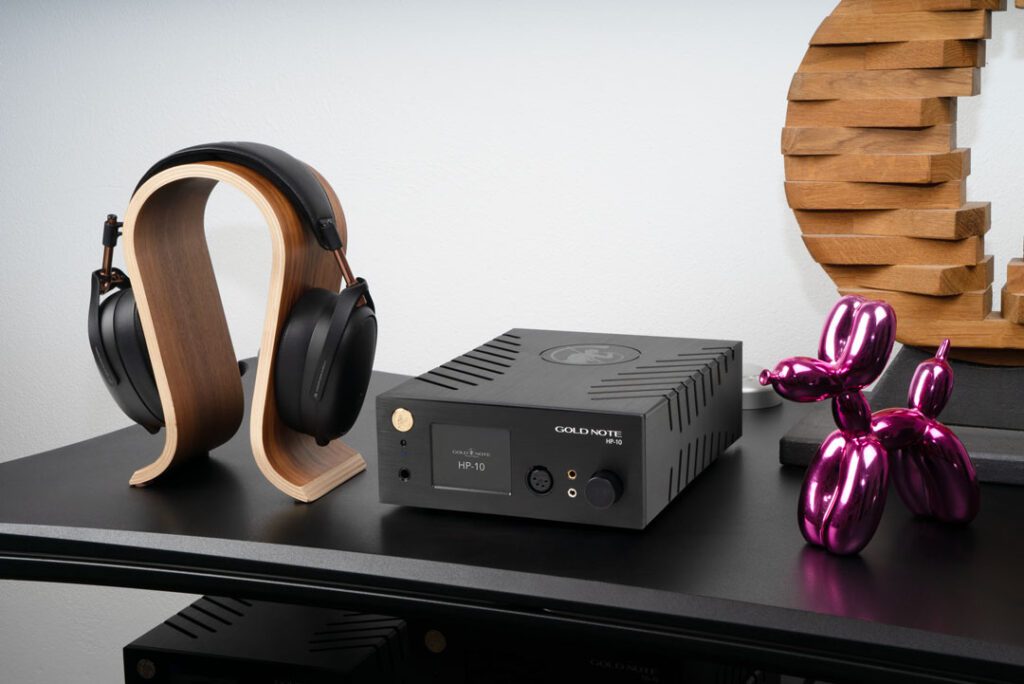
Initially, using the USB-C input, there is a great deal to like about how the Gold Note approaches making music. The most immediately arresting aspect of what it does is the sheer amount of detail it effortlessly extracts from material. Paul’s Boutique by the Beastie Boys [Capitol] shows this off to exceptional effect. This album is a layering of samples, intertwined to astonishing impact with the trio’s high-speed lyrics spread across them. The Gold Note never loses the relationship between vocals and samples, but it’s easier to understand the interplay and just how much is going on.
Conventionally ‘hi-fi’
Play something more conventionally hi-fi like Agnes Obel’s Philharmonics [PIAS], and the Gold Note HP-10 Deluxe demonstrates excellent tonal realism coupled with enough dynamics to ensure that a real sense of the constrained force in her piano is conveyed in the recording. This is aided by excellent bass extension. The Focal is not and never will be a truly seismic headphone (for me, the trade-off is the truly magnificent dynamic speed they possess), but the Gold Note does a better job than most headphone amps of coaxing a little more low end from them. Using the ‘Damping’ function helps to keep everything sounding fast and tight, and from the moment I turned it on, I had no desire to turn it off again.
The crossfeed function also works exceptionally. Some years ago, I sat through a 90-minute presentation from a company that had introduced a product of theirs and left none the wiser about what they were aiming for. Spending five minutes with the HP-10 yields a more eloquent explanation than the presentation ever could. Listening to Mazzy Star’s So Tonight That I Might See [Capitol] ensures that when Hope Sandoval begins her stunning vocal turn in Into Dust, she’s in front of you and not simply singing into each ear. For me, it aids the suspension of disbelief in a way that almost no other single function can.
Decent decoding
Although the internal DAC is good, it is only fair to point out that, if you already have decent decoding capabilities at hand, the standard HP-10 might be a better choice. The resident Chord Electronics Hugo Mscaler and TT2, connected via XLR, were able to expand the soundstage further and enhance the already excellent tonality beyond what the digital stage of the HP-10 could achieve. This is hardly momentous news- after all a dedicated £7,500 digital front end should exhibit benefits over one built into a £2,300 headphone amp- but what is interesting is the headphone section of the Gold Note is still better than the TT2 used as a headphone amp when the Focal is switched over to its 6.35mm connection (as the Chord does not have a four pin XLR out). The actual headphone amp of the Gold Note HP-10 Deluxe is quite special.
What seals the deal here, though is knowing that if my – possibly slightly puritanical – take on turning on all the bells and whistles doesn’t work for you, they are all there waiting to be played with, and it is highly likely that some combination will deliver the sound that you desire, making this very close to a one size fits all recommendation. Gold Note might spread its resources over many categories, but it still knows how to deliver a winner.
Technical specifications
- Headphone Amplifier: Class-A Dual/Mono
- Analogue Inputs: 1x unbalanced RCA (5 Vrms max), 1x balanced XLR (8 Vrms max)
- Digital Inputs: 1x USB-C up to DSD512 and PCM 768kHz (HP-10 DELUXE),1 x Bluetooth 5.1 HD aptX (HP-10 DELUXE, HP-10 BT)
- Headphone Outputs: 3.5mm jack (unbalanced), 6.3mm jack (unbalanced), 4.4mm jack (balanced), 4-pin XLR (balanced)
- Line Outputs: 1x unbalanced RCA, 1x balanced XLR
- Headphone Power Output: 10W Max
- Frequency Response: 20Hz-20kHz ± 0.3dB
- THD (Total Harmonic Distortion)+N: <0.015% @ 1kHz
- SNR (Signal to Noise Ratio): 110dB
- D/A Converter: AKM AK4493 (HP-10 DELUXE) or Sabre ES9023 (HP-10 BT)
- Bluetooth: 5.1 HD aptX (HP-10 DELUXE, HP-10 BT)
- Crossfeed: Adjustable (full spectrum or lows/mids / highs)
- Analogue EQ: Adjustable Harman Curve, Superflat
- Damping Factor: Adjustable (High/Low)
- Phase: Adjustable (0/180)
- Dimensions: 200mm W | 80mm H | 260mm D
- Weight: 3.5kg
- Price: £1,800, €1,890, $2,199
Manufacturer
Gold Note
UK distributor
Airt Audio
+44 (0)754 879 6832
Trending Articles
See all
By Ed Selley
More articles from this author
Read Next From Review
See all
Reiki Audio SuperSwitch X/Pro X PSU
- Oct 06, 2026
Audiobyte SuperVOX
- Oct 06, 2026
Unitra WSH-805
- Sep 29, 2026
Wilson Audio Sabrina V
- Sep 29, 2026