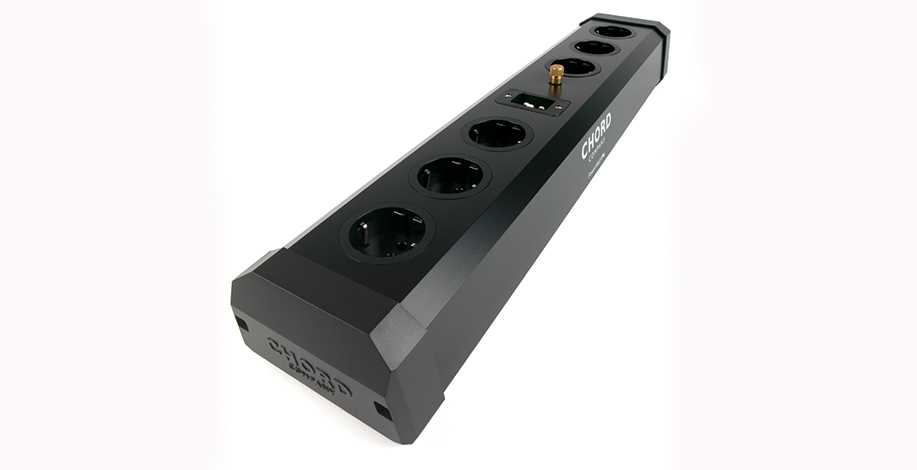
Electrical generation and distribution in the UK are generally good. However, the quality and robustness of the equipment connected to the UK supply can vary. What is needed for delicate hi-fi systems is consumer equipment made to professional standards. That’s where products like Chord Company’s PowerHAUS P6 come in.
The P6 evolved from the custom distribution boards that Chord Company has been building for its use at hi-fi shows and internal demonstration rooms since the mid-1980s. It has experimented with numerous wiring techniques, filters, shields, and conductors in various multi-stranded and solid-core wire gauges. Put another way, the P6 draws on four decades of iterative product development. The ‘real world’ problems that had to be identified and solved would, it would seem, also apply to the domestic environment.
As its name suggests, the Chord Company PowerHAUS P6 has six sockets. This number should be sufficient for most high-grade hi-fi systems. It’s enough for a pre- or power amp, turntable, phono stage, CD transport, and DAC, for example.
Faultless build
One cannot fault the Chord Company PowerHAUS P6 for build quality. If you’ve recently handled a cheap multiway plastic extension lead, here’s a product to restore your confidence in British industry. On its solidly constructed two-piece metal chassis are two sets of three 13-amp sockets. There is a version with Schuko sockets for EU users and there will likely be an Aus/NZ version, but no sign of a US version. These are separated amidships by the IEC mains input socket and a grounding post. Used sensibly, the latter can help you identify and ‘break’ the earth loops that can cause audible hum. Chord Company also told us that “some people with sprawling AV systems can benefit” from the casework earthing.
It’s pared back to basics, though. You don’t even get a master switch. Chord Company, I was told, “doesn’t like serial filters and instead, focuses on keeping impedances as low as possible”. The latter design goal helps to, for example, reduce wasteful voltage drops (and unwanted heat generation) with heavy loads – such as big, powerful amplifiers. The chances of distorting the all-important sinusoidal mains waveform are also reduced.
C13, C19… go
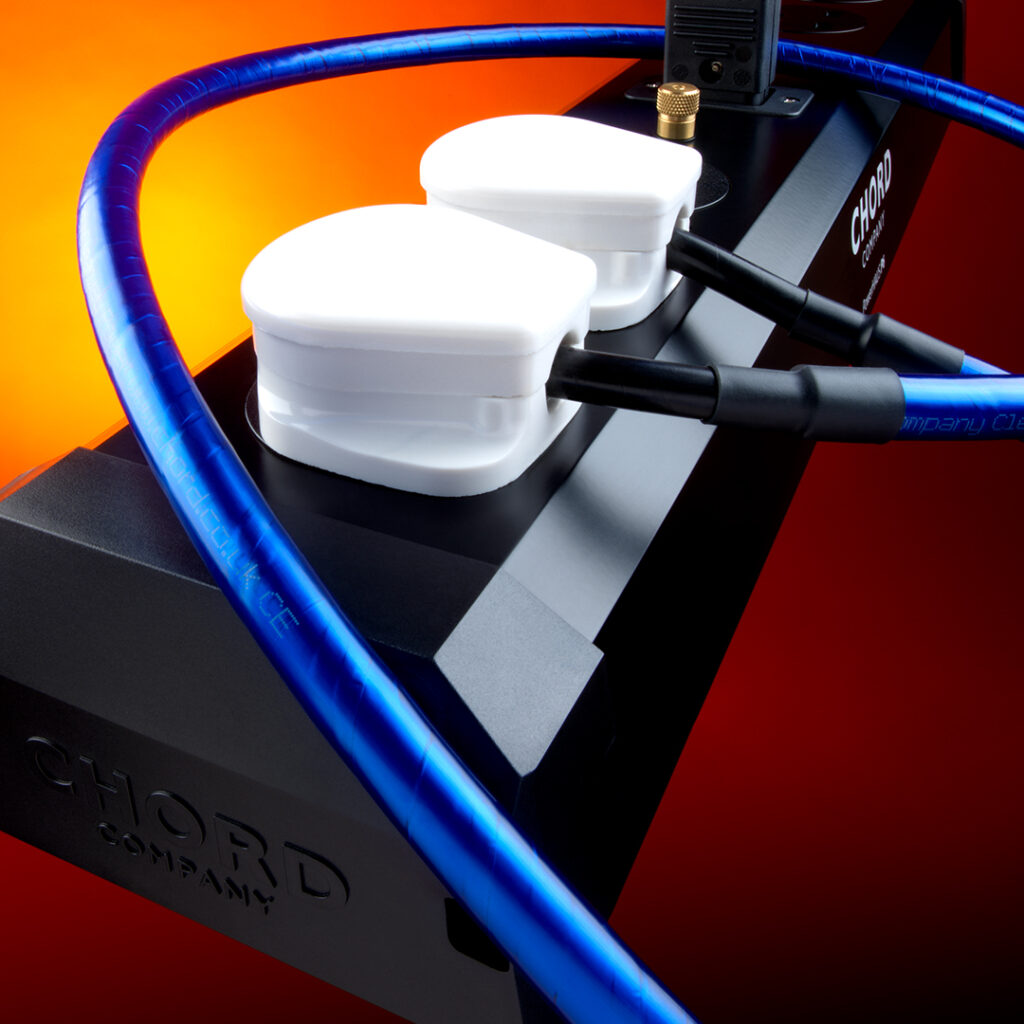
Instead of the C13 IEC connector (rated to 13 amps, hence the name), Chord Company has specified the larger, higher-current C19 variety (up to 20 amps, depending on voltage) for mains input. C19 connectors aren’t standard in the UK, at least not in consumer products, although I have seen them fitted to some ‘muscle amps’. Thankfully, Chord Company supplies a two-metre C19 mains lead to ‘get you going’. This can be upgraded later, possibly to a Chord Company Clearway.
The Chord Company PowerHAUS P6’s nicely finished body is capped at either end with tough plastic mouldings. These are fitted on the underside with rubber feet to prevent the P6 from sliding around. Chord Company says that it’s suitable for an assortment of surfaces, including wood, carpet, tiles and the shelves of hi-fi racks. For installation of a more permanent nature, slotted recesses for mounting have been stamped into the rear of the body. These are for wall- or stand-mounting.
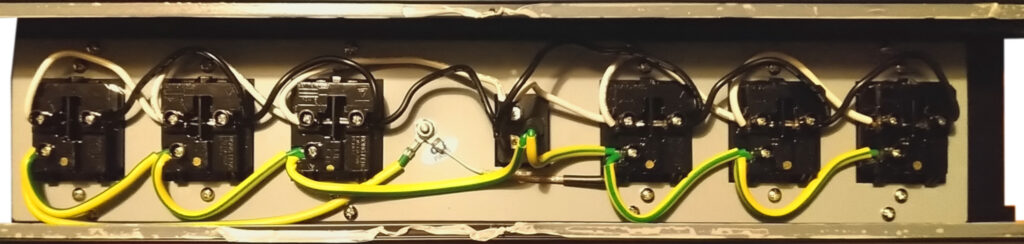
A peek inside the Chord Company PowerHAUS P6 reveals neat construction. The heavy-gauge wiring looms are the product of hand assembly – no cheap brass strips here! The six ‘carefully chosen’ mains sockets that they interconnect are individual components. If one is damaged or develops a fault, replacement should be possible. This is much better than throwing away the entire unit – hardly a desirable outcome at £600 a pop! A lifetime warranty demonstrates Chord Company’s faith in its product.
Ferrites – nein danke!
In keeping with Chord Company’s philosophy, no ferrites or other RFI-reduction measures were visible, nor were there any ‘noisy neons’. Chord does, however, claim that P6 employs some of the GroundARAY and PowerARAY mains noise-reduction techniques used by some of its more expensive products. Sensibly, Chord Company recommends keeping mains cables as far away as possible from those of the signal-carrying variety.
Over an extended period, I tried the P6 with two very different systems. There was also a ‘vintage’ one, which included a Dunlop Systemdek IIXE/900 turntable with Alphason Opal tonearm and Denon DL304 MC cartridge feeding an Audiolab 8000A integrated amplifier. The first of the more modern outfits consisted of a Cambridge Edge NQ streamer/preamp, Edge W power amp and Quadral Aurum Wotan VIII floorstanders. Vinyl replay here involved the Systemdek used above, with a Pro-Ject Phono Box S2 Ultra preamp to bring the Denon’s tiny signals up to line level. Systemdek aside, all these components are CE-compliant. Despite the considerable gain needed for MC cartridges, mains-borne noise was negligible.
Also pressed into service was a highly revealing (bordering on unforgiving!) digital arrangement built around a Callia headphone DAC from the highly respected pro-audio manufacturer Prism Audio. This drove Focal Utopia headphones, while sources included a Cambridge CXN streamer and Arcam CD transport. This second system could be transported to different rooms to gauge the effects of house wiring. The P6’s six sensibly spaced mains outlets proved ample in all cases. I used multiple IEC cables, including Chord, Black Rhodium, Kimber and QED models. None gave any trouble mating with the Chord Company PowerHAUS P6’s sockets, and all such connections proved utterly reliable. Despite much plugging and unplugging of equipment, no deterioration in sound quality was noted.
Potential show-off
Both systems showed off the potential of the Chord Company PowerHAUS P6. ‘Staircase’, from Steven Wilson’s solo album The Harmony Codex, is a dense and atmospheric prog epic. It even manages to name-check chrome cassettes (remember those?)! But then again, Wilson, who came to public attention through his Porcupine Tree project, was always serious about audio. ‘Staircase’ segues into a reprise of the title track via piano and percussion parts that are easier, through the speakers of the first system and the headphones of the second, to pick out from the surrounding musical layers with the P6 in the circuit.
Indeed, the attention to detail that Wilson has lavished on the recording, despite the CD resolution through which I experienced it, became more evident with the P6. The deep bass lines, synth textures, and Gilmouresque guitar on the album are given due proportion and space. As is the heartbreaking Ninet Nati Tayeb vocal that dominates the comparatively stripped-back ‘Rock Bottom’.
Low-frequency emphasis
There’s a definite low-frequency emphasis on ‘Light as Grass’, the jazz-influenced track that opens Lucy Rose’s This Ain’t The Way You Go Out. With the Chord Company PowerHAUS P6 in my system, the bass parts were palpably better articulated than with a standard board. With the latter, they seemed more overblown and congested. Even as the album’s third track ‘Dusty Frames’ builds up, Rose’s vocal is endowed with a tad more of the breathy intimacy that is so important. Surprisingly, compressed material also benefits.
The BBC was fortunate to have secured the services of the Halle Orchestra and choirs, together with its outgoing musical director Sir Mark Elder, for this year’s Proms. The fruits of their combined labour, a spectacular performance of Mahler’s Fifth, were heard here as a 320kbps AAC stream, played from the BBC’s ‘catch up’ service. I found that the P6 better accommodated the dynamic musical forces here.
Where the juice is
Interestingly, the high-res ‘portable’ system with its state-of-the-art uber-phones demonstrated that the closer the P6 was to the house’s consumer unit – i.e., where the mains comes in from the ‘outside world’ – the better the sound that resulted. Subtle improvements in the ‘microdetails’ that help to convince, as well as the ‘space’ occupied by better recordings (Emily Palen’s solo violin, as featured in the Blue Coast audiophile DSD Light in the Fracture, being a case in point) became apparent. It also became easier to discern the differences between the various mains cable varieties used to connect equipment. The benefits of switching from a ‘bundled’ IEC cable to (for example) a QED XT5 were obvious. Using a cheap mass-market distribution board, these improvements were lost. However, switching to an ex-broadcast MDU did restore most of them.
Paying attention to mains matters, like aftermarket interconnects and sensibly chosen speaker cables, can yield audible benefits. Once you’ve considered the ‘fundamentals’—notably speaker positioning, room acoustics, and the provision of rigid platforms for your equipment—you owe it to yourself to explore the Chord Company PowerHAUS P6.
Price and Contact Details
- Price: £600, €695
Manufacturer
Chord Company
+44(0)1980 625700
Trending Articles
See all
By Martin Pipe
More articles from this author
Read Next From Review
See all
Reiki Audio SuperSwitch X/Pro X PSU
- Oct 06, 2026
Audiobyte SuperVOX
- Oct 06, 2026
Unitra WSH-805
- Sep 29, 2026
Wilson Audio Sabrina V
- Sep 29, 2026