First Two Pages of Frankenstein, the 9th and latest album from Brooklyn-based band The National, is highly reminiscent of the two best albums from the band; 2010’s High Violet and 2013’sTrouble Will Find Me. It has similar minimalist tracks, mostly dominated by their trademark Joy Division-like drums and background synths, alongside Matt Berninger’s baritone vocals. What’s changed from the brilliant Trouble Will Find Me, is the occasional use of female backing vocals. Female backing vocals is usually a questionable choice for rock bands, and more often than not, signals a path towards becoming more commercial and poppy, while loosing their edge. Taylor Swift’s backing vocals is no deviation from this “rule”. Her backing vocals makes ‘The Alcott’ track quite “poppy” despite its excellent deep techno heartbeat drums and other good qualities.
Like the two earlier mentioned The National albums, this album is a welcome return to their earlier melancholic soundstage, that they weave with expertise. Their newest album might even be more minimalist than Trouble Will Find Me, with more piano driven tracks and with lead singer Matt singing in a slightly higher range than on High Violet. A few slightly pedestrian, ”bright” and short guitar solos, feels a bit out of place on a couple of tracks.
On the two tracks with Phoebe Bridgers on backing vocals, her voice seems much better integrated and natural part of the song, than the Taylor Swift backing vocals track.
As with all the great The National tracks, we are given an intimate first row peek into what feels like deeply personal reflections or letters about; that one girl that got away, after it all went wrong and the relationship is way past saving. Matt and band takes us back with oddly specific lyrical images to a time before the relationship went bad. We get to ride along; relive and savour those past experiences, with a bittersweet taste in our mouths and our hearts.
The only two tracks that might not measure up to the rest of the album is ‘Eucalyptus’ and ‘The Alcott’ (and this only because of Taylor Swift’s backing vocals… and I’m willing to admit to some bias here).
The album opens with the piano-driven ‘Once Upon A Poolside’. Filled with ambient, female backing vocals, and synths. And almost void of drums, which, as far as I recall, is a first for The National. A great atmospheric opening track.
Since they have a track that refers to New Order, another track; ‘Tropical Morning News’ feels like a New Order-styled track. High paced – with a fast descending bass-line and “poppy’ snapped drums.
My favourite tracks on the album come at the end of the album. ‘Ice Machines’ has a great acoustic guitar and great rolling deep drums. And my absolute favourite – ‘Your Mind Is Not Your Friend’, is another piano driven track that has a great crescendo with Matt repeating the chorus over and over as the tracks climaxes. Very reminiscent in both lyrics and melody of the excellent ‘Pink Rabbits’ track from Trouble Will Find Me.
The Closing track, ‘Find Me’, seems like a desperate hope in his mind’s feeble fantasy; that the girl that got away, could possible one day need him again. The music on ‘Find Me’ is again piano driven, melancholy and atmospheric, like most of the album.
Like the best The National albums, First Two Pages of Frankenstein might not bowl you over at first or first couple of listens. But if you keep listening to their albums, they get under your skin and slowly wins you over, one track at a time. Their ninth album is no exception and a lot better than their previous couple of albums, and puts The National back among the best Alternative/Indie rock bands.
I don’t want to reduce The National’s output to just these three albums; their first eponymous album, Alligator, Boxer and Sleep Well Beast are all well worth checking out, but Frankenstein is a return to top form!
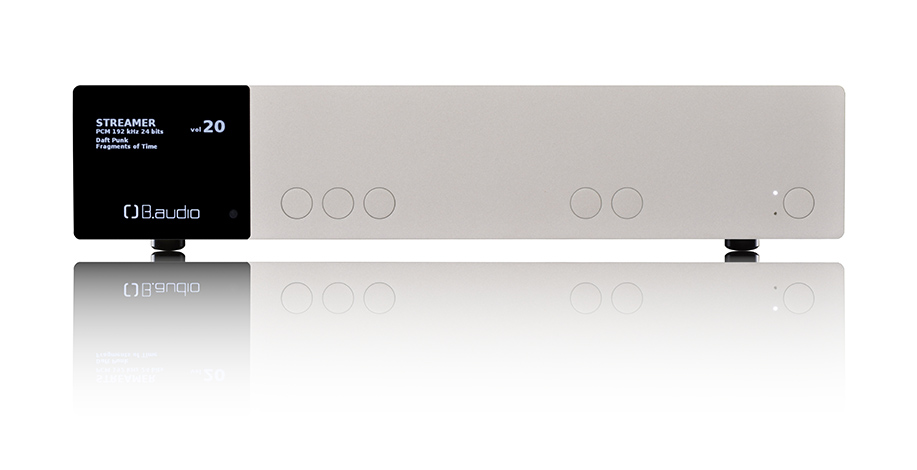
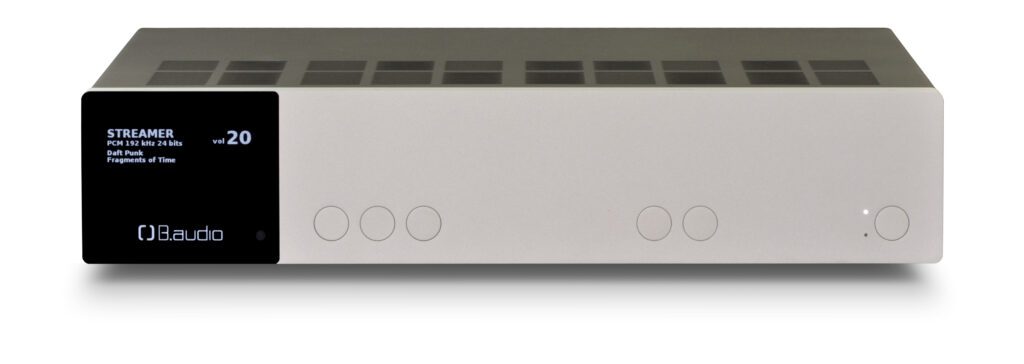
The high-end integrated amplifier – seen here in the shape of B.Audio’s Alpha One – is a relatively new phenomenon; back in the 20th century, almost everyone who wanted to hold their head high at audiophile gatherings had or planned to have a preamplifier and power amp in a minimum of two boxes, often many more if you were a Naim person. But the desire to have a stack of black boxes on the rack is not as strong as it was and given the space that most of us can dedicate to our musical passions, that’s hardly surprising; as a result, enthusiasts have been looking to downsize their hardware without compromising on quality.
Move to better
Over the past 20-plus years, there has been a move toward better quality integrated designs, which has got to the point where I reviewed a cost-no-object example from Aavik. Such designs have started to include digital electronics, with some examples also offering streaming capabilities, which cuts down on the clutter even further and brings with it the possibility of a single piece of electronics and a pair of speakers being all that’s needed for top-notch home entertainment. The serious streaming integrated amp has arrived.
B.audio is a French company that specialises in electronics and has two small but superbly finished ranges of separates on its roster, each containing separate DACs, preamps and power amps, sometimes monoblocks such as the B.amp monos that produced some magnificent results via Bowers & Wilkins 800 D4 Signature speakers in my listening room last year. But B.audio can see the way the wind is blowing and has spent many hours developing an integrated design that they feel lives up to the standard for which the brand is known. The Alpha One not only has a capitalised name but could, at a glance, be one of B.audio’s preamps or DACs, as they all share the same minimalist fascia and square black display seen here.
Perfect linearity
However, it is more heavily loaded than any box in the B.audio catalogue. It has a high-quality digital to analogue converter, streaming engine and analogue preamplifier, which controls a 120-watt Class AB stereo power amplifier. This dual-mono design is based on the circuitry developed for the reference power amplifiers, including the B.amp mono. This means that it has high current reserves and claims “perfect linearity” regardless of the load presented by the speakers, which is a bold claim but one that B.audio amplifiers have met in the past, albeit rather larger ones.
The key to this is an intermediate driving stage between input buffers and the output stage, which controls the loudspeakers. B.audio calls this intelligent output drive (IOD). This consists of a local feedback loop around the output stage, which stops back EMF currents from reaching the gain stage, an approach that produces strong linearity.
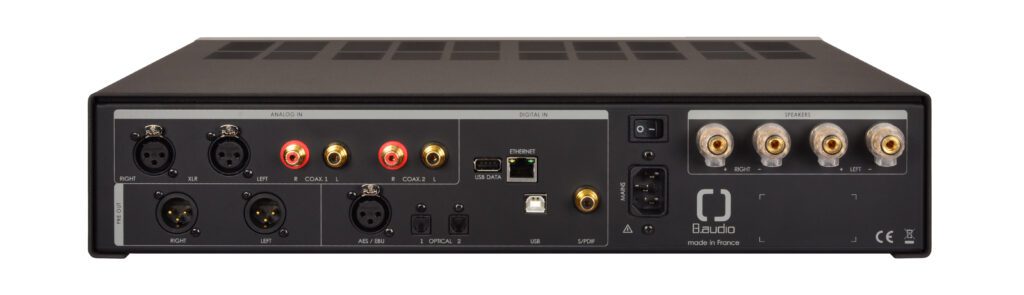
The digital side of Alpha One combines a multi-input DAC with all the usual socketry and an ethernet input for the onboard streamer. The digits pass through B.audio’s patented jitter removal processing, designed to make the actual digital-to-analogue converter’s life easier and thus result in higher sound quality. Analogue inputs extend to one balanced and two single-ended pairs, with the latter referred to as ‘an.coax’ in the display. In contrast, the balanced input is called ‘an.XLR’, which is only slightly idiosyncratic, given the high-end nature and French origin of this amp. Pre-amp outputs are on XLR only.
Squeeze it
All functions are accessible with the combination of display and remote or front panel buttons, and there are many of them to scroll through, they include the option to turn protocols on/off for UPnP/MPD, Squeezelite (LMS), Roon, HQ Player, Airplay and Spotify. I can’t remember the last time I saw the option to use Logitech’s Squeezelite on a streamer, but it’s the basis of the software in Innuos products, so it clearly has a lot of potential.
The Alpha One offers server functions for music files stored on USB media, and this can be controlled with a third-party app such as mConnect or BubbleUPnP for Android devices. B.audio do not offer their own control app yet (one is in the pipeline) but the list above indicates that most of the worthwhile apps on the market will work with the streamer in this amp. I used JPlay because it sounds better than the alternatives, it found the Alpha One as both a server and an audio output, which is a good sign.
One feature that caught me out is the automatic mode, which puts the amp to sleep. If a signal is undetected, the relays click in (it’s a very clicky amp), and you have sound. I preferred to disengage this function for ease of operation. The amp runs warm but not particularly hot and sounds noticeably better when it’s up to optimum temperature after a couple of hours. You can set a standby time from a range of options which will help the energy bill.
Curve your enthusiasm
One RCA input can be used as a bypass with no volume control, so with an AV processor or separate preamp, subsonic filtering can be applied to low frequencies (below the threshold of audibility), and you can adjust left/right channel balance. There is also the option to activate parametric equalisation with eight independent filters, each offering high and low pass, shelving, peak and notch variations. Meanwhile, there’s a visualisation utility to help understand how these filters work and some wise words on how best to use them, eg “it is advisable not to attempt to obtain a perfectly flat curve”. And there is plenty of processing power available to the inquisitive enthusiast.
For the more technically challenged, however, the remote handset can be a puzzle. Some have been known to open the four fixings to check whether there’s a battery inside before realising that the black bit should not be pointed at the amp… There are no legends on the seven buttons, but there are some on the back. It is intuitive, however, if pointed in the right direction.
Making a Start
The Alpha One made a start in my system by driving PMC twenty5.26i loudspeakers with a digital signal from a Mutec MC3+ USB reclocker going into the AES input. This pairing produced a fast and muscular response that was very strong on detail and control but short on warmth. My room is on the bass-light side, and the lack of thickener from the amp and speaker made the balance a shade on the lean side. Still, the timing was magnificent.
After adjusting to the balance, I started to enjoy this amp and its ability to revel in so much of the delineation of every musical phrase. Moving over to the mighty Dali Epikore 11 speakers proved to be a good move; these are much warmer in balance yet deliver very high transparency, so we were able to reveal just how much texture and tonal colour the B.audio can resolve whilst offering class-leading timing. It lets you hear into everything that’s played, the reverb on a very familiar piece of music seeming far more extreme and going on far longer than usual, which means that the sense of space is holographic and the room almost disappears.
Fast and bulbous
Moving over to the onboard streamer proved to be a very positive experience, its delivery is fast and full, even juicy, with the right music. But it’s the textures that shine out of the deepest notes on Bugge Wesseltoft and Henrik Schwarze’s Duo, the latter can be heard to add a crunchy edge to the bass line that makes it even more appealing on ‘Leave My Head Alone Brain’, a tune that Take Five inspire, not that they would admit it. With vinyl on the line input, the results were equally impressive, with good integration of musicians in a mix like Herbie Hancock and Norah Jones’s version of ‘Court and Spark’. Some amplifiers separate out the voice more distinctly. Still, the way that the B.audio allows band and singer to hang together sounds very natural, and it’s easy to appreciate just how beautiful the piano is on this great song.
With the Locrian Ensemble’s rendition of Mendelssohn Octets (Chasing the Dragon), the presentation is a little more urgent and engaging than usual; the instruments are well separated, and you get a strong sense of the melodic flow and dynamic variety of this excellent recording. The Alpha One is nothing if not dynamically sensitive; this was apparent in many music types and not something you find with many amplifiers, integrated or otherwise. On Steely Dan’s ‘Babylon Sisters’ there is an emphasis on the snare drum that gives this tune stronger metronomic precision than is usually the case. Likewise, on Kraftwerk’s live version of ‘Radioactivity’, the band sounds more robotic than usual, and the heavy bass on this track is meaty, achieved whilst resolving the noises from the crowd more clearly than I have heard it in quite a while.
Royal biscuit
The Alpha One very well serves vocals, Lizz Wright is exceptional on ‘Sparrow’ (Shadow) but Jeff Buckley takes the royal biscuit on ‘Hallelujah’, here the dynamic subtlety that this amp brings to the party gives this song a depth and precision of imaging that makes it palpable in the room, the power of the bass is clear and controlled, which underpins the emotional depth of the voice. Vying for the top spot in the B.audio’s roster of strengths is the way it combines speed and power. Fast amps frequently lack profound impact on the bass; they almost seem to lighten the bass to provide the sense of immediacy higher up the range.
Conversely, amps with lots of power in the bass can often be sluggish when turning on the proverbial dime when the signal requires. The Alpha One seems to be able to do both and that makes for an intense experience with a track like ‘Interstate 5’ by The God in Hackney, this starts out with drums alone and gradually builds with bass then guitar and keyboards, there appears to be little or no limiting involved, which means that with an amp like this, you get the full visceral thrill power of live music without the nasty PA which that usually includes. Playing this after the amp had been on for a few hours made it clear that the Alpha One gives its best when it’s cooking, but not smoking (you wouldn’t want that).
Combat
Nigel Payne from Quiescent introduced me to an exciting track last year: the ‘Battle Scene’ from Gladiator (the movie so beloved by AV demonstrations a few years ago). Playing this on some decent amps reveals why it sounds so horrendous on most AV amps. It’s a dense, seemingly heavily compressed recording of a large orchestra and various less acoustic elements with heavy-handed studio processing. On the B.audio, however, the track opens up, and you can hear the rhythm of the piece; it no longer sounds hard and compressed but makes musical sense; I would even go so far as to say that it becomes involving, which is certainly not the case on a great many amplifiers.
It would be nice if the Alpha One offered input gain adjustment, but other than this, little comes to mind that could be added to its very strong roster of features and capabilities. The DAC is particularly good. Clearly, the B.audio jitter reduction tech is doing a good job, and the amplifier is also exceptional, with a nimbleness and power that does justice to everything it plays. I also found that the remote control was straightforward to use once that initial hiccup had been overcome. With the Alpha One, B.audio proves that the all-in-one streamer, DAC and amplifier have arrived at the high end and without apparent compromise in either sonic or feature count departments. In fact, when it comes to features, it’s hard to think of many separates that can hold a light to it.
Technical specifications
Type: Solid-state, two-channel integrated amplifier with built-in DAC and streamer.
Analogue inputs: Two single-ended line-level inputs (via RCA jacks), one balanced input (via XLR connectors).
Digital inputs: Three S/PDIF (one coaxial, two optical), one USB port, one AES/EBU, one RJ45 network connection.
Analogue outputs: One pre-out (via XLR connectors).
Supported sample rates:Coaxial S/PDIF: PCM up to 24-bit — 192kHz
Optical S/PDIF: PCM up to 24-bit / 96 kHz
USB: (PCM up to 384 kHz / DXD / DoP / native DSD up to DSD256
RJ45: PCM up to 384 kHz / DXD / DoP / native DSD up to DSD256
For hi-fi enthusiasts over a certain age the name Morel has certain resonances, back in the eighties and nineties it was a well-established drive unit manufacturer with a plant in Ipswich and a base in Israel. Russell Kaufman (now better known as the guy behind Russell K) was the company’s UK sales manager and the brand was on a par with SEAS, Scanspeak and KEF when it came to driver quality.
Somewhere along the line however the name faded from the scene and was forgotten by all but the dedicated few. Morel never went away however and today they are going to extremes to put their name back on the map. Morel was founded nearly 50 years ago, next year will be their golden anniversary, and this has spurred the brand onto re-engaging with the hi-fi scene by producing a very competitively priced range of loudspeakers called Avyra of which the 633 is the largest.
This is a compact but visually distinctive floorstander with a bit more physical style than average for the price and, as you will read, a lot more sonic capability. But take a moment to assess what has gone into a product that sells in the US for $2,000. The Avyra 633 starts at the bottom with a separate sculpted plinth with proprietary chunky spikes and a small shadow gap between it and the main cabinet. This is permanently fixed; there is no assembly required by the end user. Atop this is a straightforward reflex-loaded cabinet that has been elaborated with curvy side panels which give the speaker a bit of shape and a little bit of stiffness.
Long coil, short gap
The drive units and their integration with one another and the overall design are what make this speaker special. This is a compact floorstander that is a two-and-a-half way design. Those six-inch mid and bass drivers are made by hand at Morel’s facility and incorporate one-piece cone/dust caps that you can see, and unusually large-diameter 75mm voice coils that you cannot. This large coil/small cone approach is also very unusual, almost unheard of in my experience, presumably because it requires high manufacturing tolerances, higher costs and the fashion is for small coils on large cones. The 28mm soft dome tweeter is also Morel’s own and like the woofer has an aluminium voice coil plus a hand applied Acuflex coating.
Morel supplies its drivers to several well-known high-end brands and apparently those found in the Avyra 633 are also used in designs costing three times as much. I somehow doubt that they can supply the sort of bang per buck that’s on offer here.
Sounds so good
Morel’s idea is to offer a speaker that sounds so good for its price that it makes an impression on a very crowded and distinctly soft market. It’s the opposite of the model usually seen where a new brand brings a flagship out to show the full extent of its abilities, which is more of an elitist approach that’s marketing to a relatively small audience.
The Avyra is a domestically friendly sub-metre-high design with some nice styling details for its price, a single pair of cable terminals and a relatively benign 90dB (four-ohm) load that can be driven by a wide range of amplifiers. It sits alongside the Avyra 622 bookshelf two-way and the Center C5 three driver centre channel speaker, as well as a matching sub. But don’t let the home cinema vibe distract you from the fact that this is a rather impressive stereo speaker.
Thillers in the midst
This Morel turned up whilst I was in the midst of reviewing several significantly pricier speakers, yet it quickly became a favourite because it is so even-handed, coherent and seemingly impossible to faze. It has the sort of rightness in its presentation that is usually only found with two-way bookshelf designs yet offers bandwidth to match its 22kg mass and decent physical volume. It is also a remarkably good communicator of emotion, which suggests a degree of mid forwardness, and while the treble is extremely clean it is certainly there and doesn’t sound rolled off, ditto the bass. Morel have got the balance so right that the Avyra 633 delivers impressive transparency across the board with no apparent tonal emphasis. The fact that a colleague who prefers the classic BBC monitor balance thought that they were excellent would tend to vindicate this.
What first struck me about these speakers was their ability to deliver a fluent yet solid physicality with some piano trio jazz, placing the instruments in a clear soundstage and fleshing them out in both spatial and tonal terms. They make you sit back and close your eyes so that the music can flow past the intellect straight to the harmonic receptors that understand the message without seeking to interpret it, they facilitate a direct connection between artist and listener. Something that no measurement can assess but which is obvious as soon as you put some music on that has genuine artistry behind it, which might sound airy fairy but the ability of simple music to sooth the soul is one of its most important qualities as every Metallica fan knows.
Gulp
I discovered this with a few records but the one that brought a lump to my throat first was Bobby Womack’s rendition of ‘Fire and Rain’, a James Taylor song that generates extra impact in Womack’s words via this speaker. I also tried some mainstream music for a change (don’t worry it’ll pass), with George Ezra’s ‘Shotgun’, here the bass line bounced along in a fashion not encountered with other speakers and made the track sound remarkably good considering its target audience. Nathan Salsburg’s acoustic guitar playing is much more my cup of tea, however, and these Morels show just how much feeling he manages to get onto tape on tracks like ‘Timoneys’ (from the album Third).
I have come across more than a few speakers that achieve this with a strong midrange emphasis but few that also offer the low-end muscle delivered with the Avyra floorstanders, they grumble in clean, articulate fashion with Kraftwerk and bring out the body of pianos which gives them a solid presence in the room.
Look at me
On brighter releases the treble remains clean and open, there’s none of the glare you get with some speakers in this price range. It’s almost as if Morel is not going down the ‘look at me’ route found with many mid-market speakers, instead they are hoping that buyers are sophisticated enough to realise that boom and tizz only get you halfway to sonic nirvana. I hope that they are right.
Given the apparently straightforward cabinet construction the Avyras are surprisingly quiet, the box doesn’t appear to join in with the mid and bass in the way that is often the case with speakers at this price. They need a bit of space behind them to keep the bass clean, a normal situation with rear firing ports, but nothing excessive in my room at least where they distracted me with the delight in so many pieces of music including Julian Lage’s ‘Myself Around You’ (Speak to Me), which is delivered in a neutral, yet charming fashion as is this speaker’s way.
Real world listening
By way of contrast, I tried the Avyras with a couple of more appropriately priced ancillaries in the form of a Gold Note IS-10 and a Naim Uniti Atom, both sub £3,000 all-in-one streaming amps. The results reflected the relatively modest nature of the electronics but were nevertheless very entertaining. The Gold Note has plenty of power and produced strong dynamics, power handling and surprisingly good imaging, a live version of Dire Straits’ ‘Money For Nothing’ expanding around the speakers and making a very good case for this pairing. With the Naim’s 40W the result was softer round the edges but very musically compelling thanks to the excellent timing that this marque has mastered so well.
I had a very good time with the Morel Avyra 633s, they have an evenness of tone and a coherence that belies the price and that’s before you add in the dynamic capabilities and build quality. I doubt that many European brands could compete in all respects. This is a welcome return for Morel and one that I hope a British distributor will make the most of soon.
Technical specifications
Type: Two-and-a-half-way, three-driver, floorstanding speaker with reflex-loaded enclosure.
Driver complement: One 28mm Acuflex handcrafted soft dome tweeter with aluminium voice coil; one 160mm midrange with integrated one piece cone, double magnet motor, 75mm external aluminium voice coil, one 160mm bass driver with integrated one piece cone, double magnet motor, 75mm external aluminium voice coil.
Crossover frequencies: 250Hz, 2.2kHz
Frequency response: 25Hz – 20kHz (+/- 3dB)
Impedance: 4 Ohms
Sensitivity: 90dB/2.83V/1m
Dimensions (HxWxD):982 x 310 x 326mm
Weight: 22kg/each
Finishes: Natural light walnut, natural oak wood, black, white
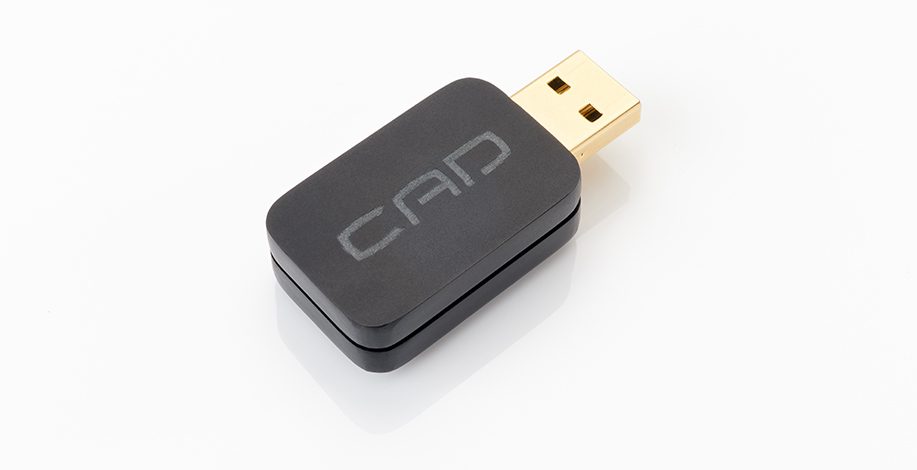
Computer Audio Design is a company with feet in two camps. CAD’s original Computer Audio Transport and 1543 Mk II DAC are a big part of its product line. However, recently, CAD has become better known for its Ground Control grounding devices. As the name suggests, the Computer Audio Design USB Control extends that grounding to USB. We’re used to in-line filters (such as the AudioQuest JitterBug FMJ and CAD’s USB filter). These are designed to help reduce noise from the USB source to a receiver in the musical signal path. But the USB Control is different. It isn’t intended to be used in an in-line context at all.
Instead, the Computer Audio Design USB Control (which looks like a USB dongle) is used on any spare USB ports. That includes software update ports. The USB Control reduces higher-frequency noise on the +5Vdc line present in all USB ports over a large frequency spectrum. It also reduces noise on the Signal Ground, similar to CAD’s Ground Control products.
In-line filters can reduce noise from that +5Vdc line. However, they are inherently limited by data lines on the same cable. Worse, the +5Vdc generated by the USB controllers on your digital device is engaged in acts of self-pollution! They must have a +5Vdc feed to power USB memory sticks. Sadly, that isn’t good for low noise in a digital audio system’s most sensitive areas.
It’s not just digital
The big change to audio in recent years is just how much upgradable firmware there is in each device. We naturally think of digital audio when we think of USB connections. However, many amplifiers have no digital audio components but still include a USB port. These are potential upgrades to control software and other options. The USB Control helps here, too.
This quickly becomes a cumulative thing; buy one USB Control, and you will end up with several of them. Start by using one in a spare USB port on a digital audio device. Then, put one on an upgrade port. And then yet more on amplifiers, tuners, phono stages, and the works. I received two USB Control devices, and I could use more.
I used the two USB Control devices in several ways. First, using one, then two, on my Innuos Statement Next Gen server. These went on the USB port connected to an external HDD, and the second for backup. Then I used one on the Innuos and one on my Primare I35 Prisma’s USB A input. After that, I removed a USB Control from the Innuos altogether, leaving just one in the Primare. Then, I unplugged the Innuos from the network and the Primare. Finally, I used one, then two, on my Mac Book Pro.
In each case, the USB Control was removed from the audio signal chain (it’s in the Primare’s wireless module, designed for powering an external hard drive full of music). The Primare also allowed me to see what happens when a USB Control is used with USB-based audio and pure Ethernet.
Whole lotta swappin’ goin’ on
There was a lot of swapping going on, which precluded fast A-B style switching for testing. I also believe the USB Control’s effect on a system improved over time. However, the initial change was enough to hear on the device’s insertion.
Let’s get the easiest test out of the way first. The USB Control proved equally effective on the Primare I35 Prisma’s performance whether it was being fed from USB or via Ethernet. It didn’t matter which one you were playing or if one or both sources were connected, the Computer Audio Design USB Control plugged into the Primare worked consistently, whichever way you connected it. Taking next-gen digital out of the equation altogether and connecting an Audiolab 8300CDQ to the Primare’s DAC via TOSlink optical also benefited from the USB Control plugged into the back of the amp.
What it did in the Primare was make it seem more directly connected with the music. Sounds had more purpose and musical intent, and there was a sense of snap and drive to the musical performance. It made ‘Go!’ by Public Service Broadcasting [The Race For Space, Test Card Recordings] even more evocative than usual through this system. It’s a tribute to the Apollo 11 landings and always pulls deep emotions from anyone who is either a science nerd or was watching the skies in 1969. Here, it brings out a lot of the emotion in the track, in part because the recording of the Mission Control team from that era is so clear and detailed. I don’t think I could bring myself to play ‘Fire in the Cockpit’ again though. Too harrowing.
Scratching the surface
This only scratches the surface. As we move to multiple USB Control devices we get a lot more directness and realism. This increased when using a USB Control in each device more than stacking them in the Innuos, but I suspect some of that is down to the high degree of shielding in the Statement Next Gen. However, that being said, the Innuos wasn’t immune to the charms of Computer Audio Design, and deploying one, then two USB controllers did improve the sonic output of the top Innuos server. It’s that there was a greater improvement when one of those two Controllers was used in the Primare. Every time. To the point where I would make it the first port to be filled in a similar system.
Once again, the USB Control devices improve the system’s ability to convey musical themes and improve the overall communication between musician and listener. Yes, it cleans up the sound quality, making the sound rise out of a quieter background, improving intelligibility and creating more soundstage space and size, and seemingly faster attack and release of notes.
The more I listened with the CAD USB Control devices in place, the more I realised just how much noise USB controller chips must be putting into everything audio they get near, and the USB Control device, er, controls the controllers. These don’t just tame noise, they direct the system to perform its tasks better. It’s like your system went to night school and studied time management and musical arrangement, because it learns how to organise a piece of music.
Hiding below the floor
Yes, they help bring out detail that might be hiding below the noise floor, and yes they help make the soundstage seem larger and more open. They even make the sound more dynamic and expressive. But more significantly, they tie the sound together like it was meant to sound.
I think the best way to describe what the USB Control does so well is to play The Atomic Mr Basie [Roulette]. Probably Count Basie’s last great record, and that powerful opener – ‘The Kind From Red Bank’ shows his orchestra in fine Big Band form. But above all, it’s that rhythm section that really shines; Eddie Jones on bass, Freddie Green on guitar and Sonny Payne on drums. They play so tight that you can barely hear Freddie Green’s guitar part (but take it away and the band falls apart). With a pair of USB Controls in place, that rhythm section became even more ‘in the pocket’, more upbeat and coordinated and just tighter and faster. That’s some feat.
Sailing away
Finally, there’s the sound from a computer. To many, the Mac+DAC ship has long sailed, and they choose better-sounding server-side alternatives. But the USB Controls on that computer go some way to even the score. Yes, dedicated separates sound better, and the excellent models are considerably better, but the USB Control cleans up the Mac’s act once again. A lot.
I’m trying not to go overboard here, but I find the Computer Audio Design USB Control devices so good at their job that it’s hard not to be swayed by them. It sounds crazy, but their biggest downside is that they are small; we in the audio world are so attuned to the ‘large, heavy thing sounds better’ hypnotic suggestion that we might overlook what looks like USB dongles as just another accessory. Audio enthusiasts would sing their praises if they were made in a rack mount (and cost five times as much).
The CAD USB Controls deserve the same acclaim handed out to the company’s Ground Control boxes. These pocket rockets are true game-changers. They make your system sound more like music. Buy some!
Our ‘Out of the Box’ Series features companies who might slip through the net from time to time. Companies with something more than hot air, who make loudspeakers but make them with a rare passion that drives them and shapes the products they design and build.
When did you start the company?
Arion Audio was established in 2004 as MK Audio LLC by Mike Kalellis. In 2008 the Arion Audio brand was created to launch a new series of products.
What makes your loudspeakers different to other brands?
Arion Audio’s mission is to innovate, design and create “OUT OF THE BOX” high performance, high value audio equipment for the music enthusiast. Arion uses state-of-the-art materials and assembly techniques. Every detail receives meticulous attention. Each component is thoroughly inspected prior to the careful hand assembly process. Arion products are designed to be environmentally responsible and suppliers are carefully selected to be the same and be USA based. Arion AMT drivers are designed and built in-house.
What challenges do you face in making and selling loudspeakers?
Arion speaker systems are designed to reproduce music at near-live performance levels, with virtually no restrictions on dynamic range, frequency response, or soundstage scale while maintaining finesse and refinement. The Apollo series feature extended range AMT line array dipole towers with outboard open baffle woofer modules. The Athena series features integral OB woofers. Unlike most active speaker systems, Arion speakers can be powered by any amplifiers the owner chooses to use, from low power SET tube amplifiers to high power SS amplifiers. They are ideal for a wide range of listening environments providing a unique combination of extraordinary detail, clarity, dynamic linearity, accurate timbre reproduction and natural dynamic contrasts.
Where can consumers hear about your products and find out more?
To learn more about our speakers, please visit our website or follow us on Instagram at @arionaudio.
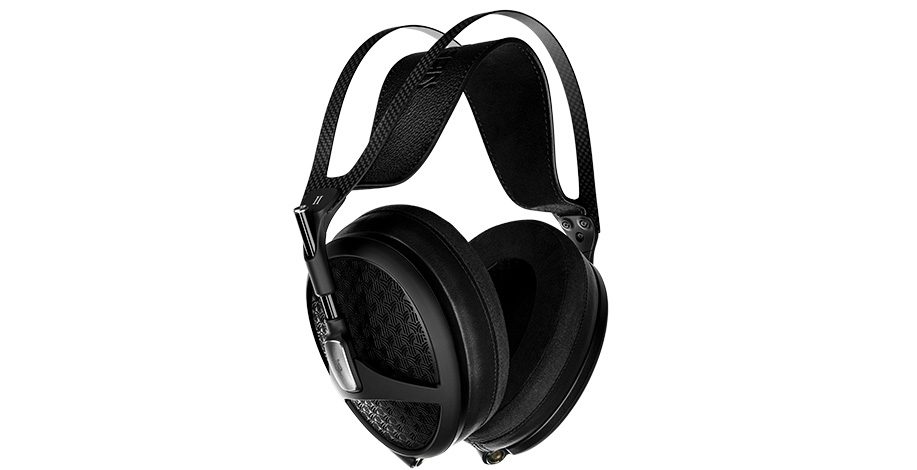
Meze Audio has established a pretty enviable reputation in the 13 years since its inception in Baia Mare, Romania. Its designs are well-regarded and competitive. However, Antonio Meze is not one for resting on his laurels. So, while nothing was overtly broken about 2018’s Empyrean headphones, his company has fixed them anyway.
£2,749 secures you a pair of Meze Audio Empyrean II. It’s a considerable sum, the fact that they’re far from Meze Audio’s most expensive headphones notwithstanding. Mitigation can be found because the Empyrean II has two pairs of earpads. The first, ‘duo’, is a blend of leather at the base and Alcantara everywhere else. These provide a ‘harmonious’ tonal balance.
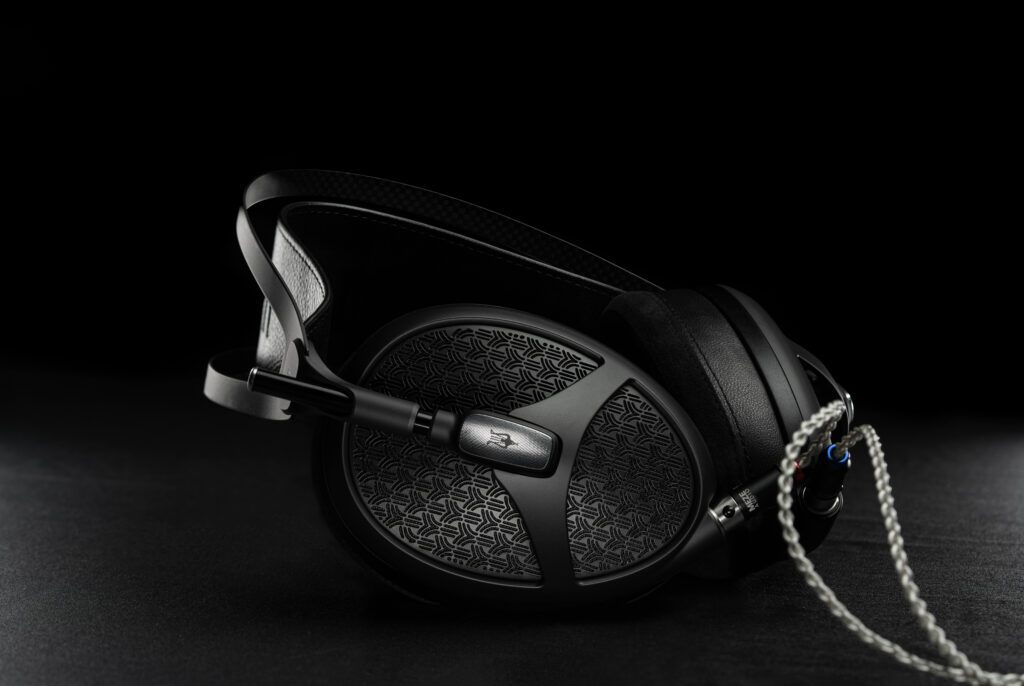
The ‘angled’ alternative is fully Alcantara-covered, with a fine mesh over the grille. It supposedly offers a ‘detailed, airy and accurate listening experience’. Your choice comes with quite a selection of cables. Each earcup has an enclosure for a four-pin mini-XLR connection. Meze Audio offers a total of five cables (three of 1.3m length ending in either 2.5mm, 3.5mm or 4.4mm terminations, and two of 2.5m length terminated with either a 6.3mm jack or four-pin XLR). Each comes in a choice of two materials (copper or silver-plated). You can select one of these ten variants when placing your order.
Isoplanar
No matter which of the cables best suits your purposes, it will deliver analogue audio information to one of the more distinctive driver arrangements currently available in the whole of Headphone-Land. Meze Audio, not for the first time, has enlisted the help of Ukraine’s Rinaro Isodynamics, and the result is a refinement of the MZ3 ‘isodynamic hybrid array’ driver the company first created for the original Empyrean model.
At the back of the driver is a hybrid magnet array arranged to create uniform activation across the whole surface of the diaphragm. At the front, there’s a fibreglass-reinforced ABS frame. In between, there’s Rinaro’s ‘isoplanar’ diaphragm, which combines an active area of 4650 mm2 with an all-in weight of just 0.16g. This is made possible by Rinaro’s manufacturing process, which involves heating and stretching the isotropic polymer in transverse directions. So, despite the extraordinarily low mass, the driver is remarkably stiff and stable.
Further evidence of Rinaro’s virtuosity comes from the diaphragm’s dual-coil arrangement. There’s a ‘switchback’ coil handling lower frequencies on its upper section, and beneath it, there’s a spiral coil. This spiral layout is more efficient at producing frequencies in the midrange and above, and it’s positioned to be more or less directly facing the listener’s ear canal. This layout is designed to allow soundwaves to enter the ear without time delays and overcome the tendency for the soundfield to become hazy when the soundwave length is shorter than the physical depth of the inside of the ear cushion. Meze Audio suggests this driver arrangement is suitable for a frankly disquieting frequency response of 8Hz – 110kHz.
Appropriately overwrought
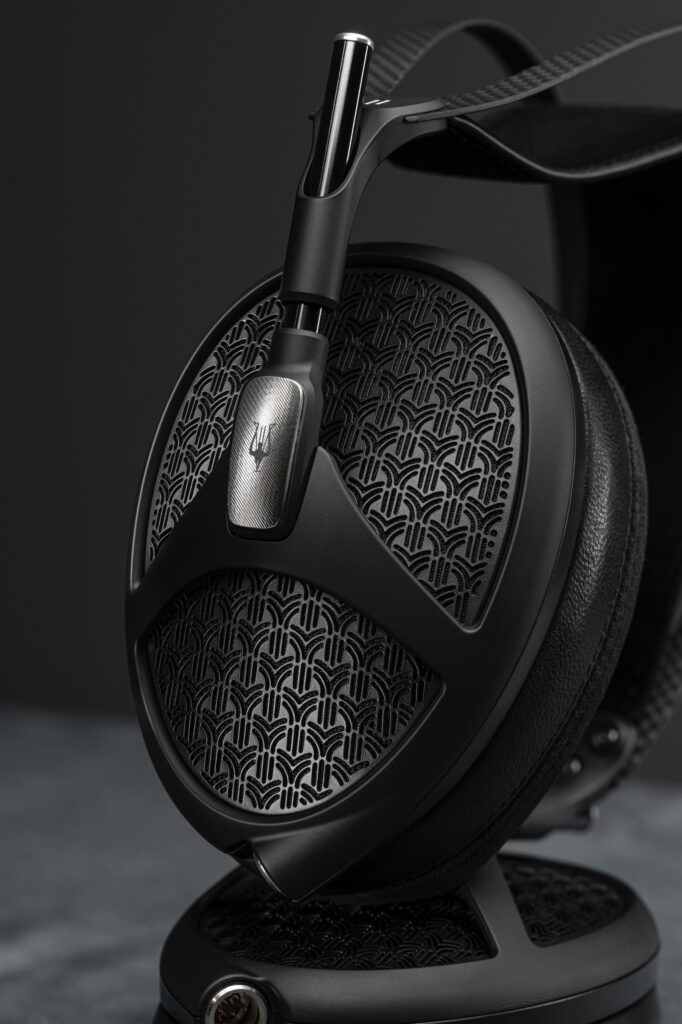
And the Meze Audio Empyrean II wouldn’t be a Meze Audio product if all of this uncompromised and uncompromising engineering weren’t housed in some appropriately overwrought industrial design. The aluminium earcup frame is CMC-milled and assertively three-dimensional in its union with the sliding headband adjuster. The open-backed grille inside it is perforated with an Art Deco-inspired pattern that seems to bear no visual relation to the rest of this design or, indeed, to the broader Meze Audio design language.
Meze Audio supports the essential parts with a patent-pending system of ‘suspension wings’ outside a thin, wide leather headband. This layout maximises the contact point between the headband and the head while minimising apparent weight and pressure.
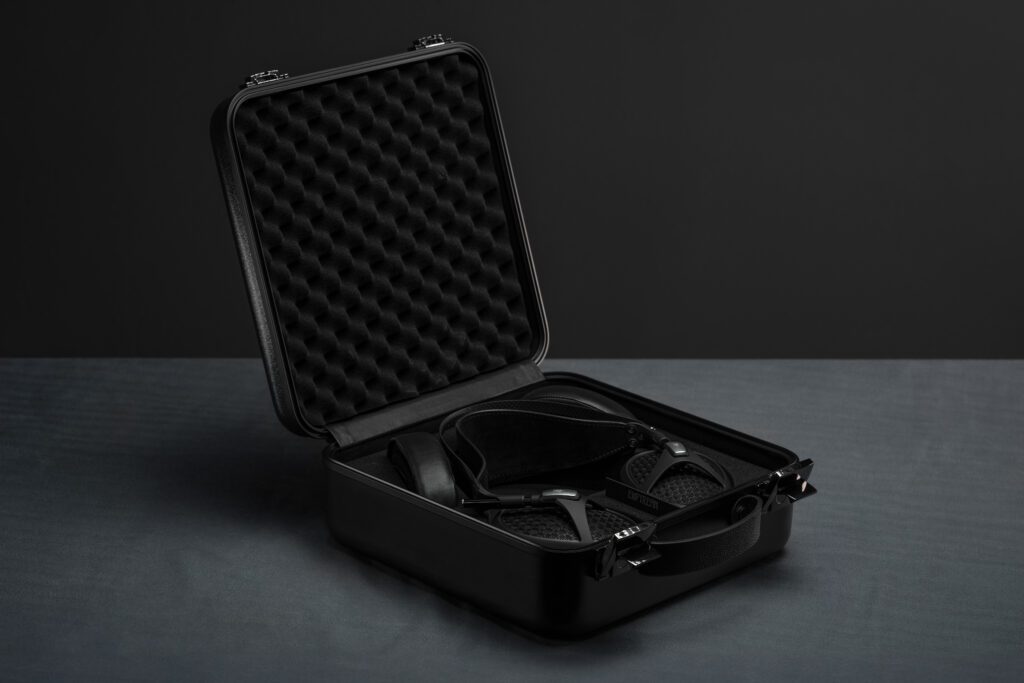
The Meze Audio Empyrean II arrive in the sort of hefty, square and robustly fastening travel case you wouldn’t be surprised to see handcuffed to the wrist of a burly, short-haired man in a suit and sunglasses. Once they’re liberated from their confinement, it’s simply a question of attaching the cable you’ve selected, choosing which of the earpads better suit your purposes (they attach to the earcups using Rinaro’s ‘isomagnetic’ coupling technology, which enhances efficiency by using the demagnetising field generated by the driver to secure the earpads while simultaneously redirecting the magnetic field back into the driver), and connecting them to your source of music. From there, we’re in business.
Colibri collaboration
I used the 1.3m silver-plated cable with the 4.4mm balanced termination for my listening. It’s connected to an iFi iDSD Diablo v2 and a 2021 Apple MacBook Pro loaded with Colibri software to facilitate playback of genuinely high-resolution audio files (FLAC and DSD, mostly). For some reason, the ‘duo’ earpads seem a little more comfortable on my head, so they’re the ones I attach.
Lately, I’ve been impressed with the sound of the 2017 remaster of David Bowie’s Low [Parlophone] as a 24-bit/192kHz FLAC file, so it seems a good place to start. With all 5484kbps of Always Crashing in the Same Car playing, the Meze Audio is an eloquent, confident, and thrilling complete listen.
In the first instance, the balance of the sound is most attention-grabbing. The Meze Audio Empyrean II are natural and unforced, seemingly effortlessly correct in their tonality and the poise of their frequency response. The top end is bright, substantial, and crammed with broad and delicate detail, and it’s a story similar to weight, substance, and control at the opposite end.
No matter how transient, minor, or deep in the mix a given detail of the recording might be, Meze Audio brings it out, gives it appropriate weighting, and places it in context. Their control over every area of the frequency range is such that rhythmic expression is unerring, tempo description is compelling, and the unity and togetherness of the performance—even though so many elements of this recording are treated and tinkered with—is vivid and persuasive.
Midrange communication
The headphones’ midrange communication powers are even more impressive. Insight is total, and detail levels—it almost goes without saying—border on the excessive. There’s a brilliant balance between neutrality and intensity, and the articulacy of the vocal line not only makes the singer’s character, attitude, and technique plain but also makes the mechanics of the recording—the distance between performer and microphone, for instance—explicit.
Best of all, though, the Meze Audio Empyrean II sound is not showy or flashy. It’s like its musicians serve the recording—and, by extension, the listener—rather than seeking to draw attention to themselves and their fluent musicality. They are here to entertain, not to smother the listener with self-conscious audiophilia.
This impression only deepens with a pass through a 320kbps MP3 file of You! Me! Dancing! By Los Campesinos! [Wichita]. The drop-off in detail levels and overall resolution are only to be expected, of course. Still, Meze Audio maintains its ability to broadly and fully express dynamic variations. Their ability to describe a solidly organised, properly controlled soundstage is undimmed, too. The layout they generate is open, well-defined and three-dimensional – but not in an artificial, ‘spatial audio’ sort of way but simply in a manner that makes it simple to identify a specific strand of the recording from its position on the ‘left/right’ and ‘front/back’ axes relative to every other strand.
Downside? What downside?
Honestly, there doesn’t seem to be much downside to Meze Audio Empyrean II ownership. They’re not going to suit the smaller-headed among us. Despite the clever nature of their hangar arrangement, there’s not a tremendous amount of adjustment available below ‘average-size cranium’. Those with a head of appropriate size will have to get used to (at best) quizzical looks from observers. These headphones are not what you’d call ‘discreet’. But serving up a complete, uncolored and thoroughly engaging rendition of your favourite tunes (via an equally talented source, of course) requires no accommodations or excuses.
Technical specifications
Type: Circumaural; open-back; over-ear
Drivers: MZ3 Isodynamic Hybrid Array
Frequency response: 8Hz – 110kHz
Impedance: 32 Ohms
Sensitivity: 105 dB SPL @ 1 kHz, 1 V
Distortion: <0.05% @ 1 kHz, 1 V
Accessories: Case: High-strength ABS plastic suitcase with foam inserts and leather handle; two sets of earpads (‘duo’ and angled Alcantara); cable (silver-plated or copper PCUHD; 2.5mm, 3.5mm, 4.4mm, 6.3mm or 4-pin XLR)
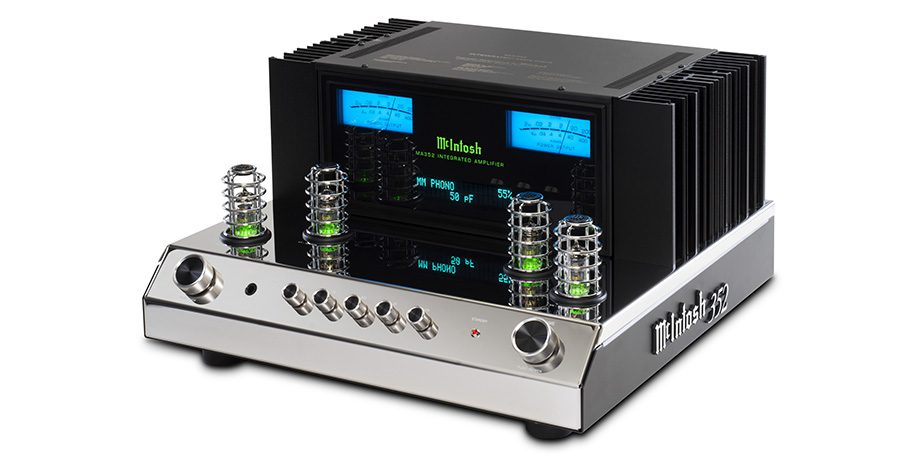
Many are fascinated by the sonic charms of valve amplifiers, and I am among them. However, a single-ended valve amp pushing out 10 watts may not be up to the task of driving inefficient or ‘difficult’ loudspeakers—and certainly not at high levels in a large room. Enter the McIntosh Labs MA352, one of a growing breed of hybrid amplifiers.
These amps attempt to offer the best of both worlds, often combining a valve preamplifier stage with a transistor power amp.
US company McIntosh has an impeccable pedigree, introducing its 50W-1 valve power amplifier in 1949. That was the year Frank McIntosh and Gordon Gow founded the company in Silver Springs, Maryland. It moved to its current factory in Binghamton, NY, in 1951. The company’s current CEO, Charlie Randall, has been with McIntosh Labs for the longest time. He is one of those super-energised, super-enthusiastic people who keep driving what could be a very brand ever forward.
Huge range
McIntosh manufactures a wide range of products, from phono stages and headphone amps to turntables and DACs. However, it is best known for its amplifiers. The company makes all its amplifiers in-house, from the sheet metalwork for the cases to flow soldering the circuit boards and winding its transformers.
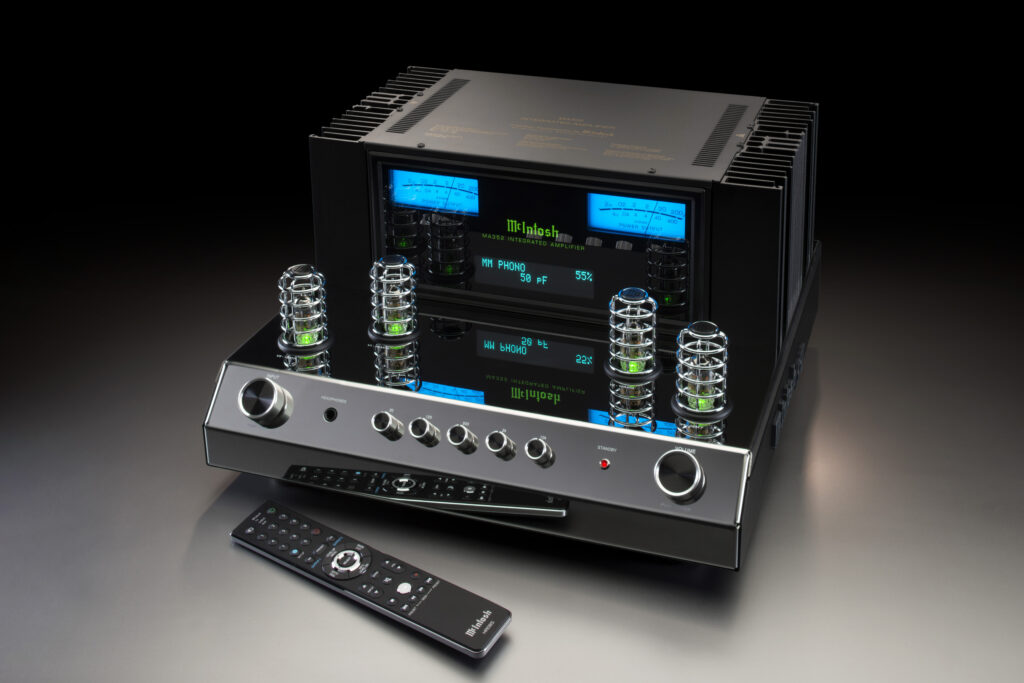
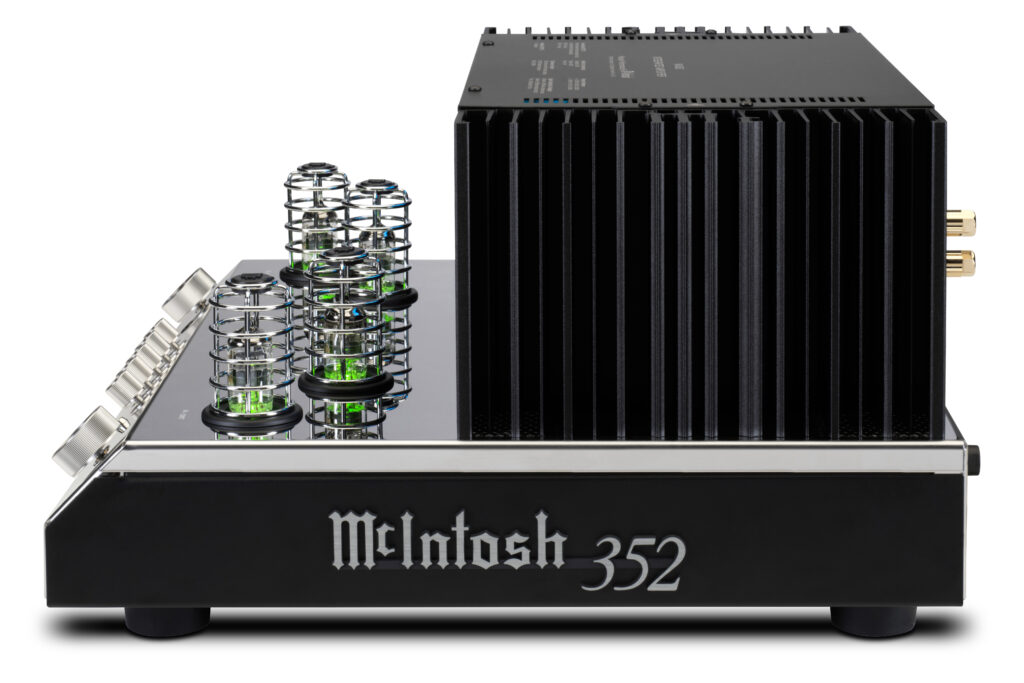
The McIntosh Labs MA352 hybrid integrated amplifier sells for £8,995 ($7,000) and uses a valve preamp and transistor power amp stage. It is an impressively solid piece of kit, weighing in at 30kg, so lift carefully! It has a high-quality chromed stainless-steel chassis. The large, raised section at the rear houses the power amps. You might guess this from the massive heatsinks down the side. This has a glass-fronted display panel that sports two of its signature blue VU power meters and an information display that shows the input selected and the volume setting.
The MA352 has a rotary knob on the far left of the chassis at the front for input selection. There’s a matching one on the far right to switch it on and off and adjust the volume. In between those are the five smaller knobs that control the in-built five-band graphic equaliser. These operate at centre frequencies of 30Hz, 125Hz, 500Hz, 2kHz and 10kHz, with each providing a whopping ±12dB of adjustment. Thankfully, they default to being out of the circuit, and you need to switch them in on purpose using the remote control. I have never felt a need for such things and left them out of the circuit for all my listening. Switch them back on using the remote control for those who wish to play. There is also a headphone jack on the front panel.
Remote power
The remote control alone controls channel balance, mono/stereo, and the capacitive load for the phono stage. Its range of adjustment is between 50pF and 800pF.
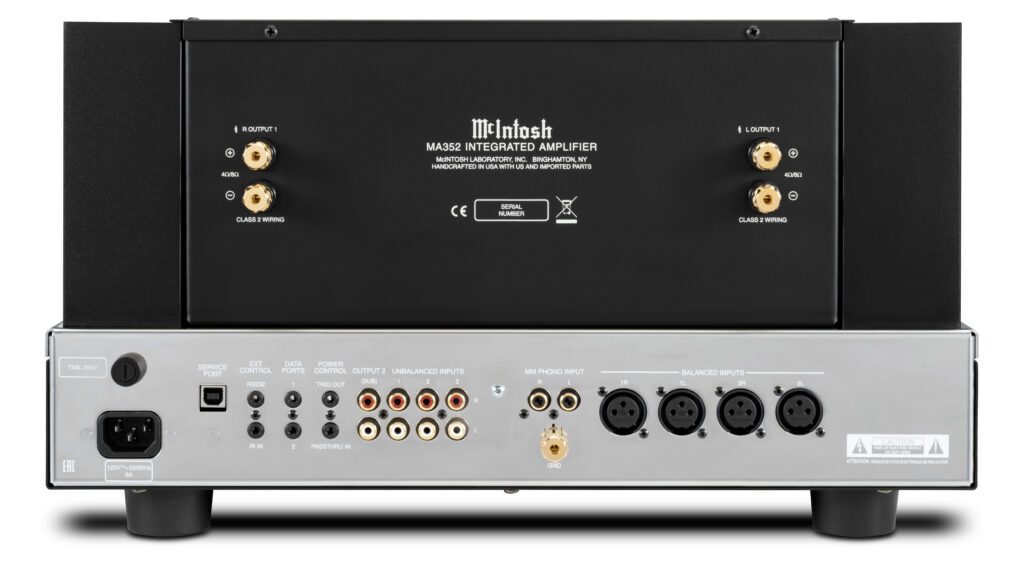
The rear panel has four unbalanced RCA line-level inputs, one phono input (MM), and four balanced XLR sockets. Balanced inputs usually offer a worthwhile sonic improvement over unbalanced inputs, which proved the case during my listening tests. There are also preamp and subwoofer output sockets, plus data ports for remote control of other components. One set of gold-plated speaker binding posts is provided.
The valves are mounted towards the front of the chassis. To fend off curious little fingers, they have metal guards that slot in around them. The MA352 preamplifier section uses two 12AX7A and two 12AT7 valves. These are illuminated from underneath. An orange glow signifies that they are in warm-up mode. The valves are ready for action when ‘orange’ turns ‘green’. These will also switch back to orange in the unlikely and frankly mind-boggling event that the amp should start clipping.
Substantial
The MA352’s quoted power output is very substantial: 200 watts into eight ohms and 320 watts into four ohms. I never had cause to doubt that it had more than enough driving power for any speaker you could throw at it.
To listen to what the McIntosh Labs MA352 could do, I connected it up to two different systems, one with an Innuos Statement streamer/Meitner MA3 DAC front end through Russell K. 150 speakers and the other using an Audio Note TT3 turntable with Arm Two/Io1 and S9 transformer and Audio Note CDT-Five CD transport and DAC Five Special DAC, both with Russell K. 120Se speakers. I also had to hand a well-respected, similarly priced, high-power transistor-only amp that would prove a valuable benchmark to assess where this McIntosh indeed sits in the market.
Start with a line
Let’s start with line-level inputs and streaming through the Innuos system. I played ‘Smiles And Smiles to Go’ from Larry Carlton’s superb Alone But Never Alone album to kick off. The drums and percussion had a snappy and dynamic quality that impressed me immediately. At the same time, the bass line was tight and easy to follow, driving the track along forcefully. Carlton’s guitar had good leading-edge detail, allowing me to hear how each note was being played better than the pure-transistor amp. The McIntosh was pacey, fast, tight, and tuneful.
Still streaming, I tried the superbly emotive and moody ‘Racing in the Streets’ from Bruce Springsteen’s Darkness on the Edge of Town. The piano on the intro had grace, while Springsteen’s vocals were packed with emotion. The body and presence were tight and explosive, and when the bass line came in, it had weight, power, and movement. I felt that the pure transistor amp did not have the emotion and impact of the McIntosh.
Songbird
Next, I played another emotion-packed song, the sublime ‘Songbird’, performed by Christine McVie on Fleetwood Mac’s Rumours. I remember watching the BBC documentary on the making of this legendary album and Lindsay Buckingham describing how it was just McVie on stage in a church with only the recording crew in attendance. He recalled how there wasn’t a dry eye in the house at the end of it!
I am pleased to say that the McIntosh Labs MA352 did not let Christine McVie down and conveyed the emotional impact of the performance well. It captured the nuances of her vocals and the piano’s body and gave a good impression of the recording venue.
Switching to the CD source and playing ‘Never Too Far to Fall’ from George Benson’s In Your Eyes album, the McIntosh acquitted itself creditably. It conveyed the track’s layers of vocals and rhythmic impetus well and kept all of the instrumental layers nicely separated.
Groovin’
I then played the title track from one of my favourite Peter White albums, Groovin’, which is White’s cover of the old Johnny Nash classic, ‘I Can See Clearly Now’. On this, McIntosh handled White’s guitar well, capturing its character and the nuances of his play. The reggae-style bass line moved along nicely, with reasonable control and tunefulness. It was also good to hear things like the accordion not getting lost.
‘Sunny Side of the Street’ from Ben Sidran’s Enivré d’Amour was next. I know this track well and can tell you that the McIntosh did not disgrace itself here, with a tight and weighty bass line, great openness and articulation on vocals and a good ‘walk’ to the rhythm. Sidran’s vocals never appeared to shout, and on balance, I enjoyed what the McIntosh Labs MA352 did with the track.
Since a phono input is provided, it would have been remiss of me not to try it. So I used another track from Larry Carlton, his cover of the classic ‘Minute by Minute’ initially released by The Doobie Brothers. Here, McIntosh conveyed the ebb and flow and weight and precision of the bass line well, as well as the skill of Carlton’s guitar play and the nuances of his technique. The MA352 also, I felt, provided an accurate representation of the qualitative differences between the streaming, CD and vinyl sources.
I quickly hooked up some Focal Clear headphones for a brief listen and can report that the MA352 did a very decent job and drove the Focals well. OK, so if you spend several hundred pounds on a separate, dedicated headphone amp, you will doubtless gain an improvement. Still, the McIntosh turned in a perfectly acceptable performance straight out of the box.
Enjoyable
I enjoyed my time with the McIntosh Labs MA352 very much. It turned in a well-balanced, musical, dynamic, and detailed performance. And it did so without any objectionable flaws or defects, letting the side down.
I have listened to a few hybrid integrated amplifiers recently. Undoubtedly, they have generally proved to be an improvement over those comparably-priced entirely transistor competitors I have put them alongside.
The McIntosh retains a valve design’s sweetness, seductiveness, and emotive impact. That’s backed up by a transistor power stage’s heft and driving power. At this price, you’d be crazy not to put it on your shortlist.
We want to thank McIntosh retailer Home Media in Maidstone, Kent, for their assistance during this review.
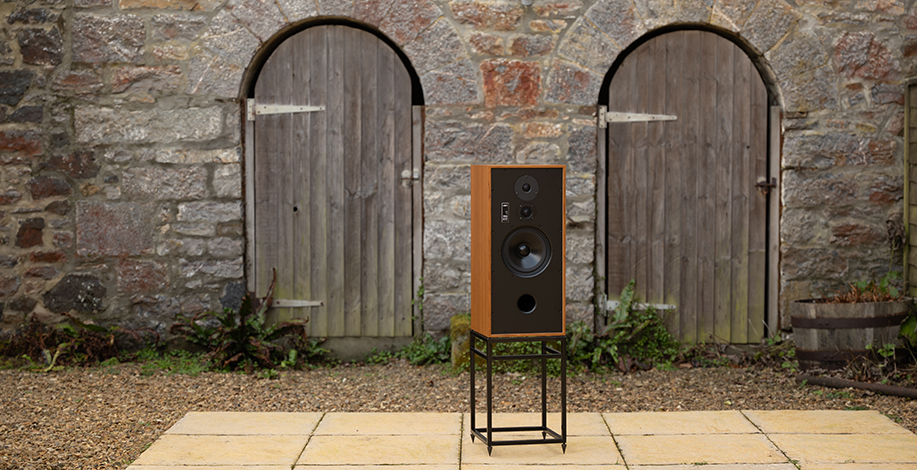
Although the UK punches above its weight in classic loudspeaker designs, a few models stand out. The most obvious are the Quad Electrostatic, the LS3/5a and the Spendor BC1. However, of the three, that latter three-way ported design – first seen in 1968 – is the only one not to have a direct 21st-century equivalent. The Graham Audio LS8/1 goes some way to make up for that shortfall. It is no clone of the classic BC1. The result honours and updates that 60s masterpiece.
It’s easy to forget how significant the BC1’s impact was because it happened 56 years ago. The Spendor BC1 was one of the first acoustic suspension loudspeaker boxes. It competed with the low distortion of electrostatic designs. For its time, it delivered an outstanding low-distortion sound with an excellent frequency response and good dynamic range.
Entropy
But let’s reiterate this: that design predates Neil Armstrong’s setting foot on the moon. The problem with listening to a 1960s loudspeaker in 2024 is fifty-something years of entropy and component ageing. However, a lot has changed in the intervening 56 years.
A roll-off happens in both bass and treble. There’s also a ‘once heard, always heard’ peak in the upper treble. Bextrene was the absolute cutting-edge loudspeaker cone material at the time. But so were loon pants and casual misogyny. Bextrene is a poor relation to modern driver tech today. Saying this is heresy in some Brit-fi circles.
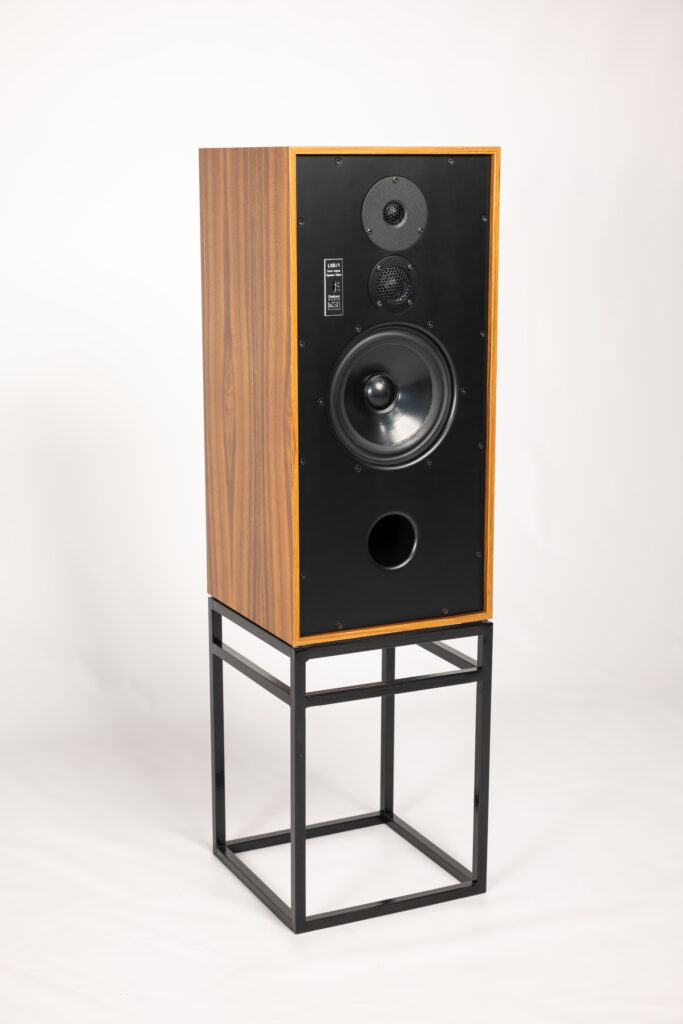
Fortunately for Graham Audio, the LS8/1 doesn’t come with that baggage. Yes, it’s a BBC-derived, thin-walled, stand-mount loudspeaker. Sure, it uses a mid-bass, tweeter and supertweeter with a front-firing port. And, yes, of course, the designer of the LS8/1 is Derek Hughes, son of the late ex-BBC designer Spencer Hughes. Derek put his considerable design smarts into developing this design. Given that he has also worked on many similar BBC-derived projects, it’s clear that he carries on the Hughes tradition. The speaker-designer apple didn’t fall far from the tree.
This is the BBC!
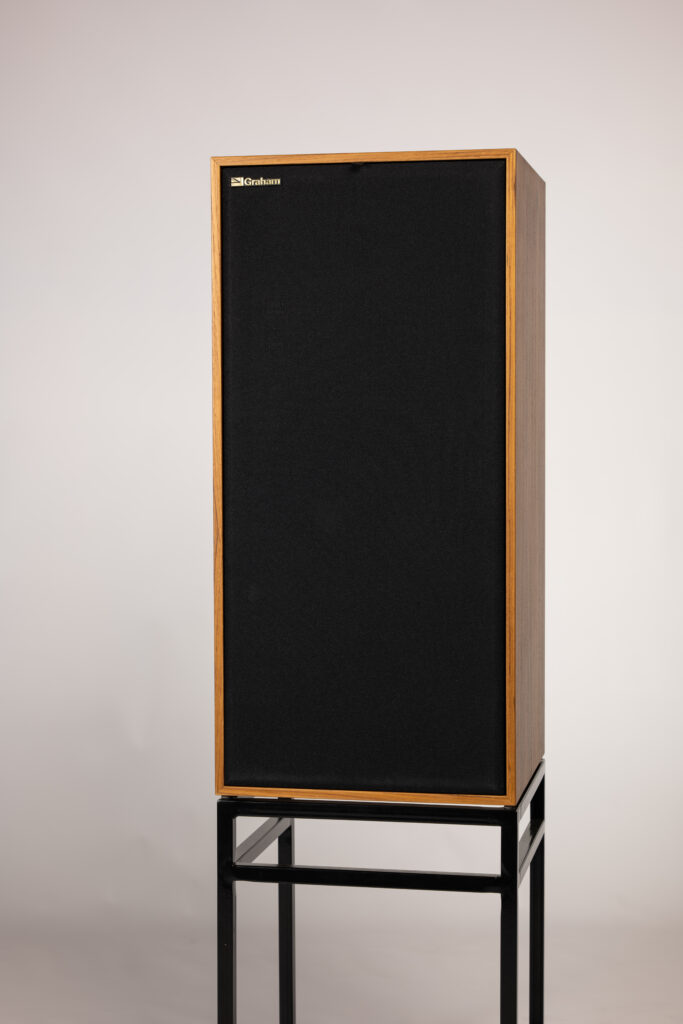
The three-way Graham Audio LS8/1 loudspeaker retains Hughes’s basic design and has the same shape, cabinet volume, and construction. That design moved with him when he and his wife Dorothy began building loudspeakers under the SPENcer-DORothy brand name. Given its layout, cabinet design, dimensions and drive unit array, a casual glance transports you back to the late 1960s.
However, closer investigation shows that a 200mm drive unit features a polypropylene cone, a 26mm tweeter, and a 19mm supertweeter featuring soft domes. There is also a switch to give a ±1dB boost or cut to those high frequencies. The LS8/1 doesn’t roll off at about 15kHz like it was playing an episode of Round the Horne on the BBC Light Programme.
The argument needs restating because this loudspeaker’s looks and layout have caused a stir among those who like the idea of the BC1 but have never heard one or haven’t heard one in decades. The Graham Audio LS8/1 is less uneven and has better power handling and frequency extension. It is also more consistent and has a higher volume ceiling than the BC1. Fortunately, the LS8/1’s existence does not degrade the ‘precious’.
What happens if…
A 21st-century reimagining of the same ‘what happens if…’ thought processes that created the BC1 more than half a century ago should be a win-win. It irons out bugs that could not be fixed with 1960s materials science.
Regardless, the LS8/1’s sensitivity is slightly below average, at a realistically rated 87dB. The impedance is a highly untroubling eight ohms, with no nasty dips or phase angles anywhere along the frequency range.
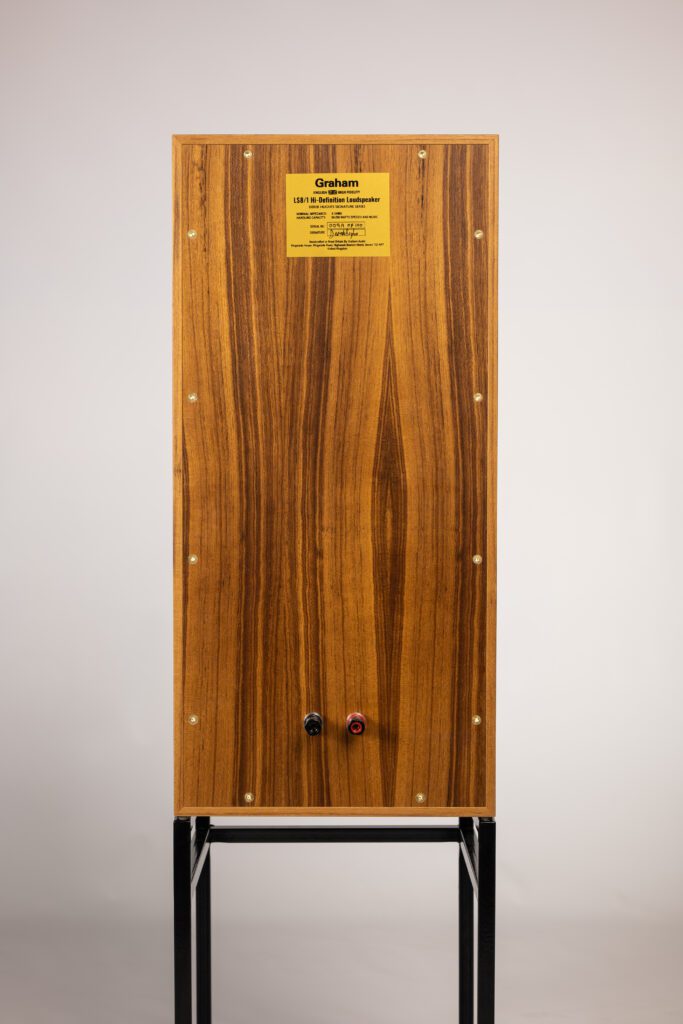
Set-up is easy. Graham Audio’s LS8/1 is single-wired and front-ported. It benefits from a slight toe-in, at least 30cm of rear and side wall breathing space, and lightweight stands. The obvious choice here is the open-frame XF models custom-made by Something Solid.
I played the Graham Audio LS8/1 with several amplifiers, both solid-state and valve (tube) based, and it worked exceptionally well with all of them. My samples of the LS8/1 were already well run-in, so I can’t comment on their break-in time or performance.
Intrinsically lovely
There’s something intrinsically lovely about the sound of the Graham Audio LS8/1. It seems almost entirely incapable of making a bad sound. The music sounds so enticing and attractive here. The performance is seductive. It’s also one of those loudspeakers that gets the midrange right as a priority. Instruments and music that occupy the midrange (string quartets, lots and lots of jazz, folk, and anything with a solid vocal component) shine here.
For example, ‘Canadee-I-O’ by Nic Jones [Penguin Eggs, Topic]. Jones’ percussive, low-tuned guitar and his voice sit in the room between the loudspeakers. It’s like you are cast back to 1980. The detail and precision of the sound are outstanding. If you listen carefully, thousands of wannabe folk guitarists can be heard having their dreams dashed as they try and fail to replicate his playing style.
The same holds when playing almost every jazz album from about 1958-65. Herbie Hancock is perhaps the musician who points to both ends of the Graham Audio LS8/1’s performance. Play ‘Cantaloupe Island’ from Empyrean Isles [Blue Note, from 1964]. It’s like being teleported into the studio with the band. The sound is sublime.
Move to Chameleon
Move across to ‘Chameleon’ from the 1973 Head Hunters album [Columbia], and that more synth-led fusion sound – though still very good – doesn’t emphasise the funk-oriented groove as well. We skip his vocoder-tinged disco years for good reasons. ‘Court and Spark’ – featuring Norah Jones – from 2007’s River: The Joni Letters [Verve] restores the order.
The overall sound is sophisticated and refined. The LS8/1 will never be the first choice for playing rock at ear-splitting levels, but that was never the intention of the original BBC designs and isn’t the plan here, either. They can play rock or dance music. It’s just that they make such a good and convincing portrayal of midrange that you are drawn to that part of the music, and in genres that place the accent on gut-crunching bass lines or all-attack synth chirps, you step beyond the LS8/1’s zone of excellence.
Tradition!
The British tradition always involved making a loudspeaker that sounded good in moderate-sized rooms. The bass rolls off in the mid-50Hz (with a clean and honest roll-off) partly because sub-50Hz sounds can prove challenging in its intended listening spaces. It’s not designed to go too loud because that, too, gets uncomfortable in those listening rooms. While that sounds ‘terribly, terribly’ British, it’s also a pragmatic approach to music reproduction in typical listening rooms. And it works. Decades from now, the Graham Audio LS8/1 will still be playing. It will be passed down from father to son like classic audio always used to be.
Wide-baffle stand-mount loudspeakers went out of fashion in the 1990s, as style and slimline tower loudspeakers dominated the audio world. Despite the slim tower’s dominance, there’s still a place for loudspeakers like this one. The LS8/1 would pass muster if it were a loving recreation of a 1960s classic. However, Graham Audio LS8/1 improves on a little slice of perfection for many classic audio enthusiasts. And that makes this loudspeaker something extraordinary.
Technical specifications
Type: Three-driver, stand-mounted, bass-reflex box-speaker system
As a founding member of Depeche Mode and one-half of the duo’s Yazoo (with singer Alison Moyet) and Erasure (with frontman Andy Bell), electronics wizard Vince Clarke has created some of the greatest synth-pop songs of all time.
After a career that lasted 42 years and saw him sell around 30 million records, he’s finally decided to release a solo album, Songs of Silence. It’s a dramatic departure from his trademark electro-pop – a dark, brooding instrumental record based on drones created by Eurorack modular synthesisers and often inspired by his love of science fiction films.
The very cinematic-sounding album was created when he started experimenting in his home studio in Brooklyn, New York, during the COVID lockdown.
hi-fi+ chatted with him over Zoom to find out more about the background of this surprising and bold record.
SH: How does it feel to be releasing your first solo album after a career of more than 40 years?
VC: It feels very strange – when I started recording, it was never my intention for there to be an actual album. I was doing it to keep my brain active and explore a different style of music. The whole ‘solo album [thing].’ It kind of sounds really naff.
Besides being in Depeche Mode, you’ve always been part of a duo: Yazoo, The Assembly and Erasure. How does it feel to be in the spotlight?
It’s a lot more work – a lot of the decisions I’ve had to make, like titles, the order of the tracks and artwork approval, I used to hand over to Andy [Bell]. It’s a very different experience, but as it wasn’t really planned, I’m taking each day as it comes.
So, let’s talk about the background of the album. After Erasure’s 2021 UK tour finished, you had to isolate due to getting COVID. You were in a hotel in London for 10 days…
It was after the last show – everyone else went home but I couldn’t. The worst thing was phoning my wife to say, ‘Oh, by the way, I’m not coming home tomorrow…’
What was it like being in the hotel?
It was a lovely hotel – in the East End. The location was fantastic, even though I couldn’t really go out and go to discos or anything like that.
So, it wasn’t like Alan Partridge?
No (laughs).
How did you keep yourself sane? Did you watch a lot of TV?
When I go away or I’m on tour, I’ve always got my computer and a mini studio setup – speakers and a keyboard – so I can mess about. I’m not very good at sitting down and watching TV.
I started doing some arrangements – some very rough demos – for the next Erasure record, but I hadn’t thought about making the drone tracks.
So, lockdown allowed you to fully explore the potential of your Eurorack modular synthesisers, which you’ve used on Songs of Silence…
Yeah – certainly. One thing I did over the whole COVID thing was that I watched a lot of tutorials – Eurorack stuff and, prior to that, I did a couple of online history courses and I tried to do an online samba dance class, but that just didn’t work out. I prefer watching tutorials on modular synthesisers than I do watching films on Netflix. It’s a bit sad really, isn’t it?
Whatever floats your boat… So, for the new record, you’ve experimented with drone ideas based on one note maintaining a single key throughout each track…
Yeah – that was a challenge because it wasn’t a style of music I was particularly familiar with.
I always wondered how people did it – the mechanics of it. How could you make a track with no vocals on it – an instrumental – interesting and still engaging?
That was part of the challenge. If there’s a vocalist or a song with lyrics, you have sections – a chorus, a bridge… It’s very obvious where you go, but this time around, I thought if I can still keep people engaged – and keep myself interested – without having to do that, then that was an interesting challenge.
The album artwork and publicity pictures are striking – stark, moody, black-and-white photographs of you…
I wanted it to look documentary-style – I like the idea of everything being in black and white. I wanted the photographs to show all my lines and creases because you are what you are. My days of wearing hoodies are over. I wanted the images to be upfront and honest and it makes the album look more serious, which is what I was after.
The record will surprise people, won’t it? It’s new territory for you…
Yeah – it is. It’s been an interesting learning process for me. I enjoy a challenge – if I’ve got a [synthesiser] module in front of me, which I’ve bought, because someone recommended it to me, but I don’t understand it, then I can spend an hour or two trying to figure it out to see what comes out of it.
The album is very dark, sombre and unsettling. Did lockdown and COVID influence that? Did you go through a tough time?
I think we all went through some dark times over that period, and I had some personal stuff happen to me and the people around me.
I was also watching a lot of science fiction movies. I’m a huge fan of science fiction and often something I heard or saw in one of those movies would inspire me to write a track. You don’t get disco dance songs in Bladerunner… (laughs).
Tracks like ‘Red Planet’, ‘Scarper’, and ‘White Rabbit’ have a cinematic feel – I think they sound like sci-fi movie soundtracks or themes from a futuristic, dystopian thriller. Have you ever done much soundtrack work?
I’ve done a little bit, but not on a big scale, and I don’t know if I would want to.
There was a time a few years ago when I started looking around and I was talking to people about the idea of doing it, but it was a very difficult world for me to get into.
Me and my girlfriend, who was soon to be my wife, spent two weeks in L.A, talking to film people, but I found it a bit depressing.
If you’re a director and you’ve spent years and years working on a movie and trying to get finance for it, then you’re not suddenly going to go with some bloke out of a pop band to do the soundtrack for you – you would use someone you trust and who has a track record. I didn’t want to put in the extra effort to try and get into that world – I didn’t want that amount of direction and those limitations.
You came up with the titles of the tracks on the new album after you’d written them, didn’t you? They were initially called ‘Drone 1’, ‘Drone 2’, etc, weren’t they?
Yeah.
The album opens with ‘Cathedral’, a majestic piece of music with a more hopeful feel than some of the other tracks…
That’s interesting because it came towards the end of recording the tracks – it was one of the last things that I did. In the song, nothing really happens – it’s just full of evolving sounds, but it created an interesting atmosphere.
That was one of the songs that wasn’t called ‘Drone 7’, or ‘Drone 8,’ – it was called ‘Cathedral’ almost from the beginning, because, in my head it sounded, as you said, majestic and cathedral-like.
‘Passage’ is a beautiful track – vocalist Caroline Joy is on it, providing a wordless operatic contribution…
I did the track and in my head I could hear an operatic tone, but not singing lyrics – there were no words.
It was something I couldn’t achieve with just synthesisers – I wanted to incorporate another texture into the song – and I based the melody on an aria from a Puccini opera. I fiddled around with a few notes – hopefully he won’t sue me…
‘The Lamentations of Jeremiah’ is a powerful and haunting track, with a mournful cello by your friend, composer Reed Hays. How did that piece of music come about?
It was originally a very science fiction track – I sent it to Reed and asked him if he was interested in playing something over the top of it. The guy’s a genius cello player – he just came up with these ideas and suddenly it went from being something that was filmic to something very human. It’s almost a human voice.
Am I right in thinking that the title of the final track, ‘Last Transmission,’ is a nod to the Joy Division song, ‘Transmission?’
Yeah – I love that track. It was one of the first singles I bought when I was a kid.
And the album’s title, Songs of Silence, was inspired by Simon & Garfunkel, who greatly influenced you in the early days…
Yeah – definitely. That idea came immediately – I didn’t have to think about what the album should be called. The only alternative was ‘My First Solo Record…’ (laughs).
Before you discovered synthesisers, didn’t you start playing guitar because of Simon & Garfunkel?
I did guitar club after school and then I watched the film The Graduate – I was blown away by it. The next day I went out and bought the songbook and learnt every song. Music became something that wasn’t just on Top of the Pops – you could do it yourself.
You wrote songs independently at the start of your career, but in Erasure, you write collaboratively with Andy in the same room. How was it making the solo record? Was it a challenge?
No. I like being in my studio – it’s a bit of a toyshop. I’m very happy and content spending hours in there on my own, experimenting. No one else in the house is particularly interested in what I’m doing anyway – apart from the cat. I’m left to my own devices.
I’m quite happy on my own really, but when it comes to the Erasure stuff, I do start having ideas and writing stuff down, but, at the end of that period, Andy and I will always be in the same room, face to face, because decisions can be made there and then, and we work off each other.
We both know when an idea is good and is worth pursuing, or if a melody idea isn’t working and we trash it.
We do that rather than doing it over the Internet – rather than me sending him an email saying, ‘Andy, that vocal line is terrible…’ It’s better to be in the room and to have him telling me that I’ve used that bassline 17 million times before, which often happens.
For me, there’s no substitution for being in the same room. I’ve known Andy for a long time and we read each other really well – I can tell from his face if he likes or doesn’t like my idea, and I have no problem saying to him that what he’s suggested for a section of a song isn’t working very well. It’s a very honest relationship. I enjoy that aspect of it.
What’s kept Erasure going for so long?
I don’t know… I like Andy and I think he likes me. We have similar political views and musical tastes. He’s just a good bloke to be around and he laughs at my jokes. What more do you need?
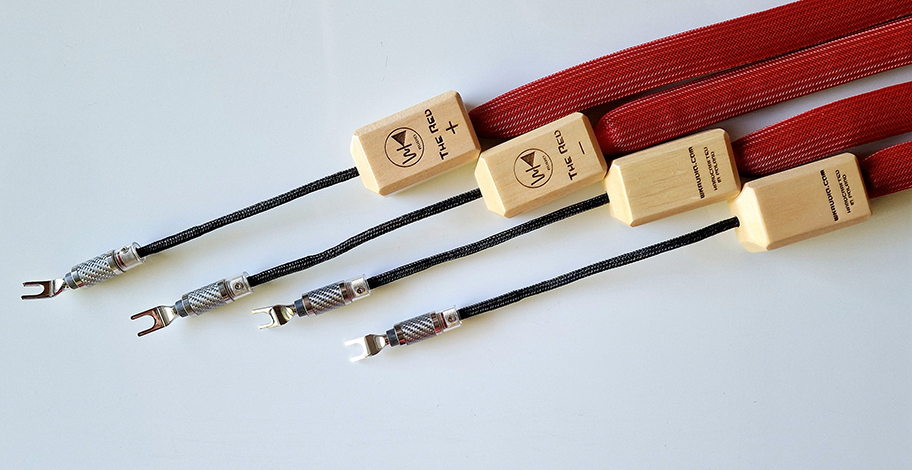
We were impressed by TheRed power cord by Polish-based manufacturer WK Audio. So impressed that we made it our Power Cord of the Year in our 2023 Awards. In turn, Witold ‘Witek’ Kamiñski of WK Audio was so ‘chuffed’ that I came back from the 2023 Warsaw Audio Video Show with a suitcase filled with the then-newest product in the WK Audio line; TheRed loudspeaker cables.
If you saw TheRed power cord, you’d know what that meant. For speaker cables, it means four substantial and completely individual conductors – one each for positive and negative conductors, two per channel – each using a combination of two high-purity copper conductors. The cables are sleeved in the distinctive bright red found in the power cord, and each end finishes in a wooden terminator/vibration damping box to the Furutech-based loudspeaker termination of your choice. The structure of the conductor differs depending on whether that cable is used for ‘send’ or ‘return’ purposes. Additional vibration damping is used throughout the cable.
Class and Control
As the cables I used were the ones demonstrated at Warsaw, they arrived entirely burned in. These are excellent cables, with all the class and control exhibited by the power cord, with extra weight and majesty to the sound. TheRed is powerfully dynamic but never in an unconstrained or wayward manner. It’s mighty sounding like your amp and speaker just got a boost.
I’m worried about people getting the wrong idea about ‘majesty’. It’s ‘majesty’ in terms of ‘exuding soft power’, not ‘glacial pomp’. Things bounce along well with TheRed, and although it might not be the first choice for the beat-oriented, it’s especially good at picking out a bass line. Like the bass, the soundstaging is constrained more by the music than the cabling and is given the perfect opportunity to run wide and deep.
But what I liked most about WK Audio’s TheRed loudspeaker cables was the lack of artificiality. Music sounded like music, not an overbright spotlit sound. Vocals and instruments sounded more like the real deal, and sitting in a three-dimensional space when the recording was at its best. Like all the best of the best in audio, you are transformed.
The cable doesn’t suffer musical fools gladly, and poor (read: thin and compressed) recordings are not given a soft landing or a place to hide. Yet it doesn’t eviscerate the recording, and there’s a sense of cohesive holism that few cables, regardless of price, can match. WK Audio hit the ground running here, creating a world-class performance with its first loudspeaker cable. Its sheer refinement in the midrange, higher frequencies, excellent bass depth, and superb imagery would make it a top-tier performer. But its vocal projection pushes it even further to the top of the tree.
Hide the snake
The downsides? WK Audio’s TheRed loudspeaker cables are currently only available in 2.5m or 3m lengths. There is also an interconnect gap in TheRed line-up. Finally, if you try to sneak cables into your system, four giant bright red snakes are not the easiest to hide!
This is WK Audio’s first signal cable. Judging by its performance, it won’t be the last. This bright red cable shouldn’t be high-end’s most apparent but its least-known star. It should be at the top of every high-end wish list. Since this review was published, TheRed interconnects have joined the party, and a new line is in production, too. If there is any justice in the audio world, WK Audio’s TheRed cable family should take its rightful place among audio’s cable elite!
11 November 2024 – (LOS ANGELES, CA | STUTTGART, GERMANY) – Known for precision engineering and emotional music experience, ACCUSTIC ARTS Audio GmbH, the revered German manufacturer of reference-grade audio components, announces a major expansion in North America with the appointment of On A Higher Note, LLC as its exclusive distributor for the United States and Canada. The collaboration introduces a new generation of audiophiles and music lovers to ACCUSTIC ARTS’ innovative products, known for precision and an ability to deliver a deeply emotional musical experience.
ACCUSTIC ARTS, celebrated worldwide for its “Absolute Sound Fidelity Through Reproduction” philosophy, handcrafts each component in Germany through an uncompromising two-week testing process. The brand’s signature achievement—its emotionally engaging midrange reproduction—has earned passionate followers among audiophiles and music industry professionals globally.
“We are thrilled to bring ACCUSTIC ARTS’ precision and the emotional warmth of its midrange to the homes of North American music lovers,” says Philip O’Hanlon, President of On A Higher Note. “Their commitment to the highest standards in audio engineering, particularly in their modular integrated amplifiers aligns with our mission of offering products that allow listeners to connect deeply with their music.”
Hans Joachim Voss, CEO of ACCUSTIC ARTS Audio GmbH, adds: “On A Higher Note shares our commitment to authenticity in musical reproduction. Their experience and passion for high-fidelity audio from their signature system setup process to produce the best audio component synergy, combined with their exceptional understanding of the North American market, make them the ideal partner for our expansion.”
The initial focus for the North American market will be on ACCUSTIC ARTS’ state-of-the-art integrated amplifiers, featuring optional DAC and phono modules, available in silver or black with chrome or gold trim. These amplifiers not only showcase German precision but are also designed to evoke the natural, detailed sound of live performances, allowing listeners to feel every nuance of their music.
Music lovers and audio professionals are invited to attend demonstration events hosted by On A Higher Note at select high-end audio dealers across the U.S. and Canada, where they can experience ACCUSTIC ARTS components firsthand and discover why the brand is celebrated for its unmatched midrange reproduction and emotional resonance.
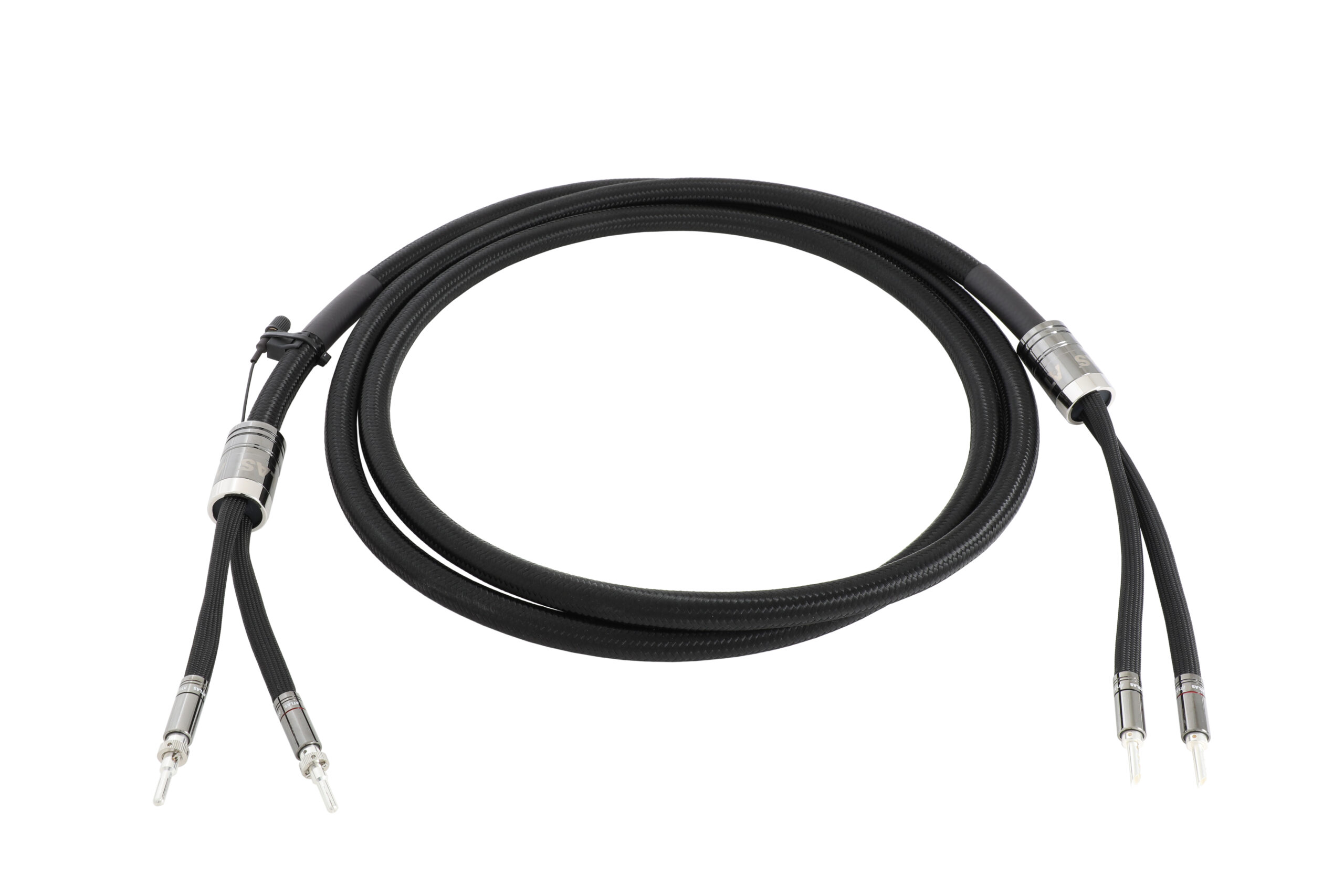
November 2024 – Kilmarnock – Atlas Cables the engineering-led cable specialist is excited to introduce the latest improvement to its acclaimed Mavros range: the Mavros Transpose Speaker Grun loudspeaker cable, launching on November 5, 2024. Designed for audiophiles and music lovers, this new cable continues Atlas’s tradition of excellence, leveraging more than 25 years of technological evolution.
Available now, a two-meter pair of Mavros Transpose Speaker Grun has a UK SRP OF £3,525.00 inc vat.
The Essential Elements that set the new Mavros Transpose Speaker Grun apart.
Ohno Continuous Casting (OCC) copper conductors for deletion free transmission
High efficiency, tension controlled microporous PTFE dielectrics with stabilised geometry for wide bandwidth operation.
Cold weld Transpose solder-free connectors that ensure optimal signal migration without distortion or interference.
Grun grounding system that enhances shielding, protecting against RF and EMI, thus improving sound clarity and reducing noise floor.
Hand assembled and tested in Scotland using calibrated tooling to ensure zero variability cable to cable.
All of the above take delivered performance to new levels, irrespective of cable configuration. Available in multiple configurations for single-wire, bi-wire, and bi-amping setups, the Mavros Transpose Speaker Grun is transparent in any high-fidelity system.
Finished in a smooth black fabric finish with complimentary Tin Cobalt Plugs the Mavros Transpose Speaker Grun is certainly a head turner! Physically larger than its predecessor with a diameter of some 16mm the cable certainly has presence.
The product offers a top-tier solution for those seeking to unlock the full potential of their audio equipment. Atlas Cables continues to push the boundaries of audio technology, delivering high-performance solutions for the most discerning listeners.
Available in UK at SRP
2.0m £3,525.00 inc. vat
3.0m £4,075.00 inc. vat
The sound of excellence delivered your way
Whether you prefer the feel of print or the convenience of digital, hi-fi+ keeps you connected to the world of high-performance audio.