Up to 37% in savings when you subscribe to hi-fi+
hifi-logo-footer

Begin typing your search above and press return to search. Press Esc to cancel.

Electrocompaniet ECG-1 turntable and arm

At the turn of the century, LP was all but dead (every magazine was headlining ‘final vinyl’ features), CD was king, and SACD was the challenger to its throne. So who would have imagined that a decade and a half later, it would be LP that might end up the last physical format standing? Vinyl’s reawakening in the 21st Century led to Electrocompaniet designing its first ever turntable, the ECG-1. It also led to the new ECP-2 balanced phono stage, which we shall be covering in a future issue.

There’s a lot of negativity in audio, and a brand best known for audio electronics making its first turntable in 2015 could be a target for that kind of negative thinking. The turntable could be seen as simply cashing in on the record-playing boom. Or, it could be considered to be a ‘make weight’ model, on the books simply to help complete the range and allow products like the ECP-2 to sell in Electrocompaniet specialist stores. However, the most cursory inspection proves the ECG-1 to be neither of those things, because that kind of cynical ‘design’ invariably involves placing the company’s logo on an OEM turntable, and the ECG-1 is not just a Pro-Ject or Rega design wearing Electrocompaniet’s distinctive gold on black livery.

Instead of adopting another company’s turntable, Electrcompaniet built the ECG-1 from first principles, adopting some of the anti-resonance and vibration control that went into products like the EMC 1-UP top-loading CD player (now in its EMC 1 MkIII SACD player guise), and applying them to the unique demands of the spinning vinyl disc. This becomes most notable in the chassis, which is a sandwich construction formed of a layer of aluminium between an upper and lower layer of acrylic. The acrylic layers are good for resonance damping and control, but require a more structurally sound aluminium layer to add the rigidity needed to keep the arm and bearing in alignment and, in the process, prevent any speed control issues from small changes in motor-to-platter placement.

The motor itself is a 24V asynchronous AC motor in its own housing, driven by an external two-phase speed controller. The motor housing stands almost completely independent of the main chassis, with only a single mini-DIN captive lead flying from the deck. This drives the basic speed controls in the Electrocompaniet’s signature four gold button layout – here, the buttons relate to turning the deck on or off, and 33, 45, and 78 rpm speed changes. There are no user adjustments to fine-tune speed.

Its platter is a thick acrylic design that sits deep in a recess in the top section of the chassis, and the belt sits around the outside of the platter. The belt, when first installed, can potentially slip under the platter and extracting it involves lifting the platter and the bearing housing; however, once installed the belt doesn’t ride up or down when playing.


Electrocompaniet may have started out with a clean sheet on the turntable, but when it comes to the choice of tonearm, the company turned to the tried and trusted 10”, oil-damped Jelco SA-750EB arm. Early reports also suggested the ECG-1 was to be bundled with a SoundSmith moving iron cartridge, but this seems to have been dropped from the final specification. This is both a good and a bad thing – good, because at this level most users will want to specify their own cartridge and will usually have the provision to install it, but bad because a SoundSmith moving iron is an almost perfect partner (I used it with Origin Live’s Aladdin cartridge from the same parentage, as well as a more meaty and historic Ortofon MC7500 to see what it was capable of). Fortunately, the arm is good for a wide range of cartridges, with masses between 4g and 12g.

Set-up is quick and easy, for a turntable. The feet are not level adjustable, though, and the turntable works best with a level, light, rigid, and vibration-free surface (a dedicated wall shelf is ideal).

It’s important to separate the ECG-1 from Electrocompaniet products, because the deck shouldn’t just be thought of as ‘the turntable for Electrocompaniet users’ but as a fine record player in its own right. However, Electrocompaniet also has a distinct family sound, and the ECG-1 is clearly a member of that family. There’s an unforced, easy, effortless sound common to many products in the range, and the ECG-1 follows that path, too. Never brash, the ECG-1 stresses the tonal beauty of a recording rather than leading edges. It’s more about musical and emotive insights rather than barefaced detail retrieval. If the performance is full of energy, it will portray that energy, but the ECG-1 is not a turntable that imposes its own ‘zing’ to the replay process.

This tonal (and timbral) integrity comes shining through with albums like Beck’s Sea Change album [Mobile Fidelity], where it’s all about the emotional content of the (mostly acoustic) music; but it also does surprisingly well with ‘Living For The City’ on Stevie Wonder’s legendary Innervisions [Tamla/Motown], because the ECG-1 deals with the lyrics, not just the rhythm. The rhythmic aspects of the album are still there, because the album would collapse without its driving sense of rhythm, and there is no sense of Stevie Wonder suffering a funkectomy (that came later in his career). Rather than stress the precision of the beat and that precision alone, the ECG-1 takes a more holistic view of the music. Those who define audio by ‘pace, rhythm, and timing’ will probably dismiss the ECG-1 as a result, but there are a lot of people who prefer a more complete picture, and one not dominated by one or two aspects of performance.

The ECG-1’s other great strength is spatial consistency. The soundstage cut into the groove is reproduced with tremendous accuracy. Whether it’s a close-knit jazz combo playing together on a small stage, or a full orchestra playing in a large auditorium, the ECG-1 is adept at scaling the soundstage presented to the amplifier up or down accordingly. Unless it’s on the recording, there’s no sense of 30m tall singers, stretched pianos, or tiny guitars. A lot of this comes from the ECG-1’s natural and unforced dynamic properties (it’s extremely good at portraying those ‘microdynamic’ sounds within a larger sound-field, such as the triangle playing in the overture to the Pirates of Penzance [Decca]) and from surprisingly good image solidity: instruments are rooted in their positions in the mix, unless the engineer is experimenting with the pan pot.

There’s a common theme emerging here, and one that holds well through the rest of the Electrocompaniet range: what the ECG-1 does is let you hear what went on in the studio. Not in a eviscerating manner (this isn’t the kind of turntable that makes you want to write to an engineer and question their choice of microphones); it simply lets you into the studio and the control room.

I dislike reviews that reference another product, but in this case I can’t help be sonically reminded of turntables like the Michell Gyro Dec. Both turntables have a sense of effortlessness about the performance; not ‘unable to shift out of low gear’ but instead the kind of audio presentation that doesn’t draw attention to itself, and just keeps on playing music happily for year upon year. This is, I suspect, one of the great strengths of the ECG-1: it’s not a player for those with Restless Ear Syndrome for whom any turntable is just a passing acquaintance. This is a turntable for keeps.


In a way, I’d love to see the ECG-1 available as a complete turnkey kit (with that SoundSmith cartridge) and just as a turntable with a range of cut-outs for different arms. The Jelco is fine and a perfect partner in its own right, but I can’t help thinking the ECG-1 is capable of partnering some really top-end arms like Mørch or even something as esoteric as a Graham. I think the turntable is potentially capable of that in its own right.

In the real world, however, I suspect Electrocompaniet has pitched the ECG-1 turntable and arm perfectly as a complete package, both in terms of absolute performance and in the context of an Electrocompaniet system. As a consequence, I doubt many would go for a deck without a matching tonearm, and the Jelco is a perfect match. At first, I thought I’d find the name ‘ECG’ irresistible in terms of knocking out a few electrocardiogram jokes: at the very least, I planned to play Queen’s Sheer Heart Attack on the turntable. But then it dawned on me the name is actually perfect for the Electrocompaniet
ECG-1 and no punning is necessary, because for many vinyl lovers old and new, this will be the heart of their system. The first turntable from the Norwegian audio brand comes strongly recommended.

Technical Specifications

  • Turntable
  • Operation: Manual
  • Drive system: Exterior (round) rubber belt drive
  • Motor: 24V AC synchronous motor
  • Speeds: 33 1/3 – 45 – 78 RPM
  • Speed selection: Fully regulated electronically
  • Platter: 12” / 2.8 kg acrylic
  • Tonearm
  • Operation: Manual
  • Profile: S–shaped
  • Headshell: SME-mount
  • Efficient length: 258 mm
  • Overhang: 15.17 mm
  • Offset angle: 21˚
  • Tracking error – angle: 1.75˚–1.25˚
  • Cartridge weight: 4–12 g
  • Cartridge height: 38–60 mm
  • Moving mass: 21 g (cartridge screws (0,5 g))
  • Dimensions (W×D×H): 46.5×36×15.3cm
  • Weight: 14.3 kg
  • Price: £2,760

Manufactured by: Electrocompaniet

URL: www.electrocompaniet.com

Tel: +47 51 74 10 33

Back to reviews

Read more Electrocompaniet reviews here

Graham Audio LS5/8 standmount loudspeaker

The LS5/8 was one of the last great loudspeaker projects of the BBC Research and Development team, dating back to the late 1970s. It was designed to reflect the increasing need for a large, high-level monitoring speaker for the studio. This was at a time when ‘Auntie’ had to drag itself kicking and screaming into the late 20th Century and couldn’t just rely on smaller, low-level monitors designed for speech. The Beeb needed loudspeakers that worked with rock as well as classical.

Porting the BBC-derived LS5/8 into the 21st Century is not an easy task, even if polypropylene cones and one-inch dome tweeters are commonplace now. The basic parameters of the loudspeaker drive units are very different today, and the original LS5/8 was an active design, and a passive crossover was something of an afterthought. To revive this design in 2015’s audiophile domain needed some considerable thought. Fortunately Graham Audio is prepared to do that thinking, and designer Derek Hughes was the person entrusted with the task.

There is something of a disconnect here. Derek Hughes is the son of Spencer and Dorothy Hughes, who founded Spendor Audio Systems in the early 1970s, and while Spencer was working for the BBC R&D team prior to that, there is no direct link between the Hughes family and later BBC projects like the LS5/9. Nevertheless, Derek is considered one of the keepers of the BBC flame, and if anyone can rework the LS5/8 into a modern context, it’s Derek.

The new Graham Audio LS5/8 is a passive, single-wired, front-ported, two-way standmount design, featuring traditional bitumenised thin-wall cabinets and Volt drive units. That’s the easy part. The harder part is conveying the size of the things. The 5/8 always was a big loudspeaker, but with years and years of slimline floorstanders, they look even larger than you might recall. The front baffle is extremely large in the flesh and the physical size of the speaker is somewhat imposing. With an internal volume of 109 litres, it all but dwarfs the 28 litre LS5/9 model from the same company, and towers over the five-litre LS3/5a. Nevertheless, it’s not a heavy loudspeaker (thin walled cabinet, remember?), and the Something Solid-like stands are rigid enough to keep the speakers in check. The two speakers, stacked side on side, would fill about three quarters of a doorway, though.

They also need a lot of space, both around them and between them, in order to work at their best. They need at least a metre from the side and rear walls and about three metres from acoustic centre to acoustic centre. Fortunately, they work extremely well firing across a room, with the listener sitting in the near field between the two toed-in loudspeakers. This can make them seem like the biggest headphones in history.


The LS5/8 uses a 34mm Son Audax tweeter, once again protected with a metal grille in the Graham Audio design. It couples this with a custom-designed Volt bass unit, similar to the one found in the LS5/9 (another polypropylene-based design), but this time a 300mm unit.

A crossover is a little more difficult. The loudspeaker was originally powered by a modified Quad 405 (AM8/16 in BBC-speak) and later by a dedicated Chord Electronics amplifier, but wasn’t thought of as a passive design. However, passives remain popular with domestic listeners around the world, and a passive crossover was called for. Fortunately, Derek Hughes stepped up to the 4mm binding posts. According to Hughes, “Converting an Active to Passive design is not fundamentally too difficult up to a point. The overall objective is to achieve the same target response.” However, he continued, “one complicating factor is that the variation in driver impedance is not isolated from a passive crossover as it is in an active design, which means that simple filter slopes have unexpected variations to be allowed for, especially around unit resonant frequencies.” The problem is compounded because those late 1970s drive units are not available today, “The tweeter, although basically the same model, had some differences compared to the original, so slightly different slopes and equalisation had to be used. The 300mm driver had rather more differences, although Volt worked well with us to make it as close as possible.”

Graham Audio has retained the BBC’s ability to make a big loudspeaker that has no need of a big amplifier. The LS5/8 is the opposite of fussy, acting instead as a great leveller of electronics. The differences between a good amplifier and a great one are reduced here. You can still hear deep into the recordings – never forget this project began as a studio monitor – but the choice of amplifier and source device is not so crucial in the delivery of good sound. Typically, designs like the LS3/5a were made with far above average impedance figures, which means an amplifier seldom gets out of first gear. So, most amplifiers never leave their comfort zone, and those amplifiers with power and quality in reserve, never tap those reserves. Nevertheless, it means the Graham Audio can be used with surprisingly modest electronics, even if roof raising is called for.

The LS5/8 is unique among big thin-walled standmounts, such as the Spendor SP100R2 and the Harbeth Monitor 40.2, because it’s a two-way (the others at this level all feature a midrange cone driver). This has advantages and disadvantages; the integration between treble and bass is usually better handled on a two-way, but a good three way has a more open sounding midrange as a result of having a dedicated driver working in that sector of the frequency response. So it is here; there is a sense of effortless integration across the frequency range, in the manner that only one cone and one dome can provide, but there is a slight hardening at the limits of the bass driver that comes across on massed male voices. Rutter’s Requiem [Reference Recordings] highlights this perfectly – the scale and dynamic range required to let a choir breathe and sound like a choir is beautifully retained, but there is a mild ‘edge’ to those male voices that is like a step between their middle and upper registers. On a lone voice, or on any instrument you weren’t intimately familiar with, you would probably not notice this hardening of the vocal cords, but with many singers, it’s noticeable. If anything, this mild hardening is pronounced because of the absence of flaws through the rest of the speaker’s performance envelope.

The LS5/8 is extremely smooth across the midrange and bass, with an effortless dynamic range that only a big, easy-driving bass unit can bring. In the context of a medium-sized listening room, it’s as full-range as you’d like to go (those last few notes of a piano’s keyboard come at the expense of a larger room, and typically a lot of room treatment). Curiously, the LS5/9 from the Graham Audio stable delivers more bass, despite it being built into a smaller cabinet, but the LS5/8 presents what it has in a more balanced manner: the LS5/9 puts you in the control room, while the LS5/8 puts you in among the musicians.

Perhaps the most noticeable difference between the LS5/8 and its smaller BBC brethren is the big speaker’s abilities to raise the roof. These loudspeakers play louder than other BBC designs, not to headbanger levels (although the combination of large loudspeaker with big bass and plenty of dynamic range playing at a reasonable lick is impressive) but with a sense of scale and drama that is viscerally exciting. I think this can all be summed up in the words ‘musically authentic’; you get the sense of floorboards creaking beneath a fast-paced kick drum, of rosin flying off a fast moving violin bow, of Jaco Pastorius playing a real fretless Fender bass, and of a singer standing up to a microphone. A lot of other loudspeakers make this sound like a simulation of these events taking place, the Graham Audio LS5/8 makes that seem like the musicians are really there. Slight midrange hiccup aside, this does all you want from a monitor loudspeaker, and yet without the kind of fatigue commonly associated with monitors retasked for home use.


In some respects, BBC-derived loudspeakers are the easiest products to review. If you like the sound of one, you like them all – they just get bigger, capable of going louder, with deeper bass, and more dynamic range. The port changes the parameters, and a 100+ litre ported loudspeaker with a 300mm drive unit is never going to sound quite as fast and as lithe as a five litre sealed box with a 110mm ‘bass’ driver – but the basic character is retained across the board. And that’s what you have here in the Graham Audio LS5/8. It is a loudspeaker that perfectly follows the BBC legacy and heritage. This is a loudspeaker that might have forever been hidden away from public view and the last of the line of BBC speakers could have just been a footnote in audio’s history. Graham Audio deserves great credit for bringing these classics to light.

Technical Specifications

  • System: Two-way reflex-ported standmount loudspeaker
  • Driver compliment: Son Audax 34mm tweeter, 300mm Volt polypropylene mid bass
  • Cabinet: Thin wall construction (critically-damped) Birch plywood
  • Frequency response: 40Hz-16kHz +/-3dB
  • Crossover: 1.8kHz, 19 Precision Elements, HF 18db/oct, LF 12db/oct
  • Nominal Impedance: 8 ohms
  • Sensitivity: 89dB SPL (2.83V, 1m)
  • Maximum Output: Over 110dB for a pair @ 2m
  • Finish: Teak or Cherry Wood Veneer
  • Dimensions (H×W×D): 76×46×40cm
  • Weight: 34kg
  • Price: £6,995 per pair (Cherry finish, £7,295 per pair)

Manufactured by: Graham Audio

URL: www.grahamaudio.co.uk

Tel: +44(0)1626 361168

Back to reviews

Read more Graham Audio reviews here

Audio Research, Wilson, Crystal, and HRS system

‘High-end’ is a term with specific mean­ings but also less specific implications. In audio terms, it’s not just about performance but a particular style of performance. Historically speaking, it exhibits distinct leftist leanings (left of the Atlantic that is), no surprise given that the term – indeed, the whole concept – was first coined in The Absolute Sound magazine by the late, great Harry Pearson. Ask most audiophiles to draw a quick sketch of a typical high-end system and you’d probably end up with something that looked remarkably like the system featured here. Again, that’s no real surprise, given that in UK terms at least, you don’t get much more ‘high-end’ than Audio Research, Wilson Audio, and of course Absolute Sounds, the distributor named for the US magazine but responsible for introducing US high-end products and thinking to the UK market.

What is more, this system contains current versions of two early high-end icons. Wilson Audio’s Watt/Puppy speaker system quickly became (and remains) a high-end benchmark, one of very few imported speakers to enjoy any real success or longevity in the UK market, while it was Audio Research’s pre-amps and especially the two-box SP10 that were the first products to introduce the UK market to a world of performance (and price) that stretched out beyond the flat horizons of Linn and Naim. The size and nature of UK rooms also played its part in creating a firm preference for compact speaker systems (at least in high-end terms) and single chassis stereo power amps. In fact, what you have before you might well be described as not just the current incarnation of several classic high-end products, but the modern embodiment of the archetypical UK high-end solution.

Over thirty-years young, Wilson’s Watt/Puppy evolved out of a near-field location monitor, first gaining a range of accessories to try and extend its bass before finally gaining an optional conjoined sub to turn it into a credible domestic speaker system. Now in its tenth iteration, it’s a neater and far more elegant product, having cast off its studio roots. These days the subs are no longer optional although it remains a four-box set up; that evolution reflected in the adoption of the Sasha name, bringing it in line with the rest of a family that stretches all the way from Sabrina to Alexandria. The latest Sasha 2 employed here boasts further developments of the baffle and head-unit to better integrate the established 178mm midrange driver with the new silk dome tweeter, adapted from the unit developed for the flagship Alexandria. The baffle itself is now constructed from Wilson’s proprietary phenolic material and angles the two drivers individually. Beneath the back of the head unit is a machined ten step, sliding ‘staircase’ that engages with the single rear spike and allows the baffle to be precisely angled and set relative to the bass units to allow for the listener’s height and distance from the speaker. The bass unit retains its two 200mm pulp-coned drivers a side, along with the interchangeable casters and spikes that are such an effective (and necessary – the Sasha 2s weigh over 90kg each) aid to set up. It would be easy to point to the introduction of that soft dome tweeter and stepped baffle as the big news here, but despite the fact that this is the first W/P version to eschew the inverted and latterly titanium dome used in all previous models, that would rather miss the point. The Sasha 2 is simply the latest step in a long but steady evolution – and evolution by its very nature involves subtle change. The Sasha 2 might offer more outwardly obvious clues than previous steps in the progression, but make no mistake: this is still very much a Wilson, and very much a Watt/Puppy.


Audio Research’s Reference 150SE power amp and Reference 10 line-stage have enjoyed a similar, evolutionary development path to the speakers they are paired with – albeit not quite as long or unbroken. The Ref 150SE can arguably be traced all the way back to the D90, although its true, spiritual roots lie in the D115 with its four 6550 output tubes per channel. Like the Sasha 2 it can also claim a key technology innovation, being part of the company’s first range to use the KT150 output tube. But that SE designation indicates more than just a change in output tubes, with the KT150 demanding totally different filament and bias supplies as well as revised output transformers. The enclosed chassis is cooled by a pair of rear-mounted fans whose speed (and thus the noise they generate) can be adjusted using two small switches concealed under the cover: Not the quietest, they arrive set on the highest speed, which you might want to reduce if you are using the amp in an open setting as opposed to a rack, or near the listening seat.

ARC has a long history of producing legendary twin-chassis preamps and the Reference 10 is going to do nothing to damage that lineage. Roughly amounting to the “(almost) everyman” evolution of the limited production 40th Anniversary Edition reference line-stage, it employs a number of significant refinements in componentry over its predecessor, along with a touchscreen user interface paired with a single, large volume control rocker. Sadly lacking the pleasing symmetry of previous ARC flagship preamps, my initial disquiet was quickly dispelled by the utterly intuitive and ultra positive control and switching options offered by the touchscreen. I’ve been saying for a while that if hi-fi manufactures are going to move to touchscreen control, they need to make sure they execute it to the same standard as Apple and the iPhone/iPad: that’s exactly what ARC have done here and the results are as reassuringly clear as they are easy to use. With a full suite of both balanced and single-ended, fully configurable inputs and outputs, the Ref 10 is as versatile as it is capable, perfectly suited to the task of driving the balanced input only Ref 150SE.


Of course, we could have paired the Ref 10/150SE with a Ref 2 or Ref 10 phono-stage and an appropriate record player (Absolute Sounds would doubtless suggest a TechDas) but in the spirit of keeping things iconic, we stuck to an all ARC solution, using the Ref CD9 as the system’s primary source component. A top-loading CD-only machine, the CD9 nonetheless embodies current digital thinking with a host of up-sampling and filter options as well as digital and USB inputs, allowing it to act as a DAC for multiple digital sources, including file replay at data rates of up to 24bit/192kHz. I did dabble with the USB input, but primary listening for this review centred on the all ARC chain and optical discs, a choice that produce such impressively engaging results that for once I really wasn’t tempted to look elsewhere.

System reviews are often seen as somehow limited: they only apply if you use the whole system together. Unfortunately guys, that’s true of audio in general and it’s the individual product review that’s out of step. We can’t listen to an amplifier or a CD player – we can only listen to a system. The best systems are considerably greater than the sum of their parts and this one is a case in point. Rather than fixating on the individual contributions here, what’s more interesting and useful is understanding just how we reached this state of grace. Yes, I can marvel at the sweet top-end and overall spatial coherence of the result – and it would be easy to put that down to those revisions in the Sasha 2. But do you really think that the Ref 10 line-stage isn’t playing a part? In fact, if I’m going to start pointing fingers at what makes this system work so astonishingly well, it’s the Ref 10 that’s going to get the attention. Sure, the CD9 has to deliver the signal and the Ref 150SE and Sashas have to preserve and project it, but it’s the line-stage that invests it with the sheer musical integrity and authority that I’m hearing here, that provides the firm footing for take off and the glue that binds the whole thing together.

There are other, equally important factors at work too. Taking the system coherence concept a stage further, Absolute Sounds ensured that I was using a full set of Crystal Cable’s Absolute Dream to hook up the AC supply, distribution, balanced signal path, and speaker cables. They would have insisted on sticking everything in an Artesania rack too, but I drew the line there, given that I’ve already got a number of other racks in-house and under review: The listening room would have looked like a furniture depository. Instead, they (somewhat grudgingly) ‘allowed’ me to use the excellent HRS RXR rack, equipped with a mix of M3X and R3X shelves, Nimbus couplers, and damping plates. As impressive as the system sounded when first fired up, it was a number of these final steps that really elevated its performance. Switching the speaker connections from the 4 Ohm to the 8 Ohm taps on the Ref 150SE introduced a remarkable increase in presence, immediacy and dynamic authority – despite the fact that the Sashas represent a solid 4 Ohm load, with a minimum impedance that barely scrapes above the 2 Ohm mark. Placing HRS damping plates on the rear top of the CD9 and running down the spine of the Ref 150SE’s cover produced the kind of increase in harmonic resolution, and dynamic definition, along with a reduction in grain leading to a much blacker background, that was hard to credit – until you look at the quality and resolution of the equipment involved. If this system might be considered a window, it’s a window Canaletto might have used to view Venice, instantly reflecting any change in light or shade, just as it immediately reacts to any shift in musical weight or emphasis.


Wilson speakers and ARC electronics have always done the space thing. From the starkly spot-lit, walk-in soundstages of early Watt-based systems, to the expansive warmth and presence of the SP8 and 10, these quickly became both sonic trade marks for the respective brands and sticks their detractors beat them with: too clean; over-etched; too warm; too soft; no sense of pace, rhythm or timing – that last the most damning criticism of all. Well my, how times have changed! While the flat earth long ago started to curl up at the edges, the high-end also embarked on embracing those contrary views. In the last few years, musical integrity has stepped right to the centre of the high-end stage, with an increasing awareness of the relationship between direct and reflected energy informing a deeper understanding between the notes and the acoustic space in which they’re played. Increases in performance are never linear across different elements in a system or different technologies: you don’t always hear what a change can do because other elements in the system are masking it. But occasionally, just occasionally, you get one of those happy accidents or coincidences where advances across a system and across different manufactures happen to fall in step, creating a step change in performance. That’s exactly what we have here.

Sit the original Sasha and the Sasha 2 side by side and there’s no doubting the increased dynamic, musical, and spatial coherence of the revised speaker. Truer harmonics, a broader tonal palette and sweeter, more natural balance are valuable by-products, but the key musical results lie in its more emphatic delivery, its ability to sound both more delicate but also more purposeful. At the same time, the switch to SE status has allowed the Ref 150 to deliver its power in a more unimpeded way, with a greater sense of substance and flow. Now throw in the fact that the Ref 10 has taken the relaxed, unforced, and spacious presentation of earlier ARC Reference line-stages and added considerable focus, and resolution, while also anchoring the whole musical edifice to a firmly planted sense of time and place and the remarkably impressive musical results start to make a whole lot of sense. Bind those changes together with a carefully considered and totally coherent system infrastructure and you really hear the benefits. In the case of Absolute Dream, the cables don’t just come from the same range; each and every cable throughout the system employs identical conductors, construction, and materials. Likewise, the HRS supports employ a completely integrated approach to both isolating the equipment from the outside world and isolating the signal path from microphony generated within the equipment itself. These are not ancillaries or accessories: both supports and cabling are crucial elements of the system as a whole that you underestimate at the peril of the musical performance that results.

And what a performance it is. Play familiar recordings on this system and you’ll be astonished at the sheer presence it brings to the performance. If the mark of a great system is to bring the original event, the sense of that performance into the room with the listener, then this is definitely a great system. It’s partly to do with the size and dimensionality of the acoustic, partly to do with the system’s ability to track shifts in level and dynamic density. But it’s all to do with the natural perspective, scale, and the lucid clarity it brings to proceedings. It doesn’t matter whether you are playing classical recordings from the Decca Analogue Years box, or contemporary rock or pop recordings; you’ll immediately recognize the unforced quality, with all the effortless flow and dynamic response, presence and rich tonality that have long been familiar in ARC-based systems. But where this system takes a significant step forward is in terms of its almost physical sense of substance, of concentrated energy and musical purpose.

It’s down to that planted quality I referred to earlier. There’s a temporal security, a sense of each note having a place and being in its place, that brings a wonderful, natural inevitability and flow to the performance, whether it’s the restraint and hesitations of a Nanci Griffith or the joyous, propulsive riot of Paul Thorn covering ‘Doctor My Eyes’. There’s a new-found sense of musical purpose to this latest generation of ARC and Wilson products that gives music an unmistakable and incredibly natural sense of direction. Combine that with the impressive presence and substance and it reveals an immediacy that makes listening a compelling and engaging experience. Throw in the ability to capture the texture of instruments, the character of a voice, and suddenly you find yourself being pulled into the music. Few systems I’ve used allow you to forget the system itself quite as completely as this one. Few systems I’ve used encompass different genres with such ease and scale the dynamic shift from solo voice or instrument to large ensemble with such comfort. When Lorin Maazel calls for the bass drum and timps to punctuate a point in his Sibelius One, it’s point that gets made and stays made.

Those who’ve dismissed older ARC electronics as lazy, or past Wilson speakers as splashy and disjointed owe themselves another listen, because this system is special. It takes all of the spatial, tonal, and textural qualities for which ARC products are justifiably renowned, all of the Wilson speakers’ dynamic range and projection, and binds them to a solidly anchored musical structure that is full of life, intent, musical energy, and (that word again) purpose. It captures the motivation, the space and the atmosphere of recordings – and it brings it, nervous, hesitant, kicking or screaming into your room. If you want to experience that expectant hush that falls when a conductor raises his baton, or the muggy atmosphere and sticky floor of some backstreet gig, this system can take you there – because that’s what it is and that’s what it does. This is a system that does indeed exceed the sum of its very considerable parts. You’ll pay (handsomely) for the pleasure but that’s not really the point. In the real world you’ve either got the money or you haven’t. For the rest of us, this system stands both as an example of what “high-end audio” is all about – and just what’s possible.

System components

  • Audio Research Reference CD9 Price: £10,998
  • Audio Research Reference 10 Price: £25,998
  • Audio Research Reference 150SE Price: £11,998
  • Manufacturer: Audio Research Corporation
  • URL: www.audioresearch.com
  • Wilson Audio Sasha Series 2 Price: £30,998/pair

Manufacturer: Wilson Audio Specialities

URL: www.wilsonaudio.com

Crystal Cable Absolute Dream Prices: from £10,000

Manufacturer: Crystal Cable

URL: www.crystalcables.com

UK Distributor: Absolute Sounds Ltd

Tel: +44 (0)208 971 3909

URL: www.absolutesounds.com

HRS RXR Rack with M3X and R3X shelves
Prices: from £1,280

Manufacturer: Harmonic Resolution Systems

URL: www.avisolation.com

UK Retailer: The Audio Consultants

Tel: +44 (0)118 981 9891

URL: www.audioconsultants.co.uk

Back to reviews

Read more Audio Research reviews here

Lindemann/ProAc system

Often, when building a system, it’s a good idea to put yourself in the hands of a dealer you trust. Done right, such systems produce rare and wonderful results, as with the system reviewed here, made of German audio electronics from Lindemann, and fine UK loudspeakery from ProAc, and put together by Noel Cloney, of Cloney Audio.

Those with an archive of Hi-Fi+ issues might remember Lindemann as a maker of a very nice CD, amplifier, and loudspeaker system under the 800 Series, which was reviewed by Chris Thomas in issue 98. Since that time, the German Lindemann company has undergone a complete reboot in terms of its product line. The company now has just a handful of products in its musicbook: Series; two DACs, two network players, and two power amps. Although the DACs and network devices have provision for connecting ‘legacy’ analogue line inputs, Lindemann’s musicbooks are really designed as complete standalone systems, which possibly shows both how far the audio industry has come in recent years, and where it’s going.

In reality, most people are going to choose either the network player or the DAC and use it with an amplifier. The use of both network player and DAC is unlikely. Lindemann is obviously highly aware of this, because both share common components in terms of line inputs, outputs, and functionality. Noel chose the network player (in this case the musicbook: 25) for this system, but we also have one of the DACs lined up for an upcoming test. This brings Ethernet streaming and a handy Apple/Android app to control the system (the DAC, by its very nature, implies your computer will be sitting close to the system and that does all the ‘legwork’).

The term ‘digital hub’ has become hackneyed of late, but it’s entirely relevant in the case of the musicbook: 25. It covers almost all the bases, except for SACD replay and DoP (DSD over PCM) support. It has a slot-load TEAC-based CD player, two S/PDIF and two Toslink inputs, and one of each for digital outputs. It has both a wired and wireless Ethernet input, and can support UPnP, and vTuner internet radio. It has a front mounted USB socket for both thumb drives and hard drives. There’s even a dedicated Class A headphone amp, both balanced and single ended outputs, and an elegant USB-chargeable remote control alongside the app support. Fold in the two sets of RCA line inputs and you get why the whole ‘hub’ thing counts here.

Its style is extremely elegant, too. It’s a ¾ sized device, with a rounded off top and bottom brushed aluminium clamshell, curved aluminium sides, a black ‘business’ end, a power button set into the left, and a knurled, large thumbwheel set into the right of the top plate. The OLED display is a surprisingly readable shade of yellow, which looks much better than it sounds. In sum, the whole musicbook: 25 exudes a sense of well-built solidity.


This is met and matched by the Lindemann musicbook: 55. This is a 240W per channel amplifier with balanced and single ended inputs. The amp is designed to be bridged to deliver 450W in mono mode should you require an upgrade, all packed into the same ¾ size amplifier chassis. How this is possible comes down to the letters ‘UCD’, short for ‘Universal Class D’ amplifier module.

Lindemann’s manual is an exercise in making the fairly complex task of putting a network streaming system together read like it’s not a problem. This doesn’t mean it hides things from prospective owners (resulting in a lot of headscratching and panicked phone calls and emails). Instead it guides you through the usual set-up procedure and offers some semblance of legitimate help should things go awry. This comes down to Lindemann building a digital front-end that doesn’t require a secret-service codebreaker to configure, and to a clean and logical layout of the manual. If you can follow the instructions to set up a TV or cook a meal, you can install the musicbook: 25.

There are even scaled down versions called the musicbook: 20 and musicbook: 50. The musicbook: 20 network player is basically the musicbook: 25 without the CD drive, while the musicbook: 50 is an 80W per channel, non-bridgeable Class D amp in the same musicbook: 55 chassis. In fact, the musicbook: 50 came before the musicbook: 55 in the development cycle, and the bigger, more expensive amplifier came about as a result of pushing the 80W musicbook: 50, which sometimes has difficulties driving low-impedance loads. The musicbook: 55 is an engineer’s creative response to just criticism; unless you are trying to drive a pair of old Apogee Divas or welding together parts of a battleship, you’ll rarely need more than a musicbook: 55.

Not that the ProAc Response D20R is what you’d call a ‘difficult’ load. The D20R is a simple eight-ohm load and has a sensitivity rating of 88.5dB, explaining why ProAc frequently demonstrates this loudspeaker with a Naim SuperNait in the UK. The D20R is essentially a variant on the extremely popular ProAc Response D18, replacing the 17mm dome tweeter with a custom-made 60mm x 10mm ribbon tweeter in the same offset position as in the D18 (which still remains in the catalogue). The D20R keeps the same 165mm fibreglass weave mid-bass cone, with a phase plug and what ProAc refers to as its Excel magnet. In re-evaluating the D18, ProAc took the opportunity to rework the crossover network and remodel the bass loading – the port still fires into the floor, but the construction of this system has changed, giving the loudspeaker a more graceful bottom (something we can all appreciate) and making it easy to install in a wide range of listening rooms. ProAc also experimented with a new white finish in time for the Bristol Sound & Vision Show in February, and was surprised by the uptake, so now these classic loudspeakers are available in a tidy shade of pure white.

Whatever the colour of cabinet, I admit that this would never have been a combination of products I would have thought of putting together. There is no real reason for saying this; there are no obvious incompatibilities, and there is nothing up with using the electronics from one European country with the loudspeakers of another. It’s just that there are so many possible permutations and combinations of products that this one would have taken years to fall upon. But having heard it, I’m awfully glad that someone did fall upon it.

This system brings together much of the convenience of Sonos with almost Apple-like levels of design and operation, and yet does so without sacrificing the sound quality in the process. Traditional audiophiles have their personal Rubicon to cross with Class D, and some will never make it. If you view it as just another form of output device, you’ll fairly quickly find Class D falls into three broad sonic signatures; too warm, too bright, and ‘goldilocks’. The ‘goldilocks’ point is all too rare, with just a handful of top-class brands enjoying the sweet spot. Well, now, you can add Lindemann to that select list of those getting Class D intrinsically right. This, coupled with the subtle performance of the ProAcs, works wonders.

Taken as a system, it’s got a hugely graceful sound, with outstanding dynamic range, great bass and super-accurate midrange. It’s one of those systems that never draw attention to their performance, and that is its greatest strength. In ‘doing a Yoko’ (breaking up the band), it became clear that this was also a common strength in all three components – the musicbook products reminded me of Primare’s understated, yet intrinsically ‘right’ presentation, and the ProAc’s overall balance just invited you into listening to the music and kept you there. Once again, the ‘goldilocks’ point springs to mind.


It really didn’t make much difference what type of music you played through the system; it remained clean, clear, open, and informative. It was always musically charming without being saccharine, insightful without sounding ‘etched’ or hard, and energetic without being over-exuberant.

It’s all too easy to whizz through one’s music collection when streaming on a network. The iPad in your hand invites such a mindset. But through the Lindemann, although such a gallop through my musical past was easy, at no point did I feel the need to do so. I was just happy in the musical moment, and played more albums than snippets. This is a sign of something very ‘right’ going on across the system.

It’s hard to find flaw for the money. No, the system doesn’t have the home-shuddering dynamics, the extraordinary detail and transparency, the volume headroom, the bass extensions, or the seamless coherence of a system costing at least as much as an S-Class Mercedes. And the headphone amp, though good, is no match for the anointed standalone ones. But the thing is the Lindemann/ProAc combo gets close enough. Some think there is no such thing as a law of diminishing returns in audio, but you could be mistaken for concluding that line in the sand is drawn here.

If you listen really hard, you can just about hear the sound of audiophile statues being torn down. This system is part of the quiet revolution that is taking place in audio today. Ten years ago, such a system would have been possible – just – but it wouldn’t have been any good. Such is the delta of change in audio that this system isn’t just possible and isn’t just good, it’s at the core of what good audio is today. And, not long after you read this, the Lindemann will also be able to stream Tidal, Qobuz, and Deezer, adding more functionality and good audio to the mix. It would be excellent if the CD transport interacted more with one of the online music databases, to show more than title and track (such as showing the album cover on the app), and it would be fantastic (if almost impossible) to turn that CD transport into a ripper should you wish, but this is being picky.


There is an old-world caveat to this revolutionary zeal; a system this well-matched wouldn’t have happened without a good bricks-and-mortar dealer who did due diligence to find a system whose components work together this well. The whole isn’t significantly better than the sum of the parts, but I’d struggle to find a system that hangs together better. Cloney Audio proves that a good dealer is not the enemy, if they never forget who their customers are, and if they put together systems like this that work for those customers.

Truth is, I’m a little shocked at how good the Lindemann musicbook: audio equipment sounds, especially when the price is taken into account. ProAc, in fairness, is far more of a known quantity, but even so, we were expecting ‘good’, and got ‘great’. But when you put the three boxes together… that’s world class, and Cloney deserves high praise for putting them together. It’s all very highly recommended!

Technical Specifications

  • Lindemann musicbook: 25 network player
  • Supported formats: MP3 max. 320 kbit/s VBR/CBR | WAV and AIFF max. 192 kHz / 24 bit | FLAC max. 192 kHz / 24 bit | ALAC max. 96 kHz / 24 bit | AAC | Ogg Vorbis | WMA (only Standard, no Pro and Lossless)
  •             Gapless playback with WAV, AIFF, FLAC, ALAC, MP3
  • Ethernet: 10/100 Mbit/s
  • WLAN: 802.11b, g, n. 2.4 GHz band. WEP, WPA, WPA2 safety support. External screw-in antenna
  •             DHCP and static IP support
  • USB 2.0 host interface: fullspeed and highspeed mode. Charging of smartphones and tablets up to 2.1 A. Support of mass storage devices with FAT16/32 file system, e.g. USB sticks, USB harddisks, smartphones and tablets
  • Internet Radio: vTuner
  • CD Player: Slot-in drive (TEAC) with CD text support
  • Digital/analog converter
  • Inputs: two optical and two coaxial digital inputs (75 ohms) for SPDIF signals (LPCM) up to 192 kHz and 24 bit
  • Outputs: one optical and one coaxial digital output (75 ohms) for SPDIF signals
  • THD & Noise: < 0.0005% (@ 0dBFS)
  • Dynamic range: >125 dB
  • D/A converter resolution: 352.8/384 kHz, 32 bit
  • Converter architecture: Anagram Sonic Scrambling DAC in dual-differential mono mode
  •             jitter performance 250 femtoseconds
  • Jitter reduction: > 60 dB
  • Digital filter: minimum phase ‘apodizing’ filter
  • Analog Inputs: 2× line level inputs (RCA)
  • Outputs: one balanced (XLR) and one unbalanced (RCA) line level output
  • Headphone connection: ¼“ (6.35 mm) jack socket
  •             Recommended Headphone Impedance with 32–300 ohms impedance
  • Frequency response: 0–200 kHz (-3 dB)
  • THD & noise: < 0.0005% @ 2.50 V output
  • Dimensions (W×H×D): 28×22×6.5cm
  • Weight: 3.50kg
  • Price: €3,900
  • Lindemann musicbook: 55 power amplifier
  • Inputs: XLR inputs: analog line level inputs with 20 kOhms input impedance. RCA inputs: analog line level inputs with 10 kOhms input impedance
  • Speaker outputs: safety 4mm banana sockets
  • Power output: 240 W into 4 ohms per channel (< 1 min)
  • Maximum output current: 16 A peak
  • Gain: 27.8 dB (24.5-times)
  • Frequency response: 0 Hz–45 kHz (-3 dB)
  • THD & noise: < 0,05% typ.
  • Dimensions (WxHxD): 28x22x 6.5cm
  • Weight: 3.7kg
  • Price: €2,800

Manufactured by Lindemann

URL: www.lindemann-audio.de

  • Tel:  +49 (0) 8153.9533.390
  • ProAc Response D20R
  • Floorstanding ported two-way loudspeaker with ribbon tweeter
  • Drivers: ProAc 60x10mm ribbon with rear-chamber damping, 165mm ProAc unit fitted features glass fibre weave cone, Excel Magnet system, and acrylic damping phase plug.
  • Recommended Amplifiers: 20 to 180 watts
  • Frequency Response: 28Hz to 33KHz
  • Nominal Impedance: 8 ohms
  • Sensitivity; 88.5 dB linear for 1 watt at 1 metre
  • Standard Finishes: Black Ash, White, Mahogany, Cherry, Maple.
  • Premium Finishes: Rosewood, Ebony.
  • Dimensions (WxHxD): 19x96x22.7cm
  • Weight: 26Kg each
  • Price: from £2,650/pair (depending on finish)

Manufactured by ProAc

URL: www.proac-loudspeakers.com

Tel: +44(0)1280 700147

System recommended by: Cloney Audio

URL: www.cloneyaudio.com

Tel: +353 1 288 8477

Back to reviews 

Read more Lindemann reviews here

Nordost Odin 2 cables

There are other cable systems that cost more than Nordost’s Odin, but none of these rivals seem to draw as much fire from the sceptics and cynics. Odin is the most visible high-priced cable system in audio, and now Nordost’s new Odin 2 raises the bar… and the price. I can almost hear the sound of pitchforks being sharpened and torches being lit.

Odin 2 was possibly the worst kept, most blindingly obvious secret in audio. Nordost has been systematically improving its lines for several years, starting with Leif and the Norse 2 ranges, and most recently with Valhalla 2 (tested in Hi-Fi+ issue 112). Given that Valhalla 2 improved the performance of Valhalla to a point where the difference between Valhalla 2 and Odin was beginning to blur, the development of an Odin 2 was almost inevitable.

The problem is you don’t just ‘update’ Odin. The original Odin cable system from 2008 already set a high standard of attention to detail and uncompromising focus on getting a signal from source to speaker with the least possible compromise. Where do you go from there? Fortunately, the key to this was the design and development criteria that went into turning Valhalla into V2, blending that with what set the original Odin apart from the first version of Valhalla, and then adding Odin 2’s technological distinctiveness in its own right.

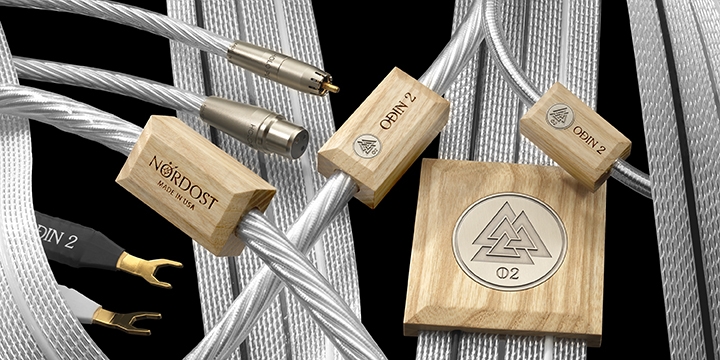
The principle element taken from Valhalla 2 is the HOLO:PLUG terminator for phono, XLR, power, and spade connectors. The HOLO:PLUG is designed to create an optimum interface between cable and component, with precisely aligned 360° low eddy current terminations for each conductor in the relevant cable, a rear termination grounding ring, and sophisticated vibration control. This means that the individual HOLO:PLUG must be designed in tandem with the specific cable, so there are no components shared between a Valhalla 2 phono plug and a Odin 2 phono plug. It also means that building the individual cables is a slow, specialist, and painstaking task. But, the path to perfection is paved with such dedication. The one missing element from the HOLO:PLUG list (at the time of writing ) is a 13A UK plug, and fellow traveller in the Nordost bus Quantum has produced a new fused version of its Qbase with Schuko sockets that will get the job done, thereby limiting the number of Furutech UK 13A sockets. The HOLO:PLUG carbon-fibre IEC socket, together with Schuko and US wall plugs are available in HOLO:PLUG form.

The element taken from Odin was its Dual Monofilament layout, which is also now featured in Valhalla 2. A precision double-helix of Fluorinated Ethylene Propylene-wrapped monofilament cables itself encased in a further layer of FEP, in Odin 2, the individual conductors are formed of a number of silver-plated high-purity solid-core copper strands. The actual thickness and number of individual strands that make up a single Odin 2 conductor vary according to their ultimate purpose, and the composition of a Valhalla 2 conductor for a specific cable may have little in common with the make-up of an Odin 2 conductor in the same situation.


Since Norse 2, and especially after Valhalla 2, Nordost has placed increasing significance on making sure the mechanical properties of a cable are optimised to a degree of precision that borders on the obsessive. In Odin 2, however, it crosses that border and marches on Compulsiville. Odin 2 features what Nordost refers to as TSC, or Total Signal Control. TSC comprises additional shielding and spacing tubes, most easily seen in the black and white tubes separating the paired cable sets on the ‘send’ and ‘return’ conductors. These help create an optimum mechanical positioning for the individual conductors in each cable. The wooden resonance/serial number blocks are retained from the original Odin: the branded name, numbers, and direction indicators are now joined by a metal circle (with the three sets of interlocking triangles that make up the Odin rune) set into one side of each block.

Although Odin 2 should be considered as a complete system because of its gestalt totality, it’s wrong to lump the various cables in Odin 2 together as one. This is because Nordost Odin 2 is not isomorphic. In an isomorphic cable family, the same layout is used to develop the loudspeaker cables, interconnect cables, and power cords. Nordost instead develops a series of different designs that apply specifically to the task in hand, but are calibrated through rigourous listening tests to work together. As a result, the power cord uses 7×14 AWG solid-core wires per conductor, the analogue interconnects use 10×23 AWG wires per conductor, and the loudspeaker cables 26×20 AWG wires per conductor.

While there are also tonearm cables, digital interconnects (no USB as yet, however), and
bi-wire jumpers in the Odin 2 range, we concentrated on the core elements: power, interconnect, and speaker cables. We also went with spade connectors rather than 4mm banana plugs for loudspeakers, because my Wilson Duette S2’s don’t eat bananas. With the exception of a single Furutech 13A plug reaching to the wall, every connection and cable to the speaker terminals was pure, unadulterated Odin 2. We also had identical lengths of Valhalla 2 to compare and contrast, as well as some top-end rivals. Our runs of Odin 2 were fully conditioned with one of Nordost’s VIDAR burn-in conditioners.

Valhalla 2 shifted the goalposts. Although it was priced between Valhalla and Odin, Valhalla 2 came dangerously close to the performance of Odin, and Odin 2 is Nordost’s response. Odin 2 is, to use a touch of British understatement, ‘a bit good’, in that while you listen to V2 and think it’s outstanding in its absence of tonal character, if you compare the cable to Odin 2, Valhalla 2 almost sounds ‘broken’. And given V2 already made most other cables sound arch and similarly ‘broken’, Odin 2 makes it all but impossible to listen to lesser cables, even in the context of cheaper audio equipment.

This is a conceit to reviewing, because putting around £100,000 worth of cable in a £10,000 system is likely only ever going to happen in a reviewer’s listening room, but the odd thing about Odin 2 is it makes such a system appear understandable and logical. The £10,000 system produces a more integrated, coordinated sound as a result of the Odin 2 upgrade, making that system hang together in the way most systems at the price don’t. It also makes the system more receptive to the improvements brought about by Nordost’s Sort Kones, Sort Füt, and other devices with similar intent.

The scale of personal epiphany and re-education that takes place with Odin 2 means I can’t quite bring myself to cancel the idea of that seemingly cable-heavy system out as ‘unrealistic’, because I can envisage someone perfectly content with their system as it stands wanting to bring out the best from it, and ultimately settling on Odin 2 as a logical extension of that process. In reality, someone settling on Odin 2 is extremely likely to be using a system that uses £10,000+ components as a bare minimum, rather than a £10,000 system. But while I understand that intellectually, having spent a considerable amount of time listening to Odin 2, I can’t shake the idea that if that £10,000 system was made up of the devices that went really well together, Nordost’s Finest would just tie that system together better than almost anything else on the market, all other things being equal.

So, precisely what does Nordost Odin 2 do that makes it so exceptional? Nothing. It does nothing to the sound of your system, but it does nothing better than almost every other cable out there. You quickly realise just how active that ‘nothing’ really is, which means mixing your mythos – out go Norse gods and in comes Buddhist metaphysics – and Odin 2 is like a Rinzai Zen monk meditating on ‘Mu’ or ‘nothingness’. The devices in the system are unconstrained by Odin 2 to a point that even cables like Odin and Valhalla 2 are unable to attain.

All this sounds like pretentious nonsense, but spend time with Odin 2 and how its calming ‘absence’ nature influences both the system and the way you interact with that system, and you will understand why this ‘nothingness’ is crucial to good sound. You also might discover how the regular audiophile vocabulary is past its limits when trying to describe Odin 2’s performance thresholds. And ‘performance thresholds’ is possibly the best description of where Nordost Odin 2 exists. Alongside a very select list of rival cables, Odin 2 takes your system to new levels of performance you might not have thought possible: in this respect, it’s like listening to great old recordings played back on top-notch new equipment – you end up asking yourself, “did they know how good this is when they made it?” Odin 2 does that to both music and the equipment upon which that music is played.

Bringing this down to single musical examples seems like a constraint in its own right. Describing Odin 2 in terms of “the soundstage width…” or “Beck sounded like…” seems like defining a camera by its strap or the tree you photographed. More importantly, it seems like breaking down something best experienced as a whole into its component parts, and (staying with Buddhist thought a while longer) the parable of a group of blind men trying to describe an elephant seems relevant here. The whole is comparatively straightforward – “it’s your system, only better” – while the sum of the parts is a complex list of tick-boxes in terms of imagery, detail, dynamics, leading-edge attack, trailing-edge resolution, articulation, solidity, and transparency. All of these things are improved, and improved relative to the system you are using. So a system that throws out a wide soundstage will either deliver an even wider soundstage or a more solid soundstage depending on what your components are doing. You can hear more of the recording, too, but not in a hyper-analytical way (unless your system is designed for such hyper-analysis) and yes, Beck sounds more like you would expect Beck to sound on his pained-yet-brilliant Sea Change album [Geffen]; more broken, more emotional, and more melancholic. I’ve not singled Beck out here; what applies to alt-rock acoustic guitar noodling works just as well with an orchestra in full throat, or a taut small combo playing modal jazz. Most other cables at best ‘tease’ out the musicianship of people at the top of their game playing together, but Odin 2 simply has more in reserve and makes this a natural part of the audio replay process. What strikes you when pulling back from Odin 2 is just how rare and fleeting such honesty and integrity to the recording really is in the cable world.


All the usual audiophile clichés apply, so I’m not even going to spout them. Pick the one you like the best and it fits here. Pick another, and that also applies. And yes, the Hi-Fi+ trope of using a complete cable family works too – I’m trying to consciously avoid using the words ‘coherent’ and ‘loom’ together, but sadly it fits. From the power cord on out, Odin 2 just dresses the system in its Sunday finest, and keeps it there.

In short, Nordost’s Odin 2 doesn’t just push the envelope of how unforced audio can sound through a cable; it breaks the sound barrier. Nordost’s original Odin set high standards for cables, whether viewed individually, or in ideal circumstances taken as a complete system. And Odin 2 takes that to another level. The best that became ‘one of the best’ has just returned to its place at the head of the table. Wow!

Details

  • Cables as tested:
    Nordost Odin 2 Supreme power cord: £13,599/1.5m
    Nordost Odin 2 Supreme interconnect cables: £19,999/1.5m RCA pair
    Nordost Odin 2 Supreme loudspeaker cables: £43,399/4m terminated pair

Manufactured by: Nordost

URL: www.nordost.com

Distributed in the UK by: Atacama Audio

URL: www.atacama-audio.co.uk

Tel: +44(0)1455 283251

Back to reviews

Read more Nordost reviews here

Burmester BA31 floorstanding loudspeaker

Reviewers sometimes pride themselves on their ‘firsts’. I was the first UK reviewer to review a DVD player and the first to test plasma TV technology, for example. Occasionally, however, these ‘firsts’ are not something to be happy about – and this assay of the BA31 floorstanding loudspeaker will likely be the first review of a Burmester product not seen by Dieter Burmester, who died in mid-August this year.

When someone so strongly associated with a company passes away, there is a tendency for people to think the company dies with that leader. Witness the ‘Apple is lost!’ panic following the death of Steve Jobs. The reality is that a good leader creates a good team; a team that will be defined, but not hide-bound, by the legacy that good leader created, and a company that can and will survive after that leader has gone. In a way, such a pessimistic vision of a company’s outlook is disrespectful to both the good leader and the team they created: Apple didn’t disappear after Jobs died, and neither will Burmester in the years following Dieter’s passing.

Part of the reason Burmester’s future is assured is products like the new BA31, the second device in the company’s new Ambience line of loudspeakers. The term Ambience is more than just marketing speak – at the back of the BA31 (and the original, larger BA71) is a second rear-firing Air Motion Transformer (AMT) folded ribbon tweeter, with a large level control, designed to introduce an extra degree of ambience into the system.

This is a radical departure for Burmester, in more ways than one. For some time, Burmester has been creating a range of smaller, slightly less uncompromising looking loudspeakers; less like the imposing B100 and more like, well, loudspeakers non-Burmester fans might buy. Speakers like the BA31 have one-piece front baffles that don’t have a chrome insert shining back at you, and braced, curved MDF cabinets finished in domestically-chummy veneers and glosses.

Back-mounted AMT tweeter aside, the rest of the design is a two-and-a-half way, with a newly-developed version of the AMT tweeter, coupled with a pair of 170mm GRP-treated paper cone mid-bass units. It sits on a heavy, integrated plinth and four spikes, and there is a large rear-firing port, which comes with foam bungs that are a ‘get out of jail free’ card for close-to-wall locations. Well, almost free… if it’s at all possible, get the loudspeakers at least half a metre from rear and side walls and between 2.5m and 4m apart. The manual is very clear and comprehensive on this: it also has a quaint throwback to past times, because the loudspeakers are not magnetically shielded. This means that anyone still using a cathode-ray tube television needs to keep the loudspeakers at least 50cm from the loudspeakers to prevent magnetic field interaction. Presumably, that will undermine your viewing of upcoming episodes of Beverley Hills 90210, Dynasty, and SeaQuest DSV.

The loudspeaker is a diminutive floorstander by Burmester standards, but is still over a metre tall. However it is claimed to deliver -3dB points at 38Hz and at 45kHz, meaning a flat frequency response from about 40Hz on up, and this is realistic in a medium sized listening room. Moreover, although Burmester is known for its power-house amplifiers, its 87dB efficiency and benign impedance (nominally four ohms) means the BA31 could be driven by products from other brands (we used it very successfully with a Hegel H160 integrated amp, and there was no sense of unbalance or struggle). That being said, the advantage of more power and more current delivery means improved performance and integration at low listening levels, but the H160 was suitably ‘grippy’ to drive the speakers well at high volumes and low.

The rear connection panel is a little confusing, but actually extremely logical. It allows the BA31 to be bi-wired or bi-amped (the manual shows three different methods of bi-amping: ‘vertical’, ‘horizontal’ and dual-mono), but there is twice the number of terminals expected for such an arrangement. In fact, the explanation is simple; the outer WBT connectors are designed specifically for spade connectors, while the inner set are designed for 4mm banana plugs. There are jumpers designed to connect the HF and LF terminal blocks.


Although the ‘ambience’ rear-firing tweeter does what it says it does, and introduces a variable degree of ambience into the room, I think this is selling the BA31’s rear tweeter short. Carefully (and individually) adjusted, these rear tweeters act as universal room insertion devices. You can effectively dial the treble and even the midrange of the loudspeaker ‘into’ the room (sub-200Hz bass still requires its own passive or active treatment… or, if you are an audiophile purist, your own ability to listen past the room). Its benefits are immediately apparent, too. Dial the room in correctly and the soundstage just unfolds out into the room. Burmester itself suggests the speaker develops omni-directional or dipole-like properties of soundstaging and this isn’t far from the truth. Correctly implemented in room, the ambience setting makes the ‘sweet spot’ in the listening position really, really sweet.

This ambience control makes reviewing both easier and more difficult. Easier, because the results one hears in a listening room can be more readily translated to any other listening room, but more difficult because the degree of ambience can be adjusted to taste, making a definitive statement on the loudspeaker’s imaging properties dependent on how you like your dial tweaked. Ultimately, though, the BA31 is a loudspeaker that offers a neat take on creating good, personalised soundstaging in the room.

The BA31 does three very Burmester things very well indeed: it plays good, solid, and powerful bass lines (Dieter was, after all, a bass player), it plays at high levels without a problem (Dieter did, after all, like it loud), and it’s incredibly detailed (Dieter was, after all, an audiophile at heart). Sounds played on the BA31 rise out of a very solid foundation, with instruments rooted in place. Play something deep and powerful – whether that be Peter Hurford playing Bach on a church organ or Leftfield playing synthesisers in a studio – and you can raise merry hell. This also means you get to play menacing music that rarely sees the light of audio show day like ‘IM The Supervisor’ by Infected Mushroom on the BNE label (never, ever drive with this playing unless you like speeding tickets).

Burmester’s BA31 passes the ‘Just a Little Lovin’’ test. Play the Shelby Lynn track, then follow it with Dusty Springfield’s version. Overly audiophile devices will point you in the direction of Lynn because of the recording quality, while more prosaic devices will make Dusty win out because of the integrity of the music. The BA31 showcases what is good about both versions of the track, without grace or favour to either. Similarly, on ‘Constant Craving’ from k d lang’s Ingénue [Sire] album, the overproduced, early 1990s mix is reproduced well, but doesn’t detract from the performance. A lot of audiophile loudspeaker systems accent the vibes on this track, while others just make this a bit of a syrupy mess. The BA31 helps bring out the chorus and the subtleties of the rhythm section in this softly-rolling – but deceptively ‘tight’ – country vibe.

Jazz and Classical are the speaker’s happy places, though. ‘Duke’s Mixture’ from Donald Byrd’s The Cat Walk (audio wave K2 disc) simply hangs together beautifully, the quintet perfectly ‘in the pocket’ and Byrd’s trumpet sonorous and sweet, yet extended. Pollini playing Beethoven late piano sonatas [DG] has similar class. The BA31 delivers a sublime sense of performance, more performance-stressed than impact oriented – it has that detail, but doesn’t over-stress this aspect.


I like to think of the Burmester BA31 as a Plantagenet king – simultaneously courteous and cultured, and capable of unleashing great power when it’s called for. These are speakers that can play softly in the background, yet let slip the musical dogs of war when needed. And it can be slotted into some difficult rooms with ease thanks to the Ambience system. If this is a part of Dieter’s legacy, it’s something to be proud of, and comes strongly recommended.

Technical Specifications

  • Type: Two and a half way ported floorstanding loudspeaker with rear-mounted ‘ambience’ drive unit
  • Drivers: rear: 1× AMT tweeter, front: 1× AMT tweeter, 2× 170mm cone mid-bass units
  • Crossover frequencies: 400Hz, 3kHz
  • Frequency response: 38Hz–45kHz (± 3dB)
  • Rated power: 200W
  • Efficiency: 87dB (2.83V, 1m)
  • Impedance: 4-8 Ω
  • Nominal impedance: 4 Ω
  • Finishes: Macassar, light and dark walnut, solid white, solid black (all high gloss)
  • Dimensions (W×D×H): 25.3×105×37.5cm
  • Weight: 40.5kg
  • Price: £16,250 per pair

Manufactured by: Burmester Audiosysteme GmbH

URL: www.burmester.de

Tel: +49 30 787 968 0

Back to reviews

Read more Burmester reviews here

Stillpoints Apertures acoustic panels

Many years ago, I decided that my ear and brain were the best acoustic treatments sound could get. The thing with acoustic treatments in general is that dealing with one area often merely shifts the problem to another, hence those towering absorbing pillars that tend to sprout up around larger rooms. Sound quality is, to a large extent, a matter of personal taste, and this means that one man’s over-damped acoustic is another man’s flat room. And there’s that word ‘flat’. Place a microphone where your head is usually situated, play some tones, and you can see the room’s response with a spectrum analyser. I had an acoustician friend come to do this in my listening room and show me a picture of the room in real time. There were humps and dips everywhere.

Of course, knowing more precisely what is happening acoustically is only the start, but it does provide the means to attempt a correction. For instance, I was able to watch the effect that various devices had on my room’s response and then, by listening to music, make a judgement as to whether they actually worked and this, I think, is the crux of the whole exercise. It is completely understandable that you want your music to sound at its best. Getting there – acoustically anyway – is a very different story. Let’s face it, the sound and acoustics are never going to be perfect (whatever perfect is). For me, at least, there is little else that is as uncomfortable and atmospherically cloying as an over-damped room. I would say that a relaxed listening space is at least as important as an acoustically balanced one; achieving both can be difficult.

Acoustic consultants will design or treat spaces where music is to be played (or played-back) – be it a concert hall, recording studio control room or even a listening room – with a view to reverberation times and reflections etc. But there is no machine or set of calculations within their armoury that will guarantee that the space will actually sound any good. If there was, then concert halls and recording studio control rooms would sound a lot better than they do. The recording studio trend toward using small speakers of low quality affixed on or near the desk itself (let’s call them ‘near-field monitors’ as it sounds cooler) began as much for the unruly behaviour of mammoth cabinets with massive bass drivers traditionally employed as some sort of reference point. The problem was that these ‘near-field monitors’ provided no reference at all, but rather a cacophony of booming bass with cutting edge sizzle transplanted on top. Articulation? Forget it. Let’s listen through the little ‘uns.


But back to the domestic listening room where the problems are similar but on a different scale. There is no ‘perfect’ acoustic, but there is music. We need it in our lives and we want to make it as accessible and involving as we can, so we often embark on a path of system improvements but seldom take effective steps toward addressing the behaviour of the room. Most of us have to live there as well. Over the years, I have tried everything, from tiny bowls of different metals strategically attached to the walls, to towering micro perforated panels, and plenty in between. All made a difference, but somehow I have managed to live without them, preferring the raw and rather reflective nature of my ‘over-live’ listening room. I like a bright, live sound it seems, and it’s amazing what you can get used to.

I was very surprised when I heard that Stillpoints had ventured into the acoustic arena and thought that their Aperture panels initially looked like they would probably be employed as absorbers for a bit of bass cleansing. However, I was wrong. What came as a huge surprise to me was just how precise our hearing and memories are when it comes to our own listening rooms. In hindsight, it really shouldn’t have been so surprising.

My first exposure to the Apertures came when I unpacked six of them and initially sat them hard against the rear wall on the floor, between and behind the speakers that were standing about a metre out. Close your eyes when you are listening and hopefully the lack of visual distraction will enable you to concentrate and have a better connection with the music. When I did this with the Apertures sitting there I couldn’t believe how the rear wall had almost vanished. The acoustic space between the speakers, where most of the musical action was happening, had taken on a completely different dimension. It seems to me that when we listen we subconsciously map the room’s boundaries, but only become aware of it when something radically changes. With the Apertures lined up in admittedly haphazard fashion the boundary between the wall and the floor vanished. The effect was initially stunning. Not just the change of depth perspectives, but also the increase in instrumental freedom, and the improved focus of the music. Reviewers like to speak of the sound becoming detached from the speakers, and this is indeed a good thing. But here was a whole new way of achieving that. After early listening I began to understand why Stillpoints had explored this area. In many ways it was not that different from what they had been doing for years. Their resonance control products free the music, giving it more air, much more speed, and instrumental eloquence and control, right down to note level. These panels will also help remove the music from the mechanical confines of the system. The Apertures were doing something very similar but within the room’s acoustic: both panels and the Apertures can have equally profound effects.

Each Aperture measures 560mm square and 75mm deep. They can be supplied in a couple of forms. The solid-wood framed versions were the ones I used. The special fabric that covers the working parts is recessed within the frame. According to Stillpoints, identifying exactly the right material took time. The fabric they chose won’t sag, and will resist probing fingers and return to shape. Using dye-sublimation printing they can also be used to imprint anything from a company logo to a highly detailed photograph and still remain sharp, taut, and acoustically transparent. There is another version of the Aperture where the cloth covers the whole of the panel and the internal frame in these is formed from plywood.


Stillpoints are understandably a bit more guarded as to exactly what is contained behind the grille. Essentially, the Apertures incorporate three technologies: an absorber, a diffusor, and a resonator. These treatments are obviously available individually through other acoustic solution products. But this is a relatively small and domestically acceptable design that claims to do a bit of everything. I do know that the absorber is a heavily bonded fibreglass design that traps moving air into crevices to limit its reflection. It is designed to self-attenuate with changing volume levels in the listening room itself, and the aim is to form a kind of acoustic vortex, rather like a sonic Black Hole.

All in all, the Aperture is a reasonably compact device that shouldn’t be too difficult to accommodate in most rooms, and achieving this is where the interesting part begins. Each panel can be fixed to the wall with the lightweight metal attachment provided and hung like a picture; or they can be left freestanding at floor level or sitting on a convenient support anywhere in the room. The third way incorporates a mounting method I have yet to see, which is supplied by a US-based company called Sound Anchors. This is an adapted speaker stand supplemented with a fitting capable of accepting between one and six Aperture panels for either a semi-permanent or mobile approach to room acoustics. These stands are available through Sound Anchors themselves and not Stillpoints, although Sound Anchors are now manufacturing speaker stands that actually incorporate Stillpoints Ultra devices so the collaboration between the companies has been fairly established.

My listening room is different to yours, so it’s impossible to make hard and fast rules as to where you should place the Apertures. But I can suggest that if you sit with your back close to a wall then that wall will be a very wise place to start. Additionally, the wall behind the speakers is a prime candidate for treatment, as is the area between the speakers on the rear wall, though some experimentation with height is recommended. You will certainly have an intuitive feeling where the best place will be, but I would strongly advise that you have a bit of fun and move them around. I guarantee you will be surprised. Side walls and just about anywhere that first reflections might be a problem are prime positions for the Apertures. They can open the acoustics of narrow rooms enormously by reducing the effects of reflections when mounted, probably at driver height, along the walls. Longer rooms might ideally need two per side, and really large spaces could require even more treatment. This is obviously where a free mounting system like the Sound Anchors stands could come in handy.

I listen across a through-lounge so the room is in many ways unbalanced. To my left is another room and to my right is a large bay window. I found that placing a single Aperture at head height to my left effectively attenuated the large, open acoustic space so much that it became actually audibly confining, and although it balanced the room and made it more acoustically symmetrical, I didn’t like it at all. Again, it is a question of making an audio map of your own space. I discovered, or should I say reconfirmed, that I really don’t like a lot of damping in my room and I don’t want anything in there that ‘closes’ the space too much. What is great about the Apertures is that you can use them strategically both to focus the music and to bring its whole field of sound closer without negative effects on tonal balance.

The film music from the Crouching Tiger, Hidden Dragon (2000) really shows what the Aperture can bring to the musical experience. Bowed instruments can be so very expressive in the hands of a sensitive master, and the central theme of the movie is quite lovely through just about any system, anywhere. But with five Apertures in the room, two on the rear wall, one behind each speaker, and one in the middle the acoustic space, opened up the sound in all dimensions. The Apertures have an uncanny ability to ‘quieten’ a space and remove boundary effects without excessive damping or any noticeable attenuation of high frequencies. This gives full rein to the dynamics, large and small, and especially to the gorgeous textures of the instruments. With the panels in place, the main theme was achingly beautiful, and the phrasing exquisite. The almost languid bowing brought a velvet texture brimming with tightly gathered harmonics that elevated the performance immensely. Another bowed instrument – I don’t know its name, but presumably of classical Chinese origin – had an open-throated character unsettlingly like a human voice. Pure, plaintive, and unbelievably sweet, this instrument’s unusual tonal envelope and note ‘shape’ soared into the room, free of the confines of the system. It reached out and touched all who were listening. Remove the Apertures and it is still good, but calming those areas of the room usually excited by the energy of the instrument bought it closer and left it so much more vivid that it was thrilling. All who were present agreed. It wasn’t just the change in perspectives or the spooky expansion in width and depth, though these are welcome additions; it was the increase in instrumental freedom, the clarity of supporting instruments, and of course, the remarkable opening of acoustic space beyond the room boundaries that was so beguiling.

With the Apertures it’s getting this balance right that is the trick. Unlike other panels that seem to take some of the music with them, the Apertures don’t. Tord Gustavsen and his trio are cool, slightly aloof musicians playing on Manfred Eicher’s ECM label. ‘Being There’ is my favourite title and it is ECM to the core. Dark, sonorous backgrounds and an eerie quietness to the recordings bring a sombre and rather serious tone to Manfred’s recording sound. I have always found the piano to be rather dark, but the Apertures were effective here. They increased the recording space and left a glow to the piano and actually improved the attack and shape of each note.

Melody Gardot’s albums, and in particular The Absence, continues to hold an elusive fascination for me, but I have to pick the times I listen to it very carefully. Late night, in the still air is when I usually reach for it. For me it can offer a seriously immersive listening experience, and if I enjoyed the intimacy and nakedness of her emotional baggage before, then the addition of the Apertures only intensified this. When an artist feels as if she is singing to you and telling you her story, it’s certainly special. But to hear the relationship between her and the musicians change so radically so it seems as if she moves closer to you and further into the room is astonishing. I have seldom heard a listening space so wonderfully ripe with an atmosphere positively dripping with presence.


There is nothing new in the world of acoustics from the point of view of the way that sound behaves. Most of it has been known for decades, but now there are new materials and inspired thinking about how to make use of such knowledge. The Apertures demonstrate this. They work excellently, but do require some experimentation to get the desired effects. Ultimately, the Apertures are the acoustic treatment for those who aren’t particularly looking for any. Yes, they can certainly help with the usual listening room anomalies, but they can go much further than that. As I mentioned before, placement is everything, but their potential can be huge. They will treat standing waves, and they can tidy up troublesome corners; but after several months’ use I see them as an invaluable tool that focuses the music, and reduces boundary effects. The Apertures are also the perfect accompaniment to a Stillpoints-equipped system: together they work brilliantly.

If you can borrow a few from your dealer have an open mind and the taste for experimentation; I would absolutely recommend that you give them a try.

Technical Specifications

  • Type: Acoustic Panels
  • Fixings: Picture rail-type fittings supplied. Sound Anchor stands available
  • Finishes: Walnut, Dark Cherry, Maple. Available with or without visible wooden frame. Different grille colours also available
  • Dimensions (WxHxD): 560x560x75mm
  • Weight: varies according to covering
  • Price: £600 per panel.

Manufactured by: Stillpoints

URL: www.stillpoints.us

Distributed by: Kog Audio

URL: www.kogaudio.com

Tel: +44 (0) 24 7722 0650

Back to reviews 

Read more Stillpoints reviews here

YG Acoustics Carmel 2 floorstanding loudspeaker

YG Acoustics is based in Arvada, Colorado in the USA and in the States it is widely regarded as one of the ‘big three’ high-end loudspeaker manufacturers—the other two members of this exclusive group being Wilson Audio and Magico. But, in the UK at least, YG had a relatively low profile. However, that’s set to change, because the brand has returned to the UK under the auspices of the Cambridge-based distributor, Padood, Ltd. It’s our opinion that great pleasures await discerning UK listeners who audition the brand’s products, and we thought it might be good to start out with the firm’s most compact and least expensive model: the £22,800 Carmel 2 floorstanding loudspeaker.

Before we begin, I should supply several pieces of background information, if only to set a context for this review. First, my listening room, which measures about 14’ x 17.7’ (4.3×5.4m), is about the size of a medium-large UK lounge—it’s not a huge space, but neither is it a small 8’ x 8’ parlour. Second, I have had extensive experience with YG Acoustic’s original Carmel loudspeaker, which I favourably reviewed several years ago for our U.S.-based sister publication The Absolute Sound. In that publication, the original Carmel went on to win accolades as a loudspeaker of the year within its price class. Moreover, I would say that between then and now, I have long regarded the original Carmel as a ‘personal best’ of sorts, in that it set a high-water mark for overall audio system performance in my home—a mark that remained unchallenged until quite recently, when I heard first the superb GamuT RS3 standmount monitors reviewed in issue 127, and now the Carmel 2 floorstanders.

Recognising that the original Carmel was one of the best loved (and best selling) of all YG products, the YG team were very keen on having me hear the new Carmel 2 in comparison with the original Carmels. Accordingly, they arranged for both sets of speakers to be sent to my home for back-to-back listening sessions, so that I could better understand and—they hoped—appreciate the differences between the models. Consequently, this is not only a review of the Carmel 2, but also a comparison between it and its critically acclaimed predecessor.


The Carmel 2 is a two-way, two-driver floorstanding loudspeaker whose sealed, non-vented enclosure is constructed of CNC-machined panels carved from thick, solid plates of high-quality, aircraft-grade aluminium. The panels, in turn, are pressure-assembled using an exclusive YG process that effectively draws the panels together with great force, creating an airtight and exceptionally rigid enclosure that resists unwanted vibration and resonance. The Carmel 2, whose design shape is that of a slender, swept-back, and gently tapered tower, appears at first glance to use flat (or nearly flat) cabinet panels. Closer inspection, however, reveals that the speaker’s 3.5cm thick front baffle consists of a symphony of subtle and complex compound curves (it’s truly a work of machining art). The Carmel 2, like all YG speakers, is offered either in satin black or silver-anodised finishes.

Although you might never guess this from the external appearance of the Carmel 2, the loudspeaker’s enclosure is internally subdivided into three computer-optimised chambers, the support structures for which feature very small quantities of precision-placed damping materials that help eliminate specific resonances, without imposing a ‘lossy’ or ‘high-friction’ operating environment for the drivers. YG has decided to call this targeted approach to resonance reduction ‘Focused Elimination’ technology, which actually works and works well as far as I could tell.

The Carmel 2 driver array consists of a proprietary YG-designed and manufactured 184mm ‘BilletCore’ mid-bass driver and a 27mm ‘ForgeCore’ tweeter whose diaphragm is manufactured to YG specifications by Scan-Speak but whose motor assembly is designed and manufactured solely by YG. By comparison, the drivers used in the original Carmel were both modified Scan-Speak units.

The term ‘BilletCore’ refers to the fact that the Carmel 2’s mid-bass driver diaphragm, which in finished form weighs just 10 grams, is cut from a two kilogram billet of aircraft aluminium. Although this might seem an extreme manufacturing approach, YG’s contention is that it yields a diaphragm that exhibits extraordinary dimensional uniformity and structural integrity throughout, without any of the microscopic stress cracks, stretch marks, or unit-to-unit variations in material strength and/or thickness as found in stamped, woven, or injection moulded driver diaphragms. The result, says YG, is a mid-bass driver that offers greater strength, significantly lower distortion, and more predictable behaviour over its entire operating range than any competing composite, metal, or ceramic diaphragm-equipped driver.

The term ‘ForgeCore’ refers to the fact that the motor assembly/magnet structure of the tweeter starts out as a CNC-machined steel forging “with some non-machinable features”, which are then given “computer-optimized, highly sophisticated 3D geometries” via CNC-cutting of various magnet/motor system parts. According to YG, these 3D-optimised machining processes together yield a dramatic reduction in tweeter distortion—especially in comparison between the Carmel 2’s ForgeCore tweeters and the original Carmel’s custom-built Scan-Speak tweeter.

Both in terms of concept and execution, the Carmel 2’s crossover network is very distinctive. Conceptually, the crossover circuit was created using YG Acoustic’s proprietary ‘DualCoherent’ speaker design software, which is said to be the only CAD program of its type capable of simultaneously optimising both linear frequency response and linear phase response. The nominal crossover point is 1.75kHz. As so often happens, though, the genius of the crossover lies in the details of its execution. YG was dissatisfied with the overall performance and quality of traditional printed circuit boards, so as an alternative it found a way to bond very thick layers of pure copper to underlying fibreglass circuit board material and then to CNC-cut the crossover circuit into the copper side of the board. The result is a non-traditional circuit board, with circuit traces that provide higher quality conductor materials and more precise trace placement and dimensions than any traditional etched-type PCB could offer. Populating the crossover board are very low noise resistors, exotic and expensive oil-filled Mundorf capacitors, and YG’s own ‘ToroAir’ toroid-wound, air core inductors (which space does not permit me to describe in as much detail as these very special inductors probably warrant).

Put simply, YG Acoustics not only pursues cutting-edge loudspeaker performance and technologies, but also is obsessed with achieving the highest-possible quality in both materials and assembly processes. In fact, perhaps the best way to think of YG products would be to picture them as the sort of loudspeakers that ultra-high-tech defence contractors might build if they ever decided to apply themselves to the art and science of high-end audio. But when the music finally meets the metal, so to speak, are the results as impressive as we might hope?

Let me start by stating unequivocally that the Carmel 2 really does sound better than the already-excellent first-generation Carmel. Those who have heard and enjoyed the original Carmel will know that this is no mean feat because the first Carmel enjoyed a reputation for being YG’s ‘magical’ model—the model where a confluence of complex musical performance variables made for a loudspeaker that was extremely revealing yet unfailingly musical and that seemingly could do no wrong. Coming into this review, then, I couldn’t help but wonder if the Carmel 2 would actually be a step forward. As it turns out, though, I needn’t have worried since the YG team was most definitely on its ‘A’ game when it created the Carmel 2, meaning that it handily outperforms the original Carmel in virtually every way.


First, I found the Carmel 2 to be more detailed, more revealing, and more finely focused than the original Carmel, yet at the same time it also delivered a noticeably smoother and more coherent presentation. Honestly, this is a rare and desirable combination, since many loudspeakers that offer ‘enhanced detail’ all too often extract a toll in the form of unwanted rough edges or excess upper midrange/treble brightness. With the Carmel 2, however, this simply is not the case; instead, the speaker digs out more low-level textural and transient information than either the original Carmel or most of the other speakers I’ve heard in its price class, yet it does so without imposing any noticeable sonic penalties (well, apart from the fact that it will inevitably show how and where poor recordings stray from the path of sonic goodness). Stated another way, the Carmel 2 gives us substantial musical gains, without any sonic ‘collateral damage’ whatsoever.

Second, the upper midrange and treble regions of the Carmel 2 enjoy noticeably greater freedom from grain than do those same regions as heard either in the original Carmel or in contemporary like-priced competing high-end loudspeakers. For this reason, ‘silkiness’ (or perhaps ‘silky smoothness’) is a term that comes up early and often in any discussion of the Carmel 2’s sound. It is important to understand that this is not the sort of ‘silkiness’ that is audiophile code-speak for ‘a speaker that sweeps sonic problems under the rug or glosses them over with a layer of artificial sweetness. On the contrary, the Carmel 2 is highly transparent and revealing; it’s just that it goes about its work without so much as trace of obnoxious edginess or abrasiveness.

Put on a recording that is rich in upper midrange and treble spatial and reverberant details, such Zhao Cong’s ‘Moonlight on Spring River’ from Sound of China [Focus] and the benefits are immediately apparent. Instead of presenting soundstages comprised of multiple two-dimensional layers of sound, much like photographs slid atop one another in a folder, the Carmel 2s instead creates unusually deep and strikingly three-dimensional (indeed, almost sculptural) soundstages, while also conveying the sense of air as a fluid medium that gently surrounds and support each of the instruments in play.

For a speaker that is not terribly large in volume, the Carmel 2 demonstrates truly astonishing power handling capabilities and vibrant, full-bodied dynamics. It also belies its modest size by serving up surprisingly deep, powerful, and extended bass. You can happily play rhythmic and percussion-orientated material through the Carmel 2, such as the bouncy, funky, and appropriately named ‘Bass and Drums’ from John Paul Jones’ Zooma [Discipline Global Mobile] without feeling any need for a subwoofer or larger speaker. Crank up the volume to realistic levels and the Carmel 2 just grins and plays along, typically taking anything you might care to play in its stride. The same holds true when playing pipe organ material rich in low-frequency content, which the Carmel 2 happily reproduces with powerful and shuddering depth tempered by an excellent measure of control.


Such impressive performance should not be all that surprising given two factors in the Carmel 2’s design. First, the speaker’s drivers and especially its crossover network were developed with high power-handling in mind, and second Carmel 2’s usable bass response extends all the way down to 32Hz, which counts as genuinely low bass by any rational standard. Unless you like listening to subsonic blasts at near deafening levels, you should find that the Carmel 2 serves admirably as a satisfyingly full range loudspeaker—or at least it does when used in mid-sized rooms like mine.

While the Carmel 2 is a relatively compact loudspeaker, please do not be deceived by its size. This compact and exquisitely made floorstander is a legitimate ultra-high-end loudspeaker—one that offers transparency, detail, neutrality of voicing, and overall refinement comparable to YG Acoustics’ larger and significantly more expensive Hailey and Sonja loudspeakers, but in a smaller package and at a more manageable price. The Carmel 2 is without a doubt an unqualified design triumph.

TECHNICAL SPECIFICATIONS

  • Type: Two-way, two-driver floorstanding loudspeaker with an acoustic suspension enclosure CNC‑machined from solid aircraft aluminium.
  • Driver complement: One 27mm fabric-dome ForgeCore tweeter, one 184mm aluminium-diaphragm BilletCore mid-bass driver
  • Frequency response: 32Hz – 40 kHz, ± 2dB, ±5° relative phase throughout the entire overlap (region between the mid-bass driver and tweeter)
  • Impedance: 4 Ohms nominal, 3.5 Ohms minimum
  • Sensitivity: 87dB/2.83V/1m 2π anechoic
  • Dimensions (H × W × D): 103 × 23 × 31cm
  • Weight: 34kg per speaker, unpackaged
  • Finishes: Black or Silver anodised aluminium
  • Price: £22,800/pair

Manufacturer Information: YG Acoustics LLC, 4941 Allison St. Unit 10, Arvada, CO 80002 U.S.A.

Tel: +1 801-726-3887

URL: www.yg-acoustics.com

Distributor Information: Padood Ltd., CBI Business Centre, Twenty Station Rd., Cambridge, UK CBI 2JD

Tel: +44 (0)1223 653199

E-mail: [email protected]

Back to reviews

Read more YG Acoustics reviews here

PS Audio Yale OS firmware for the DirectStream DAC

Have you ever purchased an audio product only to learn that the manufacturer had released a new, improved, and upgraded version of your new baby only a few short months after you plunked down your hard-earned cash? If you have, I’m sure you might agree that it’s a frustrating (even maddening) experience, to say the least. In an instant, your pride and joy has become ‘last year’s model’, perhaps even obsolete. But when it comes to PS Audio’s critically acclaimed DirectStream DAC (reviewed in issue 125), I’m pleased to say that owners will be spared the ravages of unforeseen ‘early obsolescence’ and here’s why.

The DirectStream DAC is not so much a singular digital-to-analogue converter in the usual audiophile’s sense of the term, but rather a flexible, powerful, FPGA-equipped and DSP-enhanced digital audio decoding platform whose operation and sonic performance are in very real ways governed by the operating system software the device happens to be running at the time. The term ‘platform’ here is deliberate, to convey the idea that the DirectStream DAC’s sonic performance can and does (along with the unit’s operational characteristics) evolve over time as better and more sophisticated operating system software becomes available. Obviously, this ambitious software-driven product evolution schema sounds promising, at least in theory, but do the real world results make good on PS Audio’s promises? The short answer is that they do.

When I reviewed the DirectStream DAC earlier this year, the device arrived with PS Audio’s then current ‘Pikes Peak’ operating system installed. By all accounts, the Pikes Peak-equipped DAC sounded better than did versions equipped with earlier iterations of operating software, but since I hadn’t heard those earlier versions I basically had to accept reports of sonic improvements as an article of faith. In any event, I came away highly impressed by the Pikes Peak-equipped DAC, especially its detailed, gracious, and free-flowing presentation, which reminded me of the sound of high-quality analogue master tapes (minus the tape hiss).

Lately, however, PS Audio has released a new DirectStream DAC operating system upgrade named Yale (not after the famous Ivy-league university, but after Colorado’s Mount Yale—which PS notes is one of “the 53 mountain peaks in the state that rise above 14,000 feet.”). In a press release on the new OS, DirectStream DAC designer Ted Smith said, “For Yale, I rewrote about half of the DSP code to take advantage of what we’ve learned about noise and jitter from the FPGA.” According to PS, the new OS also reduces the DirectStream DAC’s already low noise floor by 3dB and fixes a few small operational glitches present with the Pikes Peak OS.


OS upgrades are easy to install: download the OS upgrade package from the PS Audio website, load the package on an SD card, power down the DAC, insert the DS card in the DAC rear panel, re-boot the DAC, and wait for the auto-install process to run its course. The amazing part is that the OS upgrade manages—without altering the hardware in any way—to transform the DAC’s sound.

Specifically, I found that with the Yale OS in place, the DirectStream DAC took a significant leap forward in terms of resolution—especially resolution of very low-level textural and reverberant details, and also became even smoother and more mellifluous in its presentation. As a direct result of these changes the DAC sounded noticeably more ‘continuous’ (to borrow a term coined by the late, great audio journalist Harry Pearson) and more convincingly three-dimensional. Perhaps more importantly, the DAC’s ‘palpability factor’ also went way, way up, meaning that sonic images of instruments and human voices became far more solid and vivid with a kind of breath-taking ‘you-are-there’ realism.

These sorts of substantial improvements in sound quality usually take place through costly and elaborate hardware upgrades. Now, however, PS Audio—along with a handful of other forward-looking manufacturers—has shown us a better kind of upgrade path. In the case of the DirectStream DAC, PS Audio’s formula calls for building and selling a hyper-capable hardware platform whose full sonic capabilities are, arguably, not fully known to the design team at the time of the product’s initial release. Then, over time and as the team gains more insight into what their platform can actually do, successive operating system updates tap more and more of the platform’s sonic potential, giving the product an ‘evergreen’ quality that will not rapidly become obsolete. Well done, PS Audio!

TECHNICAL SPECIFICATIONS

  • Type: Operating system upgrade software for the PS Audio DirectStream DAC
  • Noise: Noise floor is reduced by 3dB vis-à-vis the ‘Pikes Peak’ OS
  • Jitter: Jitter reduced by an unspecified amount vis-à-vis the ‘Pikes Peak’ OS
  • Storage/Installation requirements: SDHC memory card (OS upgrade software requires approximately 4.1MB of storage capacity)
  • Price: Free of charge to owners of PS Audio DirectStream DACs

Manufacturer Information: PS Audio

URL: www.psaudio.com

Distributor Information: Signature Audio Systems

Tel: +44(0) 7738 007776

URL: www.signaturesystems.co.uk

Back to reviews

Read more PS Audio reviews here 

GamuT M250i mono power amplifier

In anticipation of my review of the GamuT RS3 loudspeaker in Hi-Fi+ issue 127, the GamuT team asked if I might consider driving the loudspeakers with a pair of their 250Wpc M250i monoblock amplifiers (priced at £8,658 each). Naturally, I was happy to oblige. Little did I realise at the time that the arrival of the M250i amps would force me to reassess my thinking on the profound, and in this case profoundly positive, impact that truly great amplifiers can have on the overall sound quality of one’s audio system.

While some claim, “all high-quality amps sound pretty much the same”, most Hi-Fi+ readers know that there are in fact clear-cut differences between amplifiers that can be heard by almost anyone willing to listen carefully and critically to his or her audio system. Even so, many of us also have a general notion of the probable magnitude of the sonic changes that amplifier substitutions are apt to make. Quite frankly, after installing the M250i amps in my system and giving them the GamuT-recommended half-hour of warm-up, my preconceived notions regarding the impact of amplifier swaps were immediately and completely upended (in a good way). I say this because the big GamuT amps dramatically took charge of my audio system and transformed it in delightful and somewhat unexpected ways.

Over the years, many of us have encountered (or perhaps even written) amplifier reviews that essentially declare that listeners face a dilemma. They can either choose lithe, agile, and nuanced amplifiers that, sadly, might have relatively limited power output capabilities, or they can select big, robust, and powerful amplifiers that are long on muscle, but potentially not very subtle or quick on their feet. What’s an audiophile to do, then? The Danish firm GamuT responds to this thorny topic with a suitably gnomic question: why not both? GamuT’s answer comes in the form of the M250i monoblocks.

The M250i is a very powerful, wide bandwidth (5Hz –100kHz) amplifier, capable of delivering a conservatively rated 250 watts into an 8 Ohm load, 500 watts into a 4 Ohm load, and a mind-bending 900 watts into a 2 Ohm load (actually, GamuT says the M250i is safe with loads ranging all the way down to 1.5 Ohms, which is the point at which GamuT, in its own words, draws “a line between what is a loudspeaker load, and what is a short circuit”). As you might expect, each amplifier sports a massive power supply complete with a huge toroidal transformer and beefy filter capacitors, which take up considerable space within the amp’s chassis. Internally, the amps use GamuT’s proprietary WormHole wires throughout.


But, to address the agility, nuance, and resolution side of the equation, GamuT has deliberately designed the circuit of the M250i to be as simple and direct as possible and to use—this is the really critical bit—as few amplification devices as possible. Thus, where most brawny amps use large numbers of beefy output transistors in banks, the M250i uses just two identical (not complementary), ultra high-capacity (NPN type) MOSFET output transistors—one per voltage rail—and that’s it; output stage completed.

Why did GamuT take the unorthodox approach of using identical NPN transistors to modulate both the positive and negative voltage supply rails of its amplifier, rather than follow the more common approach of using complementary sets of NPN/PNP transistors? The answer is that so-called complementary transistors are not, strictly speaking, truly complementary. GamuT says the inherent differences between PNP and NPN transistors inevitably “create phase smearing” and require use of compensatory resistors that, “reduce the output stage’s ability to control the speaker.” In contrast, GamuT’s M250i circuit topology “has the benefit that the difference between the two transistors (both of the exact same type) is 100 times smaller than it would be in a normal complementary based circuit.” The result, GamuT claims, “is an output section without crossover distortion, no emitter resistors, and very low distortion, consisting mainly of even-order harmonics.”

As you can imagine the two giant MOSFETs used in the M250i are no ordinary transistors. Benno Meldgaard, GamuT’s chief of design, observes that the huge and very costly MOSFETs used in the M250i do not come from the audio world at all, but rather are ‘industrial strength’ devices “normally used in big welding machines.” GamuT claims that each of these very special MOSFETs can handle “500 watts, and a peak current of 400 Amperes and 100 Amperes long-term,” meaning that just two of the devices are able to meet the amplifier’s hefty power output goals.

To further simplify the M250i circuit for critical listening applications, GamuT has given the amplifier two sets of outputs: one labelled ‘Normal’ and the other ‘Direct’. The Normal output incorporates a Zobel network designed to protect the amplifier from extremely low impedance and/or highly reactive loads. The Direct output, however, deliberately foregoes the Zobel network in the interest of even greater sonic clarity, purity, and immediacy. Meldgaard says that, “in 99% of all situations, the Direct Output can be used.” In our listening tests, we tried both outputs and found that, as claimed, the Direct output really does sound more open, airy, and transparent. Accordingly, we used the Direct output for all of our review listening.

As well as the PS Audio DirectStream DAC and YG Acoustics Carmel 2 loudspeaker system used in this extended feature, I also tried two other demanding (and revealing) loudspeaker systems: the Magnepan 3.7i planar magnetic panels, and GamuT’s own RS3 standmount monitors.


First, let’s observe the obvious; the M250i amps are well and truly powerful and have all the current drive capabilities any sane listener could want. As a result, the GamuT amps took the notably power-hungry Magnepan 3.7i’s to higher levels of performance than I had ever heard from them before (and I have heard them with a wide variety of amplifiers). Bass immediately seemed deeper, more articulate, and had greater impact, while dynamic capabilities all across the audio spectrum were markedly improved. The result was that, with the GamuTs in charge, the Magnepan 3.7i’s started to sound more than a little like their bigger brothers, the firm’s flagship 20.7 loudspeakers. To be sure, the 20.7 is still the better speaker, but the GamuTs helped Magnepan’s number two model close the gap considerably.

But what was impressive was not just the quantity of power on offer, but also the quality of the power. Some big amps are sadly a bit like competitive weightlifters: that is, massively strong, but not necessarily individuals you would want to see performing at the ballet. The M250i, on the other hand, is more like the equivalent of an imaginary, scaled-up version of Mikhail Baryshnikov in his prime. Suddenly, power and grace along with agility, expressiveness, and raw grunt come together in one remarkably capable package.

To hear what I mean by these comments, Mark O’Connor’s ‘Fanfare for the Common Man’ from the album of the same name [Sony Classical] makes a perfect illustration. The first four minutes of the composition are exactly what you might expect from an orchestral fanfare, complete with soaring and heroic brass section statements punctuated by deep, thunderously powerful tympani outbursts. The M250i’s take all of these things in their stride. But at about the four-minute mark the piece changes mood, emphasising softer, but quicker-paced passages featuring the voice of O’Connor’s solo violin. In an instant, the focus shifts from power to speed, subtlety, and nuance—a challenge that the big GamuTs answer with a deft, sure touch as well as cat-quick reflexes.

To further illustrate this point, try listening to Zhao Jia Zhen’s performance of ‘Three Refrains on the Yangquan Pass’ from Masterpieces of the Chinese Qin from the Tang Dynasty to Today [Rhymoi], as performed on a period-correct Song Dynasty Qin. The Qin is moderately large and typically seven-stringed fretless Chinese instrument, ancient in its origins, that is renowned for the many soulful and thought-provoking textures and moods its sound can evoke. It is, in short, an instrument that is all about subtlety and finesse all the time. The GamuT amps, playing through the YG Acoustics Carmel 2 speakers, met these demands with a performance that was delicate, perfectly paced, highly transparent, and heartbreakingly beautiful. On recording after recording, this pattern repeated itself, with the GamuT amps managing to sound big and powerful, yet small and agile, all at the same time.


GamuT’s M250i monoblock amps have proven revelatory for me. They are one of the very few amplifiers I have ever heard that can combine world-class power delivery and dynamic clout with all the subtlety, expressiveness, and pace that one could possible desire. Now if that’s not audio magic of the first rank, then I can’t imagine what else would be. Passionately recommended.

TECHNICAL SPECIFICATIONS

  • Type: Solid-state monoblock power amplifier
  • Analogue inputs: One single ended (via RCA jack), one balanced (via 3-pin XLR jack)
  • Analogue outputs: Two pairs of speaker taps (via 5-way binding posts): one Normal with Zobel network protection, one Direct without Zobel network features
  • Power output: 250 watts @ 8 Ohms, 500 watts a 4 Ohms, 900 watts at 2 Ohms, stable into loads as low as 1.5 Ohms
  • Bandwidth: 5Hz–100kHz
  • Signal to Noise Ratio: At least -100dB at full output (250 watts at 8 Ohms)
  • Dimensions (H×W×D): 164 × 431 × 470mm
  • Weight: 38kg/each
  • Price: £8,658/each, £17,308/pair
  • Manufacturer Information: GamuT A/S

URL: www.gamutaudio.com

UK Distributor: Sound Fowndations

Tel.: +44 (0) 118 9814238

URL: www.soundfowndations.co.uk

US Distributor: GamuT USA

Tel: +1 888-252-2499

Back to reviews

Read more GamuT reviews here

The Rules Of The Road

Audio reviewers just love car analogies, the perfect shorthand for the cost/performance/benefits curve. Often it’s just laziness or a mistaken impression that they’re actually audio’s answer to Jeremy Clarkson (same shape, just without the audience figures or the money) but there’s one area in which the parallels are too close to ignore. Motorsport and audio are all about the same thing: performance – and how to achieve it. When it comes to trying to build a decent hi-fi system, the conceptual challenges are surprisingly similar to building a sports car – just without the comfort blanket of meaningful, empirical performance indicators.

Buy a car with a published performance that includes a sub-four second 0-62mph figure and you probably think you know what you are getting. But do you? It’s undoubtedly quick and it definitely takes off from the lights, but to actually reach a mile-a-minute in less than four seconds, you need a professional driver, slick tyres, perfect weather, and a perfectly manicured drag strip – not a weekend warrior on the Clapham High Road. More to the point, there’s actually no guarantee that if you race a car with a 4.2 second 0-62 figure away from the lights, you are actually going to achieve that target. It’s all down to the conditions and the vehicle that’s best suited to them. When it comes to actually going under the four-second barrier, it’s all about creating the conditions for optimum performance – or realizing potential – and hi-fi systems are just the same. Get the right car, the right driver, the right mechanic, fuel, tyres, and track – and you’ll see that car at its best. Bolt together an engine from one source, a chassis from another, add a bunch of tuning parts and fill it with something you found in a can at the back of the garage, and you’ll be lucky if it even starts – yet that’s exactly what a lot of people do with audio equipment. Then they wonder why they’ve stopped listening to it. Most end users spend too much time agonizing over the equipment choices and not nearly enough worrying about giving that equipment a fighting chance. The boxes might well be the sexy bits, but they quickly lose their allure if you can’t hear what they’re doing – and that’s definitely down to the operational environment.

The enduring popularity of What Hi-Fi and the Stereophile Recommended Components listings rests on the buyer’s need for answers. But we all know (including the people handing out those Five-Star reviews and Class A ratings) that simply assembling a system made from those prize-winning components is a recipe for disaster. The problem is that, even leaving matching and set-up issues aside, picking products off somebody else’s short list is like letting a total stranger choose your meal in a restaurant – somebody who has never met you and has no idea that you suffer from violent food allergies!


The first step to building a really good hi-fi system is understanding that the only person who can provide those ‘which product’ answers is you. So rather than trying to offer you short cuts that turn out to be dead ends, spurious ‘recommendations’ that ultimately don’t deliver, perhaps it’s time to approach this problem from the other end. If magazines can’t (and really shouldn’t try to) provide universal recommendations, perhaps they should work on making it easier to arrive at really meaningful answers of your own. With that in mind, and couched in the form of a loose assortment of half a dozen motoring truisms, three devoted to establishing a decent operational foundation for your system, three concerned with selecting the system itself, here are the golden rule of system building success. Following them won’t guarantee musical satisfaction (there’s a bit more to it than that) but ignore even one and you’ll be severely limiting your system’s potential. How do you build a system? Here’s how…

Rule 1. Don’t try and run a top fuel dragster on diesel

When you listen to an audio system, you are actually listening to your AC supply. The electricity that comes out of the wall is the raw material that is converted into sound – and just like any other process, the resulting performance depends on the quality of the fuel you use. The increasing use of wireless communication systems, switching power supplies, and the massive increase in electrical components loading the national grid all contribute to a situation where AC quality is at an all-time low. What we tend to forget is that a lot of those problems emanate from within our own houses, with multiple appliances, computers, mobile/wireless phones, and data systems all polluting the immediate area. Running a single, dedicated mains spur to feed your audio system, preferably wired with a screened, heavy-gauge cable, and selected sockets and hardware in the fuse-box is possibly the single most cost effective contribution you can make to the performance of your audio system. It might not offer the instantaneous gratification of a NOS injection system, but believe me, the benefits are both permanent and absolutely fundamental.

Rule 2. Don’t try and drive a Ferrari across a ploughed field

Let’s be honest, you wouldn’t do it: indeed, you probably couldn’t do it – not enough ground clearance or suspension travel. The Ferrari is definitely designed to run – in fact, will pretty much only run – on perfectly smooth surfaces. Your audio system is the same. Think of discontinuities in the signal path or external mechanical interference as the furrows of that field and you begin to get the picture. Each microphonic intrusion or change in the materials or nature of the cables connecting your boxes together will erode performance, destroying the linearity and musical coherence you are trying so hard (and spending so much) to preserve. In turn, what that means is that you need to pay attention to what sits between your equipment and the floor and what connects it together. So choose racks and shelves that are dispersive and non-resonant in nature – which means avoiding welded steel, glass and if possible MDF. They need to provide a stable and level surface and also consider what (if any) isolation the structure provides from the outside world, between the rack and the floor or the rack and its shelves: and no, spikes don’t count. Likewise, choose your cables (all of them, including the power cords) from a single, coherent range, where a manufacturer uses the same conductor, dielectric materials and design concept across all the products.

Rule 3. It’s all about traction…

All the power in the world is no good to you if you can’t hook it up – and spinning wheels don’t get you very far. In motoring terms you can talk about torque and tyres, but it’s the road surface that is ultimately the limiting factor. For audio systems, the equivalent constraint is the signal to noise ratio, or noise floor: it’s the other side of the isolation/integration argument outlined above – just even more critical. In this case it’s all about grounding – mechanical and electrical. In real terms, what you are seeking to isolate or protect isn’t the equipment but the signal path within it and that’s an important distinction. As well as mechanical energy reaching the signal path from the air and the floor, via the rack, the equipment generates internal mechanical energy too. Transformers vibrate, as do capacitors as they charge and discharge and other components as they pass the signal. The actual level of the energy might be low, but it is right where the signal is, making it disproportionately destructive. To make matters worse, the soft ‘isolation feet’ fitted to most products actually trap that energy inside your electronics where it smudges the signal and raises the noise floor. Hard couplers that ground the chassis to a dispersive supporting surface (which could be as simple as a plywood or laminated bamboo shelf) provide an exit path for that energy – generally with pretty dramatic results. The resulting drop in noise floor, increase in dynamic range and improvements in timing and rhythmic articulation can have a profound impact on just how listenable your system is. Ever wondered how those ‘isolation’ cones worked? Now you know – and it’s not by isolating the equipment!

Likewise, there’s no substitute for a clean ground when it comes to reducing the electrical contribution to the system’s noise floor. Use a single, star-grounded distribution block to power your equipment, with the centre of the star connected not just to the main AC ground but also to a separate ground-post buried in your garden and you’ll experience an equally dramatic reduction in grain, a blacker background behind the music, richer, more vibrant colours and more emphatic dynamics – all crucial to your system’s musical expression and sense of emotional communication. Once again it’s a cheap and easy fix that delivers results it’s hard to credit – until you experience them.

Once you’ve paid attention to the basic steps outlined above you will have established conditions of operation that will give your equipment a fighting chance of performing somewhere near its potential – and you a fighting chance of hearing what it’s doing and the musical impact of any changes or choices you might make. Now it’s time to look at the system selection guidelines…

Rule 4. Don’t try to bolt a big engine to a tiny transmission

There are certain critical junctions in any system; joins where the parts need to mate seamlessly if the whole is going to become greater than the sum of the parts. In a car, it goes way beyond whether the mating parts use metric dimensions or not: the design team needs to consider power and torque curves, gear ratios, and performance goals. Audio systems are exactly the same, except that the critical junctions are not necessarily quite so obvious. We tend to divide systems into three parts: source components, amplification, and speakers. In fact, we should divide them in two: everything up to the amplifier inputs and everything after them. The electrical relationship between the driving amplifier and the speaker load it is connected to is so critical that it cannot possibly be separated if you want to get everything out of both components. The speaker/amplifier pairing should be chosen together (even if you are not buying them together), matched to each other and the room in which they’ll be used. That’s the only way to achieve the best possible performance.


Rule 5. Straight line speed gets you nowhere fast if you don’t have the handling to match

The chassis and suspension might not be the most visible or the sexiest part of a car, but they are what joins the engine to the wheels, keeps those wheels on the ground and that car on the road. In an audio system, that role is occupied by the line-stage – and it can totally make or break the performance of the system as a whole. Over the years, ever since the advent of CD, it has been fashionable to try and eliminate the line-stage from the audio signal path, either replacing it with a variable output source component (as championed by Wadia and dCS, amongst others) or a passive pre-amp of some description. In my view, what benefits that seem to come with direct connection or passive control are merely a reflection of how bad many line-stages really are. For something that on paper at least, should be so simple, designing a decent line-stage is incredibly difficult – making worthwhile examples rare if not necessarily expensive. In fact, it’s really what establishes the musical foundation, sorting the incoming signals and defining the quality and integrity of what reaches the power amp and speakers. The line-stage is the living, breathing heart of any system and you need to listen long and hard until you find the one for you.

This is, I grant you, not an opinion shared by everyone; many enthusiasts (including some on the Hi-Fi+ team) use systems without active line stages. However, I still hold that the best systems I’ve heard all feature an active preamp. 

Rule 6. Don’t decide on a two-seater if you have a family

One of the biggest mistakes you can make when it comes to building a system is pre-allocating your budget, dividing it up by unit function – so much for the source component(s), so much for the amplifier and so much for the speakers. In reality, such an approach is utterly nonsensical. Not only will the relative component costs change with technology, but with overall budget too. End up with a horn speaker and it could cost many times the price of the driving amplifier – the complete opposite of a classic flat-earth pairing. Building a CD replay system or a record player are two completely different engineering problems with completely different cost structures: there’s no correlation between the expenditure on and performance of the two solutions – not to mention the fact that the record player needs a phono stage as well!

Finally, think back to our first three rules. Assembling a coherent set of cables and supports as well as executing the electrical work necessary doesn’t have to be massively expensive (at least in high-end audio terms) but there is a minimum cost involved. In the context of a £3,000 system that cost might well constitute as much as 50% of the budget – a figure that seems ludicrous on paper, until you actually listen to what these elements contribute to the overall sound. They aren’t just luxuries or accessories, they are the foundation on which the system is built and on which it’s performance depends. Although many disagree, I remain convinced that £1,500 worth of electronics and speakers properly set up with £1,500 worth of infrastructure, will out-perform £3,000 worth of kit set up on a sideboard using bell-wire!

Audio history is littered with examples of apparently mismatched systems that really worked. From the £2,000 ARC SP8 pre-amp driving the Meridian M2 interactive loudspeakers (£800 including the power amps) to the ARC M300 mono-blocs paired with the Sonus Faber Electa Amator, or from a quartet of Naim NAP135 power amps driving active Kans to the Border Patrol P21 driving the Vox Olympians, the proof is in the listening and you can only listen to a system – not individual components. Which is where audio and motoring diverge. The problem is, that when it comes to reproducing music, the simple measures (quicker, faster, further) don’t apply. What makes the difference between a set of equipment that just makes a noise, a good system that makes something approaching music and a great system that makes sense of both the music and the musical performance, is its ability to reveal the fragile chemistry preserved in the signal. Most people assume that the results are dictated by the quality of the boxes that make up the system, but in reality it has much more to do with how well the boxes work together and well you let them work.

As I said earlier, six rules aren’t a lot to follow and they won’t guarantee your arrival at audio nirvana – although they will set you on the right path and keep you heading in the right direction. But ignore even one and either you won’t have all the wheels on your hi-fi wagon, or you won’t get far before they start falling off: you set out to buy a Ferrari but you’ll end up with the audio equivalent of a Reliant Robin! 

Visit Melco Lab

Midland Audio xchange present Industry veteran Alan Ainslie – who while responsible for Technics in the UK launched the Compact Disc at the start of the Digital Audio revolution, introduced the first ever CD cover mounts, pioneered synchronized audio distribution over Ethernet and introduced Naim Audio to streaming audio and multiroom, as well as consulting to manufacturers on all things digital and streaming. An evangelist for good recordings and fine music, is now taking IT devices and computers out of the Hi-Fi system to greatly simplify High Res Digital Audio playback and increase sound quality with the Melco Music library from Buffalo Technology.

It’s on from 10am unti 5pm on Saturday 21st of November call 01562731100 for your place