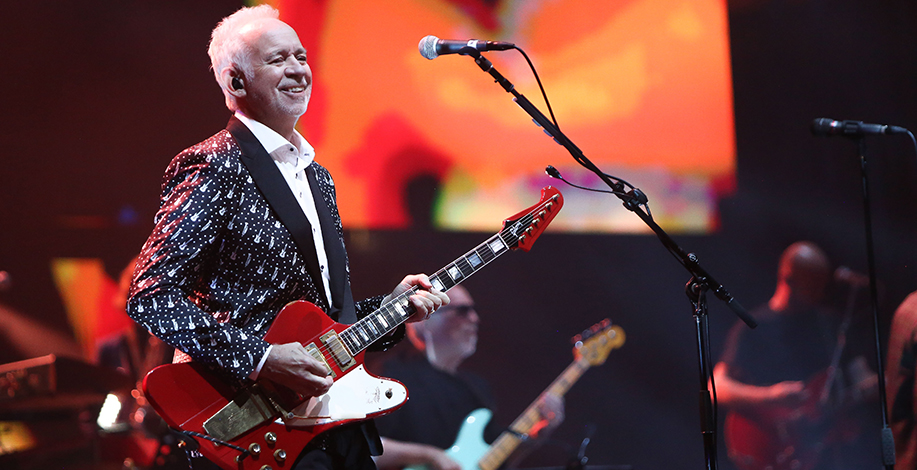
Roxy Music guitar legend, record producer and musical collaborator, Phil Manzanera, is marking his 50-year solo career with an extensive new CD box set.
Called 50 Years In Music, it features guests such as Brian Eno, David Gilmour, Neil and Tim Finn, Andy Mackay and Robert Wyatt. It includes 10 of Manzanera’s original studio albums, plus a bonus disc called Rare Two, a collection of never-before-released demos, radio sessions, and rare European singles.
The box set serves as a companion piece to his colourful and fascinating autobiography, Revolución to Roxy, which was published at the start of this year. This could be ego-driven –Manzanera’s musical contribution is the stuff of legend – but that’s not how Phil Manzanera is in real life.
As well as his music career, the book also documents his eventful childhood – he was born in London in 1951, to a British father and Colombian mother, but grew up in Cuba, Hawaii, and Venezuela, before moving back to London in 1960.
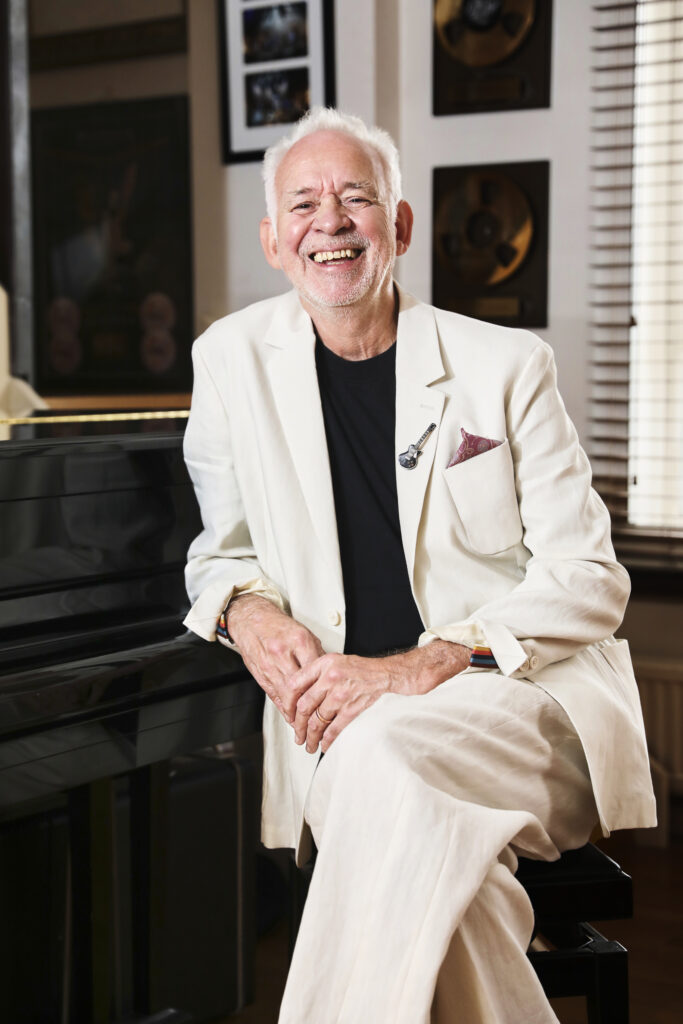
hi-fi+ spoke to Manzanera, who was awarded an OBE for Services to Music last summer, at his studio in North West London, where five of the albums in the box set were recorded.
SH: So, you’re celebrating your 50-year solo career in music with a new box set. It follows on from your book, which came out earlier this year…
PM: That’s right – I’ve collected and collated all my thoughts in the book. I’m not only trying to make sense of my musical career, but I’ve also gone way back to 1492… (laughs). That was mostly for my cousins – I have 50 Colombian cousins, and they discovered that if you could prove you had specific lineage, you could get a Portuguese passport, so that was the main driver. They were excited by that.
The box set is putting together 50 years of my music that wasn’t from Roxy. It was never about trying to establish a solo career – it was just about trying to fit in all this other kind of music and having the opportunity to do it.
Once I was out of the grip of a multinational and had built my own studio – the first studio – having owned the means of production, like Karl Marx, said, you don’t have to ask permission. I could then just do whatever I wanted, subject to the bank manager saying: ‘If you do one more recording, I’m taking everything away from you, because you can’t just keep on doing this…’
I don’t think of myself as a songwriter – I think of myself as a musician. So, the box set is me getting together with people who can write songs. OK, I did do three albums where I wrote all the songs and sang them, but it was never intended. It was just that I knew no one else could sing those lyrics because they were too personal.
So, the box set is just me and the various musicians I’ve worked with before, during and after Roxy, and friends I’ve met. Five of the albums were done here, in this room.
It’s nice to put it all together – it’s like a life in music. It felt like the appropriate time, and I can say: ‘Right – that was then, now I can look forwards…’ I’ve got new things coming out next year.
How does it feel celebrating 50 years? Does it feel that long?
No – it’s gone by in a flash.
You were one of the early pioneers in the UK music scene to embrace what we now know as world music…
I guess that was because when I started playing guitar, I was in Havana, and what I was learning were South American songs – boleros – that you could sing along to.
I was brought up going to nightclubs where all the people who ended up at the Buena Vista Social Club were in their prime and singing. I was a six- or seven-year-old with my head on the table, probably fast asleep, but all that shit – all those rhythms – was going into my brain, and sooner or later it would come out in some shape or form somewhere.
For me, it wasn’t Bert Weedon’s Play In A Day – it was all that South American stuff to start with…
But then you got into rock ‘n’ roll when you moved to Caracas, in Venezuela – you heard it through some American kids who were on holiday there, and your dad had a Zenith radio, on which you heard The Shadows and Chuck Berry…
Yeah – and The Beach Boys… And an English boy showed me some Chuck Berry riffs – they were incredibly difficult to play because you had to stretch your fingers… It used to be called R & B in those days.
That’s how all my influences came into being in my brain and then I got to London and, wow, everything happened – The Beatles, The Stones, The Who, The Kinks, Jimi Hendrix…
When I was in Venezuela, at a British school, I begged my parents to send me to England – I was speaking half-English and half-Spanish, and it was a mumbo jumbo language.
My brother, who was eight years older than me, was at a boarding school in South London. I wanted to go there – I felt like an only child… I wanted friends…
So, aged nine, I turned up in South London, in Dulwich, in September 1960, and I was there until ’69.
I went straight into the British public school system, and I was wearing pinstripe trousers and a funny starched shirt and thinking, ‘Well, what’s this? This is weird…’
But I loved it, because it was so different – I’d been a little South American boy, but now I was a little English boy and there was fog everywhere and it was freezing cold.
It was all new and I loved the food – I was fed up with rice and beans… I wanted baked beans and spam fritters.
Lots of the boys at school played guitar and they showed me how to play this or that – so, it was a way of learning, and then I became best friends with Bill MacCormick and his brother, Ian, who went on to become the famous music journalist, Ian MacDonald.
Me and Bill were given almost a university course in pop, jazz and classical music by Ian. We were number one Soft Machine fans, and we were into early Floyd, and then all the bands, like The Who, turned up, and we were like: ‘What the f*** is this amazing destructive art thing?’ It was just so exciting.
You’ve overseen the box set and you’ve worked with Barry Grint at Alchemy Mastering, in Air Studios…
Absolutely – I originated the project about three years ago. Universal own the copyright of four of the albums – they inherited it – and I’ve got seven that I put out myself: six and the album of extras. So, I rang Universal and said: ‘Will you license me the four?’
The guy there, Johnny Chandler, said: ‘Why don’t we do it [the box set] together, Phil?’
So, I said: ‘Hmm, OK – that sounds great.’ But then it took three years… I then remembered why I’m wary of multinationals… I could’ve had it out sooner…
Originally, I wanted it to come out the same time as the book, but when you’re in the machine, that’s what happens. But it’s great that it’s coming out now.
Has it been a hard project to work on?
There was a lot of graft – I had to go through every bloody track and listen to it again with Barry, and we had to go back to the original half-inch tapes…
Technology has changed so much in 50 years – some of the tracks were on half-inch tapes, some were on DAT, ADAT, Pro Tools… It was great that Barry then unified the whole thing by sticking it through his gubbins… You can always make whatever you’ve got 10 per cent better through mastering, but it can take a long time for people to realise that – what actually happens in a mastering room…
I’ve delved into the box set and there’s so much in it – lots of different styles and genres. It’s a melting pot: Latin, pop, funk, ambient, electronica, psychedelic stuff, disco, prog, rock… It’s a sonic adventure, isn’t it?
It is – there’s a lot of music in me. You listen to all this wonderful music from the twentieth century, it goes in, and it gives you a huge palette to draw on.
Whereas some artists make an album that’s in a certain genre, you often explore lots of different ideas and styles on individual records…
It’s a mixture… I guess that’s because I love all kinds of different music. So, if I did one type of music on one album, it might be more focused and sell more, but it was never about that. It’s just about being free. It’s not designed to be in the charts – it’s designed for me to express myself, and then find other ways to make money. (Laughs).
Like getting one of your songs ‘K-scope’, sampled by Jay-Z and Kayne West on their track, No Church in the Wild?
Exactly – that came out of nowhere.
The box set starts with Diamond Head, which was your first solo album – you joined Roxy Music in 1972 and Diamond Head came out in 1975. Guests on that record include Brian Eno, Robert Wyatt, Paul Thompson and Andy Mackay, and you recorded it at the Basing Street Studios, which Island owned – Free and Bob Marley had recorded albums there…
Bob Marley was recording Exodus there either just before or just after Diamond Head. I was doing the first Split Enz album – Bob Marley was in Studio Two, which had round windows. When you looked in, it was full of smoke… There was a little football table outside and we all used to congregate there. It was great.
I knew that if I had the chance to do a solo album, I wanted Robert Wyatt… When I was 16 or 17, my heroes, whom I met, were Robert Wyatt and David Gilmour – I met David the week he joined Pink Floyd. Obviously, I wasn’t going to get David on my first solo album, but Robert was my first choice.
Robert wrote some Spanish lyrics for the track Frontera, which opens Diamond Head. It’s a colourful and joyous song – very upbeat and exotic, with a Latin-American feel…
I knew he knew some Spanish, so I asked him if he could write some lyrics – I think he just got a phrase book, picked out six phrases and sang this thing… Although it wasn’t grammatically correct, I went with it, but some Spanish people I knew said: ‘What the f***is he singing about?’
I said: ‘It’s very Dada,’ which was very Robert Wyatt… It sort of makes sense… I’ve had to explain it in South America and all over the bloody place and give it a little extra spin. But, because it’s Robert and he’s a national treasure as far as I’m concerned, I just adore it.
That track is quite trippy and mesmerising, and the big guitar break in the middle is very psychedelic and out there…
It is, and the use of echo is my sort of trademark – I had it before in my band Quiet Sun, and I brought it to Roxy as well – it was a way of trying to beef up the rhythmic side of things, and I’m still doing it.
How do you listen to music these days?
I use every combination. In our cottage in the country, I’ve developed a strange combination of an old-fashioned Sonos with a new one and I blend the two. I have a very satisfying sound.
Have you still got all your old vinyl?
Yeah – and I’ve got all the Roxy acetates and white labels going right back to ‘72, but it’s not catalogued properly.
If I had more time I’d offer you my archiving services, but I have a wife and two young kids at home…
My wife, Claire, says: ‘What the f*** is going to happen to all that stuff if you peg it?’ I say: ‘Leave it with me…’
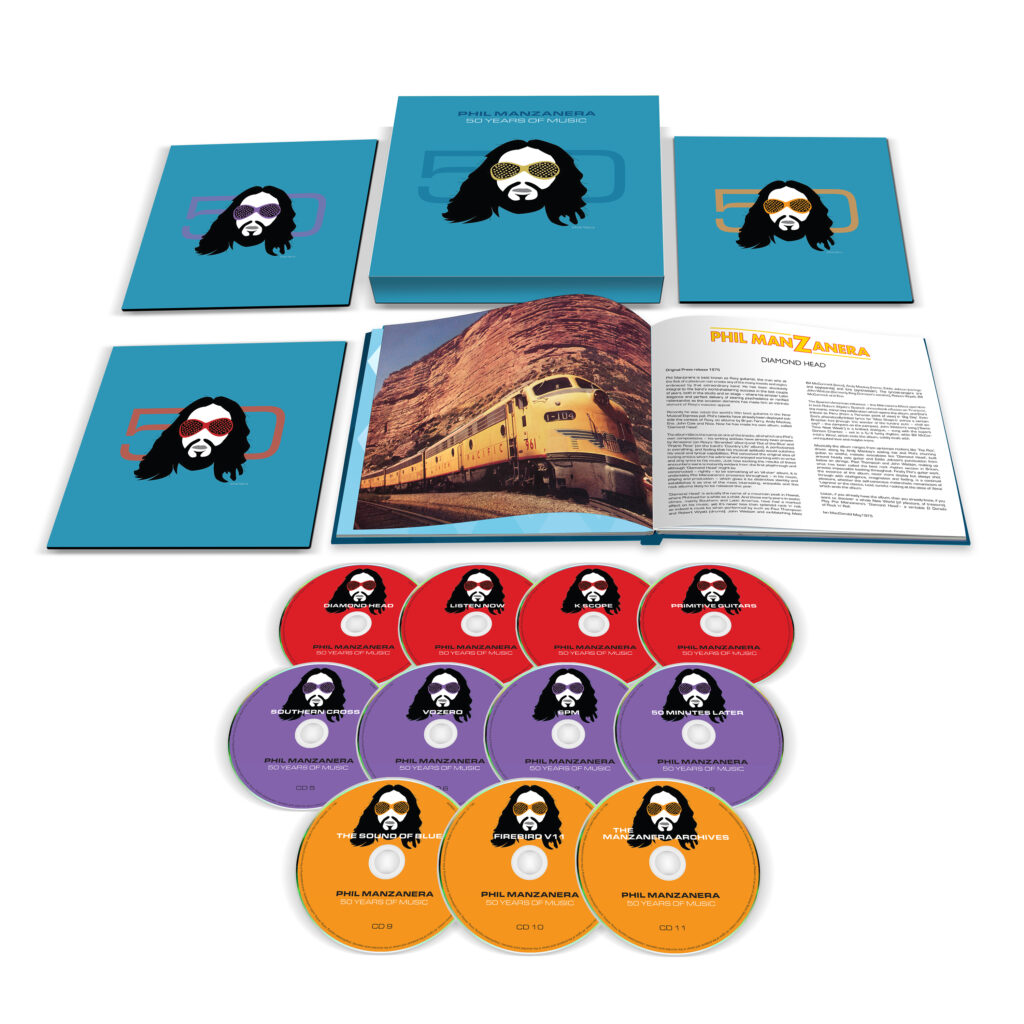
50 Years of Music was released on November 1, 2024 (UMR).
Trending Articles
See all
By Sean Hannam
More articles from this author
Read Next From Music
See all
The Teskey Brothers: Half Mile Harvest
- Oct 13, 2026
Emma-Jean Thackray: Weirdo
- Oct 06, 2026
Klaus Mäkelä: Stravinsky; Debussy
- Sep 29, 2026
Sting: All This Time (Live)
- Sep 08, 2026