Up to 37% in savings when you subscribe to hi-fi+
hifi-logo-footer

Begin typing your search above and press return to search. Press Esc to cancel.

A Swingin’ Affair

Gordon’s 1962 Blue Note release, recorded only a couple days after his classic Go! is one of the greatest jazz releases of all time. It’s Gordon at the height of his powers, playing in a dream quartet composed of Sony Clark on piano, bassist Butch Warren and drummer Billy Higgins. Yet jazz is such a niche market that with a very few exceptions, jazz titles take fifty years to sell as many units as today’s top pop artists turn in a few days. Yet great jazz recordings have much longer legs than today’s pop sensations. Hence the long history of reconstituting the music into (hopefully) better sounding versions.

Music Matters 45 RPM LP set sets the standard for vinyl Blue Note sound. As many times as Blue Notes have been issued on CD, nothing has ever come close to the Audio Wave version sound. Produced by Joe Harley and mastered by Alan Yoshida at Ocean Way Mastering, they are the ultimate digital Blue Notes. The project has been a labor of love for Bob Bantz of US record distributor Elusive Disc, meaning they have not returned a profit. This release is one of four (including two new Blakey and a Tina Brooks) new releases. With five more titles coming, the series will be completed. Let’s pray it doesn’t end there. 

Neil Young’s Singing Toblerone

You’ve got to love Neil Young. He has matured nicely into the music business’ finest curmudgeon, and he has become one of the most visible and outspoken champions of good sound quality at a time of poor sounding recordings. All of which makes him in hindsight an obvious proponent of high-resolution audio. So, when less than 18 months ago, Young announced he was going to make a high-resolution audio system called Pono, perhaps we shouldn’t have been surprised.

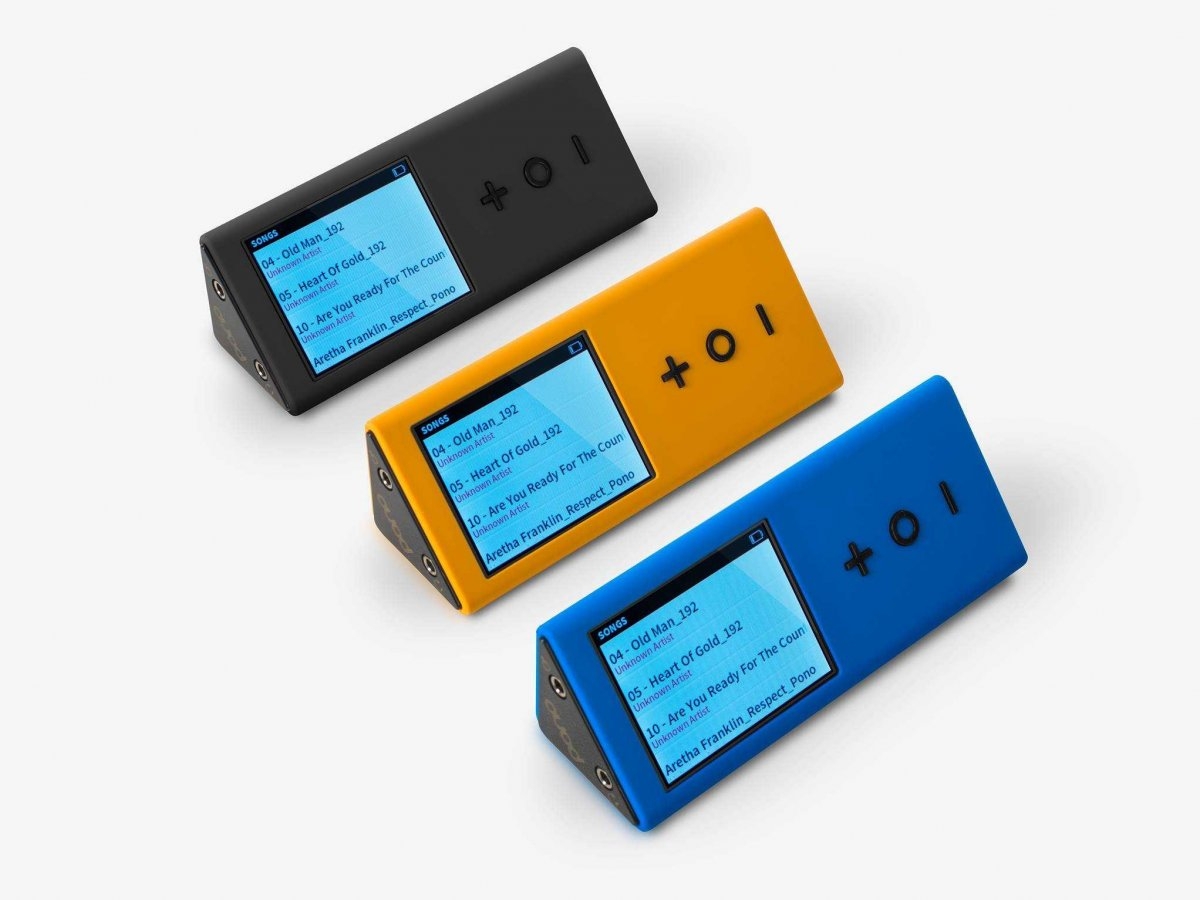
Details were, at first, sketchy. In late 2012, Young appeared on Letterman clutching a five-inch long, bright yellow triangular device with a screen and a few keys last year. More followed. Pono is a system, comprising the device itself (PonoPlayer) and a music store (PonoMusic). PonoPlayer is a portable audio player, designed to bring high-resolution audio to a new audience (it’s intended to be $399 at launch). Specs confirmed at this time are that PonoPlayer will support files up to 24bit, 192kHz in FLAC format, it has a line and headphone output, the analogue stages are zero-feedback designs, it comes with 64GB of on-board memory and a further 64GB of microSD storage, uses an ESS 9018 ‘Sabre’ DAC and minimium-phase apodizing filter. We guessed as much when Neil Young went to visit Meridian Audio last year, but it was fellow apodizing filter-supporting Ayre Acoustics that was involved in the design of the player proper.

More information springs up almost hourly. We learned at SXSW about the Ayre connection, and that PonoPlayer will not be locked into PonoMusic content, but can play high-res material from other sources. Whether a shrewd marketing scheme or a need to raise further capital remains unclear, but Young announced a Kickstarter campaign (complete with testimonials from a host of big name musos Young, young and old) to raise an additional $800,000 in order to bring the player to market in the third quarter of this year. At one point earning $700 per minute, Pono has currently raised more than $2.65m at the time of writing.


There have been some slip-ups along the way. In the audiophile world, the first was a swipe by Linn Products CEO Gilad Tiefenbrun, calling the device ‘misguided’ (http://blogs.linn.co.uk/giladt/2012/10/neil-youngs-misguided-solo-project.php), although in fairness, Gilad later retracted this comment and is now quite the Ponophile (now that’s a word that needs to be put out there, even if typos might prove problematic). Then, Pono was slated to be a 2013 project, but suffered some slippage. There was also the question of who would design the hardware; despite a well-publicised visit to Meridian’s factory in Cambridge, UK, the actual design was kept under wraps. Also, when it comes to the promo Kickstarter video, it’s hard to take Flea from the Red Hot Chili Peppers seriously when he praises Pono’s sound quality, given the band’s Californication album could be considered a war crime in the Loudness Wars… but maybe it’s not his fault. Then Pono CEO John Hamm (no, not the ‘Mad Men’ star) was caught out by the words, “What’s your cut?” shouted from the audience during the SXSW presentation. But these are just minor bumps along the road (an interview with both Neil Young and John Hamm has been published on our sister site: https://www.theabsolutesound.com/articles/an-interview-with-neil-young-and-pono-ceo-john-hamm/

Naturally, this being the Internet, there are detractors too. Fairly predictably, there’s the cries of, “it all sounds the same” and, “it’s made for audiophools”. There’s also the “it’s too expensive” argument (neatly forgetting that Apple’s first generation iPod and its latest 64GB iPod Touch also cost $399). And then there’s the similarity of the name to websites and literature that encourages, “vigorous relaxation in a gentleman’s way” (Pono actually means ‘righteousness’ in Hawaiian). But, curiously some of the most vociferous ‘anti’ arguments come from those most likely to welcome such a device – audiophiles themselves.

Pono’s detractors expose some of the differences in the state of high-resolution across the planet. In the US, its lack of DSD support has been criticised and Pono has been dismissed because those who want a high-resolution portable player already have a more up-market model. Whereas, in the UK, many of those who dismiss the idea do so because they feel high-resolution offers no tangible improvement over CD quality (possibly due to the continued availability of CD in the troubled HMV store chain), and a smartphone is good enough for portable use. It appears to have been well received across the rest of Europe, where 24/192 is upheld as a digital goal worth aiming for. Time will tell whether the detractors are just the usual 

There seems to be animosity aimed at Pono, as if Neil Young is muscling in on our safe little game. This is extremely myopic. This is an affordable player (one that doesn’t need the “… by audiophile standards” qualifier), with an as-yet-undisclosed quality-oriented music site that is fronted by someone with enough of a profile to take on the big players like iTunes. Moreover, if PonoMusic delivers content with some form of studio provenance, it will make those who pass off upsampled 16/44.1 PCM or even MP3 files as ‘high-res’ all the more exposed to the criticism they so richly deserve.

If I come across as a Pono apologist or swivel-eyed Pono supporter, that’s not the case at all. Personally, I have misgivings about the form factor, that Pono takes on the iPod as sales of iPods decline in favour of music apps on smartphones, and the simple fact that to date few formats based on sound quality alone have proved successful beyond a few passionate audiophile collectors. Also, the specifications ask as many questions as they answer at this time. But, I’m willing to suspend disbelief. I’m also prepared to give great credit where it is due: in the process of making Pono happen, Neil Young has put sound quality back on the map for music lovers, not just audiophiles. For the first time in years, people have been discussing sound quality without fear of being branded an audiophool or a music nerd. Even if Pono fails to thrive, if it signals a ceasefire in the Loudness Wars, that’s good enough for me.

Aesthetix launches superlative ‘Signature’ edition of the acclaimed Atlas hybrid power amplifier

In Greek mythology, Atlas was the Titan who supported the heavens. If you name something after him, it had better be rousing. Fortunately the Atlas amplifier has proved worthy of its name, attracting an impressive array of accolades. So how do you better that? With a crowning ‘Signature’ version…

California-based Aesthetix’ Atlas amplifier features an innovative hybrid design incorporating a bipolar output stage, bipolar driver stage and vacuum tube input gain stage. It still stands alone as the only hybrid amplifier with zero feedback, essential for maintaining harmonic integrity, air, space and coherence.

In the six years since the launch of the original Atlas, this big-hitter has earned an enviable reputation, described by reviewers at What Hi-Fi? Sound & Vision as “one of the finest pre/power amps that money can buy”, and by those at Stereophile as “one of the really great amplifiers”.

The Atlas’ circuit layout and elaborate power supply design are superlative. One 6SN7 tube per channel is used to provide all of the voltage gain for the entire amplifier. Its two transformers and three chokes are housed under a stainless steel cover to prevent magnetic fields from interfering with the audio circuitry. A 6dB/octave high-pass crossover can be set to 16 different values between 40 and 200Hz – an unusual feature which is ideal for speakers featuring powered woofers (such as Vandersteen) or for audio and home cinema systems using outboard powered sub-woofers. Alternatively, a direct input on the rear panel by-passes all of the switches and crossovers for the purest performance when used in traditional full-bandwidth mode.

The results are, quite literally, awesome. To say that the Atlas is capable of driving virtually any high quality speaker would be an understatement. Its boundless muscle delivers a momentum that feels unstoppable. But this isn’t a mindless power: the Atlas is commanding and authoritative. Its energy masterfully pushes speakers to perform at their peak. Even wayward speakers seem to be brought to bear: those that are hard to drive, fail to fully integrate or rise to dynamic demands, or simply lack the ‘oomph’ to drive the room, will find a new motivation and enthusiasm thanks to the degree of control exerted by the Atlas. Again, however, this is not an uncompromising control. While some amps overdo control at the expense of creative freedom, the Atlas walks that fine line between control and creativity, precision and dynamics, command and freedom.


The new Atlas Stereo Signature

The Atlas Stereo Signature uses the same circuits as the standard Atlas Stereo, but here the circuits are crafted using only the highest quality parts available. While the standard Atlas uses very high quality Rel-Caps as inter-stage coupling capacitors, the Signature upgrades these to Peter Moncrief’s StealthCaps, costing more than 10 times as much and revolutionising the sound beyond expectations. In addition, high current output stage power supply capacitance is doubled, increasing bass drive and solidity. Binding-post wiring is upgraded to an audiophile 14 AWG which further increases resolution. A further critical refinement is the replacement of all emitter resistors with a specialised metal foil low-inductance type. 

The first difference you notice is the velvety black background silence. From there, an incredible transparency emerges, revealing a new richness of subtle musical information and spatial imaging. The next thing to hit you will be the clarity of focus and stunning coherence, where every part of the music comes together and all elements are articulately focused and united in every moment, with no time smear or blurring. This in turn gives a stunning dynamic impact: since all parts of every musical note are united at the same moment, they all add up to a higher transient peak, thus reproducing the recording’s dynamics much more accurately.

It should go without saying that power and quality of this magnitude do not come cheap. Nor would you expect them to. However, if you compare the Atlas’ price tag with that of amplifiers of comparable output power and quality of build, then value-for-money must surely be added to its long list of desirable features.

The full Atlas range

Three editions of the Atlas are now available: the standard Atlas Stereo, the new Atlas Stereo Signature, and the existing Atlas Mono Signature (only available in the Signature version). The mono version dedicates the entire power supply to one channel, increasing space, drive and dimensionality. All are available with either a black or silver faceplate.

For existing Aesthetix customers, the standard Atlas Stereo can be factory upgraded to the Signature version.


The Aesthetix Atlas Stereo, new Atlas Stereo Signature and Atlas Mono Signature feature:

·         Zero feedback, fully differential amplifier with complementary balanced bridge design for open sound.

·         One 6SN7 tube per channel provides harmonic accuracy and soundstage layering. This single gain stage provides all of the voltage gain for the entire amplifier.

·         Stereo amplifier: 200 watts per channel into 8 ohms; 400 watts per channel into 4 ohms.

·         Mono amplifier: 300 watts per channel into 8 ohms; 600 watts per channel into 4 ohms.

·         Amplifier has a built-in high-pass crossover: 6 dB / octave, 16 settings from 40 Hz to 200 Hz in approximate 10 Hz increments.

·         Single-ended and balanced inputs provide extended compatibility.

·         Direct input by-passes all crossovers and switching for ultimate purity.

·         Bus technology reduces power supply impedance between output devices for more instantaneous current.

·         Power supply uses two transformers and three chokes. The high current section uses a dedicated transformer and choke input power supply. The vacuum tube high voltage power supply has choke input and is discretely regulated. The result is unequalled clarity and control.

·         Cardas patented rhodium-plated binding post with single knob lockdown.

·         All aluminum chassis construction assures durability.

·         Stainless steel cover for transformers prevents magnetic fields from interacting with sensitive audio circuitry, preserving low level musical nuances.

·         RS232 control and trigger for special installation requirements.

·         Available in black or silver faceplate.


Technical specifications


Atlas Stereo & Stereo Signature

Atlas Mono Signature

Power output

200wpc channel into 8Ω, 400wpc into 4Ω

300wpc channel into 8Ω, 550wpc into 4Ω

Input sensitivity

60mV (1 watt),

2.3V (full power)

60mV (1 watt),

3.1V (full power)

Input impedance

470K

Output impedance

0.25 at 1kHz

Signal to noise

120dB

Bandwidth at full power

4 – 150kHz

Rated THD at full power

<1%

Power consumption

100 watts at idle

Dimensions

18″ (w) x 8″ (h) x 19″ (d)

Weight

70lbs

Warranty

3 years, non-transferable


Pricing (inc.  VAT) and availability

All three versions of the Atlas, including the new Atlas Stereo Signature, are available now with either black or silver faceplate.

Aesthetix Saturn Series / Atlas Stereo

Aesthetix Saturn Series / Atlas Stereo Signature

Aesthetix Saturn Series / Atlas Mono Signature (per pair)

£8,000

£10,000

£16,000

About Aesthetix

Combining ground-breaking design with superlative build quality, California-based Aesthetix design and manufacture a range of hi-fi components from source to amplification in two reference-standard series: Jupiter and Saturn, both of which have earned an impressive stack of global accolades and awards.

At the company’s helm is engineer and music lover Jim White, who draws on his advanced studies in physics, mathematics and electrical engineering in pursuit of his passion for analogue hi-fi.

Initially a boutique niche brand, Aesthetix have grown rapidly to become a major player in high-end audio and now distribute to clients in 27 countries worldwide. Every product is still meticulously hand assembled by Aesthetix’ talented team in Moorpark, California.

Consumer contacts for publication

www.aesthetix.net

UK dealers:

Cool Gales, Bath

T: 0800 043 6710

E: [email protected]

W: www.coolgales.com

Hi-Fi Sound, Stockton-on-Tees

T: 0845 6019390

E: [email protected]

W: www.hifisound.co.uk

Press contact

For more information, product samples or high-resolution print-ready images please contact David Denyer on 07976 646 404 or [email protected].

IsoTek launch new advanced EVO3 version of high-performance Optimum power cable

IsoTek – the leading brand of power conditioning solutions for hi-fi and home cinema systems – has upgraded the acclaimed Optimum power cable to deliver enhanced performance at outstanding value for money.

Mains electricity is distorted by, and gathers noise from, a variety of influencing factors which constrain the performance of electronic components. For more than a decade, IsoTek has produced standard-setting solutions designed to filter and distribute the mains supply and deliver pure, refined power that allows audio and audio-visual systems to perform at their best.

The Optimum is the third of IsoTek’s high-performance power cables to be upgraded to the new advanced EVO3 (Evolution 3) version, and is clearly positioned at the top of the range. 

Advanced thinking, superior materials

The new EVO3 Optimum delivers radical advances over its predecessor, the earlier GII version. Cutting-edge thinking in terms of conductor geometries has been combined with excellent materials to develop a cable of superlative quality.

At the Optimum’s core are three silver plated copper conductors made from Ohno Continuous Cast (OCC) copper. The OCC process for refining copper, developed and patented by Professor Ohno of Japan’s Chiba Institute of Technology, gives a vastly superior level of purity compared with traditional OFC copper. The benefits for audio and AV applications include outstanding electrical conductivity along with improved flexibility and resistance to fatigue and corrosion.

Each of the three 3.0sqmm conductors features a new and innovative square-shaped configuration of 40 strands, each strand also being of square cross-section. This unique design provides an enlarged inter-strand contact surface, further enhancing electrical conductivity. 

A high quality Teflon FEP dielectric (insulation) is extruded over each conductor, providing a very low dielectric constant over a wide frequency range. The three conductors are given a slight rotational twist to aid RFI and EMI rejection, and are then surrounded by a cotton filler which, as well is adding internal strength and reducing microphony, also possesses superb dielectric properties – similar to FEP.  The whole construction is then double shielded by first enclosing it in a Mylar wrap to provide an additional dielectric buffer, before applying an active OFC copper shield for maximum rejection of high frequency interference. A durable, heat-resistant PVC outer jacket gives a high degree of flexibility and mechanical strength.

Finally, the EVO3 Optimum is terminated by hand using IsoTek’s bespoke audiophile grade 24-carat gold plated connectors. Connectors at the component end are available in C7, C15 and C19 IEC varieties, ensuring compatibility with a wide range of audio and AV equipment.


A clear difference

“Our new EVO3 Optimum has been significantly enhanced on almost every level” says Keith Martin, IsoTek’s founder and managing director. “Compared to its predecessor, it features a larger conductor size, superior conductor material, a new innovative design, and improved dielectric and mechanical properties.”

The resulting sonic benefits are easily heard, from greater bass weight and precision to a more detailed and extended airy treble. A lowering of the noise floor leads to inky black silences between notes and between performers on the soundstage. The soundstage itself has a stronger degree of focus, as well as supremely stable image positioning. Greater micro-details lead to a more realistic timbre and a more natural sound quality.

The Optimum’s larger conductor size, and its high quality materials and construction, make it the ideal choice for upgrading the performance of any audio or AV system – from front-end equipment to components with higher current demands such as power amplifiers, subwoofers and video projectors.

Adds Martin, “The product has evolved, but our aim has remained the same: to deliver class-leading performance at outstanding value for money.”

IsoTek EVO3 Optimum: key features at a glance

·         Construction: A new innovative construction featuring three 3.0sqmm square conductors of 40 square cross-section strands provides an enlarged contact surface, designed for superior electrical conductivity.

·         Conductors: Silver plated Ohno Continuous Cast (OCC) copper conductors provide exceptional levels of conductivity, as well as being highly resilient and less likely to fracture or degrade over time.

·         Dielectric (insulation): A high quality Teflon FEP dielectric (insulation) provides a very low dielectric constant over a wide frequency range. FEP possesses an exceptionally high degree of stress crack resistance and a low coefficient of friction making it an exceptional dielectric, and is the first choice for safety in both temperature and electrical insulation.

·         Filler: A cotton filler gives the cable internal strength, adds mechanical damping and reduces microphony. Cotton also possesses excellent dielectric properties very similar to FEP.

·         Wrap: A Mylar wrap is used to shield the cable from high frequency radiation.

·         Copper shield: An active OFC copper shield drains RFI to earth protecting the conductors from common mode noise.

·         Jacket: PVC is used as an outer jacket to give a high degree of flexibility and mechanical strength.

·         24-carat gold termination: Termination of the EVO3 Optimum is done by hand using IsoTek’s bespoke audiophile grade 24-carat gold plated connectors.

·         Available terminated with UK, EU, US and Australian mains plugs and with C7, C15 and C19 IEC connectors.

The EVO3 Optimum is provided as standard as a fixed 2-metre cable. It can also be provided on 50-metre spools for custom termination.

Pricing and availability

·         The EVO3 Optimum is available from April 2014.

·         Priced at £595.00 (including VAT) for a 2m terminated cable.  


About IsoTek

Hampshire-based IsoTek is the worldʼs leading brand of specialised power optimisation products for hi-fi and home cinema use. Its product range includes performance-enhancing power conditioners focused on the specific requirements of individual systems, plus a series of high-performance mains cables and connectors. IsoTek products are enjoyed by more than 50,000 customers in 45 countries, and have earned numerous accolades from specialist audio and AV publications worldwide. A number of third-party manufacturers use IsoTek products for development and/or demonstration purposes, including Arcam, Denon, Genesis, Marantz, Monitor Audio, Nordost, Onkyo, Pioneer, PMC, Primare, Roksan and TEAC Esoteric. All IsoTek products are designed for purpose, manufactured in Europe and built to last.

Consumer contacts for publication

www.isoteksystems.com

UK distributor:

Sound Fowndations

www.soundfowndations.co.uk

T: 07789 307619

E: [email protected]

Press contact

For more information, product samples or high-resolution print-ready images please contact David Denyer on 07976 646 404 or [email protected].

Albarry M1108 power amplifiers

Okay, so I was wrong.

In my review of the M608 amps for issue 90 I cited Albarry’s designer, Neil Burnett, saying “He thinks its 60 Watts output is enough for most situations when you’ve got that sort of headroom for dynamics, and I believe he may be right”. It was pretty clear to me, from my time with the M608s, that their modest 60W output, coupled with the enormous reserves of the unfeasibly oversized power supply, would probably prove sufficient in most circumstances. And to be fair, so it has proved in practice since then.

But… but… it still turns out that I was wrong, because it also turns out that, as far as the Albarrys go at least, there’s more to it than simply the on-paper power output.

Some markets demand more than 60 Watts if you’re to be taken seriously, so Albarry developed the M1108, a 110 Watter shoehorned neatly into exactly the same casework as the M608. (This may be a boon to existing Albarry owners who, having read this review, may decide that a little surreptitious upgrading is necessary, without having to answer any awkward questions about ‘those new boxes’).


Albarry’s initial intentions in developing the M1108 were that it was to be an export model for those power-sensitive markets, and the M608 would be just fine for everywhere else. But it quickly became clear that the M1108 was more than just an M608 with a bit more grunt. On paper, its 110W output is generous rather than enormous, probably what Rolls Royce used to describe demurely as ‘adequate’. In practice, it has that sense of effortless ease which comes with a truly powerful amplifier, thanks once again to a grossly over-specced power supply, but without the sense of mass and inertia that can so often also accompany a truly powerful amplifier. It’s a neat trick, like a middleweight boxer operating in territory normally reserved for heavyweights, while retaining the agility of his lighter frame.

The truly unexpected aspect of the M1108s performance, for me at least, is that it remains true to the M608s sense of agility, but adds a deftness and assurance rather than simply a dollop of extra scale and weight. Hearing the M1108 is rather like watching a skilled craftsman at work: one is struck by the economy of effort, the ease and fluidity of movement, the way the desired outcome is achieved with the minimum of wasted action. It feels as though, with the M1108, Albarry has found a true sweet spot. Happily, Albarry seems to agree, and the M1108 is available alongside the existing M608.

There is, also, the odd occasion where the music is getting boisterous, when you can almost feel the M608s digging deep into their reserves and rising to the occasion. In those instances, it’s very much a case of the Plucky Little Amp That Could. Things don’t fall apart (I’m plundering my library for book titles here), but you sense the M608s giving their all. The M1108 rises to the challenge, retaining its composure, and you just know that it’s got it covered. The Bad Plus’ take on ‘Smells Like Teen Spirit’ is just such a test. Its massive energy and exuberance has been the undoing of any number of lesser systems in its time. The timing and the energy delivery has to be just-so or it sounds like the band is trying to continue playing while the piano crashes headlong down a flight of stairs. The M1108s manage the energy and the timing of its delivery to a nicety, adding convincing scale and authority to the piano, without conceding any delicacy or speed. It is this ability to relax into the music and just let it happen, rather than trying to force it to happen, that sets the M1108 apart.


More jazz piano, this time Michiel Borstlap and ‘Cherish Your Sunshine’ from the album 88. I heard this trio for the first time earlier this year, live at a jazz festival, and I was struck by the dexterity and fluidity of Borstlap’s piano, and the astonishing skill and inventiveness of the percussion. The M1108s gave a better sense of the interplay between the musicians, and also between the left and right hands of Borstlap’s piano. He sometimes plays extremely rapid runs which can, in the wrong circumstances, just seem like unnecessary flourishes and showing-off. The M1108s portrayed much more of a sense of musical purpose to these fast sections, by revealing more of the articulation in the playing. Similarly, the percussion sounds more dynamic and impactful – I think one key aspect to the M1108s success lies in its lack of overhang – silences happen just as suddenly and completely as do the leading edges of notes, so transients retain their presence and effectiveness because they don’t bleed into the rest of the music. Like its less powerful siblings, the M1108s stop and start on a dime; the extra power is all sinew and muscle, no fat, bloat or inertia here. Borstlap’s bass player is also unobtrusively skilful and highly talented, an analogy which also serves to describe the M1108 quite well, particularly given that much of the benefit emerges in the quality of the bass it produces.

The extra power thus brings greater authority. Pianos are muscular and more sonorous; big bands are bigger, brassier and bolder; vocals have both ‘head’ voice and ‘chest’ voice. Bass has more power, but also more control, benefitting both tunefulness and the sense of propulsion. The M1108s retain the M608s textures, speed and nuance, even when some parts of the music are trying to bludgeon their way through. Take Leonard Bernstein’s account of Mahler’s 1st Symphony with the Concertgebouw orchestra. Here was a greater sense of the character of instruments, and the movement of air they created. Clarinets had real ‘bounce’; physically large instruments had a greater feeling of mass, a better impression of cellos and basses enclosing a large volume of air, for example. This was also helped by the air and space around the instruments, meaning that ‘tutti’ sections were clearer and less congested. All of this would be but a party trick, if it wasn’t reined in where necessary. Crucially, the opening of the first movement retained its numinous quality because it was easy to perceive the way the orchestra was being held back; the greater the sense of pent up power and potential, the more moving the effect when it is held in check – something many a bruiser of an amp fails to do because it can’t separate mass and inertia from volume and power.


Pop music also benefitted: ‘Good Vibrations’ from Smile had plenty of bounce and motion – a feeling of flow, rather than just forward progress. In among all the vocal harmonies and Theremin wackiness, there are some pretty hardworking cellos. Here there was a clear awareness of the cellists leaning in and applying their shoulders and elbows, their phrasing and timing much more apparent, and effective, in propelling the music forwards. All told, the M1108 turns out to be rather more than just an M608 with more power.

Since my review the AP11 preamp has also had some useful revisions, which unfortunately accompany a rise in price to £2,495. A new volume pot and internal changes to reduce noise even further mean that the preamp is even more agile. It retains its freshness and exuberance but adds a useful extra dollop of nuance and sophistication. The enhancements are, in my view, easily worth the price premium. I’ve also had a chance to use the inbuilt (MM) phono stage (moving coil users can purchase the separate MCA11 head amplifier for £500), and am happy to confirm that it concedes little to outboard phono stages costing a significant proportion of the entire preamp’s asking price, indeed there are quite a few, at some fairly serious prices, which lack the AP11 phono stage’s sense of freedom and dexterity. The phono stage is an ideal complement to the rest of the Albarry amplifier offering, it is nimble, tuneful and authoritative, and every bit as good as the line stage itself. 

I thought, when I reviewed the Albarry AP11 and M608 combination, that it brought a level of insight into the performance that I hadn’t expected for the price. The M1108 raises the bar even higher. It is also a considerably more expensive amplifier at £5,750 against the M608s £2,995, but it manages a neat trick. It uses its extra power wisely, and discreetly, to underpin the performance and let the music speak for itself. It is an athlete, rather than a bodybuilder, treads a happy line between strength and nimbleness and the result is a supremely confident and convincingly musical performer, well worth the asking price. 


Technical Specifications

Albarry M1108 monobloc power amplifier

Output: 110 Watts into 8 Ohms (20.5dBW)

Frequency response: 2Hz-110 KHz

Damping factor: greater than 500

Input sensitivity: 725mV 0dB

Signal to Noise: better than 113dB ‘A’ weighted 2/3s power

Size: 140mm x 158mm x 265mm (HxWxD)

Weight: 14Kg  (per pair)

Price: £5750.00 per pair

Manufacturer: Albarry Music Ltd 

Tel: +44 (0)1782 507253

URL: www.albarrymusic.com      

Wilson Benesch Square Five loudspeaker

Wilson Benesch’s recent brush with the top-end of loudspeaker design – the Cardinal – was a distinct success, but it remains a top-end loudspeaker, and those who cannot afford top-end loudspeakers, such lofty goals and lofty performance is as nothing unless these things trickle down to less lofty price points. The Square Five is that loudspeaker.

Those who judge things by surface might not see any link between the Square Five and Wilson Benesch’s upper slopes. It could be mistaken for just another exercise in stuffing drive units in a nicely veneered MDF box. Look closer… there’s a lot going on in this loudspeaker.

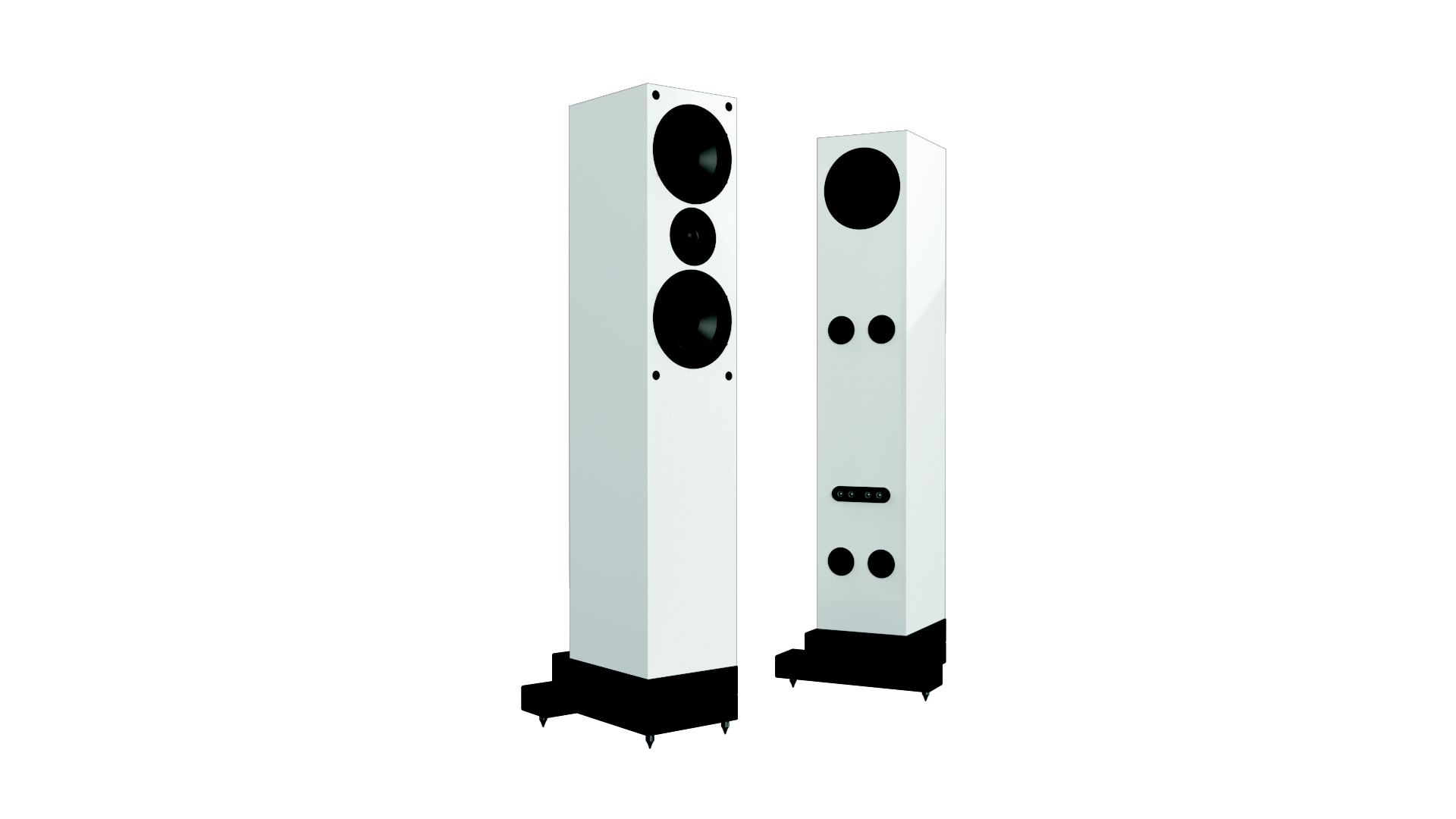
In fact, the Square Five is a four-way design, not a three-way as might first be thought. That ‘plinth’ it rests on is in fact a high-mass chamber for a down-firing, isobaric-loaded pair of 170mm Tactic drive units (WB’s own design). Then what looks all the world like a D’Appolito layout of mid-treble-mid is in fact what WB dubs its Troika layout. This means the 170mm Tactic unit above the tweeter acts as midrange proper, while the 170mm Tactic driver below acts as a lower-midrange/bass driver. The rear panel gives some clue to the differing arrangement, with a rear-firing ABR and rear ports performing supporting roles for the different driver configurations. This is only possible by the use of a complex series of chambers within the loudspeaker cabinet, reducing the possibilities of drive unit interaction. Aside from the sheer number of drivers and the complexity of the cabinet design, from a driver viewpoint, the Square Five eschews the company’s own Semisphere tweeter and uses a 25mm ScanSpeak soft dome tweeter, modified to WB’s demands.

Even that cabinet is out of the ordinary. It’s MDF as opposed to carbon-fibre, but the design is very carefully designed, with strips of carbon-composite bonded to the inner facings of the cabinet, further braced by the internal chambers required to produce the Troika layout and then mass-loaded and tuned by constrained-layer damping blocks of varying mass carefully positioned for the best possible effect. Add to that the extremely high-mass block of solid aluminium that forms the back of the plinth and its outrigger, and even the high-tech spikes/feet WB has designed to isolate the Square Five from its environment, it’s clear this is the Cardinal for us mortals.

The Square Five is about average on the easy to drive stakes; a claimed 87dB sensitivity rating and an impedance plot that hovers around six ohms with the occasional dip into four ohm territory isn’t (on paper, at least) going to prove too great a challenge. But this just gives the Square Five the ability to pick amplifiers of great quality rather than be forced into using tub-thumpin’ powerhouses. As we will see, that’s an important consideration.


The Square Five is a loudspeaker that you need to charm. It doesn’t put out on a first date; it keeps its honour until you prove your worth, wooing the loudspeaker with the finest electronics, and finding the ultimate listening position. This means well clear of the side and rear walls, even to the point of sacrificing some bass depth (fortunately, there’s a lot of bass on offer, even before you go down the optional Torus infrasonic generator route) and painstaking experimentation with fine tuning of placement and toe-in. This is also a relatively long process, one best performed by the listener and associates, rather than someone installing to a deadline. Yes, you can get almost all the way ‘there’ fairly quickly, but the final stages of fine-tuning take time and are well worth the effort. 

The same applies to the selection of electronics. This is no amp-crusher of a loudspeaker, but it benefits from a quality over quantity approach. It’s a revealing loudspeaker; although it doesn’t demand the best, it’s more than capable of showing what the best is capable of. The net result of this means the Square Five will survive more rounds of upgrades than most components in your system, if that is your audio trajectory. With products picked carefully, the Square Five could be the most expensive part of a system that will see you into dotage, but it could also end up being the cheapest part of a very high-end system and still be capable of resolution to spare. Such is the flexibility of the Square Five. In terms of general care and feeding, the Square Five is happiest with inherently uncoloured electronics; you could argue that so does everything else, but this is not necessarily the case – some speakers tend toward working with slightly warm and soft sounding electronics, some need a bit of pep from the amps to wake them. Do this with the Square Five and you’ll wonder what all the fuss is about. Wilson Benesch’s connection with the German electronics brand Audionet is a good starting place, but the Square Five is capable of not sounding out of place in amongst some true high-end royalty. We’re talking big dCS Vivaldi stacks, Jeff Rowland or Aesthetix amps and so on… in other words, the kinds of electronics normally seen driving Wilson Alexias and beyond. If a £9,000 can keep its head in such esoteric company, then you know you are on to something really quite remarkable.


When everything is in place, what you get is a loudspeaker that combines the analytical powers of a Sherlock Holmes with the entertainment value of the Minions from Despicable Me. Well, almost. 

It seemed logical to begin the process by bringing Sheffield to Sheffield, playing ‘Fair Annie’ from the bonus disc of Martin Simpson’s excellent Vagrant Stanzas [Topic]. This ‘kitchen table’ recording of essentially just voice and acoustic guitar is geographically about as close as it can get to the WB factory. Not that it matters on a musical standing, but locally grown produce sounds wonderful here. Through the Square Fives, his voice reveals all the wisdom of his years and the honesty he brings to these folk tunes. As to the guitar playing… you can here he’s using an alternate tuning (but not one I know well, there’s something a bit odd and droney with the two top strings for DADGAD or Dropped D tuning) and the sound is both melodic enough to almost bring tears to your eyes, and analytical enough for most guitarists to realise just how good a player we have in Martin Simpson.

Some speakers produce a sense of space around the music. Some create a tight ball or wall of sound. The Square Five does none of these things. It just makes the recording sound like the recording itself. If the soundfield on the disc is expansive, it will sound like a big soundstage, if it doesn’t, it won’t. There’s no artificial sense of scale or size – big or small – at work here. It presented the music as is. So, after the tidy, cosy sound of man and guitar, I moved on to John Pickard’s The Flight of Icarus, played by the Norrköping Symphony Orchestra, with Martyn Brabbins conducting [BIS]. This powerful piece of modern classical – a tribute to the Apollo space program – is an exercise in dynamic range. Any sense of scaling problems are easily spotted and here the Square Five aced this particular test with consummate ease. From the bombast of the percussion to the subtleties of the strings, from the loudest parts to the quietest this made this sound like a complex, yet coherent work… not incidental music to Planet of the Apes.

And so it went, whatever I played. The Square Five portrayed the music with accuracy and honesty. Not stark honesty – it’s not a bright loudspeaker at all – but with a sense of precision and clarity that many strive to attain and few others reach at this price point. It’s exquisitely detailed; you can tell why that recent Daft Punk album reputedly cost a million to make – there are real musicians playing professionally and skilfully with no ‘fix it in post’ or ‘clean that up with AutoTune’ mentality, but it also gets past the musical detail and digs up the reason why that album was so absurdly popular last year; its sense of fun and infectious rhythm. 

That ability to play to both the cerebral and the visceral is what makes the Square Five so remarkable. Its peers tend to be either good at the detail aspect, but leave the music cold and drab, or make everything upbeat and exciting, at the expense of the technical aspects of the music. The Square Five – virtually alone at its price point – combines both aspects perfectly. Yes, there are others that provide some of these aspects of the overall musical picture, but sacrifice others in the process. 


A pair of Square Fives do not look imposing in a small room, and while it’s physically possible to put the speaker into a room 3m wide and 4m deep, you will never get to hear what these speakers are capable of if you do. The slightly thornier issue of personal taste also plays a part, though. Although almost every hi-fi buff on the planet seems to claim what they want is more honesty and less distortion from their loudspeakers, when faced with the unvarnished truth, some go all ‘ignorance is bliss’. That’s not easy to unpack until experienced directly, but I suspect there are some who find the idea of neutrality more attractive than the reality. To those, I’d say the Square Five is not for you, and you can pretty much cross off whole swathes of high-end loudspeaker designs in a single pass. Genuine seekers of musical truth (that sounds a bit culty) will think very differently though, looking at the Square Five as an honest way of extracting £20,000 or even £25,000 loudspeaker performance without crossing the five-figure Rubicon.

It’s more than just a reflection of high-end loudspeaker design; it’s an outstanding performer in its own right. If you want a loudspeaker that tellsit like it is, and you are willing to put the effort in to achieve that goal, the Square Five is the most serious contender at the price and way, way beyond. Highly Recommended

Technical Specifications

Four way, Isobarically loaded floorstanding loudspeaker

Drive Units: 1x 25mm Soft Dome W-B Spec tweeter

1x 170mm W-B mid-range Tactic drive unit

1x 170mm W-B bass Tactic drive unit

2x 170mm W-B isobaric Tactic drive unit

Low-frequency loading: Assisted Bass Radiator/Bass ports

Sensitivity: 87dB

Impedance (Nom/Min): 6ohms/4ohms

Frequency response: 34Hz-24kHz

Crossover frequencies: 500Hz/5kHz

Dimensions (WxDxH): 20×25.5×111.5cm

Weight: 47kg

Finish: Gloss: Piano Black, White, Red Birds Eye, Birds Eye Maple, Burr Walnut, Ebonised Walnut, Walnut. Satin: Natural Cherry, Maple, Oak

Price: £8,950 per pair

Manufactured by: Wilson Benesch

URL: wilson-benesch.com

Tel: +44(0) 1142 852656

The Zanden Model 3100 Line-Stage

Reviewers are supposed to be neutral, disinterested observers. But the truth is, that to do this job well – in fact, to do this job at all – you have to be passionate about recorded music and the equipment we use to reproduce it. Now, being both passionate and disinterested is definitely an uneasy duality and, hard as we try and as objectively as we report, there are few reviewers who would deny that they have their favourites – companies that always seem to deliver and whose deliveries are awaited with a little extra anticipation. For me, one of those brands is Zanden, whose products have single-handedly been responsible for more truly ear-opening experiences than almost any other. Send me a product from Zanden designer Yamada-san and I’m unlikely to be disappointed. That being so, when it comes to the Model 3100 line-stage, the question ceases to be whether I like it, but more a case of why I like it so much?

One of the things I love about the Zanden products is their innate sense of style and identity. “Me too” doesn’t feature in the Zanden dictionary and the 3100 doesn’t disappoint. It’s chromed and slatted top-plate mimics the casework of the Model 1300 phono-stage, but here it’s combined with milky white, frosted acrylic front and side panels that echo the substantial acrylic slab that supports the biscuit-tin lid of the Model 2500 CD player’s transport. Two large, flat, aluminium knobs control source selection and level, flanked by a pair of smaller push buttons that switch from standby to operate and normal to reverse absolute phase. Status is clearly indicated by a combination of logically laid out red, orange and green LEDs, which give the 3100 a faint air of an impossibly stylish traffic control system, but make remote operation from the matching frosted acrylic handset simplicity itself. 

Whether it is the unusual, contrasting chassis materials or the elegant proportions, the simplicity of its symmetrical layout or narrow frontal aspect, nothing else looks quite like it – or quite as good. But the best thing about the quiet confidence of its appearance is that it carries over to its performance. As much as I like the way the 3100 looks, I love the way it sounds. 

Tucked inside the compact chassis with its deep, almost square footprint is a typically Zanden solution to what should be – but never is – the simplest problem in the system. Classically minimalist thinking (gain from a single 5687WB twin triode in a feedback-free topology) is combined with several unusual features (output transformers, valve rectification and triple shielding of key circuit elements) to create a circuit that’s as distinctly individual as its chassis. In fact, the basic topology is borrowed from the two-box flagship Model 3000, but you’ll go a long way before you find anything similar outside the Zanden line.


Round the back, you’ll find the input and output socketry – and another surprise. The 3100 has as many outputs as inputs: one pair of balanced XLR and three pairs of single-ended RCA inputs; two pairs of single-ended RCA and two pairs of balanced XLR outputs. There’s a ground terminal, an IEC input and a couple of 12V trigger sockets, but that’s your lot. These days, as system reach extends and sub-woofers proliferate, even in dedicated two-channel set-ups, those extra outputs are extremely welcome, while the off-loading of multiple input switching duties to DACs and CD players means that four inputs is sufficient for almost all but the most complex of system situations. This shifting emphasis from multitudinous input options to comprehensive output capability mirrors the changing role of the line-stage in modern systems – and marks the 3100 out as a thoroughly modern product, despite its apparently traditionalist roots. In fact, it’s precisely those roots – and the continuing relevance of the line-stage in current system topology, despite the expansionist tendency of DACs and digital control units – that make the Zanden so musically beguiling. 

Install the 3100 into your system and as soon as you start to listen you’ll immediately notice a lucid sense of flow and shape, a natural, inviting and engaging quality to the music you play. It’s almost as if someone took the brakes off – or more precisely, took their foot off its throat. It’s not just that the performance moves more effortlessly and purposefully, that there’s more shape to melodies and more life and colour; there’s simply more going on and it’s easier to hear. Now, the world is full of ultra detailed, high-resolution line-stages, long on information but about as lively as King Tut without the special effects. Part of what the Zanden does is indeed about resolution, but that’s almost a by-product. The really important things are all going on behind the music – and they amount to a whole lot of nothing!

Compare the 3100 to other line-stages, and you quickly discover that it’s seriously, ghostly quiet. Not just quiet for a tube unit; quiet in a fundamental, absolute way. Music comes from a background that is so dark and free of grain that where an instrument is and when each note starts (and stops) has a new, almost explicit quality – so apparent, so obvious that you don’t even notice it. Instead, it has that “just the way it should be” acceptability that lets you immediately move on to other, more engaging things – like how that note relates to the others around it. At least part of that is down to the sheer stability and focus that the Zanden brings to proceedings. It’s not just that you can hear where an instrument is (which isn’t that unusual) – it stays there, regardless of what happens in the music (and that is unusual). How loud, how busy, resting and then reemerging, there is a sense of physical presence and spatial confidence that underpins each voice and instrument, the music as a whole.

Now, “quiet” and “stable” might not seem like the stuff of dreams, but combine it with the dynamic range and discrimination that goes hand in hand with those qualities when you reinforce them with a decent power supply and some careful mechanical design (a Zanden forte) and that’s when you get something really rather special. The 3100 allows you the luxury of ignoring the constituent parts in the performance, so that you can concentrate on how they fit together. The spatial and tonal separation is such that instrumental identity is never in doubt. Instead, you can clearly hear not just who is doing what but why – and it’s this last quality that makes this (and other Zanden products) so consistently captivating.


Play the rolling vocal melodies of Lisa Hannigan’s ‘Sea Sew’ and the 3100 balances them perfectly against the repetitive rhythmic patterns. Play the Benedetti Michelangeli performance of the Beethoven 1st Piano Concerto and marvel not just at his combination of power and delicacy, but Guilini’s ability to balance the orchestra against the solo instrument, maximizing the expressive range and drama in the live performance. What the Zanden does is allow you to see further into the music, to understand both how AND why it works. Traditionally, products major on one or the other with few that encompass both – and very few that do so with the grace and dexterity of the 3100. 

Much of that stability, low noise floor, solidity and sense of drive come from the transformer coupling of the outputs. But unlike many transformer-coupled designs, the Zanden avoids any hint of clumsiness. It’s deft and agile, so that rather than bludgeoning momentum you get a sense of direction and purpose in the performance. This ability to fasten on what matters in the music is what sets the Zanden products apart. It allows the musicians to engage the listener, the listener to engage with the system – and that’s exactly what audio electronics should be all about. It’s a while since I had the Model 1200 phono-stage at home, or Zanden’s four-box CD player, but both have lingered long in my memory. More recently, the Model 1300 phono-stage has seriously impressed and now the Model 3100 joins that list. Zanden is succeeding in delivering the almost magical performance it built its reputation on, but at much more affordable prices. It’s still not exactly pocket change, but the Model 3100 is their most attractive and might just be their most engaging and enjoyable line-stage to date. In material terms it might seem expensive until you remember that it’s not about the metalwork, it’s about the music; that’s when you realize just what stunning value the Zanden really represents.

Technical Specifications

Type: Vacuum tube line-stage

Tube Compliment: 2x 5687WB

Line Level Inputs: 1x balanced XLR

3x single-ended RCA

Input Impedance: XLR – 10kΩ

RCA – 100kΩ

Line Level Outputs: 2x balanced XLR

2x single-ended RCA

Output Impedance: 300Ω

Dimensions (WxHxD): 398 x 103 x 254mm

Weight: 9.0kg

Price: £11,495

Manufactured by: Zanden Audio System Co, Ltd.

URL: www.zandenaudio.com

Distributed by: Audiofreaks (UK)

Tel: +44(0)208 948 4153

Anthony Gallo Acoustics Reference Strada 2 monitors with TR-3d subwoofer

Anthony Gallo has always been an iconoclastic loudspeaker designer and thus his speakers neither look nor sound like the majority of their competitors. Nowhere is this more apparent than in Gallo’s otherworldly Reference Strada 2 monitors (£1,500/pair) and their companion TR-3d subwoofer (£800). Veteran audiophiles might at first take this sat/sub system to be a mere “lifestyle” or “home theatre” product, but know this: beneath its stylish exterior the Reference Strada 2 package packs serious audiophile-calibre performance capabilities.

To come to grips with the Reference Strada 2, it is helpful to understand some of the engineering principles that inspired its unorthodox design. From the outset, Mr. Gallo has sought to produce speakers with high-rigidity, low-diffraction enclosure systems. With this end in view, Gallo’s “think-outside-the-box” solution has been to use semi-spherical enclosures made of spun stainless steel, with openings on one side for the drive units. Each Reference Strada 2 uses two such spherical enclosures housing wideband carbon-fibre mid-bass drivers, with the spheres attached at opposite ends of a die-cast metal backbone frame, flanking Gallo’s signature cylindrically shaped CDT3 tweeter. The whole assembly resembles a space age “barbell” of sorts, one finished in silver and black (though an all-black option is also available).

The assembly is astonishingly rigid and robust (try the time honoured knuckle-rap test and you’ll get, well, bruised knuckles for your troubles), whilst offering virtually no sharply creased edges to cause diffraction. In the interest of enhancing enclosure rigidity Gallo mounts his mid-bass drivers from within their spherical housings and then uses sturdy compression rods to press the drivers against the mouths of the enclosures. An advantage of Gallo’s approach is that not even the driver frames are visible from the outside, again helping to eliminate possible sources of diffraction.

A thorough discussion of Gallo’s CDT (cylindrical diaphragm tweeter) driver could fill an entire white paper, so a brief description must suffice. In simple terms, the CDT is a semi-cylindrical tweeter whose diaphragm is made of a film-like piezoelectric material called Kynar. As audio signals flow back and forth, the thin-film material expands and contracts, generating nearly textbook-perfect semi-cylindrical wave fronts offering an extraordinary 180 degrees of horizontal dispersion with 120 degrees of vertical dispersion. Because the Kynar film is low in mass and does not need to travel far in order to produce adequate output, transient speed is excellent whilst distortion is low. One further benefit is that the Kynar diaphragm acts a high-pass filter, meaning that the tweeter literally serves as its own crossover network (though a transformer is used to match the tweeter’s output level with that of the mid-bass drivers).


Further reasoning that the best-sounding crossover network is no crossover at all, Gallo has configured the Reference Strada 2 so that its two mid-bass drivers are allowed to run full range, using natural roll-off at the high and low frequency extremes to govern their operating band. In turn, the CDT3 tweeter, serving as its own crossover network, takes up where the mid-bass drivers leave off, handling upper midrange and treble frequencies with speed and finesse. In short, the Reference Strada 2 is for all intents and purposes a completely crossover-less, wide-bandwidth compact monitor.

The innovations don’t end there, though, because Mr. Gallo, much like his counterparts at KEF, has done considerable research into the feasibility giving compact speaker enclosures the physical characteristics of much larger enclosures. KEF’s solution was the firm’s ACE (acoustic compliance enhancement) technology, whilst Gallo’s ingenious answer involved creation of a proprietary enclosure damping material called S2. (Our understanding is that S2 is a type of shredded polyolefin film, though Gallo does not generally discuss the material’s exact formulation). Either way, the result, as Gallo says, is that the “Stradas perform as though the speaker enclosure is significantly larger than it actually is.” Finally, the Reference Strada 2 uses Gallo’s Optimized Pulse Technology (OPT), which is described as, “an impulse correction and synchronization system designed to integrate the low, middle, and high frequencies into one unified sound source.”

The TR-3d subwoofer (the larger of the two subs offered by the Gallo) applies many of the same design precepts that inspired the Strada 2. Thus, the TR-3d eschews traditional box-type cabinetry in favour of an all-metal, cylindrically shaped enclosure with the woofer fitted in one end of the cylinder and the subwoofer amplifier and controls in the other. Designed to rest on its side, the TR-3d looks more than a little like the depth charges seen on WWII-era destroyers and some quip that, if turned up too loudly, the TR-3d can sound like a depth charge, too. The sub uses essentially the same ceramic-coated aluminium woofer originally used in the Nucleus 3.5, backed by a rock-solid 300-watt amplifier equipped with line-level and speaker-level inputs and a useful set of controls, including a bass trim switch with settings for 0, +3, or +6 dB of boost centred at 30Hz.


Overall, the intent behind the Reference Strada 2 system is for it to provide much performance comparable to the now-departed Nucleus 3.5 floorstander, but in a more compact and less expensive format that gives a greater variety of placement options and is, thanks to its powered subwoofer, comparatively easy to drive. By design the Reference Strada 2 monitors can be wall-mounted, tabletop-mounted, or placed on optional floorstands (£400/pair). If placed within about a foot of an adjacent wall, the Strada 2 enjoys a significant degree of bass reinforcement and offers surprising low-end extension, whilst when stand-mounted the speaker delivers less bass extension but superior imaging, soundstaging, and overall transparency. In short, the Reference Strada 2—like all Gallo speakers in my experience, benefits from being given plenty of breathing room. Accordingly, our review samples were mounted on matching Gallo floor stands and placed well away from nearby wall surfaces.

How does the Reference Strada 2 system sound? Four observations that come quickly to mind are that the system sounds highly three-dimensional, is rich in musical detail and information without sounding analytical, offers unexpectedly muscular and incisive dynamics, and generally sounds “bigger” than it appears. Let’s explore each of these qualities in turn.

The almost eerie three-dimensional quality of the Reference Strada 2 system hinges, I think, on its rigid and diffraction-resistant enclosure design and the exceptionally broad, 180-degree horizontal dispersion of its CDT3 tweeter. Together, these design features enable the sound to break free from the speaker enclosures in an unusually compelling way. Visually, you register the fact that the stand-mounted speakers are positioned several feet from your listening chair, but the soundstage seems to lead a completely independent life of its own—as if the soundstage were a freestanding entity and not an illusion being created by the speakers at all. On well-recorded material, such as David Chesky’s Jazz in the New Harmonic [Chesky, Binaural+ CD], the Reference Strada 2 system can and does transform the acoustics of you listening room into those of the recording venue itself. This, I think, is the epitome of  “disappearing act” imaging, where the key is to keep the listener’s attention firmly centred upon the performance and the space in which it unfolds—and not upon the speakers. It’s a difficult trick that the Reference Strada 2 system somehow masters with ease.


One area where I think the Reference Strada 2 has clearly improved on previous models is in extracting considerably more low-level information from recordings, yet without upsetting the underlying smoothness that has long been a hallmark of Gallo designs. In practice, the Strada 2 is arguably the most information rich Gallo we’ve yet heard, delving deep into textural and transient details to give you a clearer picture of what’s happening in and between the notes. With that said, however, let me add that I do think the passive woofer system used in the Nucleus 3.5 offered a smidgeon more tautness, definition, and control than the Reference Strada 2 system’s TR-3d subwoofer. But please don’t misunderstand me; the TR-3d is quite clean sounding and well controlled as powered subs go. It’s just that the sub’s amplifier tends produces a slightly warmer, more rounded, and more full-bodied sound than strict accuracy would require. Even so, the Reference Strada 2 system is right in the thick of the hunt amongst the higher-resolution speakers in its price class, although top honours in that department might rightly go to hybrid electrostats from MartinLogan or to one of the planar magnetic models from Magnepan. What the Gallo does so beautifully, however, is to find a fine balance point between resolution on the one hand and gracefulness on the other.  

Whilst the Strada 2s are obviously very compact they nevertheless are capable of surprisingly vigourous output levels and demonstrate the sort of turn-on-a-sixpence dynamic agility that allows them to track with sudden changes in musical energy levels. A good example would be the at times fierce and always exuberant horn section swells heard in Clark Terry’s Chicago Sessions 1995-96 [Reference Recordings, HDCD], where the horn section often operates in subdued “cruise mode” during the body of a song, only to explode into the musical foreground with almost shocking force. Similarly, some of the oblique percussion notes captured on the eponymous new age/jazz recording Gaia [Windham Hill, CD] leap forth from the speakers with startling realism, making it a gripping experience to hear the Gallos at play, even at low volume levels. It is one thing to hear relatively large speakers handle these sorts of material well, but quite another to hear small satellite-type speaker pull off the feat. I credit the Strada 2’s expressiveness and agility partly to its rigid enclosure design, partly to its innovative S2 damping materials, and partly to Gallo’s OPT technology. In any event, the Strada 2 speaks with a more muscular, definitive, and dynamically incisive voice than its diminutive size might lead you to expect.


Above, I alluded to the Reference Strada 2 system’s ability to “play big” and frankly this is more than a matter of simply being able to play loudly (although the system can do that, if you have an amplifier equal to the task). Rather, if you expressed the Strada 2’s “play big” factor as a mathematical formula it might look something like this: small size x muscular and agile dynamics x wide-open 3D soundstaging = a huge scope of presentation. Many of us are drawn to the idea of a bantamweight that can punch far above its weight class and the Reference Strada 2 system certain is that. To appreciate what I mean, listen to Ry Cooder’s and Manuel Galban’s Mambo Sinuendo through the Strada 2 rig and note how the system produces a huge soundstage, evincing a dark, warm, and faintly mysterious Cuban vibe. Talk about being transported to a different time and place…  

Are there caveats we should address? I can think of a few. First, because dispersion of the CDT3 driver is so broad, one must avoid potential unwanted reflections from nearby surfaces (walls, furniture, TV screens, etc.). During my listening tests I solved this problem by using more speaker toe-in than usual and by placing room treatments on adjacent wall surfaces at the first reflection points. Second, in order to enjoy the smoothness I’ve described, do give the speakers as much or more run-in time than suggested by Gallo; this will help the speakers smooth out and open up considerably. Third, listen with your ears positioned at or very near tweeter height (if you listen from above or below the centreline of the tweeters, smoothness, coherency, and focus will be diminished). Finally, don’t skimp on electronics or cables. Whilst the Reference Strada 2 system may look like a mere “lifestyle” product, it demands audiophile-grade ancillary components to give of its best (hint: be sure to bring plenty of clean power to the party).

The Reference Strada 2 system is a lovely and effective problem solver. It is compact, easy on the eyes, and will fit in spaces where larger floorstanding speakers 

Technical Specifications

Gallo Acoustics Reference Strada 2

Type: Acoustic suspension 2-way, three-driver stand-mount or wall-mount monitor

Driver complement: two 100mm mid-bass drivers, one CDT3 (cylindrical diaphragm transducer) piezoelectric Kynar tweeter.

Frequency response: 68Hz – 20 kHz +3dB (in room with boundary reinforcement; loudspeakers within 30cm of wall).

Suggested subwoofer crossover frequencies: Stand mounted, 80 – 120Hz; wall-mounted, 40 – 80 Hz

Impedance: 8 Ohms nominal

Sensitivity: 90 dB @ 1W/1m

Dimensions (H x W x D): 34.3×12.7×19.1cm

Weight: 5.2 kg

Price: Speakers, £1,500/pair; matching floor stands, £400/pair

Gallo Acoustics TR-3d powered subwoofer

Type: Acoustic suspension, 

powered subwoofer.

Driver complement: 250mm long-throw ceramic-coated aluminium woofer.

Frequency response: 18Hz – 180Hz ± 3dB (in-room)

Onboard amplifier output: 300 watts RMS, 600 watts peak

Controls: continuously variable active crossover, 50Hz – 180Hz with LFE bypass switch; phase switch, 0/180 degrees; bass EQ trim with settings for 0, +3, or +6dB @ 30Hz centre frequency.

Dimensions (H x W x D): 30.5×27.3x 34.3cm

Weight: 12.7 kg

Price: £800

Manufacturer: Anthony Gallo Acoustics

URL: www.roundsound.com 

UK Distributor: Anthony Gallo Acoustics Europe

URL: www.anthonygallo.co.uk 

Tel: +44(0)1555 66 68 63

First Look: HiFiMAN HM-901 high-resolution digital music player/DAC

What follows is a “First Look” blog about a very special high-performance digital audio player that has, if truth be told, gone through one of the longest gestation periods in personal audio history. The product I am speaking of is HiFiMAN’s HM-901 high-resolution digital audio player/DAC, which began its journey toward the marketplace roughly three years ago.


Honestly, three years doesn’t sound all that long, but as gauged in digital product development cycles it’s an eternity. To appreciate how far ahead of its time the HM-901 was it helps to flip our imaginary high-end audio calendar back to 2011. Back then the following conditions prevailed:

  • Computer audio was gaining momentum like crazy, but there were still many reservations about using USB interfaces as the preferred vehicles for feeding digital audio files to DACs. At the time, S/PDIF was considered the safer, more reliable, and higher performance interface of choice.
  • Personal digital audio players were considered useful devices—perhaps especially so as storage devices—but no one really expected them to have serious, high-quality digital and analogue circuitry on board.
     
  • 96/24 files were considered “high-resolution” files and 192/24 files were regarded as “ultra high-resolution” files. Today’s whole DXD/DSD craze hadn’t even begun yet.
     
  • While personal digital audio players with solid-state memory had begun to gain traction (thanks to the ever-evolving iPod Touch), not an awful lot had been done with use of SD cards as storage for audio files.
     
  • The working assumption was that genuinely high quality, high-performance DACs and headphone amplifiers would be desktop—not portable—units.
     
  • Astell & Kern had not yet become a significant blip on the high-end personal audio radar screen.


Against that backdrop, the working design brief for the HiFiMAN HM-901 began to unfold, emphasizing the following key features:

  • The HM-901 would be a portable, high-resolution, 192/24-capable DAC, digital music player, and headphone amplifier.
     
  • Handling digital-to-analogue tasks would be not one but two very high performance ESS ES9018 Reference Sabre32 8-channel DAC devices, with each device used to process just one audio channel.
     
  • The HM-901 would have a coaxial S/PDIF DAC input. It would also have USB connectivity, though USB would be used only for downloading digital audio files to the HM-901s onboard memory card.
     
  • Unlike many then-current portable players, the HM-901 did not have a fixed memory size. Instead, it used camera-style SDHC memory cards, giving the HM-901 Storage capacity of up to 128 GB.
     
  • The HM-901 was designed to support many different file formats (WAV, FLAC, ALAC [M4A], AIFF, AAC and APE) and could, depending on file format chosen handle PCM files from 44.1/16 on up to 192/24.  Remember, the whole DXD/DSD movement had not started yet.
     
  • The HM-901 aimed to have an elaborate, full-colour, Apple-influenced graphical user interface that would feel instantly familiar to a generation of iPod users.
     
  • The HM-901 was planned, from the outset, to accommodate a variety of interchangeable, special-purpose amplifier modules, allowing the player to be tailored for use in a wide range of application scenarios. In particular, HiFiMAN made sure there would be a very low-noise amp module for use with super-sensitive in-ear monitors, but also a full on balanced output amp module for use with more power hungry ‘phones.
     
  • Finally, in the original plan, the HM-901 was to have been available with an optional, tabletop DAC docking station that would allow the HM-901 to serve as one’s primary DAC in a high-end audio system, yet would allow the HM-901 to be undocked for on-the-go listening.


Looking back, it is easy to see that, if the HM-901 had come out when initially expected, it would have been regarded as an engineering marvel, but unfortunately for HiFiMAN that isn’t quite what happened. 2012 came and went, as did a significant chunk of 2013, all without the final, fully debugged, production-version HM-901 putting in an appearance. Meanwhile, we all saw the release of the groundbreaking Astell & Kern AK100, followed by the now-iconic AK120, and later still a preview of the soon-to-arrive AK240. Even so, the concept for the HM-901 was so far ahead of its time that the finished product for the most part can hold its own with (or perhaps in some respects even surpass) the more recently released Astell & Kern players.

What took HiFiMAN so long? I can’t say for sure, but a significant piece had to be the sheer ambitiousness and complexity of the original design brief. There was, too, the age-old problem of achieving consistency of production and, more importantly, glitch-free software/firmware performance with what is an inherently complex, multi-function product. In any event the HM-901 (which ranges in price from $999 to $1,279 in the US, depending upon the amplifier module chosen) is here now and performing smoothly at last. Was it worth the wait? I think it was and is, though like many of you I can’t help but think what sort of impact the product might have had if it had come out a year and half earlier…


The HM-901 can be ordered with any of four (count ‘em) different amplifier modules: a standard module ($999), an IEM module ($1,199), a Minibox module ($1,199), or a Balanced module ($1,279). Our review sample came with both the Standard module and the Balanced module, so that we could try the HM-901 with both its entry-level amp and with its most powerful amp (suitable for many though not all full-size headphones).

HiFiMAN’s HM-901 arrives in a padded presentation case along with an included battery charger, a USB cable, and an S/PDIF input/stereo line out cable, plus an Owner’s Guide. The long-awaited DAC docking station has yet to be released.


We probably ought to discuss the HM-901’s industrial design, which could best be described as “vintage Walkman neo-funky.” In other words, this baby looks like a 21st century take on the styling of a vintage Sony Walkman. This makes perfect sense when you consider that HiFiMAN got its start by rebuilding and then hot-rodding defunct Sony Walkman products to turn them into—you guessed it—HiFiMAN players. If you love the sleek, ultra-moderne look of the Astell & Kern players (and I do), you might at first find the HM-901 a little clunky and anachronistic. However, if you love a good bit of techno-homage in celebration of glories past and yet to come (think VW’s New Beetle or the new Mini Cooper S), then the HM-901 may well put a smile on your face.


How does it sound? Thus far I’ve spent most of my time listening to the Standard amp module driving my Westone ES-5 and Ultimate Ears Personal Reference Monitor custom-fit IEMs and you can colour me impressed. This might be one of the nicest, clearest, most articulate (yet still robust-sounding) DAC/amp/players I’ve tried thus far with my top-shelf IEMs. If the HM-901 sounds this good with the Standard Amp Card, just imaging how good it might be with the dedicated IEM Amp Card. At the moment, I’m temporarily on hold in terms of listening to the Balanced amp module as I’m going to need an adapter or two to give it a proper evaluation. If it turns out to surpass the Standard Amp Card (and I fully expect it will do just that), we’ll all have cause for rejoicing.

The HM-901 (with the latest and greatest HiFiMAN firmware revision) has been able to switch cleanly between the 44.1/16, 96/24, and 192/24 files I have loaded on my SD card.  This is all to the good. Might HiFiMAN eventually add DXD/DSD capabilities? Only time will tell. Nevertheless, high-res PCM can be a beautiful thing in its own right (despite the buzz that DXD/DSD files have generated), whose benefits the HM-901 is only too happy to reveal.

My only gripe, thus far, is that the Owner’s Guide is a little bit out of sync with the actual characteristics of the HM-901 as presently delivered (not a big deal, because the user interface is so intuitive, but definitely the sort of thing that might keep detail-minded, OCD sufferers awake nights trying to work out the discrepancies).


Even so, the HM-901 has become one of my favourite vehicles for listening through top-drawer custom-fit IEMs. It looks cool, sounds waaay cool (even with just the entry-level Standard amp module installed), and is big fun to use.

One quick follow-on thought: If you like the concept of the HM-901 but find it a little too pricey for your budget, you might want to know that HiFiMAN now offers an alternative, lower-priced (but not features reduced) version of the player called the HM-802, which achieves cost-savings by substituting a Wolfson WM8740 Dual DAC in place of the HM-901’s very costly twin ESS ES9018 DAC setup. What kinds of price reductions are we talking about? The HM-802 starts at $699 for the Standard Amp Card version and ranges up to $979 for the Balanced Amp Card version.

Watch for an upcoming Hi-Fi+ review of the HM-901 and until then, happy listening.

Wilson Benesch 25th Anniversary Square One

A quarter of a century ago, Wilson Benesch started making turntables from its Sheffield base in the UK. To celebrate the company’s 25th anniversary, we have teamed up with Wilson Benesch to give away a unique pair of the company’s latest Square One loudspeakers, from its Square Series II range. The two-way standmount loudspeaker is truly one of a kind – it has the Hi-Fi+ logo on the base. No questions. No hoops to jump through: just go to http://25th-wilson-benesch.com for more details.

The Chameleon test

The absolute sound – the ethos, rather than our stable-mate – can be paired down to attempting to recreate the sound of live, unamplified music in a natural acoustic environment. This remains a valued goal of high-end audio, and a good method by which to assess audio equipment. The alternatives – either striving to choose products that ‘sound good’ with no benchmark to hold against that ‘good’, or an over-reliance on how a product measures – can create systems that are frequently ultimately unsatisfying.

However, the absolute sound ethos can tip over into dogma. Where it should be a useful tool in the audio assessment arsenal, its importance can be exaggerated to make it the only form of audio evaluation. Curiously, this can work against the end result of making live, unamplified sound more like the real thing.

Any loudspeaker system purporting to deliver full-range (or even close to full-range) sound is very likely to be tested with music that features plenty of deep bass. In orchestral music, this means something with tympani, or it may mean organ pedal tones, the far left hand of a piano or an upright bass. This is an obvious and correct thing to do: if you are about to invest in loudspeakers that do bass, you want to assess them with… bass.

The idea of using electronic dance music bass in that assessment runs counter to the ideals of the absolute sound; it’s electronic, and can therefore never fit into that ‘live, unamplified’ category (and why we are unlikely to see Kraftwerk do MTV Unplugged). If the synthesised sound is ‘DI’ (direct injection), the first time the sound gets heard is in the control room, so there’s no real-world frame of reference. However, synthesised bass does have unique properties, in that it can have an envelope (attack, decay, sustain and release) far more abrupt than any unamplified instrument. It can also be delivered with fast, metronome-like precision, something no percussionist, organ player or drummer could hope to achieve. An ideal example of this is ‘Chameleon’ from The Last Resort album by the Danish electronic music producer Anders Trentemøller. This track has a deep, repetitive and fast beat, with several occasional harmonics that reach into the low 20Hz region. These bass notes are very precisely shaped to have only slightly more attack and decay than a click track.

This is relevant because when played on a large ported loudspeaker, the ‘chuff’ of the port ends up extending the sustain of the beat, making it sound like a blurred, rolling bass than the precise start-stop beat. This is relevant because when you play the same on an infinite baffle design (or a well-designed transmission line), this rolling bass becomes a tight start-stop beat again. This is relevant because once you recognise it, you realise this applies throughout and you begin to realise that we make accommodations for instruments like timpani sounding entirely unlike the way they do in the real world, because we have become used to that rolling bass sound.

You can try this with ported loudspeakers and headphones. Once you begin to spot this bass ‘blur’, your perceptions on bass might just begin to change. But, the only way you can experience this is to try it, and try it on electronic music, which runs counter to the absolute sound ethos. Are you prepared to give it a try?

Clearaudio Da Vinci V2 Moving-Coil Cartridge

I recently reviewed Clearaudio’s Goldfinger Statement flagship cartridge, a device constructed from just the kind of exotic materials you’d expect and with a price tag to match. Flashy, bordering on the gaudy, it is Clearaudio’s finest cartridge to date and by some distance, making it a serious contender, albeit in a competition that doesn’t actually signify. Analogue transducers are amongst the most distinctive and personal of equipment choices, be they cartridges or loudspeakers, making the notion of the “world’s best” somewhat ridiculous; one man’s meat and all that… But therein lies the rub. The Goldfinger Statement might not be the “world’s best” – just as no other cartridge is – but it might easily be your own, personal world’s best – and that’s when the price-tag hits home. Few of us can afford to flirt with five-figures when it comes to choosing a needle.

So it’s a good thing that Clearaudio manufacture a complete range of cartridges, with 11 models spread in price below the Goldfinger Statement. The question is, how far up that range do you need to go to get enough of the flagship’s performance to satisfy the craving, while not having to part with flagship scale funds? Enter the Da Vinci V2, a relative steal at less than half the price of the Goldfinger. Housed in a bright red, aluminium body with the same sea anemone shaped, 12-fingered top-plate as its big brother, it sits two models below the flagship, but shares many of the same features. That means it employs the same boron cantilever and Micro HD stylus profile, the same balanced generator topology with its ring of magnets and gold coil wire, the same healthy output and moderate compliance. What it gives away to the flagship is the solid gold body, the use of eight magnets instead of 12, together with slightly heavier coil wire. It also gives away 10g of deadweight, making it a whole lot more manageable at 7.0g – which combined with its 15cu compliance make it broadly compatible with most modern tonearms.


But the proof of the pudding is in the listening. I mounted the Da Vinci V2 in an identical JMW 12.7 arm-top to my Goldfinger Statement, allowing simple swaps between the two. Clearly it needed a far lighter counterweight, but it benefitted from exactly the same extreme precision in alignment that the flagship demands. Overhang was unusually critical, the long, protruding cantilever, placing the stylus so far forward of the cartridge body that I ended up having to lengthen the slots of the JMW headshell in order to get the Da Vinci V2 far enough back to achieve the correct setting. Having decided to take a file to the tonearm slots, I went the whole hog and set the cartridge up on the Smartractor UniDIN curve, as used for the Goldfinger. This requires placing the cartridge slightly further back still, but even using the Baerwald curve would have been problematic, so it’s worth just checking tonearm compatibility here. Why was this a problem with the Da Vinci V2 and not the Goldfinger, when in most dimensional respects the two cartridges are identical? My Goldfinger has a noticeably shorter cantilever than the Da Vinci V2, perhaps reflecting differences in mechanical design (the mass?) perhaps sample to sample variation, probably a little of both. It’s easy to forget that cartridges are genuinely hand-built and hand-tuned…


Once I had achieved correct overhang, tracking force and azimuth were also found to be super-critical. Employing the SoundSmith Counter Intuitive device on the JMW counterweight allowed very small, precise and repeatable adjustments to be made, a real boon when it came to getting every last bit of performance out of the cartridge – and knowing that I’d done so. The difference in musical terms between close and just so was huge – the chasm between interesting and truly arresting – so it’s worth taking the trouble to get this right, at least if you actually want to hear the chunk of money that owning a Da Vinci V2 will cost you.

How does the bright red cartridge stack up against its bigger, heavier and bling-er brother? Side by side the two cartridges are definitely cut from the same cloth. They both have the same sense of bounce, life and energy, they both have the same vibrant colours and they both propel the musical performance with the same sense of forward momentum. If you want studied, almost ethereal delicacy, the Clearaudios can do it – but only if that’s the nature of the music and the recording. There’s no thinness or etched separation, no heightened detail or transparency – just good, old-fashioned, solid musical energy. In fact, the Da Vinci V2 stands up to the Goldfinger surprisingly well – well enough to reassure potential owners. At the same time, the flagship cartridge does deliver more: more dynamic range, more energy, more impact and a more focused, concentrated sound. It has (even) more sense of purpose and a greater sense of musical flow. But that’s why it’s twice the price. Does the Da Vinci V2 deliver enough of the Goldfinger experience to satisfy? Absolutely. Is the Goldfinger clearly better? Yes. But what is important is that the Goldfinger gives you more of the same. In many respects, the similarities are more important than the differences, marking the Da Vinci V2 out as a beautifully balanced and carefully judged rung on the Clearaudio ladder.


But there’s another way to look at this. Rather looking up, why not look down? What does the Da Vinci V2 deliver over and above lesser cartridges? That’s where things get really interesting. Let’s take Lyra’s one-time entry-level Dorian as a benchmark. Playing the Leonard Cohen album, Live In Fredericton (Columbia 88691 – 96115 7) the Dorian delivers exactly what I’ve come to expect over the years: good separation (spatially and tonally), quick, unconstrained dynamics and a natural sense of communication – it’s all there, you can dig into it as far as you like. But swapping to the Clearaudio moves you to a whole different place; now, rather than all the elements arranged to create a whole, there is only the whole. Suddenly the stage, the acoustic, the event is a single coherent entity. Wrapping the performance into a single space doesn’t just increase the sense of presence, enhance the live-ness of the show, it binds all the musical strands together too. The bass, indistinct and fading out of the lower edge of the Dorian’s delivery is now clean, tactile, subtle and tuneful, with clearly defined pitch and spacing. The cymbals, separate and borderline irritating before are now back where they should be, integrated with both the drum-kit and the music. But the biggest single difference is the newfound natural expression in Cohen’s vocals. On the Dorian the gravelly voice is distinctive and perfectly recognizable – but on the Da Vinci V2 it just comes alive, with layers of subtlety and vocal nuance, tiny inflections and details that make it almost real. The Dorian let’s you hear that this is a good record; the Da Vinci V2 makes it an experience. That’s when you realize that this is much more than just a chip off the old block – it’s a really rather special cartridge in its own right.

Step up to larger-scale works and the differences become even more apparent. The Clearaudio simply resolves more information and presents it more meaningfully. It sounds more like the original event, making it far easier for you to enjoy. Because it’s so adept at delivering musical energy, it thrives on dynamic demands, whether they come in the insistent shape of the rock solid drumming behind early Elvis Costello, or the more measured edifice of a Shostakovich symphonic crescendo. More scale, more life, more nearly there; that’s just what a big cartridge should deliver and the Clearaudio Da Vinci V2 definitely qualifies. 


Which brings me right back to where I started. There are few audio decisions that are more personal than cartridge choice. There are those that seek even-handedness or resolution above all else. There are those who just want speed. There are those for whom warmth and colour are everything. The Da Vinci V2 is sufficiently near the top of the cartridge tree to give you a well-balanced slice of all those attributes. But it also has its own character. It’s big and bold and wants to get on with things. It delivers real energy but succeeds in harnessing it to the shape and structure of the music, staying just the right side of excitable. But what makes it really special is the way it lets music and musicians breathe, placing you closer to the performance. Just like the Goldfinger, it emphasizes what’s on the record rather than the record itself – or the system playing it. As I said, the similarities between these two cartridges are more important than the differences, but the Da Vinci V2 is way, way more than just a Goldfinger-lite. It might be pricey, but its musical performance more than justifies that price, underlining just why people continue to buy expensive cartridges. A really good record player still defines the audio state-of-the-art; if that’s your aim then the Clearaudio Da Vinci V2 won’t disappoint. 

Technical Specifications

Type: Low-output moving-coil cartridge

Stylus Profile: Micro HD

Cantilever: Boron rod

Cartridge Mass: 7.0g

Compliance: 15cu (horizontal and vertical)

Output: 0.6mv at 5cm/s

Recommended Tracking Force: 2.8g

Recommended Loading: 300 Ohms

Price: £3,850

Manufacturer: Clearaudio Electronic GmbH

URL: www.clearaudio.de

UK Distributor: Sound Fowndations

URL: www.soundfowndations.co.uk

UK Distributor: +44(0)1276 501392