Up to 37% in savings when you subscribe to hi-fi+
hifi-logo-footer

Begin typing your search above and press return to search. Press Esc to cancel.

ADL X1 Portable DAC and Headphone Amplifier

Someday in the future we will be able to carry round and play our entire musical collection, on a device smaller than credit card. And while the hardware isn’t that miniaturised yet, the £395 ADL X1 portable DAC/headphone amplifier is certainly a big step in the right direction.

In a 6.8 by 11.8 by 1.65 cm enclosure that weighs only 147 grams, the ADL X1 houses a DAC with inputs for USB B, mini USB, iPod (both 30-pin and lightning connector via adapter cables), and analogue via a mini-stereo plug. The ADL X1 has two analogue outputs plus a Toslink digital output which doubles as one of the analogue outputs via an adapter (the same kind used on many Apple computers.) The ADL X1 supports PCM formats from 44.1/16 to 192/24. Currently it does not support DSD. It also has six small LEDs on its front panel that indicate the current sample rate.

The whole point of the X1 is to deliver optimal sonics for portable and computer audio devices. To do this you’ll need several specialised cables. A USB type A to mini B cable will allow you to charge the X1 and connect to your computer to gain access to digital music files and streaming sources from your computer. Next, if you have an iPod or iPhone you will need an iPod dock output to USB input cable. Depending on whether you have an iPod Touch, iPhone 4, or iPhone 5 the dock type will be either the 15-pin for older iDevices or the newer mini dock connector for the iPhone 5. ADL makes both kinds and includes one iDevice to USB cable as well as a type A to mini B USB cable with the X1. ADL also includes a mini-stereo to stereo single-ended RCA cable so you can attach the X1 to an analogue preamp when you are using it as an iDevice or USB DAC/PRE.

And what doesn’t the ADL X1 connect with? Well, if you had visions of using the X1 with the digital output of the Astell & Kern AK100 or AK120 or the new AK240, I’m sorry to say that since the X1 lacks a Toslink digital input, you can’t do that. You can connect the analogue output of the AK100, and any other player with an analogue output, to the analogue input of the X1. But if you want to use it as a DAC with your portable player, unless the player has a USB digital output or conforms to the Apple dock standards, you can’t use the X1 as a DAC for your portable player. Obviously you can still take advantage of the X1’s excellent headphone output and analogue line level outputs, but not its DAC section.

The ADL X1 has a Toslink digital output, which can be connected to any DAC that has a Toslink input. For owners of high quality ‘legacy’ digital to analogue convertors, using the X1 as a S/PDIF could be a very cost-effective way to add computer audio and streaming inputs to your current DAC.


The X1 has a built-in battery that must be charged via its USB mini B input connection. For extended listening sessions you can power the X1 directly from this input. If you prefer traveling light, sans computer, you may need to acquire an AC to USB charging device to reenergise the X1’s battery. Any charging unit that puts out a 5-volt signal should work. I found that even the cheap chargers supplied with e-cigarette vaporisers successfully charged the X1.

When you connect the X1 to a computer you will need to select it as the audio output device from your settings menu. My MacPro desktop and MacBook Pro portable units recognized the X1 immediately after it was plugged into their USB bus. According to ADL, “No drivers are needed with Mac computers, while a single standard driver is required for Windows computers.” That driver is available from ADL on the X1 product page at www.adl-av.com.

Since most potential users will be purchasing the ADL X1 because it can work with more than one audio set-up, I spent a lot more time working my way through its multiple functions than I would with a single-use component. And as you might expect, the ADL X1 performs better in some applications than others. If your principle need is a USB to S/PDIF convertor, there are more versatile options than the X1, which only has a single Toslink digital output. But the X1’s Toslink does support and pass through 192/24 files with no problems.  When I compared the X1’s USB to Toslink feed with a direct USB connection to the new Rotel RD-1580 USB DAC I couldn’t hear any drastic differences in the sound when I listened to 320 Kbs MP3 files. On 192/24 files I found that the Rotel’s direct USB connection had a slightly larger soundstage, but the X1’s Toslink feed matched the Rotel in image specificity, depth, and low-level detail.

One of the X1’s primary functions is as an outboard DAC/soundcard in a computer audio system. The X1 has a single mini-stereo analogue output. Depending on whether you are using headphones or attaching the X1 to a preamp or powered speakers, you will very likely be spending time connecting and disconnecting cables from this single analogue output, so the X1’s physical placement may require some thought. You need the X1 within arm’s reach so you can adjust its volume when using headphones, but you also need it within a metre or two of your computer so you can connect it to the computer’s USB for power and signal. Obviously with a portable computer this won’t be an issue. But, if your desktop computer has its CPU buried beneath the desk or if your stereo preamp is located in a separate room from your computer system, distances could be an problem. In theory, the X1 should be able to drive a longer than standard one-metre analogue cable with no issues, but if you are expecting to connect it via anything longer than a 10-metre cable you might want to try it out at home before consummating your purchase.

When used as a USB DAC, the X1 proved to be a stellar performer. It had no ergonomic issues or delays when switching formats from 44.1/16 to 192/24 files. On high-resolution music, the X1 was most impressive, preserving all the subtle spatial cues on my own live concert recordings. The X1’s lateral imaging was especially precise, allowing two adjacent instruments to retain their image specificity with no homogenization or blending of their edges. The X1’s ability to define the edges of a voice or instrument was exemplary, rivaling far pricier DACs that I’ve had in my computer desktop system. The X1’s harmonic balance was also excellent, with enough bass extension, drive and power to keep all but the most bass-centric listeners happy. The X1’s midrange was very smooth yet detailed with a relaxed and natural presentation that outdistanced the Fiio Alpen E-17 entry-level outboard USB DAC. In comparison the E-17 sounded slightly mechanical and lacked the X1’s dynamic drive, especially when I listened through my Audeze LCD-2 headphones.

Since the analogue output level is variable, it can be connected directly to a power amplifier or powered speakers that lack their own volume controls. When the X1 was directly connected via its analogue outputs to an amplifier I was impressed by both its transparency and its ability to deliver a full-frequency signal with no low bass attenuation. Unlike some headphone amplifiers which have some hiss or low-level noise when used as a preamp, the X1 amp section was silent when used for preamp duties. My only complaint when using the X1 directly connected to an amplifier was the volume control knob doesn’t offer fine enough graduations, so it’s hard to match levels critically. It’s also too easy to turn up the volume accidentally to a level above your original intent.


If you own an iPod Classic, iPod Touch, or iPhone, the X1 will noticeably raise their sonic performance several levels. When you connect an iDevice to the X1 via a dedicated dock cable, turning on the X1 will default the iDevice to a fixed-level digital output via its digital connection in the dock cable. The digital stream is sent to the X1, which will now do the D/A conversion. Instead of listening to the iDevice’s internal digital to analogue convertor you will be hearing the X1’s DAC section. By using the X1 you will also be bypassing your iDevice’s headphone amplifier, which may not be up to the task of driving a number of the higher-performance headphones and earphones currently on the market.

If you use an iDevice with the Audeze LCD-2 headphones and then switch over to the X1, the sonic reasons you would want to own an X1 become almost painfully obvious. The X1 delivers an all-around higher level of fidelity – the soundstage is larger, the bass is better defined and more extended, the midrange is more natural and detailed, and the top end is smoother with more air. And with EU-derived iDevices, you’ll get more gain too, because they are volume limited. There are certainly more expensive desktop DAC/headphone combinations, but this rig’s combination of ergonomics and fidelity makes it a benchmark combo.

With the ultra-sensitive 120dB Westone ES-5 custom-fit in-ear monitors, the X1 generates a noticeable low-level hiss background noise regardless of the signal’s volume level. At normal listening levels you won’t be aware of it, except during pauses in the music or extremely quiet sections. But if you already own and love the Westone ES-5 custom in-ears, the X1 won’t, unfortunately, make an ideal pairing.

Owners of the Ultimate Ears IERMs (In Ear Reference Monitors) will be happier with the X1. With its lower sensitivity the IERMs proved to be a better mating, the X1 providing an almost silent background with only the very slightest trace of hiss or noise. Even during quiet passages in classical music, the room or concert hall background noise completely masked any base-level noise from the X1.

One earphone that was absolutely silent when plugged into the X1 was the Etymotic ER-4p. The harmonic balance, midrange clarity, pace, and bass resolution through this combo was uniformly excellent. If you are assembling a high-quality, ultra-compact travel rig, especially for on-airplane use, the X-1/ER-4p pairing is hard to beat for the price.

With less sensitive headphones, such as the PSB M4U 1, the X1 had enough gain to drive them way past maximum head-banger levels. And as you might expect with a less sensitive can, the X1’s amplifier section was dead quiet. Bass extension, detail, weight, and warmth was especially compelling with this pairing. If you don’t mind carrying a pair of full-sized headphones when you travel, this combination has great appeal.


If I were an urban always-on-the-go audiophile in search of an all-in-one small-footprint DAC solution that could serve for travel, desktop, and even preamp duties, the X1 would be on my short-list of possibilities. It is flexible, easy to use, un-fussy to set-up, and will silently drive any medium-sensitivity headphone. Some combinations, such as the X1/Audeze LCD-2 pairing, are especially synergistic.

The X1’s primary drawback is that its amplifier section isn’t suited to high-sensitivity in-ear monitors, because of its some low-level hiss and noise. Fortunately, if you want to use the X1 as a preamp to drive an amplifier or active speakers, it is absolutely silent.

While £395 isn’t inexpensive, when you consider the X1’s capabilities, both sonic and ergonomic, it must be ranked as an excellent value that can serve a multiple of useful functions in a variety of situations. As a travelin’ man’s go-to DAC the X1 should be at the top of your must-try and most-likely-to-buy list.

Technical Specifications

Max headphone output at 1%THD @ 1KHz: 34mW(12 ohm), 60mW(16 ohm), 82mW(32 ohm), 86mW(56 ohm), 36mW(300 ohm), 19mW(600 ohm)

Channel separation: 60-64dB (1KHz) 33ohms -50dB/<=±3dB

Frequency characteristics: 20Hz-20kHz (±0.5dB)

Total Harmonic Distortion: 0.033% (33ohms), <0.02% (300ohms), 0.0085% (600ohms)/1mW

S/N Ratio: 95.5dB/32ohms, 98.1dB / 56ohms , 101.6dB/300ohms, 102.1dB/600ohms

Charge time: approximately  4-5 hours (AC/DC 5V, 1.0-2.0A switching adaptor – sold separately); approximately 7 hours (DC 5V, 0.5A USB bus power)

Music playback time: up to 7.5 hours when fully charged

Dimensions (WxHxD): 68x 16.5 x 118 mm

Weight: 147g Approx.

Price: £395

Manufactured by: Alpha Design Labs

www.adl-av.com

Distributed in the UK by: Sound Fowndations

www.soundfowndations.co.uk

Tel: +44(0)1276 501392

Back to reviews 

Read more Alpha Design Labs reviews here
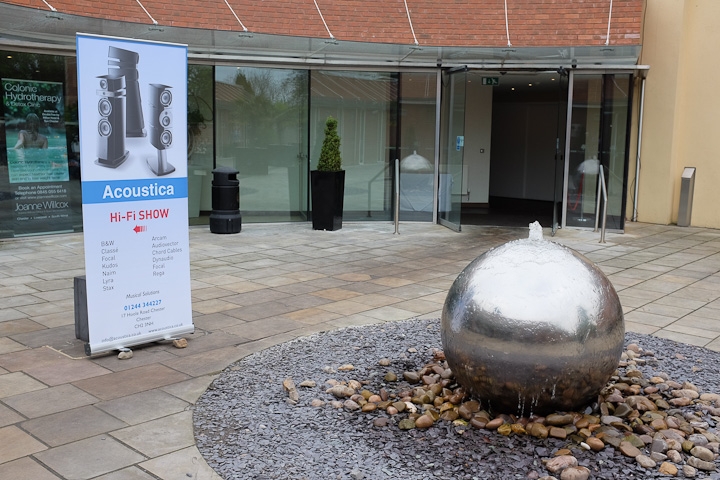
 

Acoustica Hi-Fi Show 2014

The world of audio seems to be turning full circle. In the 1980s, a lot of new audio was presented at small, dealer-based shows dotted around the country. Then came the rise, and subsequent fall, of the national hi-fi shows. That has all moved international today, with audiophiles the world over now conglomerating on places like Munich and Denver, and the smaller, more friendly dealer-based event is back on the radar. And few are as friendly, or as professional as Chester dealer Acoustica’s Hi-Fi Show, hosted over the weekend of April 12 and 13, at the nearby Doubletree by Hilton hotel.

Acoustica, Geoff Coleman’s cozy yet well-stocked store, has stocked many of the UK’s best known brands for years and has developed a loyal base of both clients and suppliers. This is not the kind of ‘flavour of the month’ store that will stock a fashionable brand for a year or two, only to leave a group of customers high and dry when that brand gets replaced by yet another product du jour. As a result, the store’s clients trust the company’s judgment, and when it’s time to put on an event, there’s a keen group of Best of the Best manufacturers and distributors only too willing to make the journey.

The show itself is split across two sections, because of the layout of the hotel itself. The small conference section of the Doubletree was given over to some of the larger exhibits, such as Bowers & Wilkins, Classé, Focal, Naim Audio, and Kudos, with the intersecting corridors taken up record dealers, and open-plan headphone demonstrations. In addition, Cabasse was showing its wireless, network streaming Stream Source digital hub system.

The Bowers & Wilkins/Classé demonstration comprised the latest revised version of the CP800 processor, coupled with the new £3,950 Classé CA-D200 stereo power amplifier, a unique DSP-controlled 200w Class D design demonstrated for the first time in the UK. The whole system was being run from an old white Apple iBook.

Next to this was the Symmetry demonstration of a range of Stax headphones, played through a basic Ayre CD and amplifier combination. The SR-009 headphones were doing their usually job of surprising people at how good recorded music can sound, and not just how good recorded music sounds through headphones.


Opposite the Bowers & Wilkins room were two rooms run by Naim Audio (although Naim electronics also appeared in every other demonstration room in the show, except the ones run by companies making amplifiers, these were the two actually run by Naim itself). The first, the most expensive system in the show, consisted of Naim’s NDS streamer (fed by a HDX hard disk player/server) with a 555PS power supply, a NAC 252 preamplifier, powered by a SUPERCAP power supply and a NAP 300 two-box power amplifier, all on Fraim supports and connected to a pair of Focal Utopia Scala V2 standmount loudspeakers.

One of the demonstrations of the show was next door, again run by Naim Audio. This time, the system was more middle-of-the-range, with a NDX network streamer, feeding into a HICAP-powered Naim NAP 282 preamp, with a NAC 250 power amp and Ovator S-400 loudspeakers. This system als sported a range of different ways of getting a signal to a streamer, including the company’s own UnitiServe and NS01 ripping servers, and a pair of Macs; one running Windows, the other MacOS. Why this was so useful a demonstration is they were running a full networking Q&A session, as well as blind tests on the difference between 16/44 and 24/88 versions of the same Daft Punk track. They were all but indistinguishable to me, although some did correctly identify the tracks.

Kudos Audio was flipping between its popular Cardea Super 20 loudspeaker, and the forthcoming X3 design. Intended to cost a lot less than the C20 (somewhere close to £2,200 per pair), the speakers were being played through a DPS turntable, Naim Aro arm and Dynavector XV-1t cartridge, or a Linn Klimax DS network streamer, and yet more Naim electronics, but this time using Chord Sarum interconnects and speaker cables. The speakers were mounted inTrack Audio platforms; not for some special magic mojo reason, but because the carpet in the room was so thick, Kudos’ regular spikes wouldn’t drive home! The new speakers sound promising and we look forward to testing a pair soon.


At the other end of the hotel, there were several newer hotel suites with systems playing. The rooms were almost universally dreadful from an acoustic standpoint (a large, live room with a low ceiling and a central Sheetrock ‘pillar’ containing a flat TV), but the six brands showing made the best of a bad job. In fact, no one grumbled about this, no-one blamed the room for poor sound, they just got on with making a good sound in a bad room.

Audiovector (actually, Audiovector’s UK distributor, Henley Designs) was showing the new Si 3 Signature Discreet Active loudspeakers, being driven by a Pro-Ject 6 Perspex turntable and arm combination, with an Ortofon MM cartridge. This was fed into a Pro-Ject Phono Box RS phono stage. Digital source was a laptop, and the demonstrator’s phone.

Dynaudio was also showing a ‘next-gen’ audio solution, in the small, but perfectly formed shape of the Xeo 3 powered bookshelves, being driven wirelessly from a Mac with a dongle (not as rude as it sounds) in another room.

Dynaudio was also showing a more conventional system, comprising a pair of Excite X34 floorstanders, driven by the distributor’s own system pulled out of his house: a Naim UnitiServe and SuperUniti. The distributor, Bill Livingston, commented that he was asked about the smaller-scale system a lot at the show, because so many people are intent on downshifting their systems, but retaining performance.


Arcam was the only company running a home cinema (home theater) system, but even this had a distinct two-channel twist. Alongside the BDP-300 Blu-ray player, and the company’s entry-level AVR-300 multi-channel amp (driving a complete Bowers & Wilkins multi-channel speaker system), the system also sported Arcam’s new Apple Airplay-equipped AirDAC, its popular irDAC and the brand new (and extremely impressive) £90 MiniBlink Bluetooth adaptor. The accent is on the ‘mini’ – it was about the size of a large egg. Many couldn’t tell the difference, flipping between CD played through the BDP-300 and music played from the hotel’s Wi-Fi network into the MiniBlink via an iPhone. That’s how good these systems have become!

Rega Research was taking a more old-school approach to music replay (albeit with many of its latest products), and many were loving the system because of that. Rega’s system comprised its new top RP10 turntable and arm, with an Apheta MC cartridge, into an Aria phono stage. Digital audio was through CD, with its Saturn-R player (which is a very capable DAC in its own right, as well as a CD spinner, but in his case it was a CD-only player). This was fed into the Elicit-R integrated amplifier, into a pair of RP5 loudspeakers, the whole system taking up just one small rack space. This is always a pleasure, not least because the choice of music is so refreshing: anyone playing the Avett Brothers and Swedish nu-folksters First Aid Kit must be up to some good in my estimation.

Alongside working with Naim Audio in the big system room, Focal had its own, smaller set-up, playing a pair of Focal Aria 926 being driven by a Naim Audio NS01 server into a Naim Uniti2. On passive display were a pair of Aria 906 standmounts and the top of the range Aria 948 floorstanders. These needed a larger room than was on offer, but are reputed to be the loudspeakers you buy if you want a pair of Scalas but are only prepared to pay 1/10th the asking price. We shall see…

Finally, The Chord Company was running demonstrations of its latest interconnects, loudspeaker and (wait for it) Ethernet cables. Using the same Naim streamer and pre/power, into the same Kudos standmount loudspeakers throughout, these regular listening tests were frying a lot of show-goer grey matter as they discovered why (and even how) things that aren’t supposed to make a difference wound up making a difference! This is a contentious subject, with people seemingly ready to go ape crazy at the mention of the concept, and even by the reporting of it. Still, The Chord Company makes Ethernet cables, it demonstrates Ethernet cables, and people buy Ethernet cables from The Chord Company as a result of such demonstrations. In every other branch of audio, I could describe such events without need to don a flak jacket and run for cover, but somehow I suspect that won’t be the end of the story…

Acoustica’s show is small, friendly, and it is very Naim-oriented, as is Acoustica itself. The people attending the show are bright and passionate about what they do, and the show-goers themselves are not the ‘legion of the lost’ that, sadly, so often frequent audio events. We need more events of this calibre around the world, and next year, you should make your way over to Chester for one of the friendliest events on the calendar. I know I will!

First Listen: Oppo PM-1 planar magnetic headphones

Back before the turn of the year, I received a message from Jason Liao, Oppo Digital’s Chief Technology Officer and Vice President of Product Development, asking if I would like to sample a very early prototype of Oppo’s new PM-1 planar magnetic headphone. Naturally, I said, “Yes, I’d love to try it,” and a few days later an unmarked box from Oppo appeared in my office.

The headphones within that box showed a great deal of promise, but also some sonic shortcomings and of course came with almost no accessories or documentation. Even so, what I could see and hear about the product based on my experiences with that early prototype made me all the more eager to hear the final production version.

Early this year, at the CES 2014 event, Hi-Fi+ Associate Publisher Pete Trewin and I had the opportunity to meet with Jason Liao and to compare notes on the PM-1 over lunch. But our luncheon turned out to involve a special surprise in that we also got to meet the designer of the PM-1, who turned out to be none other than the planar magnetic driver guru Igor Levitsky (the man who is the guiding technical force behind the well-regarded planar magnetic driver-equipped loudspeakers from the US-based firm BG Radia).


Through longstanding familiarity with Levitsky’s work for BG Radia, I already had a very favourable impression of Mr. Levitsky’s technical skills and insights, so I was pleased to learn that he was contributing his expertise and know-how to the design of the PM-1. In our ensuing CES discussion, it turned out that both Jason and Igor had heard and noted the very same shortcomings in the PM-1 prototypes that I had observed and they already had a plan in place to address them.  Accordingly, we decided that instead of doing a blog to describe the prototype PM-1s (which were about to be rendered out of date), it would be better for me to wait until the production versions were ready and then to do a blog.


Well, the auspicious moment is at hand, since just a few days ago a carton bearing the distinctive Oppo logo and the model “PM-1” designation appeared on my desk, containing one of the very first production samples of the PM-1 headphone (priced at $1,099). This blog will serve to share with you the unboxing experience, plus some preliminary and admittedly minimalist observations on the headphone’s sound (naturally, a full-on Hi-Fi+ product review will follow at a later date).

From the minute the shipping carton is opened, it becomes obvious that the PM-1 is a product Oppo hopes you will take very, very seriously. Inside the extensively foam padded shipping carton is a large, beautiful, fabric-covered box that looks like the sort of container in which one might expect to find, say, an expensive and exquisite porcelain tea service from Asia. Once the lid of the fabric-covered box is lifted one finds—another fabric covered box with small ribbon-type pull-tabs that allow the panels of the inner container to be opened. And inside that inner box user’s will find something rare and valuable: namely, a gloss-lacquered, dark wood (perhaps rosewood?) presentation case with the Oppo logo inset into the case’s top panel and a tasteful, inset pushbutton release catch that allows the case to be opened.

Inside the case, whose padded interior is lined with a soft fabric, one finds the PM-1 headphones themselves, plus a small oblong box sheathed in a black fabric bag. Inside that small, oblong box one finds the primary signal cables for the PM-1.  The whole opening sequence conveys (and I presume is meant to convey) a sense of occasion—kind of like the experience of unboxing a fine, handmade Swiss watch, but on a larger physical scale. No doubt about it: Oppo wants us all to get the message that, as we sometimes say in the US, the PM-1 headphone is “kind of a big deal.” And indeed it is.


Down beneath all these multi-layered boxes and cases, down in the bottom of the PM-1 shipping carton, one finds a padded canvas carry case for the PM-1s, plus a spare set of ear cup pads, and a second, differently configured signal cable. To review, then, the PM-1 package includes:

  • A fabric-covered outer box.
  • A lacquered wood presentation case.
  • A set of PM-1 headphones, which ship with a set of beautiful perforated leather-covered ear cup pads installed.
  • An alternate set of velour-covered ear pads for those who prefer fabric or dislike the feel (or politics) of leather.
  • A primary 3 metre long signal cable terminated with a 6.35mm TRS-type headphone plug.
  • An alternate 1 metre long signal cable terminated with a 3.5mm mini-jack headphone plug.
  • A canvas-covered, padded carry case for the PM-1.
  • A nicely executed User’s Manual.

Of the technology used in the PM-1, Oppo has this to say:

“The PM-1 utilizes a planar magnetic driver that sets it apart from the majority of headphones on the market. In our planar magnetic headphone, sound is generated by a very thin and light diaphragm whose entire surface area is evenly driven. The diaphragm is driven in a symmetric push-pull manner, and the magnetic system and conductor patterns have been optimized for maximum sensitivity and consistency.”

This description is all well and good, but frankly it could just as well apply to some, though not all, of the other planar magnetic headphones on the market today. However, no sooner does this thought pass through one’s head than one goes on to read this statement from Oppo:

“Unique to the OPPO PM-1 is the use of a double-sided diaphragm, which allows us to place twice as many conductors within the magnetic field and eliminated any passive return zones where the conductors do not work. This results in the use of 100% of our conductor length, which in turn results in greater efficiency. In addition, our flat conductor pattern eliminates inductance-related intermodulation distortion, common with dynamic headphones, and the OPPO PM-1’s purely resistive impedance means that sound quality is unaffected by a Headphone amplifier’s output impedance.”

Then, the final surprise comes when the manual states:

“The OPPO PM-1 combines high sensitivity with low weight, allowing it to be used freely with portable devices without requiring additional amplification.”


Just how high is the PM-1’s sensitivity? Oppo quotes a sensitivity rating of 102dB at 1mW, making the PM-1 (to our knowledge) by far the most sensitive of all top tier planar magnetic headphones. To see what I mean, let me cite sensitivity specifications for some of the industry’s best-loved planar magnetic models, below:

·      Abyss AB-1266: 85 dB

·      Audeze LCD-3: 91 dB

·      Audeze LCD-X: 96 dB

·      Audeze LCD-XC: 95 dB

·      Audeze LCD-2: 90 dB

·      HiFiMAN HE-6: 83.5 dB

·      HiFiMAN HE-500: 89 dB

·      HiFiMAN HE-400: 92.5 dB

The point, here, is that Oppo has pushed the sensitivity envelope farther than any other planar magnetic headphone maker to date, with the result—borne out in my preliminary listening tests—that one truly can listen to the PM-1 (and happily so) when driven by nothing more than a garden-variety iPhone. That’s impressive.


PRELIMINARY LISTENING

As above, the following are just some quick, ‘snapshot’ impressions of the PM-1 taken on the basis of a few brief, ‘getting-to-know-you’ listening sessions. They should NOT be construed as a full-fledged review and are subject to revision as I gain more listening time with the headphones.

First, as above, the PM-1 is remarkably sensitive and very, very easy to drive. In practice, this means you would choose an amplifier, if indeed you even decide you want to use one, more on the basis of sonic qualities than with an eye toward making sure your amp has ‘enough’ power (with this headphone, just about anything puts out ‘enough’ power).

I would say the PM-1 exhibits a just slightly warmer-than-neutral tonal balance that gives the headphone voicing reminiscent, at least to some degree, of the Audeze LCD-3. The midrange is richly nuanced and quite revealing, yet smooth as can be with no apparent peaks, rough edges, or signs of overshoot or ringing. The bass is also well detailed and decidedly full-bodied, though not ‘full-bodied’ in a way that would suggest low-frequency bloat or looseness. Highs are also exceedingly smooth, though they may also be just a touch recessed. I’m uncertain on this point, though, in that I really need to try the PM-1s with a broader range of amps and DACs than I’ve used thus far in order to draw more relevant conclusions (it may be that I’ve used warm-sounding and slightly rolled-off DACs thus far, in which case the Oppo is simply showing me the sound of the upstream components used to drive it).  Stay tuned for more developments and deeper commentary later on.

One point I would make is that the PM-1 is absolutely NOT one of the headphones where you have to squint your eyes and grit your teeth, working hard to enjoy the sound. On the contrary, everything about the Oppo—including both the physical feel of the headphone and its sound—is as comfortable and naturally relaxing as a weekend afternoon spent wearing a favourite pair of blue jeans and walking shoes. This comfort factor is, I think, a rare and valuable thing whose importance is often overlooked; it’s the sort of factor that spells the difference between a product that is exciting for the first 20 minutes or so versus one you want to keep using for hours on end.

We’re still in the early going, here, but my instinct is that Oppo has a runaway winner on its hands with its PM-1 headphone. Give a pair a listen and see what you think.

One final thought: Did I mention that the build quality and all-around fit and finish of this headphone are simply superb?  They are. Indeed, my educated opinion is that many other manufacturers could learn a lot by closely studying Oppo’s impressive workmanship in every aspect of this headphone.

Watch for the upcoming Hi-Fi+ review of the Oppo PM-1 and until then, happy listening to you and yours.

Meridian Director DAC

Meridian Audio is a complex brand. The firm is at once a high-end audio company, a luxury label, and a champion of new audio technology, so it has feet in many camps. Recently, though, Meridian Audio took what many see as a major sea change in extending the brand to new markets, starting with the Explorer, which is a small, clever USB-powered headphone amp. The Director is the next stage in the portable digital Meridian plan – this time, a small and clever USB-powered DAC.

The thing about making a high-end brand with the accent on luxury is you can’t let the side down. Making top-notch speakers, CD players, and streaming  devices will not save you if your starter products fail to live up to your established performance ideals. And it’s here where Meridian shows its mettle. This is every inch the luxury product, and that extends to the box it comes in. It’s easy to overlook this unbelievably important aspect of product design, and too many audio products at this level arrive in a Jiffy bag or in a bubble-wrap sleeve in a plain white box.

In Meridian’s case, a long matt black box with a similarly matt black sleeve with the Meridian name and logo in embossed silver lettering. And on the inside, it’s all black and red (auspicious colours for many parts of the world, conjuring up images of wealth and sophistication in others… and the inside of a tart’s boudoir for the cynics). The Director itself sits in its own grey foam bed inside this box, with a small container filled with USB power supply and USB cables next to this. The instructions for the Director hug the base of the box. If I appear to be banging on about trivia too much, it’s because this kind of thing should be a wake-up call to other audio brands; if you are making the Mercedes S-Class of audio, don’t present it in a box that most people wouldn’t use to store cat litter. Yes, it’s a surface thing and doesn’t add anything to the playing performance and yes, there will always be those who dismiss such things as being unnecessary expenses for the consumer, but we live in different times now, and good packaging makes a difference.


Of course, the packaging is as nothing if what’s in the box doesn’t live up to expectations. The Director looks the part too. An elegant curved brushed black body makes it look like a case for very high-end glasses, rather than a bluff piece of audio equipment. The business end of things has a USB B input, a pair of gold-plated phono terminals and a combination mini-jack/optical S/PDIF input. As the Director takes its power from USB, if you plan to use the S/PDIF connection, you need to delve into the box and pull out the international USB power supply. This cannot be used as a booster power supply for the Director if using USB, but is necessary if there is no other source of power. The other end of the DAC is neat gloss-black plastic with a single central button for input selection, flanked by LEDs for source (‘SPDIF’ and ‘USB’) and sampling rate. This last needs some explaining; ‘1x’ relates to 44.1kHz or 48kHz, ‘2x’ denotes 88.2kHz and 96kHz and ‘4x’ means 176.4kHz or 192kHz. Meridian as a company is not big on the whole DSD thing. The one criticism I have of this range of display is that it defaults to upsampling 44.1kHz music to 48kHz, and there’s no way of telling from the front panel whether this has been overridden. This can be a problem with Apple as it tends to upsample by default (it’s a trivial fix, though; go to Audio MIDI Setup and change the output setting accordingly, or use software such as BitPerfect or Pure Music that will change sample rate automatically).

Beneath the elegant exterior, the Director is all business, Meridian style. It uses a XMOS L2 processor, both for USB control and to run the DSP that allows it to use the company’s Apodising filter as standard. It also automatically upsamples 44.1kHz files to 88.2kHz (and 48kHz to 96kHz). Despite the tiny form factor, the Director has a linear power supply for the analogue stages, which feature tiny, high-grade audio caps and oscillators as seen on Meridian’s 800 series products. The DAC is a Crystal CS4353.

People’s impressions of the Director seem split over its output, some citing a sound that lacks a bit of pep and pace. There’s a possible reason for this; although the chipset is designed for portable use, the analogue stage (and the linear supply feeding it) appear to require a consistent 5V USB power feed, and the difference can be quite marked when cared for appropriately. With some computers, this will not be an issue, but others may need some support. I fed the Director through an AQVOX regulated USB power supply and compared it to the output from my 2010-era MacBook Air workhorse and a more recent (but cheaper) Acer PC laptop. While the Acer/Meridian combination worked beautifully irrespective of the AQVOX the MacBook/Meridian combination definitely needed some help. The ‘before’ was nice, but relatively uninvolving, but the ‘after’ was pure Meridian: effortless, musically involving, sophisticated, detailed, and elegant.


The drive to re-release every piece of music ever made on CD box set has served up some gems, but none so highly polished as the Roxy Music set. This was ideal fodder for the Director, yielding permafrost cool, refined music-making from the musicians, an outstanding re-mastering job at the digit stage, and the analogue conversion as slick as Bryan Ferry’s hair. As you might expect, it was best at coping with the beautifully recorded (if syrupy) Avalon end of the collection rather than the more odd eponymous first album, but the Director brought out the best in this outstanding box set.

There’s more than just refinement here, but it’s the refinement that sets it apart from its peers. A lot of DACs do detail and although the Director is a powerful detail hound, but it’s misleading to dismiss the Director as ‘just another detailed DAC’ and miss the main benefit of the Meridian. It sounds like a Meridian player, and that’s down to the refinement of the sound. That comes across when playing something like Brendel playing Beethoven Piano Sonatas; most good DACs can play the sound of the notes and the decay and the ambience, a few can make it impassioned and human, but the Director is rare in in that it gives the music the sort of gravitas it has (or should have) when performed live. This could be mistaken for a ‘mannered’ sound, especially as it’s hard to describe this musical factor without using words like ‘refined’ and ‘sophisticated’. Where the Director scores over its rivals is in its ability to sidestep the problem of making music sound too smooth or even warm, while instead giving music the kind of high-end sophistication (see? There’s that word again) that you don’t often get this side of £2,000. Much of that should be laid at the door of the apodising filter, because it has the same common elegance of sound that applies to Ayre and Meridian devices, albeit somewhat in microcosm. Of course, this requires good amplification and loudspeakers to help realise what the Director does for your music; otherwise it just sounds like yet another detailed DAC.

That all being said, I can see why people might prefer another kind of DAC in their system under some circumstances. The traditional ‘flat earth’ sounding system might find this does more with the spatial than the temporal; it makes a fine and expansive soundstage, but doesn’t have the emphasis on rhythm so enjoyed by the beat-orientated. There isn’t a judgment call to be had here, just different strokes for different folks.

OK, so this isn’t an Ayre, a dCS or Naim DAC. But it isn’t meant to be. What it is, though, is close (sometimes very close) to the sound of those fine products. The Director is meant to be a product that brings Meridian’s classic refinement and maturity to a USB audio world that could do with some of that additional maturity, and it achieves that objective with consummate ease. Ignore the price and focus on the performance, and it’s clear this is a true high-end product in every other respect. As a Directorial debut, Meridian should get an Oscar!


Technical Specifications

Inputs: 1 x USB2 B socket for computer playback (24-bit, ≤192kHz) 1 x 3.5mm socket offering S/PDIF coax (3.5mm mono connector, (24-bit, ≤192kHz) or S/PDIF Optical (3.5mm Mini-TOSLINK, 24-bit ≤96kHz)

Outputs: 1 x analogue stereo pair (gold- plated phono), 2v RMS fixed

Controls and indicators: 3 x Sample rate LEDs: 44.1/48, 88.2/96, 176.4/192 kHz sampling. 2 x Input selection LEDs. Input selected with input pushbutton: S/PDIF, USB. Optical/coax digital selected automatically.

Implementation: Asynchronous USB audio class compliant 2.0 HS 480Mb/s bandwidth.

Controls and indicators: 3 x Sample rate LEDs: 44.1/48, 88.2/96, 176.4/192 kHz sampling 2 x Input selection LEDs. Input selected with input pushbutton: S/PDIF, USB. Optical/coax digital selected automatically.

Firmware upgrade via USB.

Computer requirements: Macintosh OS X 10.6.4 (Snow Leopard) or later, Windows XP SP3, Windows 7 SP1 or Windows 8. Windows drivers provided, no drivers required for Macintosh OS X or Linux.

Construction: Extruded Aluminium shell with moulded plastic endcaps and rubber foot.

Power: 5v <500mA DC via USB interface

Dimensions (WxDxH): 8×13.9×3.4cm

Weight: 0.25kg

Price: £449

Manufactured by: Meridian Audio Ltd

URL: www.meridian-audio.com

Tel: +44(0)1480 445678

Back to reviews

Read more Meridian Audio reviews here

Cambridge Audio Minx Xi

In the time before it fell under the auspices of Audio Partnership, Cambridge Audio was an audio innovator of note. Back in the early 1980s, Cambridge Audio’s founder Stan Curtis launched the first multi-box CD player at a time when CD was almost sci-fi to most listeners. Although the company itself has changed out of all recognition since the 1980s, it has remained at the forefront of innovation, and has its finger firmly on the pulse of contemporary demands. The Minx Xi is the latest example of this thinking; it’s an amplifier, streamer and DAC in a compact and attractive box. It has considerably more features than you can shake a Wi-Fi antenna at, yet costs less than most high-end audio accessories. But as you will have surmised this is not high-end audio, though neither is it lo-fi; it’s designed for people that want a better result than can be achieved with one box solutions that incorporate loudspeakers (such as the Minx Air and Bowers & Wilkins Zeppelin), a market sector that would seem to be growing at the pace of an upwardly mobile Chinese city.

The Minx Xi’s gamut of features includes Bluetooth aptX and wired or wireless network streaming, net radio, analogue and digital inputs, USB media inputs, headphone and subwoofer outputs. All of this comes packaged in a case just 27cm wide, that’s less than 11 inches in old money… and its even got a 40 watt amplifier onboard. It is essentially a combination of technology from Cambridge’s NP30 streamer, the converter from an Azur 351C CD player and a class AB amplifier based on that in an Azur 351A integrated. This means it’s good up to 24/96 and can stream any format except those related to DSD. That it doesn’t cope with PCM 24/192 and beyond or DSD could prove a stumbling block for a high-end streamer with intent to conquer the new digital market, but when it comes to products in the Minx class, they are intended for people that prize good sound and value over the audiophile acronym du jour.

Plug it into power and the network, then add speakers and it’s up and running with alacrity; Wi-Fi takes a little longer because it needs a password, but as set-ups go in this branch of audio, it’s as easy as pie. The trickiest bit is the speaker terminals. These look pretty normal, but actually consist of 4mm plugs to which you can clamp bare wire or spades. To use the 4mm plugs on your speaker cable, you take the terminals out all together and put them in the box.


At turn on the Minx Xi gave me Radio Paradise and I discovered that the first six net radio presets had been allocated to this station and BBCs 1 through 6. If you want to add stations there is no need to go online as is the case with some competitors; you can search with the Stream Magic app or via the unit itself, but it’s a lot easier with the app. As the app is free and works on iOS and Android platforms it’s hard to see why you wouldn’t, I used an iPad for most things and though it has a few foibles, I found it an intuitive piece of software. It didn’t display album art, but this was more to do with my poor metadata management skills than faults with the app.

I started out using the Minx Xi with a pair of Cambridge Aero 6 floorstanders; a speaker I have been getting great results with on more expensive amplifiers. Here, however, it didn’t seem to gel. The speaker is remarkably clean and smooth thanks to its BMR mid/tweeter, but it can’t be all that sensitive because the relatively low power of the Minxi Xi failed to deliver any dynamics. Voice was good and detail pretty high, but overall not a happy pairing. So I took the next, ahem, logical step and put the PMC Fact.8 in place. This rather unnatural ‘mullet’ pairing was considerably more happy, delivering life and energy in the context of slightly lazy timing, but with good detail levels. Scale is somewhat wanting, but it can do reverb and – while there is a distinct lack of grip by standalone integrated standards – it produces enough welly to enjoy Massive Attack’s ‘Inertia Creeps’ at a reasonable level.

It’s a smooth and full sounding device that lacks the pace and dynamics of separates, but does a very passable job considering the price. A Naim UnitiQute 2 costs £1,150 and doesn’t have as many features (but offers DAB reception), which might be why it’s able to deliver a considerably more engaging if relatively dry sound from a smaller box.

One of the things that differentiates the Minx Xi from the UnitiQute 2 is Bluetooth streamiing, which in the Xi is achieved with a plug-in USB dongle. Cambridge uses an aptX device which offers clear advantages over the standard system. Unfortuately neither my iPad nor my mobile support aptX so I wasn’t able to enjoy the benefit. The tablet however produced a pretty tolerable result when it was streaming content from the NAS drive via PlugPlayer. By this point in the proceedings I had moved over to a pair of speakers that seemed more appropriate to the Minx Xi; specifically Q-Acoustics 2010i bookshelfs. These are compact and inexpensive (£130) speakers that work remarkably well with the Cambridge. With these in tow the lyricism of Joni Mitchell’s Court and Spark was not lost and while the Bluetooth seemed to undermine timing quite badly, it delivered adequate levels of detail. MP3 direct from the mobile phone, however, was relatively dull and ponderous however; you can discern the difference between bit rates, but it’s worth getting an aptX capable phone if you want to do this regularly. Streaming wirelessly from the network is considerably more rewarding; an Ahmad Jamal recording managed to put across most of the snap if not the scale of his performance in the context of decent tonality and atmosphere.

Net radio is generally good. I like the way it’s so easy to find stations on the the Stream Magic app and the fact that the Minx Xi holds onto radio streams so consistently, as this is a distinct weakness with some competitors, even those at higher prices.

If you are looking for a system to put in the study or fancy sticking a toe in streaming water, then the Minx Xi is an easy recommendation. It has the same sonic limitations as you find with any budget amplifier, but the feature set is strong and ease of use very high. It even comes in white so it is genuinely domestically friendly. Well worth checking out.


Technical Specifications

Digital to Analogue Converter: Wolfson WM8728

Power output: 40 watts RMS per channel (into 8 ohms)

47 watts RMS per channel (into 6 ohms)

55 watts RMS per channel (into 4 ohms)

Connectivity: Network music playback (Wi-fi & Ethernet), 16-24-bit 32-96kHz

2 x local USB media inputs, 16-24-bit 32-96kHz

Toslink input, 16-24-bit 32-96kHz

S/PDIF input, 16-24-bit 32-96kHz

BT100 Bluetooth receiver: A2DP plus aptX

2 x RCA analogue inputs

3.5mm analogue input

Headphone output

Speaker outputs: 2 x 40W RMS

Subwoofer output: ALAC, WAV, FLAC, AIFF, WMA, MP3, AAC, HE AAC, AAC+, OGG

Standby power consumption: <0.5W

Max. Power Consumption: 300W

Mains Inlet Voltage: 100-120V AC or 220-240V AC

Dimensions (H x W x D): 90 x 270 x 285mm (3.5 x 10.6 x 11.2”)

Weight: 5.8kg (12.8lbs)

Price: £599.95

Manufacturer: Audio Partnership

Back to reviews

Read more Cambridge Audio reviews here

Cavalli Audio Liquid Gold fully-balanced headphone amplifier

Over the past several years Dr. Alex Cavalli, a gifted consulting physicist and engineer, quietly has been developing some of the most ambitious and best sounding headphone amplifiers ever made. First came the hybrid valve/solid-state Liquid Fire headphone amplifier, followed by the Liquid Lightning electrostatic headphone amp. More recently, we covered Cavalli’s valve-roller-friendly Liquid Glass amplifier in Hi-Fi+ 99, calling it “a terrifically open-minded product, which offers as many uniquely beautiful sonic ‘realities’ as there are valve sets to audition.” This brings us, finally, to Cavalli’s newest model: the Liquid Gold fully differential, balanced output, solid-state headphone amplifier (originally priced at $6,450 in the US or £4,005 in the UK–but since reduced to a US price of $3950). Cavalli claims the Liquid Gold is his most sophisticated and best-sounding design to date—one that builds upon all the positive attributes of his earlier works.

Before we delve deep into a discussion of the Liquid Gold’s sound, let’s take a brief moment to review its basic features, functions, and technology details. As above, the Liquid Gold is a very powerful, ‘statement-class’, fully differential, balanced output, solid-state headphone amplifier. Cavalli has this to say about the Liquid Gold’s circuit design:

“Its fully differential topology takes advantage of all the benefits of differential operation, including high common mode noise rejection. The differential circuit design of the Liquid Gold distinguishes it from some other balanced amplifiers, which operate two separate channels connected together (bridged) at their outputs.”

The unit provides three analoque inputs (one single-ended and two balanced) plus four outputs (two single-ended via TRS-type jacks and two balanced via a 4-pin XLR jack and a left/right pair of 3-pin XLR jacks). To accommodate headphones of differing levels of sensitivity, the amp provides two switch selectable gain settings: Hi (8x or 18dB of gain) and Lo (4x or 12dB of gain).  Moreover, one of the two TRS jacks (Jack 1) is fitted with gain reduction resistors that enable the amp to be used with (most) ultra high-sensitivity headphones.

The Liquid Gold is fitted, as are all Cavalli amps, with a piezo-electric type power switch said to enhance long-term reliability (picture an ultra-reliable cross between a traditional pushbutton switch and a touch-sensitive switch and you’ve got the general idea). Once the piezo switch is activated, the amp commences a “controlled startup sequence to protect the output devices and their drivers from high startup currents.”  Thus, on startup an LED labeled ‘W’ (for ‘Wait’) illuminates in red as the amp goes through a gradual one-to-two minute power up sequence. Once the ‘W’ lamp turns white (denoting that the initial waiting period is complete) a second LED labeled ‘H’ (for ‘Headphones’) illuminates in red, while various sensing circuits “wait until the DC offsets at the outputs have stabilized to the point where no damage to headphones can occur.” Only then will the ‘H’ light turn white, indicating the amp is ready to play.


Judging by the sound it produces the Liquid Gold has been designed with a handful of sonic objectives in mind, including: dead-neutral tonal balance, low distortion, wide bandwidth, exceptional resolution, and terrific transient speed. Put these factors together and you get one of the most (if not the most) disarmingly honest and revealing headphone amplifiers I’ve yet heard. Put on a piece of music you think you know well, then, and odds are that within seconds the Liquid Gold will have you asking yourself, “My word, where did all that additional musical information come from?” The effect is uplifting and invigourating in the extreme, but also a little unnerving in that you suddenly realise much of what you thought you knew about favourite recordings suddenly seems woefully incomplete. In an instant, you discover there is so much more to hear than you might once have supposed.

The first impression is one of tapping into greatly expanded reservoirs of musical information. Timbres, textures, and transient sounds immediately become vivid, pure, articulate, and appropriately rich in tonal colours, conveying an overarching impression of musical ‘completeness.’ For a beautiful example of this, listen carefully to Anne Bisson’s vocal performance on her cover of Pink Floyd’s ‘Us and Them’ from Portraits and Perfumes [Camillio Records] through the Liquid Gold/Abyss combination. You can hear how Bisson uses extremely subtle inflections and subliminal touches of vibrato to underscore the dark, brooding emotions inherent in Pink Floyd’s lyrics. Similarly, you can hear Bisson leveraging the seeming lightness and breathiness of her voice to deftly underscore the darkest bits of Pink Floyd’s sardonic black humour.

The Liquid Gold is exceptionally good at capturing these sorts of light vs. dark or hard vs. soft points of juxtaposition and contrast in music, in the process adding not just sonic but also emotional depth to nearly every playback session. While many good headphone amps show you the general outlines of the music and give some sense of the various music-making techniques at play, the Liquid Gold goes deep and lets you hear the music from the inside out—enabling you to judge and weigh each passage as if from a veteran musician’s expert point of view.

Similarly, note how the Liquid Gold captures not only the performance details from well-made live recordings, but also the reverberant and acoustic qualities of recording venues, conveying an eerily realistic sense of place. A good example would be the ultra-funky percussion track ‘Stank’ from Jamey Haddad, Mark Sherman, and Lenny White’s Explorations in Time and Space [Chesky, Binaural+ CD], which was recorded in a pleasantly reverberant performance space that has served double-duty as a church sanctuary.


Part of what makes Explorations tick is the fact that you have three masterful percussionists performing together on a wide array of instruments that are spread across the stage in the sanctuary. In a very real sense, the sound of the instruments becomes inherently interwoven with the sound of the room—almost as if the room were a fourth performer in the ensemble. The Cavalli amp makes this fact abundantly clear, rendering the track with a rare combination of raw power and delicate finesse, so that ‘Stank’ becomes a truly immersive listening experience. You hear the sound of instruments being thwacked with great force, or tapped with the lightest of touches, and everything in between these extremes, all the while savouring the way the sounds merge and seemingly multiply as they interact with the walls, ceiling, and floors of the space.

One element not to be overlooked is that Cavalli’s Liquid Gold, though as delicate, refined, and subtle as they come, is at the same time immensely powerful by headphone amplifier standards (maximum output is a stonking great 9Wpc!). Interestingly, this does not mean the amp sounds brutal or ‘muscle-bound’ in any way; in fact, the opposite is the case. Most of the time, listeners become caught up in the Liquid Gold’s resolution of low level details and in its blinding transient speed. But, when powerful and demanding dynamic swells do come along the Gold exuberantly demonstrates that it has seemingly bottomless reserves of dynamic headroom on tap. Stated another way, when dynamic push comes to shove either your ears or your headphones will likely give up long before the Liquid Gold does.

Certain musical tracks fairly beg to be played at “kick out the jams” volume levels—a good example of which might be Peter Gabriel’s “Steam” from Secret World Live [Geffen].  A big part of the ‘engine’ that propels this track would be the mind-blowing grooves jointly created by world-class percussionist Manu Katche and virtuoso electric bassist Tony Levin (who performs, at times, on the difficult-to-reproduce Chapman Stick—an instrument that can generate positively subterranean bass notes).  Together, these factors make for a playback scenario where headphone amps of moderate output—no matter how good they might otherwise be—simply will not do the job.

Happily, the Liquid Gold stands ready, willing, and able to make most any headphone you could name boogie with serious gusto. On “Steam” in particular, the Cavalli handles the track’s vigourous, but also crisply defined and richly textured low-frequency percussion, strings, and synths passages with power and grace. You can almost feel concussive waves of low-frequency energy racing across the stage toward your ears whilst enjoying virtually complete freedom from compression or overload. The musical result is liberating indeed.

Is there anything the Liquid Gold can’t do or are there any drawbacks we need to know about? Obviously, the Liquid Gold is designed to power dynamic headphones (Cavalli’s Liquid Lightning MkII amp is designed to be an energiser for electrostatic designs). Also, the Liquid Gold absolutely will not and does not add any sort of sonic warmth or perceived ‘richness’ to the music unless those qualities are indeed captured in your recordings. Although some fine headphone amplifiers add an euphonic colouration that some listeners might find appealing, if you want an amp that supplies elements of warmth or perceived richness on its own, the honest-to-a-fault Liquid Gold is probably not for you. The fact is that the Cavalli imparts very little sonic personality of its own, but rather takes its cues from the music. With recordings that supply their own natural warmth and rich tonal colours the Gold sounds vibrant and alive, but if fed thin, brittle sounding, over-produced recordings, the Gold will reveal those qualities, too—whether for good or ill. For my part, though, I find the transparency and honesty of the Cavalli refreshing and very desirable.

Like many of you, I keep a sort of running tally of the best audio systems I’ve heard to date—including, of course, the best headphone/amplifier combinations I’ve sampled. For now, Cavalli’s Liquid Gold, used in concert with the Abyss AB-1266 planar magnetic headphones, not only made my short list but in fact earned a well-deserved place at the very top of that list. While I acknowledge that the admittedly expensive Liquid Gold will not fit every budget (my own included) and that its hyper-honest sound will probably not suit all tastes, I nevertheless regard it is the finest headphone amplifier I have yet heard. Well done, Cavalli.

Technical Specifications

Inputs: Three analogue (one single ended, two balanced).

Outputs: four headphone outputs (one via a 4-pin XLR jack, one via dual left/right 3-pin XLR jacks, and two via TRS jacks).

Power Output: Maximum output, 9W into 50 Ohms. Frequency response, THD + Noise measurement, below, taken at 3W into 33 Ohms. Operational mode: Pure Class A output for the first 2.25W into 50 Ohms.

Frequency Response: -1dB, 3Hz – 650kHz @ 3W into 33 Ohms.

THD+N: 0.0015% @ 3W into 33 Ohms.

Dimensions (H x W x D): 7.6cm x 42cm x 29cm

Weight: 5.5kg

CE Certified: Yes

Mains Voltages: Buyer’s may have their amplifiers built to support one of four possible mains voltage options: 100V, 120V, 220V, or 240V.

Price: Originally priced at $6,450 or £4,005 (but since reduced to a US price of $3950)

Manufacturer: Cavalli Audio, Austin, TX – USA

URL: www.cavalliaudio.com

Back to reviews

Read more Cavalli Audio reviews here

Timestep T-01MC phono stage

Although it’s easy to follow the alternate line of reasoning, high-end audio is supposed to be all about the sound quality. Inch-thick front panels and glitzy finishes are fine, but the end result is supposed to be “what it sounds like”, and not “what it looks like”. The Timestep T-01MC follows a well-trodden British tradition of questioning the need for bling.

Timestep is a British brand best known for its aftermarket power supplies for direct drive Technics turntables, and has engendered something of a cult following among the online SL-1200 fan club as a result. This is Timestep’s first phonostage – although Dave Cawley has been building phono stages for friends for decades, apparently. The T-01MC is an all-discrete, FET-only, no-overall-feedback, dual-mono in a single box moving coil phono stage.

Timestep has a love of fine components, on the inside at least. The input matching resistors are high-grade Dale models, the caps in the RIAA equalisation stage are from WIMA and the FETs themselves are hand selected before being placed in one of two blocks of eight. Inside the case, there’s a shielded custom toroidal transformer at one side of the full-sized case while the main (only) PCB takes up the back third of the box. Those who get all huffy about such things will undoubtedly get all huffy about this being a box of mostly air, conveniently forgetting that this is a perfect layout to help keep any vibration and/or hum fields from the transformer away from those sensitive traces on the PCB. Shared Power aside, this is a true dual mono layout – you could almost break apart the PCB into its three separate stages (well, you could… but  you’d void the warranty fairly comprehensively). It takes a while to come on song, and it’s best to give it a 20 minute wake-up call before a serious listening session.

By the infinitely adjustable standards found on many phono stages, this is almost pathologically minimalist. It’s possible to have the T-01MC set for something other than the 0.35mV sensitivity, 100ohm impedance standard ‘MC’ specification, but as a factory fit. In fairness, most modern carts perform well to this broad spec. Granted, my again Ortofon MC7500 might require more flexibility than the T-01MC has on offer, but with less brutal loads (like the Benz-Micro Gullwing SLR, mounted in an SME 10) the Timestep performed perfectly. Otherwise, there’s a button on the front. A little LED glows when it’s powered up. There’s a ground-lift switch on the rear if you have a problem with hum and might benefit from a floating earth (while the case remains fully earthed for safety purposes). There’s two good phono sockets for left input and output, and another pair for right input and output with an earth tag in the middle.

That’s it.


The pithy way of describing the T-01MC is, “if beauty is only skin deep, this is built inside out”. This is not a show-off’s audio device. Not only in the plain, none-more-black exterior, but in a sound that is the opposite of the bright and flashy sound that tends to attract immediately, but ultimately repels over time. Anyone who criticises vinyl for having a high-level of hiss simply hasn’t heard just how little extraneous sound comes off the T-01MC. It’s almost completely silent in use, even when used with what could be considered a torture chamber for hiss – a passive preamp. It’s not noiseless, but you will need to crank the volume to the max to hear much in the way of hiss at all.

The mark of a truly great phono stage is how it deals with the bumps in the road: the pops and crackles that can plague some well-worn (or in eBay language… ‘mint condition’) albums. There seem to be three possible outcomes; a loud ‘thwump’ like someone dropped a sack of potatoes between the speakers, a slow ‘pop’ that is seemingly not as loud but more musically intrusive because it seems to sit in with the recording, and then a rapid ‘tick’ that arrives and decays so fast, it barely intrudes. The T-01MC takes the latter option where possible.

More than this though, it sounds good too. It’s got a distinctly rich and full sound, but not to the point of being too rich and full; it’s a vinyl gourmand – not a glutton. These qualities made the Timestep very easy to live with irrespective of the music used; too many turntable reviews fall to the jazzier end of the spectrum, and in fairness it makes a fine fist of something like Miles Davis’ Birth of the Cool. But this is giving the phono stage a soft landing – throw Surfer Rosa by the Pixies at the phono stage and it’s a different matter. Fortunately, the T-01MC has the dynamic reserves to cope, taking the loud/soft performance in its stride.

I have two current ‘fave’ phono stages, which I like for entirely different reasons; the relevant one here is the Pass Labs XP-25 (the other being the RCM THERIAA). Despite the fairly vast price differential between the Pass and the Timestep and the fact one is an adjustable two-box phono preamp and the other one isn’t, I found these two had more in common than you might expect. They both have intrinsic warmth of midrange and breadth of soundstage that is extremely alluring, and both have that absence of noise floor that makes you wonder if you are listening to vinyl. The Pass Labs has better bass, a touch more ‘romance’ to the sound and ultimately makes that soundstage bigger, but the comparison highlights just how fine the T-01MC really is.

One of the joys of high-end is finding diamonds in the rough – those products that deliver high-end performance without an asking price that does a lot of asking. The Timestep T-01MC is just such a diamond in the rough. I hope its bluff exterior and lack of adjustment doesn’t preclude its use in the kind of systems it deserves to be used with, and as such comes highly recommended.

Technical Specifications

Dual mono MC only solid-state phono stage

Inputs/outputs: gold phono sockets, earth tag

Switchable fixed and floating ground

Gain: 67dB

Input range: 0.15-0.6mV

Input sensitivity for 0dBV output: 0.35mV

Input impedance: 100 ohm

Output impedance: 600 ohm

Dimensions (WxHxD): 44.5x5x28.5cm

Weight: 2.2kg

Price: £995

Manufactured by: Timestep Electronics Ltd

URL: www.time-step.com

Tel: +44(0)1803 833366

Back to reviews

Read more Timestep Electronics reviews here

Lumin A-1 Audio Streamer

One of the most consistent messages that came out of CES 2014 was the importance of DSD support. Never mind that the actual number of albums on DSD that have any real commercial appeal could be counted on the fingers of one knee, or that the more cynical among us suspect that this is driven by the hi-fi industry looking for another format, DSD suddenly matters.

For many streamer and DAC manufacturers, this represents a technical headache that they will be currently deciding whether or not to resolve. For other companies though, this is the sort of news that might have them reaching for the champagne. Lumin is a new arrival in the field of network audio, but the A-1 (recently titled as such, when the company launched other models in the range at CES) launched last year finds itself looking like a very interesting proposition. As well as supporting PCM as WAV, FLAC, ALAC and AIFF at sampling rates up to 24/384 (which the more observant among you will note was the must have feature of CES 2013), the A-1 is also compatible with DSD 64 but not DSD 128.

The Lumin A-1 converts all incoming material to DSD. However, you have the option of turning automatic DSD conversion off so as to compare DSD to conventional PCM decoding, which can be controlled via the control app.

The hardware that Lumin uses to perform this is a mixture of the conventional and more unusual. The pair of Wolfson WM8741 DACs operating in dual mono is far from uncommon, but Lumin’s decision to partner the Wolfson DACs with an output stage built around a pair of Lundahl output transformers is rather less conventional. The A-1 is fully balanced and can output via either XLR or RCA connections, and these transformers are in the circuit for both connections. As well as analogue outputs, the A-1 is fitted with a BNC digital output and an HDMI connection, which allows for DSD to be transferred to a suitably equipped external DAC if you wish. The final connection is a screw-in umbilical connector for the external power supply that also has an on-off button.


This is in fact the only button on the entire unit. The Lumin is otherwise completely devoid of controls and is totally dependent on the partnering control app. As if this wasn’t radical enough, the app is only available for the iPad. While this is a fairly bold move, there are two beneficial effects. The first is that the A-1 is beautifully minimalist. With only the large and easy to read display breaking up the sleek casework, the overall impression is extremely positive. The build is more than up to the standard that might be expected at the price and the A-1 manages to feel special in use. The review sample was supplied in silver, but a black finish is available to special order as a added cost option. The second is that as Lumin has no alternative but to make the app a good one, the result is a clear and easy to use piece of software that is stable and impressively well thought out.

The A-1 is unusual in that there is no on board provision for internet radio. You can stream radio via the control app, but for anyone who makes regular use of the medium it might be a detractor. The other design decision that Lumin has taken is that the A-1 is only fitted for a wired connection.

Connected to a QNAP NAS drive via Netgear router, the Lumin had no difficulty handling a few terabytes of mixed formats and turning it into a cohesive library. The performance of the A-1 is equally fuss-free, but the longer you listen, the more impressive it becomes. With the DSD processing initially turned off and a simple 16/44.1 FLAC copy of Mark Lanegan and Duke Garwood’s Black Pudding, the Lumin manages the balancing act of being phenomenally detailed, while managing to present this information in an impressively unforced manner. The guitar work that underpins the album is weighty, natural, and perfectly placed in relation to Lanegan’s sandpapery vocals and the Lumin seemed equally assured with any other instrumentation I threw at it.

This self-assured sound is underpinned very effectively by bass that is full, deep and detailed but never detached from the performance as a whole. The heavyweight low end that underpins the high res FLAC of Dead Can Dance’s Children of the Sun is reproduced with a potency that should give even relatively bass-light systems a useful boost. Whether some of this low energy is down to the output transformers is hard to tell as they can’t be switched out of the circuit, but there is a solidity to the way that the Lumin goes about making music that is very distinctive. There is a sense when playing fast-paced material that the A-1 doesn’t have the fleetness of foot that some rival streamers can produce, but this never spills over into sounding slow or languid.


Switching to first processing material in DSD and listening to a small clutch of recordings stored in the format suggest that there are some benefits to this additional processing. Recordings that are predominantly ‘real’ instruments and vocals tend to benefit from a sweetness being added that never adversely affects he tonal accuracy or believability of the piece as a whole. The benefits of DSD seem less pronounced with electronica and high-resolution PCM material, although you don’t have to use a one-size-fits-all approach to DSD upsampling.

The limited clutch of DSD recordings I have at my disposal also sounded extremely good, but I’ve never been able to completely shake the feeling that they’d still sound pretty good as PCM. What I will say for the Lumin is I feel plonking DSD files on a NAS drive and playing them via the A-1 is an order of magnitude simpler than trying to persuade your computer to play them and spit them out via USB. I’m told that tagging and attributing DSD files is not an entirely straightforward exercise but the material provided looked well-presented, so clearly it isn’t impossible.

Personally, I am a long way from being convinced that DSD will produce a meaningful body of music, but for me this actually strengthens the case for the Lumin rather than undermines it. The A-1 is such a strong performer with the formats that are actually to buy right now; even if you never actually bought a DSD recording, you wouldn’t feel that you weren’t seeing the full benefit of the unit. Furthermore, the DSD upsampling also works well with a variety of material. The more time you spend with the Lumin, the more it becomes clear that the strong performance with a wide variety of material, the extremely well thought out app, and the very handsome appearance combine to make the Lumin a very enticing buy and one that should work well in a variety of systems. And of course, if DSD is the next big thing, you can rest assured that the A-1 has got you covered.

Technical Specifications

Streaming Protocol: UPnP; Gapless Playback; On-device Playlist

Supported Audio File Formats: DSD LOSSLESS: DSF (DSD), DIFF (DSD),

DoP (DSD),FLAC, Apple Lossless (ALAC), WAV, AIFF, MP3, AAC (in M4A container)

Supported audio sample rates, Bit depths, Number of channels: PCM 44.1khz – 384kHz, 16 – 32bit, Stereo DSD 2.8MHz, 1bit, Stereo

Input: ETHERNET NETWORK 100BASE-T; USB FLASH DRIVE, USB HARDDISK

(FAT32, NTFS and EXT2/3 only)

Outputs: Analog Audio: XLR balanced, 4Vrms, pin 2 Hot

RCA unblanced, 2Vrms; Digital Audio: BNC SPDIF: PCM 44.1khz-192kHz, 16-24bit; DSD (DoP, DSD over PCM) 2.8MHz, 1bit; HDMI: PCM 44.1khz-192kHz, 16-24bit; DSD 2.8MHz, 1bit

Analog output stage: Wolfson WM8741 DAC chips, 1 chip per channel

Fully balanced layout with high quality components

Output connectors coupled with dual LUNDAHL LL7401 output transformers

Dimensions (WxHxD): Lumin: 35x6x34.5cm

Dual-Toroidal PSU: 10×5.5×29.5cm

Weight: 8kg (Lumin), 2kg (PSU)

Finish: Raw brushed aluminium. Black anodised brushed aluminium on application

Price: £4,995

Back to reviews

Read more Lumin reviews here

Wilson Audio Duette Series 2 loudspeaker

Launched almost nine years ago, the original Duette was a combination of entry-point and Swiss Army Knife for Wilson Audio. The standmount two-way was designed to work in as many ways as possible (vertical, horizontal, in free space, against the wall, or, on off the stands) and – although it achieved these tasks admirably, feedback from end users, dealers and distributors alike showed you can have too much of a good thing.

The Duette Series 2 is the response.

Although the original Duette brief may have been more universal, the majority were placed close to or up against a wall – a classic 2pi (or boundary) placement.  In the process, it sort of rationalises the starting place of the Wilson line. Instead of the jump from the Duette to the Sophia, we now have a Duette for those wanting a high-end boundary speaker and a Sophia for those after a free-space loudspeaker After this, however, it’s free space all the way.

Boundary loudspeakers were fairly common sights in UK homes in the 1980s, but gradually the pendulum swung toward free-space placement. However, at the same time, house prices soared and new builds were constructed ever smaller. This is possibly less of an issue for many of our American readers, but increasingly we are seeing high-end systems being installed in rooms that can be as small as 8’ (roughly 2.5m) wide and 10’ (approximately 3m) deep, and it’s impossible to use a loudspeaker designed to sit 3’ from the rear and side walls unless you intend using them as really big headphones. By designing the Duette Series 2 for boundary use, it can be used in exceptionally small rooms with comparative ease.

The Duette Series 2 retains some common concepts with its predecessor; both are two-way designs with an external crossover, and the most casual of glances will see the family resemblance. However, in reality the Series 2 shares very little with its forbear, and benefits as much from the R&D hours logged to develop designs like the Alexia as it does from the original Duette.


In broad terms, the Duette Series 2 features a 25mm soft dome tweeter and a 200mm bass driver (made to Wilson’s own specifications). The tweeter sits in its own sealed enclosure, while the bass driver has a large rear port. Most of the cabinet is made out of Wilson’s own composite materials, specifically the company’s cellulose/phenolic resin ‘X’ material for the bulk of the cabinet and its ‘S’ material (natural fibres, also in phenolic) for the tweeter baffle. That off-hand description almost masks the careful selection based on laser vibrometry mapping techniques of the cabinet resonant structure and how best to use the different level of rigidity and damping. This also necessitated changes to the cabinet shape, and changes the way the speaker is bolted to the stand (there is also a bookshelf-specific crossover).

As with the original Duette, the crossover is external, but in the standmounted version, it’s built into the stand. In both cases, the ‘Novel’ crossover allows some fine tuning, with a series of resistors that allow a ±1dB adjustment to the tweeter. This should not be considered an alternative for good installation and room treatment, as the excellent accompanying manual is clear to state.

Installation in Wilson Audio speakers is what often makes or breaks the sound quality. However, with a boundary design, the famed Wilson Audio Set-up Procedure (WASP) requires a bit of a rethink. The goals remain the same, but the distance from the rear wall is virtually a given in this case, and the WASP ‘vowelling in’ is more about lateral movement than longitudinal. Nevertheless, this is not a loudspeaker designed to be placed without care or consideration and the distance from the side walls and toe-in are crucial, as is running in; this is a speaker that improves over time.

The photographer Garry Winogrand famously observed, “Photography is not about the thing photographed. It’s about how that thing looks photographed.” That applies here. You want to hear how music sounds through the Duette Series 2. Of course, that relates back to how the music was recorded and the preservation of the natural ambience and the rest of the audiophile ideal. But it also relates to a peculiar thing the really best audio does to you and your music, namely that it makes you explore it over and over again. It’s not about sound quality. It’s about how it sounds.

That’s a distinction that may seem nuanced, but spending time with speakers of the Duette Series 2’s quality, you begin to realise there’s too much of a focus on the sound quality as a disparate collection of musical sub-systems (timbre, tone, detail, etc) and not enough on the sound of the music as a contiguous whole. In a way, this is where cheaper audio often scores over the high-end, but it takes something really special to do both. And that’s what we have here.


Perhaps the biggest ‘thing’ to the Duette Series 2 performance is the absence of noise. This sounds weird, because a passive loudspeaker contains no active devices that might raise a noise floor. And yet, the Duette Series 2 has a lower noise floor than most loudspeakers. It just does. You hear it the moment you swap it out for almost anything else. This isn’t a ‘limpid pools of pellucidity’ cliché thing, it’s more like painting on a fully prepared canvas or even formatting your SD card before going out for a day’s photography. It’s a springboard, upon which you can launch your music. And that has profound implications for your listening.

Although I don’t subscribe to the whole ‘good for classical’, ‘designed for rock’ pigeonholing, there is a kernel of truth in this. However, I suspect it’s trying to dress up the limitations of a design by accentuating the positives. The best loudspeakers – and I mean the very best – do not need to accentuate the positive because (and I’m following the lyric sheet here) they work to eliminate the negative. And this is what the Duette 2 does so very well. That lower than you might expect noise floor, coupled with a loudspeaker that does grace, space and pace – and that offer an excellent dynamic range – just makes this a loudspeaker for all seasons. It was possible to put on Pollini playing some delicate Chopin Nocturnes, then take an abrupt change in direction and crank out some swampy early ZZ Top, only to shift gears one more time and play Domingo singing the romanza ‘Una Furtiva Lagrima’ from Donizetti’s L’elisir d’amore. This last – from the album Opern-Gala (DG) and also featuring Giulini and the Los Angeles Phil is a deceptively tough task. A romanza should be a song of almost infinite sadness, but on less musically adept transducers, it’s hard to listen to without thinking of scenes from The Godfather. Here, I got the full emotion of the music with only the slightest desire to off Sal Tessio.

So far, what applies could be said of practically any decent loudspeaker. But what singles the Duette Series 2 out for special treatment is its portrayal of image depth, because it’s a wall-hugging speaker. A good soundstage is not impossible with a boundary design, but generally there’s an inevitable trade-off with image depth. Usually this is overcome by projecting a wider and more forward sounding soundstage than usual, but this can be a compromise too far. The Wilson Duette Series 2 makes no such compromise, and the soundstage it produces has a sense of depth as well as width, forward projection and height. Once again, I’m keen to disabuse the cliché of a soundstage so deep, it projects into the next town, but the Duette Series 2 does make your listening room sound as if it is bigger than it really is, by projecting a soundstage seemingly beyond the wall the speakers rest against. Thinking back a quarter of a century when I had Linn Kans an inch from the wall, all you got then was a (literal and figurative) wall of sound with almost no sense of soundstage whatsoever. The Duette Series 2 not only shows it can be done, but that the exercise is a worthwhile one. Rather than comparing the soundstage to the relatively limited stereophony of previous boundary loudspeakers, you’ll end up comparing this to loudspeakers like the Quad Electrostatic. It’s that good. I just wish I knew how it’s done!

There is also an almost inescapable temptation to play ‘how low can you go?’ with respect to products up the chain. This comes from the original claim that the Wilson Audio speaker that can be used with some surprisingly humble system components. In my own tests, I’d say the Arcam A19 (50W, 1/20th the price) was the cut-off point. The Duette Series 2 still sounded good when used with the little A19, but it was clear the relationship was getting a bit strained.

A source of some upset for me, though is I inadvertently created a match made somewhere between Salisbury and Provo, because using this speaker with the Naim Nait XS2 worked brilliantly. No caveats, no ifs or buts. This was one of those systems that sang together so well, you knew you were on to a winner. So, why the ‘upset’ part? Because the chance of anyone else (in the UK at least) replicating this system is slim to remote. The two brands move in different circles here. Now, while I’m not advocating this kind of ‘mullet’ system (in great fairness when my Devialet came back from its 240 upgrade and used with similarly more appropriate electronics, it really shone), it shows just how liberating the Duette Series 2’s shake-off of high-end demands really is. There’s a lot of logic behind the ‘get the room and speakers right and the rest falls into place’ argument, and the Duette Series 2’s sensible demands on the amplifier means if you want to take that logic to the extreme and spend way more on the speaker than the amp, this is the speaker to go for.


Alongside the upset, there’s some regret, but a very personal regret. Some years ago, about 100 or so of my LPs were damaged beyond repair. Most I replaced or replicated on CD, but not all of them. And one in particular is so far removed from the audiophile canon as to be of little relevance to most people, but I realised when I was listening to the Duette Series 2, this would have been the finest album to play on so many levels. That album was Scientist meets the Space Invaders, a mixed bag of whacked out dub from 32 years ago. It would have been great for several reasons: First, the Duette Series 2 have the bass and the drive and the drama and the fun to make it happen; second, it might have been a good test of the speakers (although that was a minor concern) and finallly it is the inverse of the vision of the stuffy audiophool listening to his well-recorded jazz through wonderful equipment. The only other personal regret is a constraint laid by the strictures of professional audio writing and a respect for the people who build these speakers, but I want to start shouting and swearing about how good they are, like a bit of a nutter.

The deeper I delved into this design, the more I realised it is one of the most important high-end loudspeakers ever. It achieves all the demands of a good high-end design (detail, macro and micro-dynamics, stereo separation and soundstage,

Technical Specifications

Two-way standmount loudspeaker

Drive units: 25.4mm soft dome tweeter, 203.2mm bass driver

Enclosures: sealed combination X/S material (tweeter), rear ported X-Material (woofer)

Frequency Response: 33Hz-21kHz ±3dB

Sensitivity: 92dB/W/m (at 1kHz)

Nominal impedance: 4 ohm

Minimum impedance: 4.35ohm at 160Hz

2pi design

±1dB treble adjustment to crossover

single-wired external crossover

Range of finishes: four standard colours, 12 upgrade colours, six grill colours, two hardware options.

Dimensions (WxHxD, speaker only): 26.7x47x23.3cm

Dimensions (WxHxD, stand): 30.2×55.6×47.6cm

Weight (per speaker): 20.41kg (per stand): 29.48kg

Price: £19,500 per pair with stands

Manufactured by: Wilson Audio Specialties

URL: www.wilsonaudio.com

Distributed by: Absolute Sounds

URL: www.absolutesounds.com

Tel: +44(0)208 971 3909

Back to reviews

Read more Wilson Audio reviews here

First Listen: Magnepan 3.7i loudspeaker

Introduction:

Over the past several years Magnepan made waves by re-vamping its loudspeaker product line from stem to stern, leading to the release of (in ascending order of price and performance) the New MMG, Super MMG System, Mini Maggie System, 1.7, 3.7, and 20.7 loudspeakers. What was (and is) significant about this veritable tsunami of new products is that Magnepan typically does not revise its product line often meaning that there have been instances where models remained in continuous production for well over ten years between new updates. 

But what was even more significant about those new models is that, in every single case, they offered—in every single instance—significant leaps forward, relative to their predecessors, in terms of measurable and audible performance, yet without any major increases in pricing. True, the new speakers are a little more expensive than their predecessors, but the increases are so modest and so reasonable as to seem more like “cost of living adjustments” than outright price hikes. It would be fair to say that Magnepan is obsessive about delivering terrific value for money.

In the US, Magnepan’s home market, Magneplanar loudspeakers enjoy an enviable reputation in two parts; first, they are known as outstanding performers in their respective size and price categories, but second, they are widely regarded as some of the greatest values in the entire high-end audio cosmos. Think about it: How often do you find a speaker family known for best-in-class sonic performance, but with down-to-earth pricing so sensible as to qualify as legitimate bargains?   


If you asked a group of confirmed high-performance audio enthusiasts which Magnepan model offered the most high-end goodness per dollar (or pound, or Euro), you might get many answers, but my bet is that the lion’s share of responses would name the 3.7 as the sweetest of sweet spots in the lineup, or would have done until now.

Why the “until now” qualifier? The simple answer is that, in a sharp break with past practices, Magnepan has elected to release a newly revised 3.7 model—called the 3.7i, which arrives just three years after the original 3.7 was released (by Magnepan standards, such a rapid revision cycle is without precedent, so that in US-based publications Magnepan ads pose the question: “A new model so soon???”).  I’ll be reviewing the 3.7i in Hi-Fi+ in due course, but I wanted to take this opportunity to share some unboxing photos and preliminary comments.

Technical differences between the 3.7i and the 3.7

In a long, free-wheeling, late evening conversation with Magnepan President, Mark Winey, Mr. Winey shared with me one of the key technical differences between the 3.7i and the earlier 3.7. However, no sooner had the information been shared than I was promptly sworn to absolute secrecy on pain of having to swap out my high-end reference audio system for a Bose tabletop radio for all eternity (Please, no, anything but that!!). Sorry, but there is absolutely nothing I can pass along about the innards of the 3.7i. The Magnepan folks prefer to keep the technical details of the 3.71i to themselves and I must respect their decision. I am able, though, to tell you this much:

  1. The technical changes incorporated in the 3.7i can be retrofitted to existing 3.7-series loudspeakers.
     
  2. The 3.7-to3.7i upgrade charge is $500, which is roughly the price differential between the 3.7i ($5,995/pair) and the earlier 3.7 ($5,500/pair). Owners will, of course, be responsible for paying shipping charges to and from the Magnepan factory.

    Note: 3.7 owners who are interested in the upgrade must contact Magnepan before returning their speakers to the manufacturer.
     

  3. The changes incorporated in the 3.7i are, indeed, readily audible and 100% beneficial, as I’ll explain in a moment.

How big are the sonic improvements in terms of order of magnitude? That question is open to some debate. Many of the US dealers who have heard the 3.7i have reportedly felt the improvements were significant enough to have warranted changing the name to “3.8”—a name that in Magnepan nomenclature would have denoted an all-new model.

Magnepan managers, who have always been and probably always will be modest to a fault, preferred going with the name “3.7i” to denote a model that is plainly improved, but that represents more of an evolution of the existing 3.7 design rather than a full-on new model.  You be the judge.


3.7i basics and the unboxing experience

For those of you who have perhaps never seen or heard Magnepan speakers in the flesh, here are some basics you’ll need to know about. The 3.7i is a 71-inch tall, 24-inch wider, and 1.625-inch deep, dipolar planar magnetic loudspeaker (the term “dipolar” means the speaker radiates sound to the front and rear, with the front wave exactly 180-degrees out of phase with the back wave). The 3.7i features a quasi-ribbon-type woofer/midrange panel coupled with a long, slender pure ribbon tweeter.  All drivers extend from a few inches above floor level on up to within a few inches of the tops of the speakers.

Thus, the 3.7i behaves (as do other Magnepan models) as a line-source-type loudspeaker, which has performance characteristics very different to a traditional point-source-type loudspeaker.  First, the 3.7i offers very even power response from a few inches above floor level on up to just shy of six feet off the ground—and all points in between. Whether you prefer to listen seated on the floor, in a favourite listening chair, or even standing up, the sound of the 3.7i will remain pretty consistent at all plausible elevations (OK, if you’re a freakishly tall basketball player you might not want to listen standing up, but otherwise you should be in fine shape). Second, note that with line-source-type speakers, volume levels do not fall off as sharply as a function of distance as they would do with a point-source-type speaker. As an example, if you listened from, say, a distance of 2 metres from the 3.7i and a point-source speaker, both playing at the same apparent volume levels, and then moved back to a distance of 4 metres, you would find that at the greater distance the 3.7i would be playing at a much higher volume than the point-source speaker at that same distance.

Interestingly, the 3.7i’s are built in mirror-image pairs, which gives end-users two possible placement options. The speakers can be set up with tweeters toward the center, for greater focus and imaging specificity, or with tweeters to the outside, for a larger “sweet spot” and more expansive soundstages. I decided to start out with the tweeters to the inside, but will of course try out both options as my review listening progresses.

The 3.7i ships in two cartons: a large carton that looks like the shipping box for an unusually beefy solid wood door panel (but that in fact contains the two main speaker panels shipped back-to-back with a protective Styrofoam panel sandwiched in between), plus a small carton that contains the speaker’s steel floor stands, installation hardware, and a user’s installation guide. Caution: The larger box is quite heavy (greater than 125 pounds) so if, like me, you have an upstairs listening room you’ll want to have helpers in order to get the speakers up the stairs prior to unboxing. Once in the listening room, it is possible for a single individual to unbox and assemble the 3.7i speakers, though it would be advisable to have a helper on hand.


Installation consists of bolting on the 3.7i’s feet, then installing either a tweeter jumper (or padding resistor, included) in the sockets provided, and then gently and carefully removing a magnetically attached protection plate that covers the ribbon tweeter when the speakers are in transit. Once, those steps are completed, it’s time to place the speakers per Magnepan’s guidelines, connect the speaker cables, and start listening (fine-tuning speaker placement over time to optimize results).

A word about looks: Depending on your own tastes, or those or your significant other, the choice to buy Magnepan’s may or may not be a (visually) controversial one. I’m blessed with a wife who took one look at the 3.7i’s and then said, “Oh, those are really beautiful.” Your mileage may vary. But, here’s a hint: Sometimes, positioning (in the marketing sense of the term) can be everything. My personal experience is that, even among skeptics, it helps to drop an observation to the effect that, “…the Magnepans look rather like classic, Japanese room divider screens, don’t you think?” Somehow, the tall, wide, thin look seems to be easier to embrace, at least for some, if they picture the Maggies as something lovely and graceful (Asian room divider screens, in this case) and not as loudspeakers. Again, your mileage may vary.

First impressions: Magnepan’s new 3.7i

Although I have never owned a pair of the original 3.7s, I have spent many, many hours listening critically to that speaker,  so that I base my comments on those prior listening experiences.

First, the 3.7i does everything the 3.7 did: I provides realistic soundstage scale (especially in the height dimension), excellent resolution and focus, truly impressive top-to-bottom coherency, astonishingly good bass energy and extension (especially so for a dipolar loudspeaker), and very good dynamics (assuming you own an amplifier that can put out substantial power into a 4-Ohm load).


What, then, does the 3.7i bring to the party that the 3.7 did not? I would say the difference is one that the ear picks up almost immediately (registering the change on an almost instinctive, “Ahh, that sounds right” level), though it can take a while for the mind to catch up and begin to describe what is different and better, and why. In essence, through the upper midrange and lower treble, the 3.7i sounds noticeably more relaxed and at ease with itself than the 3.7 did. As a consequence, the 3.7i also seems to present a slightly lower noise floor, meaning low-level textural and transient details sound clearer  and are easier to hear. Neither of these were areas where the 3.7 seemed flawed, but both are areas where the 3.7i sounds noticeably superior.

Perhaps as a direct result of these improvements, I have so far found that the 3.7i does an unusually good job of creating soundstages so precisely three-dimensional that they seem, at times, almost to wrap around the listener, so that some musical information appears to originate from the sides of the listener (and not just from the front of the listener). Many very high-quality loudspeakers do what I call “wraparound soundstaging” some of the time, but the 3.7i’s do it much more often than most. I don’t really have any technical explanation for why this happens, but I consider it to be one of the speaker’s particular strengths and a characteristic that–on many good recordings–makes for a much more immersive listening experience.

Part of what is so musically satisfying about the jump up to the 3.7i is the fact that the new model now does two good things that, in many competing designs, seem almost mutually exclusive: namely, it sounds more relaxed (which always makes music sound and “feel” more natural), yet it also makes details easier to discern (but with a reduction—not an increase—in perceived brightness and potential edginess). This is precisely the sort of “have your cake and eat it, too” sonic improvement that I find most appealing and my guess is that you will appreciate it, too.

I expect to have an interesting time as I work to tune and refine the speakers’ positioning in my listening room, while also putting some necessary run-in time on the 3.7i’s. I still have much to learn about the speaker and I’ll report my findings (and any discoveries I make along the way) in an upcoming Hi-Fi+ review, which I hope you’ll enjoy when the time comes.

Until then, happy listening.

Sonus faber Ex3ma

Sonus faber celebrated its 30th anniversary with style. The Italian company gathered together its biggest, brightest and best distributors and dealers (plus a handful of the world’s press) for a lavish event in and around its home town of Vicenza in Northern Italy. While there are always rumours of the audio press moving from one bacchanalian party to another, most of us today are happier with a coffee and a USB stick with the press release, in order to free up more time to do the real work. This wasn’t that kind of conference.

The massed troupe of Sonos faberites were bussed across the Palladian town of Vicenza to the glorious 18th Century Villa Cordellina Lombardi in the outer provinces. Here, the Fine Sounds Group took us through an edited highlights of the history of the villa and Sonos faber itself, before introducing the intellectual heir to the original Sonus faber Extrema, the Ex3ma.

If you cast your mind back to the early 1990s, the original Extrema was a two-way standmount loudspeaker with a rear-firing passive ABR drive unit, sitting on one of the deepest loudspeaker stands in history. Fast forward almost 25 years, and the new Ex3ma is also a two-way standmount loudspeaker with a rear-firing ABR drive unit, sitting on a deep stand.


The similarities don’t end there. The modern design is every bit as radical as its predecessor, utilising the highest spec materials and technology to create what could be considered a F1 car for the ears. Again. Although this time, it’s claimed not to be the modern equivalent of the Extrema’s uncompromising ‘loudspeaker in search of a system’. The materials science is very different, reflecting the almost two and a half decades between the two designs. However, rather than describe the full specification, we thought it’s best just to point the reader to the relevant part of the website:

http://www.sonusfaber.com/en-us/products/extrema

Put simply though, this is a standmount loudspeaker that features carbon-fibre monocoque, with wooden panels used as musical soundboards as well as for decorative finish. The sculptural wood shapes are all cut from a single red spruce from the violin-maker’s most loved Val di Fiemme forest. The body includes Avional and Ergal aluminium alloys, with gum-metal contrasting baskets, crossovers hand built by the chief audio engineer, and there is extensive use of diamond and beryllium in the drive units. The rear panel shows a four-position ‘brake’ to adjust damping and the crossover point is at 2.35kHz. Famous names internally include Shunyata cable and Mundorf capacitors. Everything was taken into consideration, even down to mood-boards in the design studio to find the right physical shape.

This is a strictly limited run. Just 30 pairs, with serial numbers equating to every year Sonus faber has been in business, have been made. As if to prove the point, Fine Sounds Group CEO Mauro Grange literally broke the mold, smashing the carbon-fibre tooling required to create another Ex3ma.

What’s missing though is a price. There sort of isn’t one yet. Maybe there will never be a price, making the Ex3ma literally ‘priceless’. That seems unlikely, but the chances of mortals actually possessing one of these seems so rare, perhaps ‘priceless’ is a good answer. They are sold direct from the factory, and 20 of the 30 are already sold on the day they launch, despite there being no set price!


Those of us fortunate enough to hear briefly the Ex3ma came away deeply impressed. The bass was exceptionally deep for a standmount loudspeaker, reaching well into the sub-40Hz region in a reasonably sized room. It was also exceptionally accurate and detailed. Finally, it was also extremely dynamic; possibly more than the room could stand. With short listening sessions and more than 180 keen listeners waiting their turn, it was difficult to draw many conclusion about the performance, but it was clear those 30 listeners worldwide will be buying a piece of the very best. It is clear that the current chief designer Paolo Tezzon knows exactly what he’s doing, and is extremely proud of the design.

However, it was the event that says more about Fine Sounds and Sonus faber today. This is a company determined to show a powerful presence. This is the sort of pizazz and slick product launch seen with car marques and Apple keynotes. This is not the kind of launch seen in audio, in part because of the expense involved, but audio is a part of an expensive, glitzy world now, and some of that rubs off on everything it touches. Maybe this is a good thing.

There was one omission in the whole event. While the fabulous launch party, complete with impressive light show painting the elegant villa in a manner akin to a New Year celebration run by a fairly major city, the presentation itself essentially airbrushed the company founder, the late Franco Serblin, out of the picture. This was said to be purely accidental. I hope that’s true.

Peachtree Audio nova125 integrated amplifier/DAC

Some years ago, Peachtree recognized that a seismic shift in the high-end audio universe was at hand—a shift wherein PCs would step outside of their traditional roles as office tools to become full-fledged digital audio source components. Thus, long before others began to pursue the idea, Peachtree was hard at work to develop integrated amplifiers fitted with easy-to-use, built-in, high-performance DACs. In retrospect, the concept not only seems brilliant, but downright prescient. Peachtree also understood that with the rise of interest in computer audio there would come a golden opportunity for high-end manufacturers to reach out to young music lovers who might never otherwise have considered owning high-performance audio systems of any kind. As a result, Peachtree has always sought to build components clever enough, hip enough, and accessible enough to appeal to young, computer-centric music lovers, but that also offered credible high-end features that would appeal to veteran audiophiles. This requires, of course, finding a balance between simplicity and sophistication and between price and performance—a point of balance many Peachtree components have struck in a successful way.

If there is any drawback, I think it may involve the fact that some Peachtree components may suffer from a perception problem: Are they mid-fi (albeit very good mid-fi), or are they the gateway to the serious high end, or perhaps both? What causes these questions to be raised is the fact that earlier generation Peachtree amp/DACs traditionally have had front-end sections (typically comprising a preamp, DAC, valve buffer stage, and headphone amplifier) that offered considerably stronger and more sonically sophisticated performance than their associated power amplifier sections did. In fairness, the power amplifier sections of those earlier generation Peachtree amps could perform pretty well when matched with relatively easy-to-drive loudspeakers, but they offered limited current drive and power output capabilities and thus were not suitable for driving some of today’s best, but also most demanding, value-priced speakers (e.g., Magnepan’s excellent but power-hungry model 1.7s). Faced with this dilemma, Peachtree Audio founders Jim Spainhour and David Solomon did what high-enders have always done: they’ve upgraded, and in a big way.

Accordingly, Peachtree has revised its entry-level integrated amps by improving their already very good front-end sections and then by equipping their new models with powerful, high-current Class D power amplifier sections. Consider, as an example, Peachtree’s new nova125 amp/DAC ($1499/£1,299 including VAT), which is the subject of this review. The old Nova put out 80Wpc into decidedly benign 6-Ohm loads. By comparison, the new nova125 belts out a generous 125Wpc at 8 Ohms and an even more impressive 220Wpc into 4-Ohm loads. Moreover, Peachtree claims the nova125’s “high current output stages can comfortably drive any speaker load from 2 ohms” (something that could never have been said of the earlier Nova).


Then, where the original Nova provided a 24/96-capable DAC with an isochronous USB input and four S/PDIF inputs, the nova125’s onboard ESS Sabre 9023 upsampling DAC offers 24/192 resolution (except for the optical input, which is limited to 24/96), with an asynchronous USB input and three S/PDIF inputs (two coaxial and one optical). Peachtree points out that the ESS 9023 DAC uses “a patented process called Hyperstream™,” which “buffers the incoming digital bitstream and reclocks it from thousands of picoseconds of jitter to less than 3 picoseconds.” Expanding on this theme, the firm says the new 24/192-capable asynchronous USB input, “keeps digital jitter at bay by not relying on the audio clock in the computer, which can get thrown off time by the thousands of processes running in your operating system’s background.” Finally, the nova125’s DAC section is backed by a decidedly performance-minded new Windows device driver, which is provided on an included CD ROM. In addition to its many digital inputs the nova 125 also provides one analog input to support any legacy analog components the owner may wish to connect.

Astute Peachtree observers will notice that the old Nova did have a somewhat more generous mix of inputs than the nova125 does (the old Nova offering five digital and three analog vs. four digital and one analog for the new model). But, given that the new DAC supports higher resolution formats and asynchronous USB backed by more sophisticated device driver software, there is every reason to think that the sonic performance of the nova125 should be significantly higher than that of the old Nova.

To give users a measure of control over amplifier voicing, the nova125 can be run purely in solid-state mode, or, when desired, with a triode 6N1P valve buffer section engaged (the valve buffer can be switched on directly from the nova125’s remote control). The valve buffer also provides a Class A valve-powered output for the nova125’s headphone amplifier. According to the manufacturer, the nova125 power amplifier section uses “the newest generation of Class D technology” with benefits said to include, “extended bandwidth, improved dynamic range, and exceptionally low distortion,” plus the aforementioned ability to handle low impedance loads. The bottom line is that, apart from a modest reduction in the net number of inputs supported, the new nova125 appears to be better than its predecessor in every way, but costs only slightly more. All of this, of course, sounds good on paper and in theory, but how does the nova125 sound in real life?

Well, let me come right out and say it: Peachtree’s nova125 sounds terrific. Taking nothing away from the original Nova (and iNova) designs, I would say this new amp sounds like it belongs in any entirely different and better class of equipment than the original Novas did. The original Nova had a warm, friendly, inviting sound, but a sound that in truth did not provide the last word in resolution, definition, or focus. What is more, the original Nova’s dynamic capabilities were highly load dependent. By comparison, the nova125 sounds as if someone has turned its conceptual resolution, definition, and focus “knobs” up to 12, yet without in any way causing the amp to sound sterile, mechanical, or edgy. More importantly, the nova125 sounds powerful (and is powerful) in a way no previous generation Peachtree Nova-series amp has ever been. In short, this thing flat-out rocks, yet in a quite sophisticated way.


Some will surely ask, “Yeah, but can it actually drive truly demanding speakers?” To settle the question once and for all, I connected the nova125 to my undeniably power hungry Magnepan 1.7s, put on a dynamically challenging track, and let things fly. And man, did they ever fly. The track I am speaking of is the exuberant and boisterous all percussion cut “Stank” from Jamey Haddad’s Explorations in Space and Time [Chesky, Binaural+ series recording]. “Stank” features some low percussion drum thwacks that are likely to loosen your molars, plus a plethora of (somewhat) more delicate higher percussion voices that supply piquant commentary and textures, with the proceedings as a whole captured in a wonderfully reverberant, natural acoustic space. In short, it’s the sort of track where there is a lot going on at once, serving up everything from bombastic, brute-force dynamics to multiple layers of delicate textural and transient detail. There is, quite simply, no place for amplifiers (or transducers) to hide.

Happily, the nova125 has no need or desire to hide from any types of music or loudspeakers because on “Stank” it rolled up its figurative sleeves and pushed my Magnepans with serious authority and a welcome dash of brio. The big drums on the track crackled and thundered as they should, while the higher pitched drums exhibited excellent transient “snap” and beautiful, variegated skin sounds that conveyed an impression of real players deftly varying the intensity of their touch and attack from note to note. Through all of this, the Peachtree did not whimper, whine, or wilt; instead, it just cranked out the song’s ultra-funky groove for all it was worth. In my view, this is something the old Nova could never, ever have done—at least not with Maggie 1.7s. With the nova125, then, Peachtree has cooked up a sensibly priced amplifier that possesses, in roughly equal measure, both serious dynamic muscle and a generous measure of finesse.

To explore the finesse dimension more fully, though, I decided to put on one of my favorite orchestral recordings: namely, the Michael Tilson Thomas/San Francisco Symphony performance of the Henry Brant-orchestrated version of Charles Ives’ A Concord Symphony [SRS Media, multichannel SACD]. In particular, I focused on the third movement of the symphony, entitled “The Alcotts” (each of the symphony’s movements is named for an important figure or figures in the American Transcendentalist movement). What I’ve found appealing about this live recording (captured in Davies Symphony Hall in San Francisco) is the way it provides rich but believable amounts of orchestral detail, while also placing the orchestra within the context of a naturally resonant, three-dimensional performance space (or at least that is what should happen with good electronics driving one’s music system).

Happily, the nova125 did not disappoint. It did a lovely job with the voices of the various orchestral sections at hand, offering a particularly fine rendition of the winds and brass. Indeed, the brass theme introduced about three minutes into the movement sounded heart-meltingly beautiful, conveying that elusive mix of transient bite and blooming, burnished “glow” so characteristic of brass at its best. Throughout the movement, the nova125 also revealed enough low-level detail to remind me that the recording was captured live, yet without pressing details forward so insistently as to make a nuisance of itself. While the nova125 can and does sound very focused—much more so than the original Nova did—there is also about this amp/DAC combo an over-arching quality of “just-rightness” that reminds me of the old adage regarding the importance of enjoying all good things in balance and moderation.


How did the nova125 fare as a DAC? To find out, I used an Oppo BDP-105 as digital transport to test the S/PDIF inputs and a Windows PC loaded with 100% uncompressed digital audio files to try out the asynchronous USB input. As a comparison standard, I used my reference Rega Isis CD player/DAC. What I discovered was that the nova125’s DAC and S/PDIF inputs sounded, again, more detailed and focused than the DAC section of the original Nova did. However, I felt that the DAC section’s best performance of all was realized through the asynchronous USB input, which I felt sounded even more refined, tightly focused, and generally more spacious and three-dimensional than the S/PDIF inputs did. While the nova125 could not match the even higher levels of resolution and all-round refinement of my Rega Isis, I felt it acquitted itself admirably given the huge price differential between the two components.

What of the nova125’s 6N1P valve buffer? Frankly, I came into this review thinking that I might enjoy using the buffer, since I have been a proponent of hybrid valve/solid-state amplifiers in the past. However, in doing some admittedly crude “blind testing” with and without the valve buffer, I consistently found that I preferred the clearer and, to my ears, more explicit and less coloured sound of the nova125’s solid-state circuitry. Your mileage, of course, may vary, but for the bulk of my listening tests I felt more comfortable with the valve buffer disengaged (though I continued to try it from time to time, just to keep an open mind).

Finally, I wanted to check out the nova125’s headphone amplifier section and for this purpose I listened through my reference Audeze LCD-3 planar magnetic headphones, comparing back and forth between the nova125 and the superb Burson Audio Soloist headphone amp (the Burson is essentially a handmade Australian headphone amp/preamp that sells for just under $1000). What I found was that the nova125 sounded very good, with plenty of output for powering the Audezes (which are not the easiest-to-drive headphones around), a reasonably low noise floor, and a rich (but not overly rich) and articulate sound. Nevertheless, the Burson sounded even better, with more detail, superior three-dimensionality, and even quieter noise floors. In fairness, though, let’s acknowledge that the Burson costs two thirds what the nova125 does, yet provides only a fraction of the nova125’s functionality. Once you throw that consideration into the mix, I think the nova125’s headphone amp section has got to be considered icing on the cake.

To sum things up, I would say that Peachtree has taken the nova125 forward, not just by a small incremental step, but by a giant leap. Relative to the original Nova, which was a very high-value product in its own right, the nova125 offers a front-end DAC section that is better, an asynchronous USB input that is much better than the original Nova’s USB section, and a power amplifier section that is just light years better than the original Nova’s amp. Perhaps best of all, the nova125 has lifted many of the equivocations and qualifications that applied with the original Nova; at last, Peachtree has given us an affordable amp/DAC that can drive fine but power-hungry speakers in an effective way. This means that value-minded listeners can use the nova125 without worrying about whether it has enough refinement or power to handle their speakers of choice. In truth, it’s got both qualities in spades, and for a very sensible price.

TECHNICAL SPECIFICATIONS
Power Output: 125Wpc @ 8 Ohms, 220Wpc @ 4 Ohms
Inputs: One asynchronous USB, two coaxial S/PDIF, one optical S/PDIF, one stereo analog, one 12V control signal.
Outputs: Speaker taps, 1/4-inch headphone jack, one variable level stereo preamp output.
DAC: ESS Sabre 9023
Jitter: <3ps measured at master clock.
Resolution levels supported: MP3, 16/44.1, 16/48, 24/88, 24/96, 24/176, 24/192
USB: Asynchronous up to 24/192
Optical: Up to 24/96
Coax: Up to 24/192
Valve complement: One 6N1P (used for headphone amp, switch selectable valve buffer stage)
Frequency response: 20Hz-20kHz +0.5dB
S/N: 96dB
Dimensions (HxWxD): 111 x 376 x 292mm
Weight: 9.82kg
Price: $1499, £1,299 including VAT

Manufactured by:
PEACHTREE AUDIO
2045 120th Avenue NE
Bellevue, WA 98005 USA
Tel. (704) 391-9337
www.peachtreeaudio.com

UK Distributor:
Anthem A/V Solutions
Tel. 44 (0) 1825 750858
www.anthemavs.co.uk

Back to reviews 

Read more Peachtree Audio reviews