Up to 37% in savings when you subscribe to hi-fi+
hifi-logo-footer

Begin typing your search above and press return to search. Press Esc to cancel.

The Passing of a Legend

From High Fidelity Report:

It is with a heavy heart that we must share with you the sad news of the passing of a legendary man.

Last night, the evening of November 4th, Harry Hall Pearson Jr. passed away peacefully in his home in Sea Cliff, NY, at the age of 77.

Harry will be missed by those of us who loved him as a mentor, a friend, and as the standard-bearer for our mutual pursuits in the world of audio.

His legend will live on and echo throughout the audio industry, for Harry’s was the “Gold Standard” of audio journalism. His deep love of music, and the goal of realistic reproduction in the home, became the adopted enthusiasm for hundreds of thousands of audiophiles around the globe. His lexicon of audio vocabulary became the very patois with which audiophiles communicated amongst each other, especially audiophile journalists.

Harry’s contribution to the audio world are both measureless and timeless.

Thank you, Maestro, for everything.

Sennheiser & HDtracks

From the Sennheiser UK press release

London, 31 October 2014: To mark the announcement of HDtracks online store opening for business in the UK, giving music fans the chance to listen to the most extensive catalogue of music in unprecedented audio quality, Sennheiser is gifting a free album’s worth of music to customers purchasing from its range of HiFi headphones including the renowned HD 800 headphones in the UK, USA and Germany. In addition, the offer is extended to customers of Sennheiser’s specialist HiFi dealers known as ‘Club Orpheus’.

The collaboration between the two audio experts further demonstrates a commitment to the pursuit of delivering perfect sound quality. HDtracks and the high-resolution audio download formats offered are enjoying great success thanks to the innovation in audio hardware from manufacturers like Sennheiser who remain at the cutting edge of sound technology. Digital audio opens up a world of new possibilities for music lovers and thanks to HDtracks, all the digital data captured in the studio at the time of a publishing, from the rock, pop and jazz artists of today to the number ones of yesteryear, can now be played with perfect clarity in 24-bit audio.

The creation of products from audio specialists like Sennheiser that are able to capitalise on this superior audio format and bring to life the richness and sonic excellence of this new format, allows true music lovers to enjoy their favourite tracks the way they were meant to be heard. But sound innovation isn’t stopping with high-end headphones and hi-res tracks. Sennheiser is working closely with HDtracks to explore the possibilities of taking music listening experience to the next level through the use of its digital microphones when recording, to more accurately capture the sound of artists, from grass roots to A-listers.

With the largest catalogue of hi-res music and the best sound hardware from Sennheiser, today’s listener can be taken on a truly sonic adventure with the optimum listening experience available. Together, with a joint vision to create the ultimate listening experience, Sennheiser and HDtracks will provide audiophiles who demand the highest quality recordings a music experience not available anywhere else.

To find out more, please visit sennheiser.com/HDtracks

First Listen: RHA Audio T10i earphones

Roughly a year a go I penned a Hi-Fi+ web exclusive review of a very fine and surprisingly affordable earphone called the MA750i from the Scottish firm RHA. If you read the review, some points I hope you might take away from it would be the fact that RHA has particular strengths in two key product-related areas:

  • First, build quality (which was and is exceptionally good, especially in light of the MA750i’s modest $129 price), and
  • Second, neutrality of voicing (which is one of those characteristics that seems quite difficult for manufacturers to get right, especially in earphone-type products).

My point is that the MA750i is admirable for a number of good reasons, so that it has become for me a nearly automatic go-to recommendation when listeners ask which earphones on the market offer the sonic “good stuff” and rock-solid build quality, yet don’t cost vast sums of money to acquire.

Now, let’s jump forward a year to the present time to see what RHA has done for us lately. The answer, in simple terms, is that they have just created a new upscale, yet still quite reasonably priced, high performance earphone called the T10i that goes even further than the MA750i did in terms of both sound and build quality.


The new  T10i (priced at $199 or £149) has a number of distinguishing features that set it apart from the earlier MA750i. Among these features are:

  • An all-new handmade dynamic driver (internally known at RHA as the model 770.1 driver) that is said to “reproduce all genres of music with high levels of accuracy and detail.”
  • An included set of colour-coded, metal, screw-in type voicing filters that allow users to fine-tune the T10i’s voicing for a “Reference” (neutrally balanced), “Treble” (slightly treble-enhanced), or “Bass” (subtly bass enhanced) presentation.
  • Impressive-look, ultra-comfortable, and very durable earpiece housings made of—get this—Metal Injection Moulded stainless steel (stainless steel is not an easy material to use in moulding processes, so that the construction of the T10i earpieces involves heating the earpiece housing to “1300° C for up to ten hours to ensure the steel is the correct shape and density for outstanding comfort and durability.”
  • Distinctive, patent-pending over-the-ear ear-hooks that are relatively flexible and easy to shape, yet that hold their shapes quite well once properly adjusted (qualities rarely seen together in the same design).
  • A multicore, 1.35mm signal cable with oxygen free copper conductors and an Apple-certified 3-button in line remote/microphone module.
  • Elaborate and tasteful accessories including a zip-closure premium carry case, an extensive set of single and dual-flange ear tips and well as memory foam ear tips, plus a detachable garment hook for those who like to use them.

Because we will soon (as in our December issue) be doing a full-length review of the T10i, I will limit my comments on its sound except to provide a few “First Listen” impressions that I trust will whet your appetites for more information later on.

Tackling first things first, does the T10i sound better than the MA750i? The short answer is that it does, though the differences are subtle and more qualitative and textural in nature, rather  than dramatic differences in tonal balance, etc. As we see it, this is actually a good thing, in that the MA750i offered neutral voicing (always a plus in our book) and so, too, does the T10i when its Reference voicing filters are installed.

Now, pressing ahead to the inevitable follow-up questions, do the T10i’s voicing filters give listeners worthwhile sonic options and are they subtle or garish in their effects?  The answer to the first question is that, yes, the voicing filter will give useful presentation control options to listeners who wish to make small yet quite audible adjustments vis-à-vis the T10i’s standard, “Reference” voicing curve. The answer to the second question is that the voicing adjustments are comparatively subtle (though I think most veteran audiophiles who are used to doing careful and extensive product evaluations would have no problem spotting the effects of each of the filters).

Specifically, the Treble voicing filter adds no more than 3dB of lift above 1kHz and—importantly—follows the general shape of the T10i’s neutral voicing curve without adding any untoward response peaks or troughs. Similarly, the Bass voicing filter adds not more that 3dB of lift below 200Hz, again closely following the shape of the neutral curve. If you know how to pick musical materials that highlight the regions affected by the filters, then their sonic effects are easy to discern, yet those effects are never egregious, overwrought, or over-the-top. 


Given that firms such as the famous hearing technology company Phonak (and others) have done research that shows different individuals do have different in-ear perceptions of sonic neutrality, we’d have to say that the inclusion of voicing filters (and precisely made voicing filters at that) is a definite step forward. Thus far, I can think of only three earphone designs—two of them more costly than the T10i—that offered similar voicing filter systems: the AKG K3003i (gulp, £1,000), the now discontinued Audeo/Phonak PFE 232($599), and the also discontinued Audeo/Phonak PFE 122 ($179). 

But frankly, the sheer build quality of the RHA and of its filter elements shades much more in the direction of the exquisite AKG K3003i than in the direction of the late, lamented, but also somewhat “fiddly”, Audeo/Phonak designs. This observation only serves to reinforce our perception that RHA’s T10i, much likes its forerunner, the MA750i, offers remarkable value for money.

Stay tuned for our rapidly approaching Hi-Fi+ review of the RHA T10i and until then, do take any opportunity you might have to hear these new earphones in action. You won’t be disappointed and we think you’ll be impressed.

Happy listening, all. 

Searching for True Value in High-End Audio at RMAF 2014

Sometimes I am asked by people not involved in high-end audio about what I do, and once I explain the basics of the field to them one of the most frequent comments I hear goes something like this: “I simply cannot believe that there are people out there willing to spend so much of their hard-earned money on hi-fi.” Welcome to my world.

The plain-as-day message to me is that what while many of us are accustomed to and—to a point—willing to embrace or at least tolerate contemporary high-end audio product prices, a very large number of our friends, neighbours, and acquaintances probably think that we are off of our collective rockers. 

It also seems obvious to me that what’s needed are new products whose performance/price ratios are so compelling as to convince all but the most stubborn curmudgeons that the components in question are worth their asking prices—and then some.  I’m talking, here, about products that, whether modestly or not-so-modestly priced, do so much that is musically right and good and engaging to both mind and soul that they simply leave listeners slack-jawed and wondering, “How does that manufacturer do it for the money?”

A reasonably wise man—OK, it was Antony Michaelson, Managing Director of the British firm Musical Fidelity—once observed to me that,

“The value proposition of any serious high-end audio component must be self-evident.”

I think he is absolutely right: When we hear a new component for the first time, something about the listening experience had better convince us the product is worth its asking price. (If not, then one must certainly question whether the product will enjoy long-term viability in the marketplace.) Happily, at the recent 2014 Rocky Mountain Audio Fest, I had the opportunity to sample several systems that passed the “Self-Evident Value Proposition” listening test with flying colours. Let me give you thumbnail sketches of several that caught my ear.


GoldenEar Triton One loudspeakers powered by Marantz electronics

As followers of the Hi-Fi+ newsletter already know, our magazine has a review in process on the remarkable GoldenEar Triton One loudspeakers (£5,000/pair), and as our preliminary blog on the Triton Ones indicated, they offer terrific value for money. This fact was driven home with added force at RMAF where GoldenEar teamed with Marantz to provide a demonstration that showed just how good an affordably priced audio system could really be.

While the room tended, in my view, to have only a small handful of genuinely excellent ‘sweet spots’ from which to listen, those lucky enough to spend time in those seats were treated to a serious high-end performance tour de force sourced from a system that—let us now heave a collective sigh of relief—did NOT cost the proverbial arm and a leg.

The system, as heard from those front-row centre seats, could really do all things well: full-range frequency response, macro and micro dynamics, 3D soundstages, pinpoint imaging, and brilliant tonal colours—the works. Indeed, one visitor to the room reportedly exclaimed, “This system makes many of the high-priced offerings at this show seem just plain silly!” Quite honestly, the man was not wrong in that assessment.


PSB Imagine T3 loudspeakers powered by NAD electronics

Paul Barton, founder and chief designer for the Canadian speaker manufacturer that uses Paul and his wife Sue’s initials for its name, took RMAF as the opportunity for launch his most ambitious loudspeaker to date: namely, the Imagine T3 floorstander, priced at $7500/pair (UK prices were yet to be determined at the time of the show).

The Imagine T3, like all of Barton’s designs, leverages the man’s vast experience in gathering and interpreting loudspeaker performance measurement data taken at Canada’s National Research Council acoustics labs. But Barton is far more than a cut-and-dried ‘design-by-the-numbers’ man; instead, he balances his designs with a wealth of critical listening experience that helps to fill in the gaps between what lab measurements can reveal as compared to what the ear can hear. The result is a speaker that’s very, very special indeed.

At first glance, the Imagine T3 could be misread as nothing more than “a bigger version of PSB’s Imagine T2”, but the closer one looks (and listens) the more obvious it is that the T3 has evolved in a new direction all its own. The T3 will replace Barton’s previous high-water mark design, the critically acclaimed Synchrony One loudspeaker, and Barton says the new T3 can outperform its predecessor in every way—most notably by producing significantly lower distortion than the already excellent Synchrony One.

Ably complementing the Imagine T3 were a set of NAD’s latest generation Masters Series electronics, including a very significant new Class D power amplifier based on the core technology of Hypex’ famous nCore Class D module (though by special licensing arrangement, NAD builds it own nCore-based modules, rather than using off-the-shelf Hypex units).

The net result, and I know this might seem underwhelming at first read, was a system—and in particular a loudspeaker—that in all key performance areas simply sounded “right” (very right) from the outset. But, as was the case in the GoldenEar/Marantz room mentioned above, there were some seats in the PSB room more special than others. From those extra-good seats, I was floored by the amount of musical subtlety and low-level information the T3’s could retrieve.

During his presentation, Barton commented that, “The sad thing is that the high-end world in general, and long-establish high-end performance myths in particular, do not work in favour of those of us sincerely committed to providing true value. This means the very listeners and enthusiasts who could most benefit from owning our speakers won’t even look at them—because they’ve been conditioned to think that they don’t cost enough to sound great.”

I would agree. After all, how do you persuade someone who owns, say, $15,000/pair loudspeakers to consider “upgrading” by spending less money on speakers—not more? The funny part is that PSB’s affordable Imagine T3 might well be able to do battle with more costly designs and win. Food for thought, no?


Magnepan 1.7 5-channel surround speaker system fed by exaSound DACs and Bryston electronics

Magnepan’s 1.7 quasi-ribbon-type full-range loudspeaker (roughly $2,000/pair) enjoys a reputation as a bit of a high-end giant killer, but the fascinating Magnepan/exaSound/Bryston demo took the high-end-at-sensible-prices movement in an unexpected direction. Specifically, the room featured—get this—a five-channel, surround-sound, all Magnepan-based system that took full advantage of exaSound’s spectacular multichannel e28 DAC (an eight-channel, high-res, DSD256 capable DAC) and Bryston’s mighty multi-channel 9B-SST-2 power amplifier.

What made this demonstration both fun and thought provoking was that it allowed listeners to compare high-res multi-channel recordings vs. high-res stereo mixes of the same material. Candidly, when seated in the midst of the Magnepan speaker array, I felt a bit like one of the agitated apes staring up at the mysterious monolith in the opening sequence of Stanley Kubrick’s classic 2001: A Space Odyssey (those Maggies are pretty tall, especially from the perspective of a seated listener).

But apart from being educational, the demonstration reinforced once again the idea that, with value-priced speakers such as the Magnepan 1.7s available to us, it is possible to climb very, very far up the high-end performance ladder without spending a king’s ransom.


Nola Studio Grand Reference Gold loudspeakers powered by Audio Research Corporation electronics

Nola president and chief designer Carl Marchisotto is justly famous for some of his very expensive (and quite large) top-tier loudspeakers, such as the Nola Baby Grand (£42, 995/pair) as reviewed in Hi-Fi+ issue 74. For RMAF, however, Mr. Marchisotto introduced a new model that aims to capture much of the feel, resolution, and overall presentation of his over-the-top, upper-tier models, but in a much smaller and more cost effective package.

The result is Nola’s new Studio Grand Reference Gold floorstanding loudspeaker priced at $19,800/pair. Now realistically speaking, no loudspeaker carry such a price tag could realistically be called “bargain priced,” but what makes the term almost seem to fit is the fact that the Studio Grand Reference Gold faithfully captures most of the very sonic qualities that make Nola’s bigger Reference Gold-series speakers so special.

The Studio Grand Reference Gold is a relatively compact three-way design that uses a new-for-Nola ribbon-type tweeter, an open-back and therefore dipolar piston-type midrange driver, and a small but very exotic SEAS-made woofer.

When driven by Audio Research Corporation electronics, and in particular the astonishingly good, Reference 75 valve-type power amplifier, the Nolas produced a sound that was flat out enchanting, cast big, deep soundstages, serving up excellent resolution of low-level detail (especially in the high end, where the new ribbon tweeter is exquisite), and unexpectedly deep and full-bodied bass.

To be clear, then, the Nola/ARC system was not cheap by any stretch of the imagination, yet it did offer really impressive value for money, giving listeners a big taste of what a mid-six-figure audio system might have to offer, but for a fraction of that sum.


…and on the radar screen, the iFi Retro audio system

We did not yet have a chance to hear this system in action (that will come later) as it was on static display, but the iFi Retro system (with a projected price of $1995 or £1,500) strikes us in principle as a nearly ideal merger of both New School and Old School concepts in high-end audio–quite possibly one that makes for a ‘best of both worlds’ solution.

In the New School quadrant, the Retro system’s Stereo 50 integrated amp incorporates essentially all of the functionality of iFi’s impressive iDSD Micro DSD/DXD/High-Res PCM-cable DAC, headphone amp, and preamp, plus all of the functionality of iFi’s very cool iPhono Micro MM/MC phono stage, and aptx Bluetooth support.

Then, in support of Old School values and design methods, the Stereo 50 integrated amp features a 25Wpc valve-powered amplifier section, styling reminiscent of a vintage era Marantz preamp or amp, and a lovely laminated Bamboo outer enclosure.

Completing the package are a pair of iFi-designed LS3.5 mini-monitors (note how the name makes nodding reference to the classic BBC LS3/5A compact monitors), which feature silk-dome tweeters, a “super light” 4.5″ natural paper cone-equipped mid-bass driver, and a minimalist crossover. The LS3.5 is said to be a time-aligned design that provides a “perfectly coherent sound” between the tweeter and the wide bandwidth mid-bass driver. Like the Stereo 50’s enclosure, the LS3.5s’ enclosure are mdoe of laminated bamboo, which is stiff, light, and beautiful to look at.

This affordable, something old/something new system seems very promising on paper, meaning we’re eager to see how it performs in actual day-to-day use.

A Middle Way…

I was born about 250 hours after the assassination of JFK. That means two things:

1.     I have a seriously good alibi

2.     I’m part of the last Baby Boomer cohort

Coming in at the tail end of the Baby Boom has strange implications for the editor of an audio enthusiast magazine, especially someone editing an audio enthusiast magazine in the mid 2010s.

Why ‘strange implications’? Because when I go to an audio show, if I walk into a traditional audio room, I’m often one of the youngest people there, but when I walk into a headphone demonstration, I’m frequently one of the oldest. Exceptions are rare enough to say there are almost no points of contact.

The audio scene can be neatly (although not entirely accurately) divided into Baby Boomers (born between 1946-1964) and Millennials (born between 1981-2000), with not a lot in between. The Boomers are the traditional buyers of traditional audio, while the Millennials are the principle purchasers of headphones, headphone amps, and associated ephemera. Vinyl might cross the divide, but if you see a collection of CDs, the chances are that collection belongs to a Baby Boomer, because most Millennials grew up in a time after polycarbonate; the oldest Millennial was still a teenager (just) when Napster nuked the music biz.


The audio traditionalists think headphonistas are either uninterested in audio or loudspeaker lovers in training, while the headphone enthusiasts think traditional audio enthusiasts are dinosaurs waiting for the next big meteor.

They are both right, and both wrong.

Today’s music lover has all the music there ever was at their fingertips. I can casually delve into a variety and range of music on a Saturday evening that would have been the stuff of dreams 30 years ago, and beyond the dreams of princes and emperors of seven generations past. Recorded music gave us all the ability to acquire music at a ferocious rate, and we lapped that up. The 21st Century equivalent potentially cuts out the need for collecting, as streaming sources like Spotify and now high-resolution subscription services like Tidal give us access to unfeasibly large musical collections in seconds.

The Boomer grumble – “young people aren’t as interested in music as we were” – fails to stand up to investigation, because it’s those same young people who spend hours listening to an extremely broad range of musical genre… because they can. If you index-link my first new LP purchase (which still has a £4.99 sticker on the front, almost 38 years later) to today’s prices, that’s roughly equivalent to almost six weeks of Tidal account. Coincidentally, as a teenager it took me about six weeks to afford a second album at that rate. If you think of how much music you can cram into six weeks of a subscription service, and compare that to my teenage self with one LP and a radio, it’s clear to see this ‘uninterested’ idea is a touch nonsensical. OK, so there are more distractions aside from music today, and the pace and pressure of life makes it harder for someone to just sit back and get absorbed in the music for a couple of hours, but the interest is still there, and the whole concept of using headphones is, in part, to drown out the ever-present world of ‘out there’.

The headphone revolution began with little white Apple buds for the iPod and the market has grown and matured with those users. The jump from in-ear to in-room is significant, but not insurmountable, and has happened before; those last-gasp Boomers (like me) spent their formative years glued to a Sony Walkman, and ended up buying bigger and better traditional audio systems in the late 1980s. The same is happening now, albeit in a far smaller setting. However, this prospective new market for old technology won’t make the jump unless there are the right products to meet their demands: high-performance systems, priced and designed for people who aren’t 1970s African Dictators. Fortunately, it seems that the audio market is beginning to remember who its core buyers are, and there’s increased interest in the value end of things, with products like the KEF LS50 leading the charge. Of course, it’s entirely possible that headphone lovers will stay with their headphone products, and traditional audio manufacturers need to adapt or die. There are signs that both results are already playing out.

Meanwhile, at the traditional end of things, there’s some movement, too. Those ‘dinosaurs’ have begun to wake up to the idea that the CD might not be around forever, that its ‘replacements’ might not be physical discs, and that there’s good sound to be found from the resultant networked or computer audio front ends. And there has even been a cautious investigation of all things headphone, even to the point of a few silver-haired head-fi zealots emerging. Nevertheless, the default position for many audiophiles is to pretend the 21st Century is just a temporary setback and normal service will be resumed as soon as we can find the keys to the time machine.

On both sides, though, this is small beer at the moment. There must be a middle path, and it needs to be better trodden. Those Boomer headphone converts have not abandoned their audiophile credentials by discovering the in-head world, and a 28 year old buying a pair of loudspeakers need not be buying them for his father. There is nothing about headphone-based and loudspeaker-based systems that make them mutually exclusive. So, why the animosity? There is still a group of audiophiles who think the mere mention of a headphone brand is like an abandonment of duty by an audiophile journal, and the inclusion of anything apart from the Holy Trinity of headphonista devices (headphone, headphone amp, and DAC) summons up visions of old geezers dozing along to Harry Belafonte records on the other side. The fact is there is a lot of meeting in the middle; it’s just not publically discussed.


I think part of the problem is what interests one group is of little or no interest to the other, and vice versa. It’s like discussing a new Ducati in a Ferrari forum, or a new Leica lens in a meeting of Nikon users. Possibly worse. There are a few products that cross the great divide, but the accent is on the word ‘few’; Devialet and Stax seem to have traction in their respective opposing camps, for example, but not a lot more. Personally, I think both worlds have exciting new devices that open up our audio oyster, and we are diminished for limiting ourselves by taking sides here.

I’d love to see the energy that has gone into making great headphones and headphone amps break into the traditional audio world. And I’d also love to see what those decades of maturity that a brand like Audio Research brings to the headphone party. But with a few exceptions, this simply never happens.

Some of that reticence comes down to reacting to the enthusiasts themselves, and their tendency to view such crossover products as an act of heresy by the manufacturer. This has, in no small measure, paralysed some development cycles. What company is going to make a product that at once gains it new customers potentially at the expense of its old customers? But ultimately, that old guard is going to be ignored, by an ever-expanding group of manufacturers, distributors, and vendors.

In fact, I hope that soon this false wall between ‘traditional’ and ‘headphone’ audio melts away. It’s all just sound—good sound, regardless of where it comes from. There are bigger monsters to fight.

Snapshots from CanJam at Rocky Mountain Audio Fest 2014 — Part 1

For several years in a row, the Head-Fi organization has held its main CanJam event in conjunction with the Rocky Mountain Audio Fest, and this year was no exception. What changed, though, and in a good way, is that theCanJam event became so popular that if overflowed the confines of the very large hotel ballroom it has traditionally occupied to take over the entire ground floor atrium space of the hotel as well! This change dramatised the rapid increase in interest in serious, high-end headphone-based music systems.

I actually overheard a snippet of conversation among showgoers that went something like this:

Participant 1: “Did you see the CanJam event in the atrium?”

Participant 2: “I did, but that’s not all there is to CanJam. In the rear of the hotel back behind the atrium area, there’s this great big ballroom that’s full of even more CanJam displays. Honestly, it was almost unbelievable.”

Participant 1: “How so?”

Participant 2: “Well, it was packed with people — some young, some not so young — and they all seemed really upbeat and enthusiastic. And what’s more, it looked like many of them were actually buying or ordering new equipment right here at the show. I guess they’re really into their high-end headphone systems.”

Participant 1: “That’s very impressive.”

And indeed it was impressive, leaving no doubt (well, none except among the most hard-boiled of audio curmudgeons) that headphone-based systems are now an established, legitimate, vibrant, and thriving segment of the high-end audio universe.

Instead of our usual attempts at “cover the earth” reportage from CanJam events, we would like to try something different here in the form of a small series of snapshots designed to highlight a few of the trends we observed at CanJam /RMAF 2014. Our apologies to those manufacturers we do not cover here, but please note again that these are only fleeting snapshots of a handful products observed in passing.

Important: This is Part 1 of a two-part Hi-Fi+ blog.

To access Part 2 of this blog, click here.


NEW HEADPHONE ELECTRONICS

Cavalli Audio

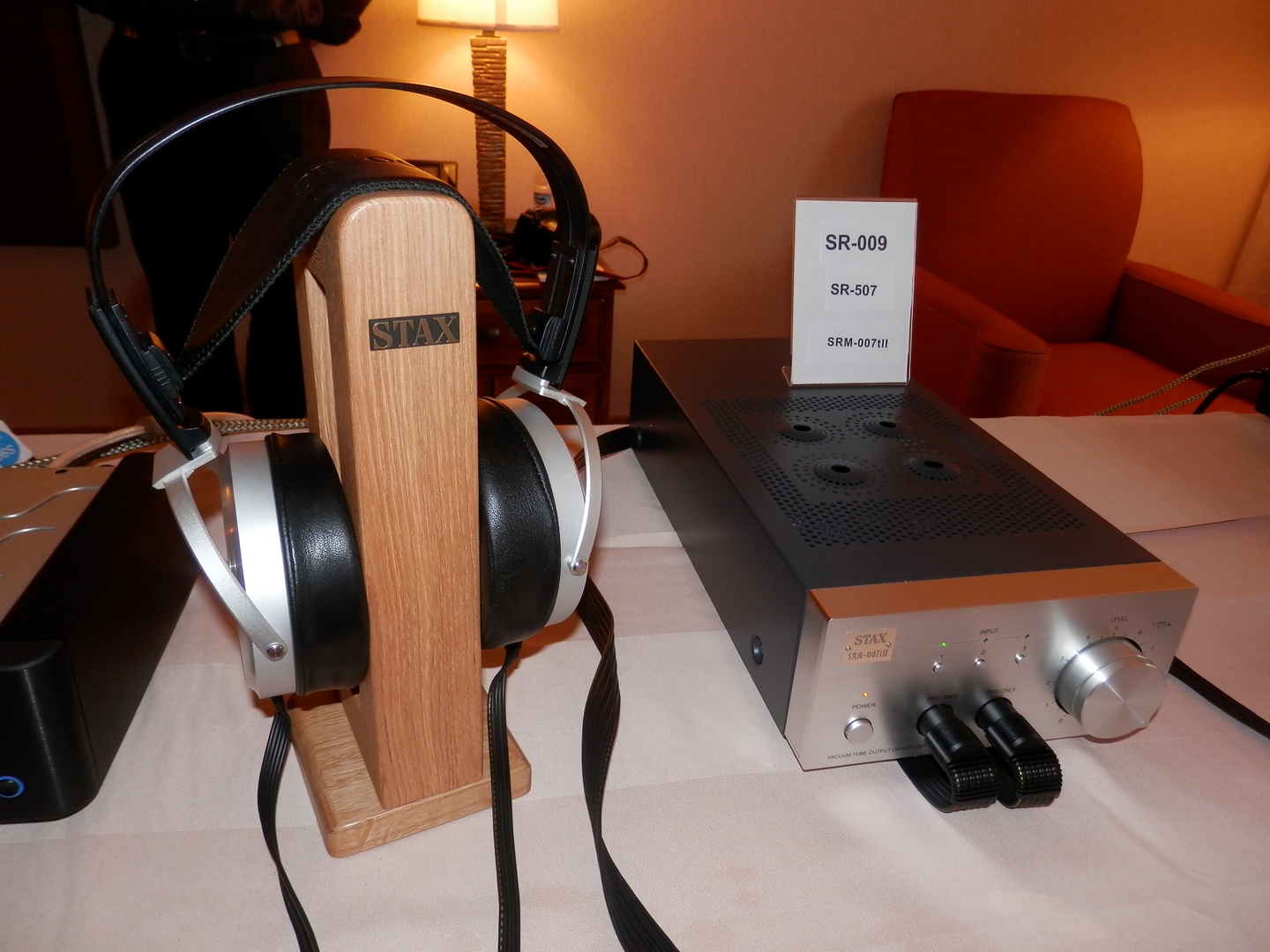
Dr. Alex Cavalli has evidently been burning midnight oil by the barrelful and as a result showed two new high-end amps at CanJam: the new Liquid Crimson DC-coupled, hybrid valve/solid-state amp for dynamic headphones ($2,850) and the very exciting Liquid Lightning II-T ($4,850). The “T” in the name, by the way, stands for Tube, which is, of course, American-speak for Valve. The LLII-T is a hybrid tube/solid-state electrostatic amplifier designed to make the very most of Stax’s awesome SR-009 electrostatic headphones (of which we at Hi-Fi+ are very big fans). The Liquid Crimson, in turn, is the long-awaited follow-up to Cavalli’s late, lamented Liquid Fire amplifier, which was a great-sounding amp in its own right and was also the first product Cavalli Audio ever made.

Prospective customers who heard the new models gave them two thumbs way, way up, and it was not lost on us that some very serious headphone makes had already purchase Liquid Crimson amps to use as their reference/demo amps of choice.

HiFiMAN

Though increasingly well-known for its planar magnetic headphones and portable high-res players, HiFiMAN rolled out a new and refreshingly affordable hybrid tube/solid-stated desktop headphone amplifier/integrated amplifier called the EF100 ($499). The EF100 breaks new ground for the Chinese firm in terms of its oh-so-elegant design motif and overall quality of fit and finish. Dr. Fang Bian, president of HiFiMAN, explained that the EF100 is primarily geared for use with analogue sources, but that it does provide a minimalist 16/44.1 USB DAC, mostly as a nod to user convenience. The little EF100 is surprisingly powerful, offering 2Wpc for more than ample headphone output, plus 9Wpc for use in driving comparatively high sensitivity speakers (making it, perhaps, just the thing for a well-equipped college dormitory room).

Light Harmonic/LH Labs

LH Labs, the subsidiary of the high-end firm Light Harmonic, is famous for its Kickstarter-funded, crowd-designed, and typically well-priced high performance headphone amp/DACs, and at RMAF LH Labs was demonstrating its nearly-ready-for-production-release Geek Pulse desktop headphone amp/DAC (~ $2,000) and its optional Geek LPS power supply ($999 – $1599, depending on configuration). In a demonstration with some very expensive loudspeakers, the new Geek pair acquitted itself admirably.


Moon by Simaudio

Moon by Simaudio is, of course, best known for its electronics and source components designed for use in speaker-based systems, but for CanJam the Canadian firm wowed showgoers with its very impressive new 430A headphone amplifier (or amplifier/DAC, depending on the configuration ordered). The 430A in amp-only form will sell for $3,500 dollars, while the amp with built-in high-res, DSD-capable DAC will sell for $4,300. Like all Moon gear, the 430A appears to be built like the proverbial “brick outhouse”, offer very high power output capabilities, and a plethora of useful features. We can’t wait to hear it for an extended period of time.

Of particular significance is the fact that the 430A comes from a highly respected high-end electronics manufacturer and, more importantly, that it shows deep familiarity with the true performance needs and wants of serious high-end headphonistas.

(Other traditional high-end electronics makers have attempted headphone amplifiers in the past, but more often than not they have failed—largely because, unlike Moon, they obviously did not grasp how sophisticated and highly-evolved the high-end headphone market has become). Welcome to the party, Moon!

Schitt Audio

OK, let me confess that I may never be able to fully make peace with this company’s puck-ish (or is that punk-ish?) name, but that doesn’t mean I fail to respect what they do. And, what Schitt brought to the CanJam 2014 party was its spectacular Ragnarok “circlotron” circuit-equipped, fully balanced, 100Wpc integrated amplifier/headphone amplifier ($1,699), complete with microprocessor controlled bias and DC offset. To say that the Ragnarok (a term denoting, in Norse mythology, the equivalent of Armageddon, or the end of the world) is sufficiently powerful to drive ANY dynamic headphone is the understatement of the year, but beyond power the Ragnarok also offers superb levels of delicacy and finesse.

Accompanying the Ragnarok was the firm’s new Yggdrasil true 32-bit/384kHz-capable PCM-only DAC, $2,299. In a fascinating, free-wheeling talk with the company’s head of product development and design, Mike Moffat (formerly of Theta Digital fame), I learned that Mr. Moffat is unequivocally not a fan of DSD, which is why the Yggdrasil (or “Yggie”, as Moffat likes to call it), is a PCM-only device. But whether one loves or does not love present-day DSD initiatives, there’s no arguing the point that the Yggdrasil is a very refined and sonically accomplished DAC—and thus is a swell companion for the Ragnarok.

In case you were wondering, the term “Yggdrasil” refers, in Norse mythology and cosmology, to a holy tree that is in essence a “tree of life”, representing the source of all things. Together, the Yggdrasil and Ragnarok are, more or less, the “beginning and the end” of things—or at least that’s the official Schitt Audio story line.

Woo Audio

Emboldened by the success and popularity of its gorgeous but quite compact WA7 “Fireflies” valve-powered desktop headphone amp/DAC, Woo Audio was showing a lovely, albeit highly unorthodox, prototype of its upcoming WA8 portable, battery powered, transformer-coupled (no, that’s not a typo), three-valve powered amp/DAC, which likely sell for around $1,500. Granted, the WA8 is pretty big as portable units go, but it looks so endless cool that we bet plenty of takers will find room for it in their backpacks.


Snapshots from CanJam at Rocky Mountain Audio Fest 2014 — Part 2

Important: This is Part 2 of a two-part Hi-Fi+ blog. 

To see Part 1 of the blog, click here.

As we mentioned in the introduction to this piece, this blog should not be contrued as exhaustive, “cover the earth” reportage from CanJam. Rather, it is — as advertised — a collection of “snapshots” drawn from a handful of products that, together, serve to illustrate some of the emerging trends we observed in the rapidly expanding universe of high-end headphone and earphone based systems. Enjoy!


HIGH-PERFORMANCE CABLE MAKERS EMBRACE THE HIGH END HEADPHONE UNIVERSE

Crystal Cables

We ran into Gabi van der Kley, head of Crystal Cables, and she informed us that high-performance headphone and earphone-based systems have really captured her imagination of late. Accordingly, Crystal has begun developing a series of single-end and balanced cables geared specifically for use with Astell & Kern high-res portable player/amp/DACs, as a well as a highly specialized cable developed specifically for use with JH Audio’s spectacular Roxanne custom-fit in-ear monitors (Gabi van der Kley’s personal CIEM of choice at the moment). These cables will be co-branded and co-marketed between Crystal Cable and Astell & Kern.

MIT

Musical Interface Technology began testing the waters for a new range of headphone cables collectively called the Vero series. Judging by the A/B comparisons made possible at MIT’s demo stand, we think the Vero cables sound very promising indeed and we await their arrival in the market place. It’s too soon to tell just yet, but expect prices for Vero headphone cables to fall in the range of $250 – $500 each.

Nordost

Nordost, too, has bought in to the headphone universe in a meaningful way by creating a Heimdal-series of purpose built headphone cables. I had the opportunity to try a set of new Alpha Prime headphones from MrSpeaker that were fitted with Nordost’s Heimdal cables and I liked what I heard. Joe Reynolds, President of Nordost, is an enthusiastic headphone user himself and that extra bit of presidential enthusiasm shines through, I think, in the finished products.

WyWires

WyWires principals Alex and Nina Sventitsky are no strangers to serious, ultra high-end cables of loudspeaker-based systems, but their firm’s most important thrust at RMAF/CAN JAM involved promotion of the firm’s new Red-series headphone cables, which WyWires regards as “a very important growth market.” WyWires’ distinctive bright red headphone cables seemed to be sprouting up all over the CAN JAM demonstration areas, with many listeners reporting that the WyWires cables offered meaningful gains in terms of perceived improvements in resolution, articulacy, and transient speeds.


NEW HEADPHONES & EARPHONES
 

Jerry Harvey Audio

From Jerry Harvey, the big news was not so much a new product (JH Audio’s announcement of its impressive Roxanne custom-fit-in-ear monitor came last year), but rather the fact that only just now is JHA production capacity for the Roxanne slowly beginning to catch up with demand.  You might think the market for a roughly $1,649 (and up, depending on materials and finish chose) CIEM would be small, but you would be wrong. In point of fact, market response to the Roxanne was so strong that JH Audio had to put on two manufacturing shifts per day and still could not begin to keep up.

Needless to say, review samples were, um, very difficult to come by. Now, however, JH Audio informs us that a review sample of the Roxanne will be prepared for us in the next few weeks (fingers crossed on that one). The Roxanne features 12 (!) balanced armature drivers per earpiece (four bass, four midrange, and four high-frequency drivers), variable bass output via an inline low-frequency output adjustment control in the signal cable, and JH Audio’s signature FreqPhase technology said to provide virtually perfect phase and frequency response across the entire audio spectrum.


MrSpeakers

Dan Clark, the President (er, Head Master) of MrSpeakers, must surely be on his way toward becoming one of the best-liked men in the high-end headphone world, largely because he so keenly grasps that people want a lot (a whole lot) of performance at less than stratospheric prices. With this said, however, Clark used CanJam 2014 as a vehicle for rolling out his most ambitious (and expensive) headphone to date: the Alpha Prime planar magnetic headphone ($999).

In the beginning, MrSpeaker offered modified—and many would say significantly enhanced—Fostex headphones, whose Fostex roots were, at first, plain to see. However, with each new successive MrSpeaker model, we see more and more of Clark’s own design ideas emerging, and nowhere is that more true than with the Alpha Prime, which starts life with the core of a Fostex driver and certain Fostex headband pieces, but winds up in a totally different place thanks to Clark’s custom-designed, 3D printed ear cup housings and to Clark’s extensive driver modifications. I got to hear the Alpha Prime fitted both with Nordost and WyWires cables and came away impressed. In my too brief listening sessions, it seemed to me that the Alpha Prime is a legitimate top-tier headphone that punches far above its weight class, so to speak.


Noble Audio

Not too long ago we offered a blog on Noble Audio’s flagship Kaiser 10 custom-fit in-ear monitors, which feature ten balanced armature drivers per earpiece, a richly engaging and involving sound, and custom finishes to die for. But for CanJam 2014, Noble rolled out a product that I, for one didn’t entirely see coming, which is a beautifully executed universal-fit version of the Kaiser 10 ($1,599, same price as the CIEM version). I compared the universal fit model vs. my own review pair of Kaiser 10 CIEMs and sure enough the universal fit model did a spectacularly good job of capturing all the essentials of the signature “K10” sound.

The only significant difference I noted is that the CIEM version does, as one might expect, offer a superior degree of noise isolation, which makes the low-frequency output of the CIEM version sound a bit more robust and weighty than that of the universal-fit version. Even so, the voicing of the two versions is much more alike than not, which is a good thing. (It is well worth noting that the K10’s enjoy an almost cult-like following among some Head-Fi members.)

Obravo

For the past several audio shows I have been following the gradual evolution of the Taiwanese firm Obravo as it has worked to develop a line of hybrid Heil/dynamic driver-type headphones (the HAMT-1 at $2,000, the HAMT-2 at $1,500, and now the HAMT-3 at $1,000), plus a new hybrid ribbon/dynamic driver-equipped headphone (the HRIB-1 at $1,299).

Obviously Obravo sees the merits of exotic Heil- and Ribbon-type drivers, but they also perceive that the excursion and output demands of contemporary headphones—especially in the bass regions—can only be properly addressed by well-designed dynamic-type drivers. Thus, the design challenge for Obravo involves finding ways to get disparate driver types to work and play well together. Are they there yet? Only time will tell when full production models become available. But let me say that Obravo’s phones have gotten better each time I have heard them at successive shows, which suggests that the company is on the right “flight path.”

Oppo

Oppo’s PM-1 planar magnetic headphone (as reviewed in Hi-Fi+ issues 115 and 116, was eagerly awaited and generally well-received. Granted, some questioned whether the initial release version of the PM-1 was not perhaps somewhat too warmly balanced or to a degree overly dark-sounding, but Oppo’s revised ear pads for PM-1 have, as Hi-Fi+ has reported, done a fine job of resolving that issue. But now, as of CanJam 2014, Oppo has released its new cost-reduced PM-2 planar magnetic headphone, priced at a decidedly down-to-earth $699.

Several observations we would offer are that A) the PM-2 is actually remarkably similar in general construction—and especially driver construction—to the PM-1, and B) the voicing of the PM-2 is, if anything, even more likely to please fans of strict tonal neutrality. True, if you look closely, you will spot areas where Oppo has trimmed costs in the PM-2 by foregoing some of the almost gem-like finishing touches used on the flagship PM-1. Nevertheless, in terms of appearance, overall design, and sound quality, the PM-2 looks like a screamin’ good deal to us.


RHA Audio

About a year ago we took note of, and eventually did a web exclusive online review of, RHA’s then reigning flagship MA750i earphone, which we felt offered terrific value. Now, we’re pleased to report that the Scottish firm has gone even further to announce its even more ambitious T10i earphones ($199 or £149), which introduce technical features unheard of at their price.

What sorts of technical features? Well, for starters the T10i uses proprietary handmade RHA drivers and uses—get this—earpiece housings injection moulded from stainless steel. Moreover the T10i ships with three sets of passive voicing filters (reference filter, or filters designed to add small judicious touches of either treble or bass emphasis), plus one of the most elaborate sets of ear tips to ship with any earphones at any price. The list goes on and on, but the bottom line is that RHA Audio, already known for offering terrific value, is pushing its own performance envelope further still, leveraging the company’s rare gift for making genuinely neutrally balanced earphones that just sound right straight out of the box. In the T10i, though, RHA gives users the the additional option of applying subtle voicing adjustments that should help these earphones satisfy an even broader range of users—still at an eminently sensible price.

Ultimate Ears

For the Irvine, California-based earphone and custom-fit in-ear monitor maker Ultimate Ears, the big news for CanJam 2014 was not so much a new product, per se, but an altogether new way of producing the firm’s extensive line of custom-fit in-ear products.

Now as most reader already know, the first step toward acquiring a new set of CIEMs involves getting a set of ear-mould impressions of one’s ears. From there, the traditional process has involved sending those impressions to a CIEM maker who works through an elaborate, time-consuming, multi-step process of the converting the ear-mould impressions into a master mould, and finally into a pair of custom-moulded CIEM earpiece housings.

Ultimate Ears, however, now has a better and much simpler process in place, where ear-mould impressions a run through a precision 3D scanner, thus creating a hyper precise 3D model of the wearer’s ear canals and outer ear surfaces, and then the 3D model is used to product CIEM earpieces via a 3D printer. This approach greatly shortens production turnaround time and, according to UE spokesman Mike Dias, also makes for an inherently precise and accurate fit for the end user. Dias says that, once UE switched to this new production technique, the company began seeing a dramatic increase in reported end-user comfort and a concomitant fall off in calls from users seeking to have their new CEIM earpieces adjusted or reworked to correct fit problems. Who wouldn’t like this sort of “get ‘em sooner, and get ‘em right in the first place” construction methodology?


Sony HAP-Z1ES ‘sort-of’ network player

To paraphrase Spock of the USS Enterprise (at least the Spock of the UK comedy song ‘Star Trekkin’’ by The Firm), the Sony HAP-Z1ES is a network streamer, Jim, but not as we know it. It cannot stream data from Network Attached Storage. It’s not a USB or S/PDIF equipped DAC, so it cannot be used to play files straight from a PC or laptop. And it’s not a CD or SACD player, so you can’t slip in silver discs and play them directly.

So, what is it, and what can it do?  It’s is a high-end music player, which stores music files on a one Terabyte internal hard disc and plays them from there. It can also stream music via a wired Ethernet, or its own built in WiFi.

The really nice thing about the Sony HAP-Z1ES is that it is also not a regular computer and so does not rely on flaky, quickly outdated, virus- and crash-prone operating systems. Of course, notionally at least anything from a CD player and beyond is a computer of sorts, and the HAP-Z1ES is no exception. It runs on a basic Linux core, however, rather than a full domestic operating system bent into shape. The result: there are a few good old-fashioned knobs to twiddle and press to select your music, as well as options from a menu. With a clear colour display to show what’s available and what’s playing. it could hardly be simpler. There’s a rather cheap plastic IR remote, but I never used it. I just downloaded Sony’s rather neat and easy to use HDD app, available for Android and iThings, and the interface became so easy quick and seamless that the remote was not necessary.

The only computer in the equation is the one used for ripping or downloading music files. Once the files are stored on a PC or laptop, they are ‘transferred’ as Sony describe, or more accurately copied, from the computer’s hard drive to the Sony’s. To enable transfers, all that’s required is to download an HAP app from the Sony website and connect both the computer and the HAP-Z1ES by Ethernet cables to a router.

So, how quick and easy was it to transfer? I had about 65 ripped CD’s and a few hi-res files on my laptop and these took the best part of the afternoon to transfer, on and off, (because the wired Ethernet link between the HAP-Z1ES and the computer dropped out a few times).  It may seem like a long time, but it was quick compared to the two hours it took recently to download just one high resolution CD length 24/96 music file over the internet.

Apart from the unexplained pauses, the Sony unit handled it all smoothly, starting up from where it left off seamlessly, even checking with Gracenote and downloading its own cover art, (though if it gets the wrong image, it’s not clear how it may be corrected). If you add files to your computer, it will add them to the hard disc of the HAP-Z1ES to match. And, if 1TB is not enough, you can add a hard drive via a USB socket at the rear and the Sony will use that as if it were internal. It will reformat this drive to Ext4, destroying any stored data on the drive, but it allows for considerable expansion needs if you want.

This might seem a sideways step. The convenience of computer audio is that it’s, er, convenient. The files on your computer can be fed easily to a DAC and the files stored on a NAS can be fed to a streamer. Once the initial setting up is completed, everything is stable and seamless. The HAP-Z1ES doesn’t do this; it creates a point of isolation between computer and computer audio, which sounds counter-intuitive, but explicable. The idea has three distinct advantages. First is the overall amount of networking skills in the prospective buyer; locking the Z1ES into an existing Ethernet network in the home is potentially fraught with problems, because Drop-outs can be a problem in the home network isn’t built for robustness, especially if you are planning to listen to music at the same time as your eldest is blatting aliens online through his PS4. Then, there’s the potential for a lot of computer components behind the Z1ES to introduce RF and EM noise, there’s the emotional link that people make with their home devices, and how that differs from laptops, and finally there’s the ‘right tool for the job’ mindset that precludes using a multi-purpose computer for a dedicated task like music replay. If one or more of these ideas resonate with you, the Z1ES might offer a solution that’s not easy to come by elsewhere.


Back to the HAP-Z1ES. Much care and attention has been lavished on mechanical construction, as well as the electronics, which are based on Sony’s ES high-end hi fi and professional audio equipment. Inside, there are two large mains transformers, both vacuum impregnated for low vibration, which power separate supplies for the digital and analogue sections. It’s all mounted within a solid frame beam and base (FBB) chassis, (refined from the FB chassis in the R and ES series) by adding a vibration damping base comprising two metal sheets of different thickness to further minimise mechanical vibration.

It’s a theme carried through the construction, and applied even to the steel mounted rotary menu selector knob and its separate enter button. While the circuit boards are mounted firmly to the base, the analogue sockets are mounted separately to the rear, with flexible connecting wires to minimise vibration transfer from the outside world. The case is mounted on vibration-isolating feet. Not surprisingly, the HAP-Z1ES is a heavy piece of equipment, but the solidity, high quality build and external finish all certainly inspire confidence.

The signal processing and D/A conversion draw heavily on Sony’s experience with eight-times direct overs. (Let’s not forget, Sony was the joint inventor of CD and the inventor of the DSD digital recording and replay systems used for SACD, so they do know a thing or two about it!)

That is highly relevant to the HAP-Z1ES, because Sony has chosen to up sample ALL input data, regardless of origin, to 128xFs DSD data, which is twice the frequency of standard DSD (therefore, sometimes called double DSD). Sony makes use of a high performance Digital Signal Processor and FPGA (Field Programmable Gate Array) controlled by a crystal clock with very low phase noise (read into that  low jitter), to convert the incoming data to DSD (as used for SACD).  Of course, the neat thing about a DSD data stream is that it is basically an analogue signal which just needs filtering to remove the extreme levels of supersonic high-frequency noise which it contains.

In the HAP-Z1ES this filtering is carried out by a combination of four analogue FIR filters per channel (basically an analogue FIR comprises simply a sequence of delays which are added back into the signal, like a tapped delay line), and a gentle passive low pass analogue filter which, between them, attenuate the unwanted supersonic noise.

It’s rather like an up-sampling DAC, which shifts all the data and hence the anti-image filtering (and its associated phase shifts), to frequencies well above the audio range. However, as we are talking about  a data rate of 5.6448 MHz for double DSD, this is a darned sight higher than even 192kHz DACs. The high frequency cannot replace information eliminated by transfer to CD, but it makes it easier to filter the ultrasonic noise of the DSD signal without affecting the audible range, minimising the potential for adding phase shifts, ringing, or early high-frequency roll off, (as can happen if the filter was set too close to the top end of the audio band). Sony claim an audio bandwidth of 2Hz-80kHz, for the HAP-Z1ES, which means the noise filter is set quite high, but to reproduce real audio information up to there would require 192kHz bit rate source material. Great for DSD fans, but if you are not one of them, this up-conversion can be switched off, as Sony have also included linear PCM D to A conversion as an alternative option available via the menu.


Added to Sony’s armoury is DSEE, (Digital Sound Enhancement Engine) which Sony has designed in an attempt to correct for losses introduced during compression (as with MP3, etc.). Hi-Fi+ readers may not be particularly interested with this feature, but, like DSD conversion, it can be switched in and out via the on-screen menu.

Of course, it is right to be sceptical about any extra digital processing, so I entered into this review with a little healthy caution. Would the HAP-Z1ES really deliver improved sound quality by up-converting to DSD as Sony claim?

Computer based audio once had more to do with convenience and less to do with quality. How things change! With 16bit 44.1kHz material ripped to mechanical, or, better still, solid state hard drives, (or to a mechanical drive and then buffered) before sending to a good DAC, it seems that some of the ills of the spinning silver disc can be overcome and sound quality elevated. Of course good higher resolution Linear PCM and DSD files betters standard CD resolution and sound quality. This is not a matter of opinion. Up till recently, DSD was the poor cousin, as it cannot be ripped easily, but now, DSD material can be purchased and stored, there is a growing band of enthusiasts who swear by it, while some may prefer hi res LPCM, and so the arguments for and against will, no doubt, go on.

Fortunately, this Sony player can satisfy all, and with files stored on the internal hard drive, the Sony has the potential to equal the quality of replay from a computer hard drive.  Listening commenced by playing my plain vanilla CD rips transferred to the Sony.  My initial (and continued) reaction was of disbelief that these files could sound so good. However, file after file and track after track played drove me to the same conclusions.

Even an old Frank Sinatra recording ‘Getting to be a Habit with Me’ from his Album ‘Songs for Swingin Lovers’ sounded fresh and new and quite remarkable for a 1956 analogue recording transferred to CD and then converted to DSD.

Old analogue recordings sound best to my ears, so it’s nice to hear them afresh even if they have been initially compromised by 16 bit 44.1kHz conversion to CD. For instance, while  playing the Moderato from Rachmaninov’s Piano Concerto No 2 and the Allegro Ma Non Troppo from the Rachmaninov Piano Concerto No 3 (Conductor Antal Dorati), I noticed soloist Byron Janis’ grand piano had a solid well grounded sound, double basses were weighty, massed violins were silky and the horns rich and sonorous. This was a fully textured presentation in which the many parts were beautifully separated. The original analogue tape noise was audible but not accentuated and the whole piece had a delightful fluidity. This was not merely lovely sound, but a more insightful reproduction of the performance, something which draws one in and holds your attention. I think that is the great achievement of the Sony HAP-Z1ES, which helps to make it a true high end product at a bargain price.

Moving up in source quality to a 24 bit 192kHz file of Elton John’s ‘Yellow Brick Road’,  ‘Funeral  for a Friend’ (a Linn Records download). The powerful synth at the intro could sound glaring and over the top via conventional DACs. However, via the HAP-Z1ES and DSD up conversion, it sounded rich and mellifluous, while bass lines were solid and punchy. In  ‘Come On Jamaica’ the tonal quality in the bass was clearly reproduced,  with everything well separated despite the density of the mix. This was a big, lush sound with seemingly vanishingly low distortion – no sign of harshness or edge –  translucent but certainly not glaring. Indeed, the sound reminded me more of an analogue master tape.

So, this DSD converted high res file sounded great, but more surprisingly, it was as though some kind of magic had been performed to make standard CD material sound less like CD and more like analogue, (or more like DSD, if you prefer!)  Many divergent musical pieces were played and my notes refer again and again to the firm punchy (well timed) bass, rich creamy mid range and smooth, textured treble, and so on.


All these initial tests were carried out with the DSD transfer on, so I wondered how much of this magic was due to the DSD up conversion.

By turning the DSD on and off, it was quite clear that, although the standard LPCM digital to analogue conversion was very good, it was the DSD conversion which sounded more natural.  DSD seemingly snapped instruments into focus and re-assembled the harmonics and fundamentals into a harmonious whole. For instance, connecting sibilants and fricatives in a more natural way to the underlying vocals – as though DSD re-aligned all the sonic parts more correctly in time, amplitude and frequency.

As just one example of many tracks tried, playing ‘Ain’t No Cure for Love’ and the ‘Song of Bernadette’ from Jennifer Warnes’ album ‘Famous Blue Raincoat’, the HAP-Z1ES with DSD revealed reverberation more clearly and Jennifer’s voice had a breathy rich, full  and natural quality to it. With DSD switched off (to LPCM DAC) her voice was flatter, thinner and instruments had a scratchy sound more like the original CD.

In general, the DSD up conversion sounded softer (but more transparent!) And true DSD best of all. Listeners used to CD and its more incisive sound may prefer DSD off. In the end it is a matter of choice, but I believe critical listening will ultimately show the DSD conversion to be the more natural of the two – not simply the smoother or less bright – for this is far more than merely a tonal difference. Well, that is my view, others may or not agree and of course the switch is there for that reason.

I played various genuine DSD sample tracks, supplied with the player, such as Herbie Handcock’s ‘Water Mellon Man’, Miles Davis’ ‘Kind of Blue’, etc., and these did sound very fine indeed, as I expected.

But, for me, the really appealing and unexpected aspect of the  HAP-Z1ES is not so much its ability to play pure DSD files, but the DSD up conversion. This means that I could listen at length to many more of my CD rips without being reminded of their origin. It is as though I have been given a new music collection. There were discs that had simply either been badly recorded or badly transferred to CD and these could not be rescued by the HAP-Z1ES. However, given a good original recording, and original digital transfer, the results could be amazing!. The few hi res files I have do sound even better, and I do want more of them,  but many of my ripped CDs sounded so good that I am now enjoying plain vanilla CD, delivered in a new and enjoyable way. So, Sony’s claims have been vindicated. The results from up converted CD may not be true hi-res, or sound as good as true DSD, but they sound very nice, thank you!

I don’t normally listen to internet radio due to the poor quality of the low bit rate sources mostly available, but I did listen to some internet radio via the HAP-Z1ES. It sounded OK, maybe slightly improved by the ESS engine. It would not be my (or, I suspect, most Hi Fi + reader’s) first choice of musical entertainment, but it is there if wanted, and sounds better than most.


Rounding up, the HAP-Z1ES  throws a curve ball on to the pitch, but may just turn out to be a game changer. At a price of £2000 it’s an audiophile bargain to boot. Though its not simply a DAC or a music server,  if you are in the market for either, you owe it to yourself to audition it against the conventional alternatives.

My only disappointment is that I cannot rip my collection of SACDs on to my laptop for transferring onto the Sony’s hard drive, or rip discs of any kind directly to the Sony. I object to paying for SACDs again as downloads (and waiting hours for them to download via the internet).  That is the big pity, but you can’t have everything!

Technical Specifications

Frequency response:  2Hz-80kHz

Dynamic range: 105dB or higher

THD: 0.0015% or less

Network

Wired Lan: 1000BASE-T/100BASE-TX/10BASE-T

Wireless LAN: IEEE 802.11 b/g/n

HDD

Capacity: 1TB*

*Some portions of the capacity are used for data management. Therefore the useable capacity is less than 1TB

Inputs and Outputs

Line Out (Unbalanced): Output 2VRMS (50kOhms)

Impedance: 10kOhms or higher

Line Out (Balanced): Output 2VRMS (50kOhms)

Impedance: 600 Ohms or higher

External port:   USB type A, High-speed USB, for connecting an external hard drive

IR Remote Out                         (For connecting a mini plug cable (supplied) or IR blaster

General

Dimensions  (WxHxD): 430x130x390mm

Weight: 14.5kg

Price: £2,000

Manufactured by Sony

URL: www.sony.co.uk

Back to reviews 

Read more Sony reviews here

Audio Cabinet Tamara 3 equipment support

There’s a school of thought that suggests the equipment table itself has no influence over the sound of an audio system, and another that proclaims no system can be considered truly ‘sorted’ until its support is taken into account.  Audio Cabinet offers a middle way.

The brand appeared on the UK audio scene at 2013’s Whittlebury Hall show. The company makes a bespoke and innovative equipment storage solution that is equally comfortable with hi-fi and home cinema systems.

The extremely clever part of the Audio Cabinet system is it contains the audio electronics ‘block’ into a pull-out rack called ‘Eazyturn’, which takes both cable and (more importantly) heat management into account. The rack sits on high-grade runners that mean you could hold up to 50kg per pull-out, rack. Then, the base of this pull-out rack incorporates a turntable (think ‘Lazy Susan’ rather than ‘Rega’), so the devices can be placed and wired up with ease and precision.

The racks themselves are 19” as standard, but don’t take front panel ‘ears’ into account (for example, amplifiers that have a larger front panel to give them a ‘pro audio’ look, such as Burmester and Audio Research). However, the bespoke nature of the Audio Cabinet concept implies a ‘no problem’ approach. If you wanted scalloped sides of the pull-out rack, to accommodate ‘ears’, that’s no problem; if you wanted a wider rack (within limits), that’s no problem either. Two pull-out racks… guess what? It can be done. There’s even an optional Russ Andrews four-gang power block, which can be screwed to the top of the pull-out rack.


Aside from the pull-out rack, there are a world of options open to the user. The solid hardwood/veneered top makes a perfect base of operations for at least two source components. Home cinema types can specify the centre portion to accommodate an acoustically-transparent front (to accommodate a centre-channel loudspeaker), and you can specify two Easyturn components, with the centre given over (as standard) to two drawers; the top designed for CD storage, and the bottom drawer… is actually two drawers in one, the uppermost is an internal slimline plush lined tray designed to keep all your remotes in one place, while the lower is extra CD storage. These are not mass CD storage cabinets, and will hold only a couple of hundred discs at most. There are also less wide Tamara 2 cabinets that hold either discs and Easyturn, or two Easyturn-sized rack systems.

Any big custom install rig, or large home cinema system, will likely have a ‘plant room’, where the electronics are held in fan-cooled 19in racks. Often, these are derivations of studio or dataserver racking systems. However, these are typically too big, ugly, and noisy for use out in the open. Audio Cabinet takes the concept into the home, using passive airflow systems to control heat (the Audio Cabinet people tested this with an old AV amplifier and a smoke bomb), and separate rear ports for power, speaker, and interconnect cables.

In truth, there’s not a lot more to say about the Tamara. It obeys the ‘first do no harm’ rule of audio design, by not undermining the sound of good equipment, even if it lacks the potentially performance-improving properties of any of the spike, spoke, pad, pod, platform, and puck purveyors (try saying that after half a dozen mojitos). It’s easy to load up, it neatly hides your equipment from view, and if you ever need to change anything, moving products out is extremely easy. What more do you need?

In sheer practical terms, the design of the Audio Cabinet limits its use with extremely thick, inflexible cables, or power cords with large Furutech plugs and sockets. At their most extreme, the inflexibility and size of some of the more exotic cables will push the pull-out rack forward on its runners, making closing the door of the Audio Cabinet difficult. In most cases, proper dressing of cables will overcome this problem, but some high-end cables are so inflexible, even dressing the cables might prove impossible. But, I suspect this is a problem that self-selects itself out of the equation; those using this kind of audio exotica are unlikely to want their audio equipment hidden away in a cabinet, no matter how well engineered.


Downsides? Well, it’s made to order, so the time from order to delivery and installation is measured in weeks rather than hours. And the end result is heavy. Bloody heavy. Our sample (one rack, one central two-and-a-bit drawer section, and a standard shelving unit behind doors, more than 1.7m wide, 600mm deep and 650mm tall) weighed in at a healthy 140kg, or 300lb in old money. Bear that in mind when thinking about using the Audio Cabinet on the top floor of an old Georgian townhouse with narrow staircases!

There’s a fairly big change happening in audio. It no longer needs to be on show. People want the performance of good audio, but are no longer willing to put up with its position of dominance in the room. One of the solutions to this is to get rid of dozens of components in favour of a one-box solution, but to others this is a compromise too far. Audio Cabinet provides a workable solution, by bringing ‘plant room’ convenience to the living room without sacrificing performance. You can keep all your existing audio equipment, without it turning your living room into a hi-fi shop. Highly recommended.

Technical Specifications

  • Tamara 3 system (Supplied with one Easyturn unit as standard)
  • Dimensions (WxHxD): 173.6x65x60cm
  • Weight: c140kg (depending on number of Easyturn units)
  • Price: from £1,995
  • Manufactured by

  • Audio Cabinet

  • URL: www.audio-cabi.net
  • Tel: +44(0)1582 450929

Back to reviews

Read more Audio Cabinet reviews

Pure Audio Phono preamplifier

Pure Audio sounds like the sort of name that we all must have heard before, yet it turns out that this is only because it’s such an obvious brand name. The surprising thing is the name has never been used before. Pure Audio hails from New Zealand and has strong links to the only Kiwi company to have made much worldwide impression, Plinius. Both the founders of Pure Sound previously worked for Plinius: Gary Morrison as an electronics engineer and Ross Stevens as industrial designer. The latter was responsible for the curved chassis look that Plinius released in 2002 and has been copied by high-end brands across the world.

Pure Audio makes a small but distinctively formed range of amplifiers, consisting of a preamplifier, Class A monoblocks, and a phono stage. All share the lattice work case design that could well have been influenced by buildings like Ai Weiwei’s ‘Birds Nest’ at the Beijing Olympics. Pure Audio’s are formed from aluminium and stainless mesh, which is not just about looks, but actually contributes to low resonance and has very little ferrous content.


While the Phono Preamplifier is the smallest piece in the range, it’s larger than average for the breed at 41cm deep. It’s also cleverly constructed out of what appears to be only two pieces of aluminium and sits on three feet; an approach seen throughout the range. Unusually, it is only a moving coil stage with fixed gain at that. As standard, it is set for ‘low to medium output’ MCs, but Pure Audio can custom set the gain for cartridges that need more or less. The reason for the absence of gain switching is the usual one. Gary Morrison puts it thus, “Switching gain compromises the RIAA accuracy, and involves contacts in low signal parts of the circuit. So our solution is the purist one. It targets the large number of MC cartridge owners.” Impedance can be changed, however, with six settings available via micro switches on the back panel. There is also an input capacitance switch that Pure Audio recommends you use, because it acts as an RF rejection filter.

Gary wouldn’t say what he had done to make this stage sound the way it does, but the fact that it is entirely dual-mono in construction and built with very high attention to detail must have a bearing. In use, it runs considerably cooler than my Trilogy phono stage and has a white indicator light that remains on until it receives a signal, at which point the light turns off. This is unboubtedly a good idea for sound, but possibly a source of confusion for the unitiated. Similarly, I once had a DNM Start preamplifier with a backlit button marked Start on the front, and when the light was on, the preamp was off; my better half once nearly threw it out the window as a result. But hey, it sounded good.

So the light goes out on the Phono Preamplifier when you plug in a record player. My personal favourite is the Rega RP10 with RB2000 arm and Rega Apheta cartridge. I defy anyone, with the possible exception of Touraj ‘Vertere’ Moghaddam, to build a faster, more revealing turntable. It may not cost a lot more than this phono stage, but is more than capable of showing off its potential. With this at the front end and a Townshend Allegri controller, ATC P1 power amplifier, and PMC fact.8 loudspeakers the fun could begin.


The sound produced was among the most open I have encountered from any source; the degree of detail, dynamics, and bandwidth it produces is shocking, and this with a none too brilliant 1980s recording by New York soul funk outfit Conjure. What becomes apparent pretty quickly is how much low level detail is being revealed; this a reflection of the very low noise floor of the phono stage and its remarkable transparency, both characteristics combining to yield the same result. You can fake transparency by emphasising the midrange, but that trick becomes apparent when you notice that the bass lacks power and extension, and the highs fail to deliver the spatial clues that they need to. No, Pure Audio is not cheating; it has built an intrinsically revealing phono stage by virtue of making the right decisions in circuit design, parts choice, and layout. In the case of Conjure, you can hear both the limitations of the recording alongside an awful lot of what’s going on with the quieter instruments in what is quite a dense mix of drums, percussion, bass, and voice. It’s a physical sound that makes the band pop out of the loudspeakers in highly convincing fashion.

An earlier recording, Joni Mitchell’s Mingus [Asylum], finds Joni and bass player Jaco Pastorius spanking their respective planks in the studio together while revering the great jazz bassist himself. Here the attack of the instruments is extremely well served because of the speed in the system; there is no overhang, which means you can appreciate the full reverb in the context of a silent background. Bringing things marginally more up to date with Leo Kottke’s Great Big Boy [Private Music] from 1991, the Pure Audio revels in the space in the recording, opening it up wider than I’ve previously heard and revealing low tympani notes that other stages have hinted at, but never elucidated so clearly. This stage is immensely sensitive to recording quality; the differences it exposes from one vinyl LP to the next are massive. This has to be picked up by the record player of course and the RP10 is extremely good in this respect, but it takes a good stage to reveal the extent of those differences. The amount of subtle percussion on Kottke’s piece ‘Ice Cream’ was also surprising. Usually, the percussion blurs a bit, so that individual instruments are hard to identify; here, it was possible to hear them.

The even newer Peace… Back by Popular Demand by Keb Mo [Sony Wonder] can often sound overblown in the bass. It’s a lush sounding record and one that this phono stage manages to deliver with all its polish intact, while keeping the kick drum clear and tight, and the bass line round and slick. The instrument that comes into its own here, though, is the Hammond organ that provides a bit of brightness against the dark, chocolaty textures of the mix.

Realising that I was just plain enjoying the Pure Audio, and not being too analytical about its performance, I made a few comparisons with my regular stage: the rather more compact but two-box Trilogy 907. This has variable gain and I run it full throttle. This may give the Trilogy some advantages over the Pure; prime among these was its sense of timing, which was distinctly stronger and drew you into the music more effectively. It also had a better sense of presence. However, it was not as open nor revealing of detail as the Pure Audio and appeared to have too much upper bass by comparison.


Going back to the fun bit of playing records through the Pure Audio, I put on Mop Mop’s Isle of Magic [Redeye],[Redeye], in which the opening track ‘Jula Kiss’ somehow created a jungle in my listening room. It literally comes alive with a vibrancy that fills the place with percussion, all the reverb is exposed, and the vibe is intoxicating. I’ve rarely been so captivated. More down to earth is ZZ Top’s album Fandango [Rhino]. This is hardly audiophile stuff, but there is plenty of detail waiting to be extracted from the groove. ‘I’m Bad I’m Nationwide’ is the stand out, and here the fizzing energy of the song is irresistible; the guitar sounds so dirty, you can hear the tubes in the guitar amp squealing for mercy. Billy Gibbon’s voice is hardly sweet at the best of times, and this degree of resolution reveals its dry, bluesy grit to perfection. But before I knew it, we were into ‘Fool For Your Stockings’, as if there was all the time in the world.

This is the first Pure Audio product I’ve heard and I have to say I’m impressed. It offers a degree of transparency that is rare at any price and adds further fuel to the ‘vinyl rules’ fire. You might be able to get this degree of openness out of digital sources, but not at this price and not without difficulty. If this is what Pure Audio can do with a phono stage, I’m very interested in hearing their amplifiers.

Technical Specifications

Input: RCA

Outputs: RCA

Gain at 1kHz: 62dB

Frequency Response: 20Hz to 20kHz +/- 0.2dB ref RIAA spec

Input Impedance: 47, 100, 220, 475, 1k, 47k Ohms user selectable

Input capacitance: 220pF switchable as rf rejection filter

Output Impedance: 100 Ohms

Distortion: <0.01% in normal operation

Hum & Noise: >80dB A weighted with ref to 5mV input

Power Consumption: 15 Watts

Dimensions: 410mm deep, 210mm wide, 115mm high

Weight: 7kg

Price: £3,295

Manufacturer: Pure Audio

URL: www.pureaudio.co.nz

Distributor: Absolute Analogue

URL: www.absoluteanalogue.co.uk

Tel: 020 8958 0707

Back to reviews

Read more Pure Audio reviews here

Chord Company Sarum Tuned ARAY cable system

In issue 107, Hi-Fi+ regular Jason Kennedy enthused over Chord’s Sarum Tuned ARAY cables in a digital and analogue interconnect context. But Hi-Fi+ has by tradition determined the true potential of a cable in a full front-to-back context, also dubbed the ‘coherent cable loom’. The Chord Sarum Tuned ARAY is an excellent example of this ethos in action, and demonstrates the importance of getting all your ducks in a row, from an audio perspective.

There’s a commonality to the cables. They all use ‘micro-polished’ silver-plated multi-standed oxygen-free copper conductors, with gas-foamed PTFE insulation, and heavy gauge foil shielding throughout. There are three conductors twisted around one another (two conductor sets for the speaker cable), with one send-two receive conductors in the inherently directional interconnects. The power cords are terminated with high-grade Furutech plugs and sockets, while Sarum interconnects use Chord’s own low-mass silver-plated copper and acrylic plugs. The speaker cables can be terminated in 4mm or spade lugs, but – as with all products in the Sarum range – this must be performed at the Chord factory.


How Tuned ARAY came about was from Chord’s digital cable models. One of the issues in a 75 ohm digital coax cable is it’s very difficult to keep it consistent (BNC improves matters, but the standard RCA phono is almost perfectly designed not
to maintain a consistent 75-ohm impedance across a cable). Chord tried to find ways to reduce reflections in the cable, and experimented with using a short additional tail connected at one end of the cable, not unlike a flying earth lead, only internal (so not ‘flying’). This worked… and worked a whole lot better when the tail was ‘tuned’ to the length of the cable itself. And the subsequent improvement wasn’t just applicable to the digital domain; it applies across the board. Well, almost… Tuned ARAY benefits apply to RCA and XLR interconnects, USB and 75-ohm digital interconnects, ‘streaming cable’ (it can’t be called Ethernet cable because the Tuned ARAY is not bi-directional), and power cords, but the loudspeaker cables are not subject to the same demands, and Chord hasn’t found a way to apply the Tuned ARAY technology to loudspeaker cables.

Taken individually, the Chord Sarum/Sarum Tuned ARAY cables deliver a sound more like a really well-thought-out component upgrade, than a change in a passive component. To be perfectly honest, I’m used to hearing very good cables, but the level of improvement these bring about is fairly substantial. You need to have very good equipment in order to benefit from Sarum/Sarum Tuned ARAY (because you stand a chance of highlighting weaknesses in mediocre electronics), but that’s fairly likely, given the price. As with pre-Tuned ARAY Sarum, it simply draws you into the music, leaving the reviewer with a note pad full of musician’s names. Sarum shows you why you like music, and why you like given musicians. It’s not a panacea – Sarum will never make me like Eric Clapton, for example – but it will make me want to run out and buy the next Kurt Vile album based on his last, so precise Sarum’s musical insight. There’s a greater sense of balance and order to the sound – the level of insight into the music could be mistaken for brightness with Sarum, and this is replaced here by absolute clarity. I didn’t have a pair of Beryllium-tweetered Focals around for this test, but I’m convinced where the Sarum and Focal mix was not a good one (two insights making a brightness), the pair would be a better match now.

What this doesn’t do is upset the balance of your system, unless it is more teetering on the edge rather than ‘balanced’. If you have an Audio Research CD player and amplifier, the Sarum/Sarum TA just reminds you why you liked Audio Research; if you use Naim, it brings out the inherent properties of Naim. It’s not a chameleon of a cable, but like the perfect host, it has abilities to bring out the best in those around it.

Use a complete Sarum run, however, and, these properties increase significantly, coupled with a clarity that takes on a depth and physicality leaving you hungry for more music. It’s like you started taking lessons in music theory; the sounds you hear just become that much more understandable and correct–not simply tonally, or even temporally, but in terms of melody, harmony, counterpoint, and form. And the really weird part is that the Sarum helps you ‘get’ musical interval in a way that normally requires a lot of ear training. This suggests a system whose elements were designed from the outset to work together, not a motley set of cables with the same name. The Chord Company is one of the few brands that fundamentally understands this ‘joined-up thinking’ approach to cable design, and the Sarum Tuned ARAY is the company’s ultimate expression of that approach.


Paradoxically, this does not in any way undermine the findings of Jason Kennedy in issue 107. The process of getting all your musical ducks in a row is not an easy one, and many find it a hard concept to fathom. They will be drawn to reviews of individual cables to find ‘the best’ for their system. And Chord Sarum Tuned ARAY will, in many systems, be that ‘best’, in the ways intimated by Jason Kennedy in issue 107. But this is also a beachhead for that global concept. The Chord Sarum Tuned ARAY interconnect delivers the sort of coherence and insight that makes you able to listen into music at all kinds of volumes and gives you the ‘wow’ factor a really top-class interconnect can bring to the table. But, when you begin to hear the same things happening to the same extent and in the same direction by adding Sarum Tuned ARAY loudspeaker cables and power cords, it starts to push the hodgepodge random assemblage of cables formerly used out, and the global approach takes over.

The naysayers will dismiss this as so much audiophile folly. They will suggest that input and output impedance alone define any possible differences in the electrical connection between two devices. They will also say there is no magical properties imbued by one cable that can be transferred across the entire system. Finally, any suggestion that a power cord can make any difference to the performance of a component will be met with a series of guffaws. They might be right to think there is no way that Chord’s Sarum Tuned ARAY used in a complete systemic context can have an effect that makes the sum of the system sound greater than its component parts. But I don’t think so. I think most people who listen to their system for enjoyment instead of point-scoring will like what Sarum Tuned ARAY does between individual components and they will like the results even better as a more complete set of Sarum Tuned ARAY cables is inserted into the system. In part, because what the Tuned ARAY concept seems to bring to the table is a sense of consistency, levelling the differences in input and output impedance between products. As a result, I think they will like what the whole ‘ducks in a row’ cable system does so much, that they will look upon the arguments of the naysayers with incredulity.


Normally, the kind of cable systems that demonstrate this level of systemic performance boost have the word ‘monocrystal’ in the description; and typically that means recabling a system in a global context represents a major financial investment. Chord Sarum Tuned ARAY is not a trivial investment if you think of it in whole-system terms, but that investment is in line with the kind of top-end equipment with which it works. In other words, it’s the cost of a new car, rather than the cost of a new house. That doesn’t make it a bargain, but it does make it attainable over time… and given that the performance of Chord’s own Indigo Tuned ARAY and Signature Tuned ARAY are in the same ‘groove’, it is possible to make a full Sarum Tuned ARAY cable system a goal to be attained over time, in a structured upgrade path, should you wish.

Finally, for owners of pre-Tuned ARAY Sarum; Chord can upgrade your cables. It makes a huge difference, in all the ways that made you buy Sarum in the first place, without any downsides. Just do it.

Technical Specifications

Conductors: Precision polished, heavily silver-plated, multi-strand copper, three conductors per cable (RCA, power), two in loudspeaker system

Shielding: High density heavy gauge foil dual system

Dielectric: Internal foamed PTFE

Ultra-lightweight contact acrylic damped RCA plugs (interconnects), Furutech power connectors (power), custom 4mm, spadelugs of BFA connectors (loudspeakers)

Price: £1,600 (2x1m, RCA interconnects), £1,650/1.5m pair (speaker cable) + £550 per additional mono metre, £1,100/1m (power cord)

Manufactured by: The Chord Company

URL: www.chord.co.uk

Tel: +44(0)1980 625700

Back to reviews

Read more Chord Company reviews

MartinLogan Montis

MartinLogan has a special place in the heart of audiophile enthusiasts. Despite many on the English audio scene feeling that the UK ‘owns’ electrostatics through the medium of Quad, MartinLogan sells well here. And the Montis is the latest iteration of MartinLogan’s hybrid approach, which combines an active dynamic bass unit with an electrostatic mid-top panel.

The Montis is at the base camp below the Summit X. The two share more in common than you might expect, with both using the same electrostatic panel. The principal difference in fact is the use of two bass drivers in the Summit X and one bass unit in the Montis. That makes the Montis notionally similar to the Spire loudspeaker it replaces. However, the Montis shows how much loudspeaker technology can move forward in a few short years.

The key to the Montis’ bass is the combination of 250mm long-throw aluminium woofer in a sealed cabinet, a 200W power amplifier, and – perhaps most significantly – a move away from analogue filtering to DSP network control, which takes on equalisation, limiting, and filtration. The net result makes the Montis slightly easier to install (it means just one level control on the rear panel) and helps integrate that bass unit with the 112cm tall CLS (curvilinear line source) panel. MartinLogan has several proprietary technologies attached to the panel and the cabinet, including the XStat panel and the AirFrame it’s attached to, the MicroPerf stators, and the Vojtko filtering and 24-bit DSP. Naturally, it bristles with custom-wound audio transformers, air-core coils, and high-grade polypropylene capacitors. However, these elaborate technologies are deceptively simple to use, leaving owners with nothing more complex than one 100Hz dial (with a ±20dB scale), the choice of spikes or feet, and speaker placement to play with. In other words, the Montis is the loudspeaker equivalent of a swan; graceful on the surface, but there’s a lot of work going on underneath.


The combination of the slim, curved, and transparent stator panel resting on a matching bass, er, base, gives the loudspeaker a design refinement that is rare among loudspeakers. This applies to most MartinLogans, but is worth restating periodically; unlike many loudspeakers that hark back to a time of marquetry or reflect a brutalist school of minimalism, the Montis is one of the few loudspeakers that could be considered attractive by non-audiophiles. It’s the view-through panels; they give the speaker a user-friendly demeanour. According to the manual, Montis is comfortable with any amp from 20-500W, but I’d err on the side of power to drive these speakers the way they’d like to be ridden.

The manual is exceptionally good at describing both the raw and fine tuned installation, and is closer to ‘a good read’ than most. It describes the way to position your speakers, how to fine-tune that positioning (and in particular, what to listen for when fine-tuning), room acoustics, troubleshooting, a history of electrostatics, and more. Some of these aspects relate specifically to MartinLogan speakers or electrostatics, but a lot is solid, universally-applicable audiophile gold for the wannabe loudspeaker installer.

The loudspeakers benefit from taking the installation seriously, so it’s worth taking time over. The speakers should begin with the centre of the front of the panels roughly 60cm from the rear and side walls respectively, and the listener seated at least as far from the speakers as the distance between the speaker, but not more than twice the distance between the speakers (and not close to the rear wall). You should then adjust toe-in using a torch from the listening chair, and then adjust the speaker position to get the best bass response, stage width, and imaging. The manual suggests a trial-and-error method for final placement which is almost perfect (it misses out on two things in my opinion; that electrostatics frequently need to settle after movement, and to mark out the speaker position with low-tack masking tape at the start of the fine-tune process, for milimetre-accurate adjustment and in case it all goes wrong and you need to re-start the process). In terms of partnering equipment, the Montis is extremely unfussy. It respects great quality audio, but does not demand it, and does not throw a sonic hissy fit if it isn’t partnered with the world’s best sources. The loudspeaker itself is fairly sensitive and capable of playing loud, and not simply ‘loud for an electrostatic’. It works best with some power behind it, and it doesn’t need the gentle touch of Class A to sound good.


It was the last week of Wimbledon when I wrote the first draft of this, and it occurred to me that Montis is all about the inner game of audio. It taps deep into the audiophile DNA, making a sound that is as captivating as it is beautiful. This is a speaker for people who cry at operas, but it’s also for people who play air guitar to ZZ Top, and those who compose poignant haiku in their heads while solving grand-master grades. If you don’t have some choral music in your collection, the Montis will gently, but firmly, direct you in the direction of Thomas Tallis, and in particular the Tallis Scholars singing Spem in Alium [Gimell CD]. The precision and purity of the voices, coupled with the sense of space in recreating the Merton College chapel in Oxford, gives a sense of religious passion so profound that it makes me want to burn some witches.

I then played ‘Son of a Preacher Man’ from Dusty Springfield’s immortal Dusty in Memphis album [Philips CD], and she was singing for me, just for me. And, in the manner of all good 1960s albums, she’s there front and centre, singing into a sweet tube mic with an equally sweet tube mic amp behind that, the backing vocals are panned left, the horn section and percussion panned right, but not sharp left or right. It just sounds wonderful.

If all this might make you think of something soft, rolled off, and incapable of playing rock, guess again. Out came ‘IM the Supervisor’ from the Infected Mushroom album of the same name [BNE, CD] and gave it some throttle. And it’s perhaps there that makes the Montis shine; no careful handling, just speed, accuracy, and level. If you want to get really nasty about this, I even played ‘Shake Yer Dix’ by Peaches from her really rather unmentionably-named album and it rocked out with its… well, you know.


It would be remiss of any reviewer of hybrid loudspeakers not to discuss the integration between dynamic bass and stator mid-top. But it’s a non-issue; the integration simply happens. The bass flows into the midrange and vice versa as if you are listening to one drive unit, not two different technologies. In fairness to MartinLogan, the company nailed this some time ago, especially with the Summit X, but this brings that fluidity across the bandwidth to the Montis level, and if you know how difficult that is, you also know how much respect it deserves. There wasn’t a single plot hole here; the bass is fast enough to keep pace with the panel and when correctly dialled for the room, the sound is seamless.

This turns the Montis into a kind of gateway for dynamic loudspeaker users. The pace and solidity of the Montis sound thanks to that bass driver will find favour with those weaned on box speakers, and they will be won over by the expansiveness of the electrostatic panel, possibly for years to come. The pithy way of summing this up; you come for the bass line, but you stay for the vocals.

In a way, the Montis is a more European-friendly loudspeaker than the Summit X. This may be a sweeping generalisation of truly epic proportions, but the combination of room size, room construction, and an acceptance of the kind of loudspeakers that work well in such rooms, means audiophile bass is something to be tamed here, and delighted in ‘across the pond’. The Summit X, with its greater bottom end authority, can potentially over-drive the bass in our typically smaller, solid-walled rooms, while the Montis is the more comfortable match. This is, in fact, more a function of installation rather than criticism per se – correctly set, the Summit X has even greater bass control along with bass depth. However, it is a sad indictment of many systems (especially those that are one or two users away from a professional installation) that the quality of set-up is ‘more honoured in the breach than in the observance’. While good installation is important in any system, it is critically important in electrostatics and the balancing of a bass unit to the stator panel. That there is slightly less to get wrong with the Montis (from a European perspective) should make it a better sounding loudspeaker in a wider number of homes. Very highly recommended.

Technical Specifications

Type: Two-way, two-driver, floorstanding speaker with electrostatic panel and active, DSP-driven sub-bass enclosure.

Driver complement: One 1118 × 287mm electrostatic transducer; one 254mm cast basket, high excursion, aluminum cone with extended throw drive assembly, non-resonance asymmetrical chamber format.

Crossover frequency: 340Hz

Frequency response: 29Hz – 23kHz (±3dB)

Impedance: 4 Ohms. 0.52 at 20kHz

Sensitivity: 91dB/W/m

Amplifier power: 200W/ch (4 ohms)

Inputs: One pair custom multiway connectors

Dimensions (HxWxD): 1505 × 322 × 457mm

Weight: 26.3 kg/each

Finish: Black Alloy with Black Ash, Dark Cherry, or Zebrawood as standard. High Gloss finish also available

Price: £9,800/pair standard finish, £12,900/pair high gloss finish

Manufactured by: MartinLogan

URL: www.martinlogan.com

UK Distributor: Absolute Sounds

URL: www.absolutesounds.com

Tel: +44(0)208 971 3909

Back to reviews

Read more MartinLogan reviews