Up to 37% in savings when you subscribe to hi-fi+
hifi-logo-footer

Begin typing your search above and press return to search. Press Esc to cancel.

Postcards from Las Vegas (part two)

In Part 1 of our ‘Postcards from Las Vegas” series, Hi-Fi+ Editor Alan Sircom provides and excellent overview of the 2015 CES event. For my part of the article, however, I thought I might provide just a small series of snapshots of a tiny handful of products that caught the eyes and ears of high-end listeners in attendance at the show. My small grouping, here, should not be construed as any sort of ‘Best Of’ list, but rather as a collection of products that created no small amount of ‘buzz’ at the show.

Great Sound, full-sized speaker based systems

Raidho X-3 floorstanding speakers and Aavik integrated amplifier/DAC

Raidho is justly famous for its C and D-series monitors, which have garnered a reputation for offering exceptional detail, resolution, dynamic contrasts, and a wonderful quality of emotional nuance. Still, some at Raidho felt a certain something—call it the ‘fun factor’ if you will—was missing. With an eye toward recapturing this elusive fun factor, while still retaining all or nearly all of the traditional Raidho virtues, designer Michael Borresen has created the new Raidho X-3 tower-type speaker ($30,000/pair).

The X-3 driver array comprises a centrally positioned ribbon tweeter that is flanked by two pairs of relatively small-diameter ceramic mid-bass drivers, with a larger side-firing bass driver occupying the lower section of the X-3 cabinet. The end result is a speaker that is very, very special indeed—one that possesses most of the resolution, focus, and nuance of the flagship C and D-series models, but that offer, for its price, considerably deeper bass extension and the ability to—how shall I put this?—flat out boogie. For our point of view, this makes the X-3 the Raidho for all seasons and reasons, and who wouldn’t like that?

Ably abetting the X-3 in its mission is the new Aavik integrated amplifier/DAC, which offers power, subtlety, and nuance aplenty, striking an uncanny balance between the ability to dig (very) deep into recordings to capture their innermost details, while also exhibiting unfailing musicality. Our only thought is that prospective customers who already own fine electronics components are likely to demand that the Aavik DAC be sold as a separate component in its own right.


Great Sound, headphone based systems

HiFiMAN HE-100 planar magnetic headphones and EF-1000 hybrid valve/solid-state headphone/integrated amplifier

If you have ever wondered what a cost-no-object HiFiMAN headphone/amp package might be like, then the HE-1000/EF-1000 pair provides your answer. Both new components are spectacular in their own rights, but to our thinking the HE-1000 must stand as ‘first among equals’ for its ground-breaking design.

Company founder Dr. Fang Bian earned his doctorate in nano-chemistry and he brought his expertise in this field to bear in the development of the HE-1000 by creating for this headphone a true nano-material diaphragm (this in contrast to some other designs that apply nano-material coatings to much thicker diaphragm materials). The result is diaphragm that is extraordinarily light, low in mass, and incredibly responsive. Not surprisingly, then, the HE-1000 seems to offer traditional planar magnetic virtues aplenty (including powerful and nuanced bass, wide range frequency response, and vivid dynamics), plus staggering levels of resolution and detail. For the listener, the net effect is not unlike having one’s ears and brain ‘hard-wired’ to the original recording console, which affords an exceptionally intimate view of the music.

Supporting the HE-1000 is the also very impressive two-chassis EF-1000 amplifier. The amp can be used either to power headphones or full-size speaker systems, with output, in class A mode, of 50Wpc or, in class A/B mode, 150wpc. As you can imagine, the EF-1000 offers superabundant power for purposes of driving most any dynamic headphone you might care to name.

Pricing for the HE-1000 and EF-1000 has not yet been determined. Dr. Bian advises, too, that good though the HE-1000 prototypes shown at CES are, he has a few more performance tricks up his sleeve that he expects to implement before the headphones are released at some point in mid-2015. Judging by the sound of the system, we anticipate pricing to be very high (as the products are arguably worthy of premium prices).


ENIGMAcoustics Dharma hybrid electrostatic/dynamic headphones and Athena A1 valve-type (single-ended triode based) headphone amplifier.

ENIGMAcoustics is best known for its self-energised electrostatic supertweeters, but for more than a year now the firm has been working on its design for a new hybrid electrostatic/dynamic driver-equipped headphone, called the Dharma ($1,200). The Dharmas incorporate electrostatic drivers that are self-energised and thus require no outboard power supplies, unlike most other brands of the electrostats. Complementing the Dharma is the lovely Athena A1 valve-type (single-ended triode-based) headphone amplifier.

Though I had time for only a cursory introductory listen, the Dharma/Athena A1 pair well and truly blew my mind, and here’s why. This pair provided what stands out in my mind as the most spacious and compellingly three-dimensional sound I have ever heard form any headphone system to date.

At times, the Dharma/Athena A1 created the compelling (though in my experience extremely difficult to achieve) illusion that sounds were literally emanating from far, far outside the headphone’s ear cup housings. In practice, this meant the Dharma and Athena combo yielded amazingly wide soundstages with very, very precise placement of vocalists and instrumentalists within those stages. Most impressive.


Compelling Bargains

GoldenEar Technology Triton Five floorstanding loudspeakers

GoldenEar’s roughly $5000/pair Triton One floorstanders with active built-in subwoofers have garnered no small amount of critical acclaim throughout 2014, but for an encore the firm announced its purely passive Triton Five floorstander ($1998/pair)—the firm’s most ambitious passive loudspeaker to date.

The driver array of the Triton Five is deceptively simple, comprising a centrally positioned Heil-type HVFR tweeter flanked to a pair of very wide-bandwidth 6.5” mid-bass drivers. Then, to provide low-end support, the Triton Five incorporates two horizontally-opposed (and thus vibration cancelling) pairs of passive radiators.

As we have by now come to expect from GoldenEar, the sonic whole of passive Triton Five is much greater than the apparent sum of its parts. How good is it? Let’s just put it this way. First time listeners who had read our and other publications’ reviews of the Triton One walked into the GoldenEar sound room and mistakenly concluded—purely on the basis of observed sound quality—that the Triton Five was surely the more than twice as expensive Triton One (itself a stunningly good value). As you can imagine, those listeners were stunned to learn they were in fact hearing the Triton Five, a loudspeaker that will sell for a tick under $2000/pair. The value for money on offer here is clear off the charts.


Audeze

The US-based planar magnetic headphone maker Audeze had a very good year in 2014, with both the firm’s LCD-X and LCD-XC headphones ($1,699 and $1,799, respectively) garnering considerable acclaim from the high-end audio press. But for 2015 Audeze has moved in a new and unexpected direction to create two new, very high-performance, yet easy-to-drive and decidedly cost-reduced new planar magnetic headphones: namely, the open-back EL-8 and the EL-8 closed back models, both selling for $699 each. But do not be deceived by the accessible prices. Judged purely on the basis of sound quality, either of the EL-8 models could easily pass for mid-$1000 range units. They’re that good.

How did Audeze achieve this result? Well for industrial design assistance, Audeze turned to none other than the BMW Design Group, which helped create a fresh, distinctive, upscale, and up-to-the-minute look and feel for the new ‘phones. On the inside however, Audeze pulled out even more stops, leveraging three distinctive patent-pending technologies known as Fazor, Fluxor, and Uniforce technologies.

In simple terms, Fazor technologies offer a waveguide that helps smooth wave launches from the ear side of the headphone’s driver. Fluxor technology, in turn, is a proprietary magnet configuration system that focuses the lion’s share of the magnet array’s flux field toward the diaphragm side of the magnet array—thus dramatically increasing the headphone’s efficiency. The only minor catch is that Fluxor technology does tend to introduce flux field ‘hot spots’ in certain localised areas across the driver diaphragm. To address this issue, Uniforce technology is a proprietary method of widening or narrowing conductor traces on the driver diaphragm to compensate for the aforementioned flux field hot spots. As a result, the driver diaphragm experiences uniform driving for across its entire surface area. A clever solution, no?

I heard both EL-8 (pronounced ‘elate’) models driven from the new Pono player, whose electronics were developed by none other than Ayre. The results were very impressive indeed.

__________

Watch for more in-depth CES coverage from Hi-Fi+ over the next several days.

In the meantime, and as always, we wish our readers happy listening.

Postcards from Las Vegas (part one)

CES is the annual hub for consumer electronics. The world’s technology makers, sellers, and press are all assembled together for a week in early January, to paw over the latest (and occasionally greatest) consumer electronics products. But it can be trumped – I was sitting in a conference several years ago when the Apple iPhone was announced at a rival expo, and news services began packing up their equipment mid-way through the keynote speech. This year, the tragic events unfolding on the streets of Paris overshadowed much of what took place in Las Vegas, effectively silencing the mass media on the subject. CES is a bit of a bubble in and of itself, but many journalists were seen wearing ‘Je Suis Charlie’ stickers on their press passes in sympathy.

Although this year saw highest-ever attendance figures and the booths in ‘the zoo’ (the Las Vegas Convention Center) were mobbed, the specialty audio section was a distinctly quieter event than usual. In part, this was down to a lot of the European manufacturers and distributors deciding that there was no point coming to Vegas if high-end audio comes to Munich in May, and Asian manufacturers and distributors increasingly looking to CES Asia and the Hong Kong Audio Show as viable alternatives to Sin City. However, the show also marked something of a return to form for the home market, with US distributors and dealers forming a significant proportion of the show’s traffic. Frankly, the lack of T.H.E. Show (which is focusing on Newport Beach later in the year) had more effect than might be expected, and the number of weird and wonderful designs in general, and ornate turntable fantasies in particular, was sorely missed.

The show was not without its interest, however. And one point of interest for many was changes over at Audio Research. Terry Dorn, former head of ARC, has stepped down;  his replacement, Mike Tsecouras, comes from a Texas Instruments background. Fortunately, Mike is no simple bean-counter; he was the person who started TI’s digital audio division, who started the Burr-Brown division, and has been a keen member of the Audio Research ‘family’ for many years, having been at first a keen user of the company’s products and more recently an active participant in the design of many of its products. His taking on the roles of CEO and CTO at the company is a logical step for so passionate an audiophile, and we joked that the reason he’s taken on Audio Research is to find some space to store those ARC boxes that clogged up his garage! On a personal note, if there’s someone in this industry more keen, more dynamic, and more happy to take on the top job in an audio company, please point them out to me!

If last year could be summed up as the rise of streaming, this year it came down to a world of consolidation. Companies that last year added a streaming design to their portfolios were either integrating the technology deeper into the range, or had quietly dropped the idea. Perhaps the most ambitious system integration concept of all was that by Boulder, in its upcoming 2120 digital converter. A fully UPnP and DLNA compliant media renderer, the DAC (itself the size of most power amplifiers) is actually five separate chassis in one, with the control architecture connected to the rest of the DAC by 10GHz comms and Ethernet connection. Not only does this help keep the noisier sections of a streamer away from the ultra-sensitive 32-bit, 384kHz/Double DSD DAC stage and the dual mono outputs, but it also presages a new way of designing ‘front ends’ for Boulder equipment in general; subsequent preamps and even power amps will sport a more Ethernet-enabled front panel, not only to lower noise, but to allow a wider window on the functions of the amplifier (it’s a big screen), and allow it to act as a control point that can be driven by any Open Home device. Granted, as the 2120 is expected to cost a little under $60,000 this is grand-scale integration, but the technology is changing fast.


At a more down-to-earth level, Lenbrook is very actively pursuing integration between its NAD, Bluesound, and even its PSB platforms. So, it’s possible to stream music from a Bluesound server to a NAD Masters Series DAC, or even to an Ethernet-enabled active loudspeaker from PSB. The number of permutations and combinations of all three brands is staggering, as NAD is incorporating this kind of connectivity across the board, and even into its new blade rack amplifier system (albeit for control and monitoring), but this seems to be an ongoing trend.

And, speaking of trends, the Big Audio Thing this year was CD-grade streaming service TIDAL. The service was everywhere, to such an extent bandwidth was severely compromised throughout the halls of the Venetian Tower, preventing wi-fi access for visitors!

For all the approaches in this, though, I like the D’Agostino route for its relatively low-cost implementation… which is possibly the first time the words, “D’Agostino” and “low-cost” have been seen together. Dan D’Agostino has developed a variant on the Momentum integrated amplifier called the MLife, which replaces the Momentum’s tone controls with a fully-featured wired and wireless streaming client device, controlled by either the five-inch LCD display or the excellent new iOS or Android app. Momentum owners can choose to upgrade to the MLife variant for about $3,000, while the MLife itself costs $48,000; $3,000 more than the Momentum.


Although big-ticket items were on show throughout CES and its attendant off-piste events, perhaps the other big news was a perceptible shift away from the super-high-end. Faced with an audience of more pragmatic US distributors and dealers, products with ‘sticker shock’ prices were often met with a resounding  “I can’t sell that!”. While hardly a return to sensible prices, perhaps audio has finally reached its price ceiling, and manufacturers were mostly using CES 2015 to launch products in the middle of the range rather than the extreme top. So YG showed its excellent new Carmel 2, VTL launched its TL6.5 Series II Signature Line and its entry-level TL2.5i preamplifiers, Ayre showcased a prototype Codex headphone amp and DAC that forms the start of a new lower priced range, and PS Audio announced the new BHK-250 hybrid stereo power amplifier, which takes its name from its designer, Bascom H King.

Of course, the higher-end and even the ultra high-end were well covered, too. Magico’s new QSub18, for example, was a $36,000, 2×18” subwoofer, driven by 6kW of amplification and extensive in-house DSP. So heavy it was bending a marble floor, and so powerful (it needs two 20A sockets to drive it), it was literally dimming the lights on every bass note, but if a job’s worth doing…

We’ll be covering all of these in greater depth over the next week or so, but finally no discussion of the 2015 high-price/low-price dichotomy could be considered complete place without mentioning Wilson Audio. Why? Because it had feet in both camps, launching the new Sabrina floorstanding loudspeaker – the company’s new entry point – and announcing the rebirth of the WAMM loudspeaker at the new top-end of audio. Photos, recorders, and the rest were banned from the WAMM launch, but think of the 2015 WAMM as a taller (and from the front, more slender) version of the Wilson Alexandria XLF, with five adjustable modules for mid and treble (in place of three), above two bass units. This time though, there are no more electrostatic panels. Price was one of the many topics not open for discussion about the WAMM, but expect it to be beyond that of the current combination Alexandria XLF/Thor’s Hammer flagship both in price and performance. 

AVM Inspiration CS2.2 system

Back in the late 1970s, the music centre (as it was once called) was the popular choice among non-audio enthusiasts. This was a time before ‘small’ and ‘minimal’ were the orders of the day, so they looked like a cross between a studio mixing desk and the flight-deck of an aircraft carrier. It was a good idea in theory, but one that was chronically hampered by the performance of the electronics at the time. However, the second decade of the 21st Century has witnessed the rebirth of the music centre, but this time it comes with great performance in tow. Which means the AVM Inspiration CS 2.2 can be considered the spiritual heir to the music centre, without any sense of the pejorative.

As with its forebears, it’s easier to describe what this modern-day take on the music centre doesn’t include, than to list what is available in the one comparatively small and well-made box. So, there’s no SACD and no DoP DSD support, there’s not much in the way of provision for multichannel or home theatre systems, and you can’t use the CD mechanism to rip discs to an external computer. It also won’t make its own electricity, can’t solve quadratic equations, and won’t make you like Brussels sprouts (unless pan-fried with garlic and pancetta).

There’s a phrase I all but threw away in the last paragraph, that deserves some serious unpicking: ‘well-made’. In fact, ‘unpicking’ is a very good term here too, because at first glance you might struggle to see how it’s put together. Although not an entirely screwless case, this brushed black or silver aluminium design drips quality – not in a back-breaking, high-mass way, but made in the way you’d expect from a country obsessed by car shut-lines and precision engineering. We’ve seen this before from AVM, but the no-compromise approach to design seen on the company’s high-end separates is writ just as large in one small box. It’s the feel of the buttons, the resistance on the volume control… all the kind of things that shouldn’t make a difference, but bespeak of assured quality.


On the inside, things are positive too. As the name suggests, the Inspiration CS 2.2 features a built-in CD player, but it also has a phono stage, and a surprisingly good MM and MC one at that. It has three analogue inputs alongside coaxial, USB, and Ethernet digital inputs (all automatically upsampling to 24/192), and it has an FM tuner with RDS. There’s no DAB, because it can stream internet radio through its UPnP/DLNA Ethernet connection. There is an update USB socket, allowing the Inspiration CS 2.2 to adapt to future changes in audio as and when they emerge. It has a Class D 165W per channel amplifier for loudspeakers and a decent amplifier for headphones. All of which could be describing any one of a number of ‘all-in-one’ systems, so where does the ‘21st Century music centre’ come in? It comes in for the by-passable tone controls, and even loudness, set and adjusted through the blue fluro front panel.

The interface doesn’t just include tone controls; you can assign names, trim input levels to precisely match sources, and even skip over unused inputs. These are all ‘front end’ aspects of use, in that they are best performed when the Inspiration CS 2.2 is being installed, rather than adjusting them on the fly as the need arises.

Historically, tone control have got some very bad press, sometimes for good reason, but the world (and especially the music world) has changed since the 1980s when they were routinely removed from good audio equipment. Since that time, music has become systematically brighter and more compressed, to help it sell to a wider audience. A small amount of tone shaping applied to some of the victims of 21stCentury recording techniques can help. In the worst cases, it’s not much more than a token gesture, but judicious use of tone controls can help make Arcade Fire’s Funeral [Rough Trade] more listenable, but no less oddly, uniquely, and brilliantly baroque-dangerous sounding. In a way, we could do with a return to the slope filter system used by Quad in its preamps from the 1970s to help compensate for modern recording idiosyncrasies, but this might be asking a lot.

AVM has also approached the loudness button with singular intent, making it a parametric loudness button designed to compensate for lower listening levels. This should be imprinted on people who traditionally used the loudness setting as some kind of ‘turbo boost’ to the sound at all times. AVM’s system increases bass and treble as volume decreases, and you control just how much more treble and bass you need for late night, low level listening. This should be set for your loudspeakers, rather than your listening habits, but also to correlate with equal-loudness contours of the human ear.

The front panel controls are small and elegant. There are a series of five multifunction buttons beneath the blue fluro display, which change function depending on what the Inspiration is accessing, and the fluro display helps guide you in this. Sandwiched between the slot-load CD player and the volume knob are a line of three buttons (for source selection) and a headphone socket. It’s not as minimalist as it sounds, and the user quickly gets to understand the functionality and operation.

This is aided by the RC9 remote. This sits in a charging cradle, which can be fed from one of the rear mounted USB sockets, or through a plug-top USB charger. The RC9 (also used by Cyrus and Electrocompaniet, among others) extends the front panel functionality, and brings a touch of useful display when using it with an UPnP network. Like many computer-side components, the installation is more complicated to describe than it is to do, because it’s extremely automated. You basically need to pair the remote to the Inspiration, and then enter the relevant network name and password. You can drill a lot deeper should you require (or in the unlikely event that the automated set-up does not work as planned). There is also an IOS app, which was not available to test but will be out by the time this review goes to press.

If this suggests a relatively lengthy installation process, it needn’t be anything of the sort in reality, but this is one time it’s worth breaking the cardinal rule of audio; read the manual. Not because you risk damage, but because you can (and should) configure the Inspiration to taste, and an evening spent systematically matching levels, setting brightness, and making sure everything is speaking to everything else pays dividends. Yes, you can automate this process and have the system up and running within about 20 minutes from opening the box, but why not add personal investment to the financial? The great thing though is this is a one-time action. Once the CS 2.2 is set, it stays set.


In order of preference, the built-in CD player ruled the roost. That being said, the other sources are not far behind. But the CD player gives you the best and most immediate impression of the CS 2.2’s overall sound. At first glance, it’s almost a contradiction, because it is at once warm, yet fast sounding, but some of that makes you realise just how set in our ways we have all become. There is nothing intrinsically ‘slow’ about ‘warm’, and there is nothing intrinsically ‘bright’ about ‘fast’ sounding equipment, but because so many ‘warm’ sounding products are never associated with sounding ‘fast’ or ‘upbeat’, we just assume the two elements are entirely disconnected. The CS 2.2 shows it’s perfectly possible to achieve both, and the resulting sound is extremely good to live with.

This is an easy sound to enjoy, on all formats; just put on ‘One More Cup of Coffee’ from Desire by Bob Dylan [Columbia, streamed through wired Ethernet from a downloaded CD] and note how the percussive speed of the guitar strumming blends seamlessly with His Bobness’ impassioned sing-cry vocals, evoking the multi-layered emotionality and force behind the song. This isn’t a system to pick out the guitar, and it isn’t one to focus on the band or the lyrics (although you can do all that). Instead, it’s a system that allows you to cut through and listen to the music. This is something separates users are used to getting, but is only now realised in the single-box world.

Moving to LP simply reinforced this feeling that the system manages to combine a degree of refined, warm, smoothness with speed, dynamics, and detail. It isn’t the kind of device that invites close investigation of the sound, however, as you spend a lot of time instead simply enjoying what you are hearing.

AVMs intention here was to shrink a multi-box audio system down into one small box, without sacrificing performance in the process, and to that end, the Inspiration CS 2.2 wholly succeeds. The on-board CD, the phono stage, and the Ethernet connection are all extremely well sorted. There is a limit to how much you can get in one box however, and in this case the limit comes across in a mild foreshortening of soundstage. If you imagine an ideal soundstage as a sphere projecting out from a space mid-way between the two speakers and about a foot behind the tweeters, and extending well past the loudspeaker position, then the Inspiration CS 2.2 creates something closer to a discus-shaped stage, extending to just beyond the outer edges of the speaker baffle. The good news is there’s no reduction of musical scale, and you don’t feel you are listening to tiny musicians, or through a letter box; it’s simply that the soundstage is a little smaller than you might find from a series of separates, like the ones from the AVM range. In contrast, the headphone socket has no such foreshortening, and sounds remarkably open and powerful enough to drive most headphones (HiFiMAN HE-6s excepted).


How this all happens in the one box without it sounding like someone emptied a sack of spoons down a fire escape is due to some fairly sophisticated technological advances in the last few years. Class D amplification has come a long way sonically in the last decade and a half, and the AVM Inspiration CS 2.2 is one of a number of fine examples of just what the technology can do, given the chance. Where in the past, Class D was grey and flat sounding, albeit with a fairly good midrange, the latest generations have added more life and energy to the upper and lower registers, and retained that smoothness across the mids. Where Class D of a dozen years ago would crap out at the first sign of a phase angle, the AVM amp modules can take some more ‘interesting’ loudspeaker loads. Just remember to steer clear of anything swinging much below about two-ohm minimum impedance (in practice, this is unlikely; the kind of loudspeakers that would impose very low impedance load problems would rarely if ever wind up on the end of the AVM CS 2.2).

If I’m being picky, the only limitation to the AVM is its use of BFA-type speaker sockets. The BFA sockets are not a problem in the UK and Europe, where 4mm banana plugs reign supreme, but a lot of the rest of the world uses spade lugs as standard, and although multi-way sockets feature in the larger Evolution CS 5.2, there is no provision for their use here.

We’ll end as we started; the AVM Inspiration CS 2.2 is the music centre of the 21st Century, but this time without the lo-fi baggage that music centres came with back in the day. The drive to downsize is an ever-present one now, and the AVM Inspiration CS 2.2 is one of the best there is for people making that transition. Today’s audio buyers have to think smaller, and this system allows you to do just that without wistfully remembering the days when you had a room stuffed with big black boxes. In short, AVM joins the select band of companies that manage to squeeze a quart into a pint pot, and make it sound good. Highly recommended.

Technical Specifications

  • Analogue Inputs: 4x line (RCA), 1x phono (MM, MC)
  • Digital inputs: S/PDIF coaxial and optical, synchronous USB, LAN and WLAN Ethernet connection
  • Outputs: 1x pre (RCA), 1x line (RCA), 2x pair 4mm/BFA loudspeaker terminals
  • Digital outputs: S/PDIF coaxial and optical
  • Power output: 165W per channel into ohms
  • Headphone output: Pure Class A amp, 3.5mm jack
  • CD drive: Slot drive, spring mounted., TEAC derived
  • Digital audio output: upsampled automatically
    to 24-bit, 192kHz
  • Supported media server: UPnP 1.1, UPnP-AV and DLNA-compatible server, Microsoft Windows Media Connect Server (WMDRM 10), DLNA-compatible servers: NAS
  • Streaming formats: MP3, WMA, AAC, OGG Vorbis, FLAC (192/32 via LAN), WAV (192/32 via LAN), AIFF (192/32 via LAN), ALAC (96/24 via LAN)
  • Internet radio: vTuner Service, Auto network config., Internet Radio Station database (automatic updates)
  • FM radio with RDS
  • Dimensions (WxHxD): 34×9.2x35cm
  • Weight: 10kg
  • Finish: Aluminium silver or black, chrome front optional
  • Price: £3,900

Manufactured by: AVM

URL: www.avm-audio.com

Distributed in the UK by: C-Tech Audio

Tel: +44(0)7738 714619

URL: www.c-techaudio.co.uk

Back to reviews

Read more AVM reviews here

Roksan K3 CD player

For Roksan’s latest K3 electronics range, head honcho Tufan Hashemi chose a rather different style of finish to grace the front panels. It seems he’s bored of the matte black and brushed silver that is found on the majority of equipment in the affordable arena. He describes these finishes as “somewhat stale,” and I have to agree that this is an area that has long been taken for granted. Roksan has some history in different finishes; it used a Nextel coating on its Attessa range, mirroring on the Kandy and Caspian models and most recently white and black piano finishes on the stylish Oxygene series. For K3, Tufan has chosen shades that are designed to match the neutral tones used for interior decoration of late, the ‘Farrow & Ball Effect’ as it’s known. The K3 front panels have a coarse brushed aluminium finish that’s hand produced by a German metalwork company. It’s subtle but distinctive, and comes in three colours with only slightly confusing names: ‘Anthracite’ is silver, ‘Opium’ a dark brown, and ‘Charcoal’ a very dark grey. The latter has somewhat predictably proved to be the most popular so far… you can lead a horse to water, etc.

The K3 does not supplant the existing K2 models, but sits above them in terms of price and specification, although in the case of the CD player, the features remain almost the same. Unlike quite a few of its competitors, the K3 CD is not attempting to be all things to all men; it doesn’t, for instance, have digital inputs and DAC functions. Instead, Roksan has concentrated on making the best disc player that it can for the money by redesigning the main PCB from the K2 player and using higher quality components throughout. It has also added an AES/EBU digital output, which is a far less compromised means of delivering a bitstream than S/PDIF via coax, and less of a rarity on affordable DACs than it used to be.

The transport mechanism is one that Roksan has built to its own specification, meaning the firm not only enjoys a custom-tailored CD drive but also has a steady supply source – not something that many companies can claim in an age where CD mechanism production is on the decline. Build is reassuringly solid throughout, output socketry is all good quality, and things like the disc drawer operate with a precision that suggests long term reliability. I like the small chrome buttons and clear labelling, but I am less keen on the orangey red on black text on the remote handset. However, with its rounded chrome surround, the remote is good looking and appears to be a solid piece of engineering.


When I started this review, I asked Tufan why the world needed another CD player in what would appear to be the age of digital streaming. He explained, “I feel that there is a certain longevity within the CD format. Being in the industry, it’s easy to forget that ‘out there’, it’s still utilised extensively! There is still a big demand for good CD players both domestically and overseas… Also, let’s not forget that CD is a simple and effective way of listening to music and it still sounds better than any wireless format.” He has a point, and one that undoubtedly resonates with many enthusiasts. There is, however, a button on the K3 handset that indicates Roksan is ready for the future as and when it arrives. It’s marked ‘streamer’.

In the system, the K3 CD takes a while to run in, it starts out sounding hard-edged and cold, but after a few days of spinning begins to mellow out. The change is quite marked, more so than with streaming products or DACs, which suggests there is something about the disc reading process that takes a bit of settling in. Once there, its muscular yet evenly-balanced sound proves very entertaining. I’m not a habitual CD user anymore (I’ve made the journey to the computer audio side, where they have cookies), so it always takes a while to come to terms with the format, but it was immediately apparent the Roksan has a broad tonal and temporal palette with which to paint aural pictures, and it does so with some aplomb considering its price point.

It did get me wondering what a more expensive player would add to the mix, so I warmed up a Leema Antila IIS Eco (£3,295) and was reminded that ‘more’ does equal ‘more’ in the world of CD, specifically lower noise, greater integrity, and better definition of leading edges. Not a fair comparison, but an indication of my expectations as much as anything. The only other alternative I had to hand came from lower down the food chain in the form of a Rotel RCD-06 that appears to be obsolete; I really must update my CD references! Nonetheless it reveals that the K3 is in another league; you can hear so much more realism and detail, the timing is far stronger, and the imaging clearly superior. If you are looking for an upgrade from a relatively affordable player, then the K3 should be on your list.

On its own terms, the K3 has a directness of style that means you get what the musicians were trying to achieve; you may not hear every nuance, but there is more than enough to keep you listening. Joni Mitchell’s song ‘Edith and the Kingpin’ is rather special when its sung by Tina Turner and played by Herbie Hancock and his band, [River: The Joni Letters, Verve] and here you get a room-filling sound and a very good appreciation of the expertise of the musicians. It’s a lavish recording of a very sophisticated production, that much is clear. The balance is not quite smooth enough to warrant the all-revealing PMC fact.8 loudspeakers I use as a rule and reminds me that source and speakers can be mismatched as easily as amps and speakers. Nonetheless, they reveal a low noise floor in the K3, and the layers of fine detail that are allowed to shine as a consequence reinforce the final result.


Bass is also well served. This player delivers surprisingly tactile bass notes from guitars and drums, as witnessed on the ‘Bass & Drum Intro’ from Nils Lofgren Band Live [Hypertension]. This is delivered with maximum texture and harmonic resonance, as the guitar really growls while the drums shift serious amounts of air – it really gets quite physical. Meanwhile, Gregory Porter is a big man but he has a voice of honey on ‘No Love Dying’ [Liquid Spirit, Blue Note], and the Roksan resolves this with perfect timing and strong vocal imaging. The sound really has shape and presence, which means it gets quite involving, despite the amount of times the song gets played round these parts.

With Beethoven’s Late String Quartets [Alban Berg Quartett (Live), EMI], you are immersed in the lyricism of the work thanks to good depth of string tone and well differentiated instruments. I can imagine a richer rendition, but this captures the spirit well and delivers the interplay between musicians that the piece requires. Searching around for CDs, I happened across the first Dali demo disc, a compilation of well recorded tracks that includes Patricia Barber’s ‘Let It Rain’ [Companion, Premonition]. Her Premonition recordings are all very good, but sadly this is one I don’t have. In the Roksan’s grasp, the track sounds so very atmospheric that it makes me want to explore her back catalogue (and that is not an euphemism). She sounds so sultry and the acoustic guitar solo is really rather good, and the way the guitarist adds a kick drum effect by banging the body of the instrument is top light entertainment. If this is an indication of the album’s overall quality it’s one I need. While I try to resist buying music that is very well recorded for its own sake, it gets very difficult if that music also has an emotional appeal.

Finally, a track that I use mainly for professional purposes is ‘Down in the Hole’, a Tom Waits song performed by John Campbell [Howlin Mercy, Elektra]. This is an exercise in separating bass instruments and voice that the Roksan takes ably in its stride, drawing out the massive reverb and revealing the solidity of the bass guitar. The sonic presentation is excellent in more than just the audiophile sense of the word.


I could go on but you will by now realise that the Roksan K3 CD player is at least as good to listen to as it is to look at. It’s not trying to change the world, rather it was built for anyone looking for a solid and dependable disc player. It is designed for one purpose: making CDs sound good. If you need a DAC or a streamer there are plenty out there, but if you don’t, then there is a lot to be said for buying a machine that’s dedicated to its chosen task.

Technical Specifications

  • Type: Solid-state CD player.
  • Disc Types: CD, CD-R/RW
  • Digital Inputs: none.
  • Analogue Outputs: single-ended via RCA jacks.
  • Digital Outputs: coaxial via RCA, balanced via AES/EBU.
  • DAC Resolution: 24-bit / 192kHz
  • Frequency response: 20Hz – 20kHz
  • Harmonic Distortion: < 0.002% @ 0dB, 1kHz < 0.006% @ -30dB, 1kHz < 0.002% @ 0dB, 20kHz < 0.008% @ -30dB, 20kHz.
  • Signal to Noise Ratio: < 96dB L&R (IHF-A Weighted).
  • Dimensions (HxWxD): 105 x 432 x 380mm
  • Weight: 9kg
  • Price: £1,250

Manufacturer: Roksan Audio Ltd

Tel: +44 (0)20 8900 6801

URL: www.roksan.co.uk

Distributor: Henley Designs Ltd

Tel: +44 (0)1235 511166

URL: www.henleydesigns.co.uk

Back to reviews

Read more Roksan Audio reviews here

Win a pair of RHA Audio T10i earphones!

Hi-Fi+ has teamed up with the clever audiologists and headphone engineers at RHA Audio to bring one lucky headphonista the chance to hear their music as good as it can get, thanks to the sound of RHA’s outstanding T10i earphones, which normally sell for £149.95.

Glasgow-based RHA Audio impressed us with its affordable MA750i earphones, but the T10i raises the game.

With its clever injection molded stainless steel housings, new design handmade dynamic driver, screw-in, colour-coded voicing filters, and unique over-the-ear ear-hooks, the T10i is practical, good-looking, and capable of excellent sound.

When reviewed by our resident earphone expert Chris Martens in Hi-Fi+ issue 118, he praised them for being, “wonderfully clear and well balanced”, and noted they have, “plenty of transient ‘snap’ and cracking good lower midrange and bass articulation and power”. He concluded that,“RHA has another winner on its hands with the T10i, pure and simple. In my view the T10i offers both the best baseline performance (and build quality) of any sub-£200 earphone I’ve yet heard, but with the added benefit of easy-to-use optional voicing filters that afford a significantly expanded range of performance options. Very highly recommended.”

And you can’t say fairer than that, as one lucky reader is going to find out!

Competition Question

What are the T10i housings made from?

A. Injection molded stainless steel

B. Liquid metal mimetic polyalloy

C. Aluminium oxynitride

To enter, please visit www.rha-audio.com/competitions.

Alternatively, send your answer on a postcard (including your name and address and contact details) to “RHA Competition, RHA Audio, Unit 3, 69 Haugh Road, Glasgow G3 8TX”.

The competition closes on March 5, 2015.

Competition Rules

The competition will run from January 8, 2015 until March 5, 2015. The competition is open to everyone, but multiple, automated or bulk entries will be disqualified. The winner will be chosen at random from all valid entries, will be contacted via

email (where possible) and their name will be published in the magazine. The Editor’s decision is final and no correspondencewill be entered into. Absolute Multimedia (UK) Ltd. is compliantwith the Data Protection Act and UK laws apply. Our policy is such that we will not pass on your details to any third party without your prior consent.

CES 2015 preview

 Audio is not the slow-moving stream it once was. The rate of change has stepped up considerably of late, and there will be many products and concepts shown at this year’s CES. We get dozens of press releases a day around this time, in the run-up to the show, and unfortunately almost all of them are embargoed, so we can’t even talk about knowing the existence of new product launches next week, even when we are well aware of what’s coming, and from whom. Nevertheless, there are some highlights we expect to see, and here’s a sneak preview of what’s expected.

TAD: On the last day of 2014, TAD announced Compact Evolution One ‘bookshelf’ loudspeaker (more of a free-space standmount that stands as high as a floorstander from most brands), and this will be shown to the industry for the first time in a private demonstration at the Venetian Hotel in Las Vegas. We’ll be there!

MartinLogan: At Munich 2014, ML showed the Neolith in prototype form. It’s fairly certain this will be shown in its full glory.

Devialet: At the end of last year, Devialet showcased its new Phantom active system. This will likely be shown alongside its existing range of electronics. And no, it’s not a vacuum cleaner!

Parasound: The company behind the excellent Halo range of electronics will very likely show its new Halo Integrated amplifier, and a new DAC. The Halo Integrated amp may very well be called the Halo Integrated amplifier and may very well look a bit like this:

We shall see.

Wilson Audio: Wilson will very definitely be showing its new Sabrina standmount loudspeaker, at the Venetian Hotel. Wilson may very well be showing something else at the Mirage Hotel, maybe something big that harks back to Wilson Audio’s earliest designs, possibly called WAMM, but we couldn’t possibly comment on that.

Stenheim: The Swiss contingent will be out in force. First up, Stenheim will be showing its Reference floorstanders, which received so much high praise in Hong Kong.

Soulution – Fellow Swiss manufacturers Soulution will be showing off the company’s new 560 DAC, played through its 7-Series audio equipment.

YG: Although details are embargoed until January 6, YG’s website describes a new version of the company’s most affordable floorstanding loudspeaker, the Carmel 2. We’ve seen some teasing red curtain action going on, but details of the replacement to the popular two-way design are not forthcoming… yet.

EAT turntables will be showing its new carbon-fibre designs; the C-Sharp turntable and C-Note tonearm. These are part of a project (no pun intended) that took more than a year of experimentation and development.

There will also likely be two new products from one of the most popular audio electronics manufacturers in Kent, UK.

Moving away from the hardware side, we expect more announcements from companies signing up to the new MQA audio standard, and a number of important conferences on High-Resolution Audio as it moves further into the mainstream.

Of course, this is just the tip of a very big iceberg. There are many more brands that are either waiting for the show to unveil their latest products, or who have put us under even tighter restrictions, preventing us from discussing the products at all prior to next week. We expect to see – and report back on – a lot more.


CES is about a lot more technology than just audio, and it’s interesting to draw some parallels. I’ve been attending the annual event for more years than I’d care to remember, and have only missed two Las Vegas shows this century, so pivotal is it to our industry. One of the rare no-shows was 10 years ago, when for family reasons I stayed in the UK. I recently dug out the equipment I would typically take to a show like CES, however, and it’s interesting to see just how that equipment has changed with the times.

We don’t tend to use video here, relying instead on stills photography. In 2005, I would have typically used a Nikon D2X, with a 17-55 f/2.8 DX lens, and a SB800 flash. We still use this for studio work, because its performance at ISO 100 is still remarkable, but it needs flash for an event like CES, because it is unworkable beyond ISO 640. How things have changed. I had to beef up my Fuji X-T1 with a battery pack, just to make it seem similarly sized to the D2X, and the 18-55 f/2.8-f/4 lens is a fraction of the size and weight of its predecessor. I bring along a flash more for artistic effect than necessity, because I could confidently print images made at ISO 6400 not ISO 640 now. The whole Fuji package weighs about half that of its predecessor, with no noticeable downside, and even this is too large for some – I could get publishable results from a high performance compact without too much strain.

The change in audio recording equipment is just as marked, although I stayed loyal to the same brand. The Marantz PMD-660 is more than twice the size, twice the weight and has a higher noise floor than the PMD-620 that replaced it, and the sole reason for keeping the original is it uses XLR inputs lacking in the smaller model.

In a way, even this has been eclipsed by technology, and both camera and especially audio recorder could be effectively replaced by a smartphone.

There are parallels in audio. We’ve shrunk the audio system, ridding ourselves of disc players and moving toward streaming services. In the process, we’ve democratised audio, and made good quality available to all, not just an elite (the cost of my 2014 camera, lens, and flash was less than the cost of my 2004 camera on its own). However, in the process, we have run the risk of making a ‘good enough’ solution; recordings made on the built-in microphones of the Marantz 620 are not as good as those made by dedicated microphones plugged into the Marantz 660, but the convenience factor is considerably greater, meaning recorder and microphone stay at home. We should be mindful of oversimplifying things to their detriment.

Now… on with the show!

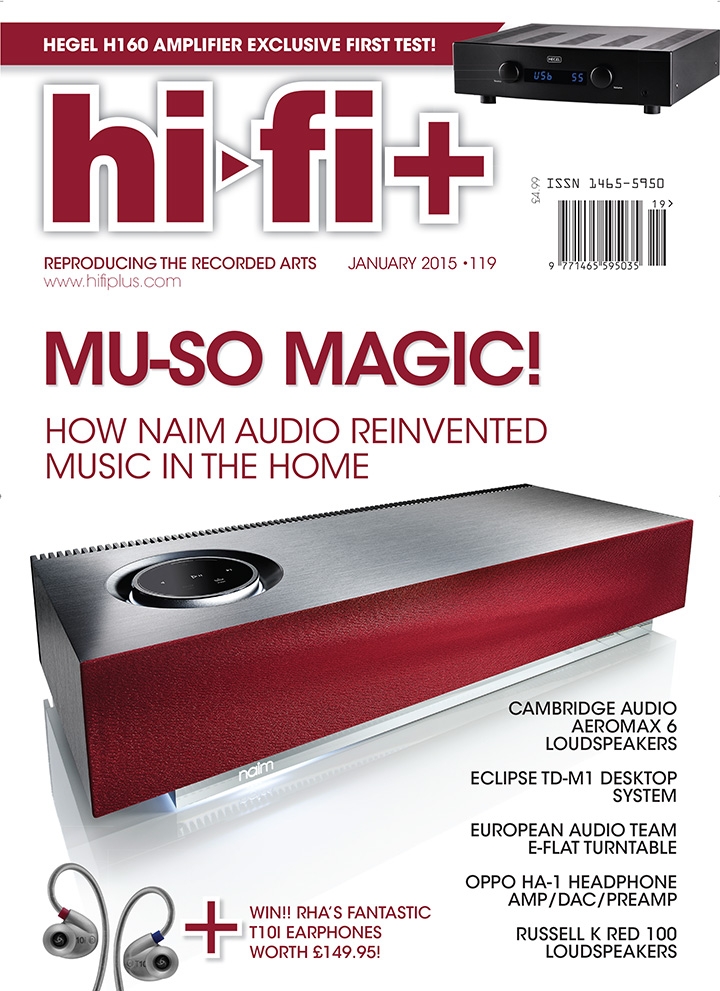
Issue 119 Hot Preview – Naim Mu-so

Hi-Fi+ Issue 119 will be available from January 8. Although we remain a bastion of high-end audio, this month we focus our attentions on the more affordable end of the audio world. And one of the biggest changes to that affordable market is the exciting new mu-so system from Naim Audio.

Naim Audio has long been at the forefront of networked audio, but its designs have always represented more of a complex, multi-box approach to music replay; an approach that doesn’t sit comfortably with the new generation of music lover. The mu-so is a bold attempt at reaching that new generation, with a complete integrated digital audio system and loudspeakers combined. In effect, Naim has reclaimed the sound bar for music lovers!

In our extensive first test, Hi-Fi+ regular Chris Thomas set aside his full-blown high-end audio system and investigated the joys of starter stereo. Even the design won him over, pulling in elements from Naim’s biggest and best, “On mu-so’s top is the ‘control centre’” he said, “a large sunken rotating aluminium volume control, illuminated with the switching functions and level indicators, which looks very much like the design fitted to The Statement.” This is important, because mu-so is not intended for the traditional audio market, “Given mu-so is rolling out to chic department stores and Apple Stores as well as the usual purveyors of fine audio,” said Chris, “that touchy-feely aspect of design suddenly becomes all important, and I wouldn’t be too surprised if many mu-so sell on that alone.”


Mu-so is not just about looks, however. Chris’ biggest surprise was how good it sounded. Chris says, “Whether playing a NAS box full of music or simply armed with a Spotify Premium account, the possibilities really open up because mu-so does bop along with a sophistication and open friendliness to its sound that none of its rivals, at least none that I have heard, come close to matching.” It’s tonal balance is “punchy and has great presence”, but most of all, mu-so is “musically together and consistent over all of its inputs.” Chris feels it gets to the core of what music is all about; “This player is about fun, and good old foot-tappin’ involvement.”

There is a tendency to evaluate streamed audio with the highest quality files, but Chris Thomas noted that not everyone who buys a mu-so will play high-resolution audio files, and the way mu-so deals with more down-to-earth services was especially good, “I have to say that I am a huge admirer of both its Spotify performance and its approach with Internet radio, one of the most undervalued sources of free music”.

There’s a lot more about mu-so, as well as the latest loudspeakers from Cambridge Audio, Russell K, and Eclipse, Oppo’s high-performance HA-1 DAC/headphone amplifier and the giant-killing Hegel H160 integrated amplifier, and a whole lot more… but you’ll just have to buy the magazine in print, on PDF, or through all good tablets and smartphones. Don’t miss out!

RHA Audio T10i Earphones

Roughly a year a go I penned a Hi-Fi+ web exclusive review of a very fine and surprisingly affordable earphone called the MA750i from the Scottish firm RHA. (https://hifiplus.com/articles/rha-ma750i-earphones/) If you read that review then you already know that we felt the MA750i offered exceptionally good build quality for its modest (£89.95) price. We were also ‘favourably impressed’ by that earphone’s almost self-effacingly neutral voicing, which offered pleasing and unforced qualities of natural warmth and wonderfully even-handed and uncoloured tonal balance – a desirable quality that many earphone makers have found difficult to achieve.

Now, let’s jump forward a year to the present time to ask a simple rhetorical question: What has RHA has done for us lately? The answer, in simple terms, is that the firm has just created a new upscale, yet still quite reasonably priced, high performance earphone that goes even further than the MA750i did in terms of both sound and build quality. The new earphone is called the T10i (£149.95) and it has a number of distinguishing features that set it apart from the MA750i. Among these features are:

An all-new handmade dynamic driver (internally known as the RHA 770.1 driver) that is said to “reproduce all genres of music with high levels of accuracy and detail. An included set of colour-coded, metal, screw-in type voicing filters to fine-tune the T10i’s voicing for a “Reference” (neutrally balanced), “Treble” (slightly treble-enhanced), or “Bass” (subtly bass enhanced) presentation.

Impressive-looking, ultra-comfortable, and very durable earpiece housings made of Metal Injection Moulded stainless steel (not an easy material to use in moulding processes, so that the construction of the earpieces involves heating the housings to “1300° C for up to ten hours to ensure the steel is the correct shape and density for outstanding comfort and durability”).

Distinctive, patent-pending, over-the-ear ear-hooks that are relatively flexible and easy to shape, yet that hold their shapes quite well once properly adjusted.

A multicore, 1.35mm signal cable with oxygen free copper conductors and an Apple-certified three-button in line remote/microphone module.

An elaborate accessories pack, including a premium carry case, single and dual-flange silicone ear tips and memory foam ear tips, plus a detachable garment hook.


Given how good the original MA750i was, I imagine the first question readers will ask is whether the T10i actually does sound better than the MA750i. The short answer is that it does, though the differences are subtle and more qualitative and textural in nature. As we see it, this is a good thing in the that the MA750i offered such admirably neutral voicing; so, too, does the T10i when its Reference voicing filters are installed. And, unlike most earphones on the market, the T10i offers not just one voicing curve, but three distinctly different ones.

Naturally, the sceptics among us will be quick to ask whether the T10i’s voicing filters give critical listeners worthwhile voicing adjustment options as opposed to providing garish sonic effects that represent little more than ill-judged gimmicks. The answer, I am happy to say, is that yes, the voicing filters do give listeners useful presentation control options—options that offer relatively subtle adjustments to the T10i’s standard, Reference voicing curve. The key word in the preceding sentence is ‘subtle’, as RHA’s Bass filters add no more than a 3dB lift in low-frequency output below 100 Hz, relative to the Reference curve. Likewise, the Treble filters provide no more than a +3dB lift in upper midrange/treble output above 1kHz, again relative to the Reference curve. What is more, the Bass and Treble filters both closely follow the shape of the T10i’s Reference response curve, so that the filters could be said to provide “a little lift”—not huge, overwrought, and potentially over-the-top changes in voicing.

For those who might be wondering about this, the small filters (which are a bit smaller in diameter than rubber pencil eraser tips) feature beautifully made, metal enclosures with knurled rims that make the filters easier to grasp and to install or remove. The screw-in filters fit into machined and threaded holes in the mouths of the T10i earpiece sound outlet tubes. Changes, then, are as simple as unscrewing one set of filters and screwing in another. To help owners keep everything straight, the filters are colour-coded (black for Bass, silver-grey for Reference, and copper-colour for Treble) and RHA thoughtfully provides a small stainless-steel carrier plate where users can store those filters not presently in use.   

One might well ask whether having multiple voicing filters is even a good idea, but I think that it can be, at least where earphones are concerned. I say this because firms such the Swiss hearing technology company Phonak and others have done research that shows different individuals do have different in-ear perceptions of sonic neutrality. Part of the reason for this may be that, with earphones, the wearers’ ear canals, which of course differ from one another in size, shape, and volume, are in a sense the “enclosures” into which the earphone drivers will load. Given this, offering a means of making judicious voicing adjustments seems a step in the right direction. Readers might find it instructive to note that one of the finest and most expensive earphones ever reviewed by Hi-Fi+, namely the AKGK3003i (£1,000), also provides screw-in voicing filters, meaning the T10i is certainly in good company.  

How does the T10i sound? Well, obviously the answer depends to some degree on which filters are installed, but to establish a baseline of sorts I did the preponderance of my review listening with the T10i’s Reference filters installed. Then, as a useful comparison I listened to the T10i in comparison both to RHA’s original MA750i earphones and to the more expensive Westone W10 earphones (£199).


The T10i (with Reference filters) is voiced quite similarly to the MA750i, which is to say that it offers refreshingly neutral tonal balance coupled with what I consider desirable qualities of natural, organic warmth with ample (but not overblown) bass weight and impact. If you listen closely, though, one significant difference you would find is that the T10i offers even higher levels of transient speed, resolution, and overall textural nuance than does the MA750i, so that the T10i figuratively might be described as an MA750i ‘on steroids’. Though both models carry the same 100dB sensitivity rating, it seemed to me that the T10i needed just slightly higher amplifier output settings to achieve the same playback levels as the MA750i. Both RHA earphones are, though, extremely easy to drive.

Once the Westone W10 was brought into the comparison, my observation was that the W10 produced a somewhat more midrange/treble-forward presentation than did the T10i—a presentation replete with crisp, energetic transients. But, one obvious trade-off was that the Westone offered noticeably less mid- and low-bass weight and support. At first, casual listeners might be tempted to blurt out that the Westone ‘sounds clearer’, but further listening reveals that this initial perception is mostly down to the fact that the W10 achieves its perceived edge in clarity at the expense of slightly skewed overall tonal balance and limited bass support, both of which are areas where the RHA, by comparison, excels. 

This, however, is where the potential benefits of RHA’s optional voicing filters loom large. Suppose, just for the sake of illustration, that you did an A/B comparison between the T10i and Westone’s W10 and found yourself narrowly preferring the Westones (even though you might miss the RHA’s more even tonal balance and superior bass). In such a circumstance, all you need do would be to substitute RHA’s Treble filters in place of the standard Reference filters to enjoy a touch of midrange/treble lift comparable to that provided by the W10s, while still benefitting from the RHA’s greater bass weight and low-end impact.  The point is that the T10i’s give you the means to fine-tune tonal balance to suit your personal listening tastes and preferences, yet without veering into the realm of garish sonic colourations.   

Technical Specifications

Type: Single-driver universal-fit earphone with moulded stainless steel earpieces and three sets of voicing filters.

Driver complement: One RHA 770.1 handmade dynamic driver per earpiece.

Accessories: Multiple ear tips (two pairs of double-flange silicone tips, six pairs of single-flange silicone tips, and two pairs of memory foam tips), stainless steel ear tip carrier card, three pairs of colour-coded screw-in type voicing filters (Bass—black, Reference—silver/grey, and Treble—copper-coloured), stainless steel voicing filter storage plate, signal cables made with OFC conductors and heavy-duty stainless steel fitting with gold-plated conductor plug, in-line iDevice-compatible mic/remote control module, zip-closure carry case, and garment clip.

Frequency response: 16 Hz – 22 kHz

Impedance: 16 Ohms

Sensitivity: 100dB/mW

Weight: 41 grams

Price: £149.95

Manufacturer Information: RHA Audio

URL: www.rha.co.uk

Tel: +44 (0) 141 221 8506

Rogue Audio Cronus Magnum

The Rogue Audio logo includes a silhouette of a bird that I am told is a raven, the largest member of the crow family. This was chosen because the raven is an intelligent bird that doesn’t travel in a flock. It turns out that Rogue MD Mark O’Brien is what the Americans call a ‘birder’, or ‘twitcher’ as we know them, so I guess some kind of winged beast is appropriate. Regardless of logo, Rogue makes some remarkably affordable electronics given that it builds them in Pennsylvania. Even by the time you add import duties and our bludgeoning levels of sales tax (VAT), this integrated with phono stage comes in at under £2,300, which must make it the least expensive example of the made-in-USA breed on the market. In fact, Rogue does make a less expensive model, in the Sphinx: a hybrid with a Class D output stage.

This Cronus Magnum is the latest incarnation of a model that has been in the Rogue range since 2005. It started out as simply the Cronus, an EL34 push-pull, and evolved into the Magnum Cronus four years later, which saw a switch to KT90 output tubes. The KT120 pentodes you see before you replaced the KT90s in 2012, in order to provide more power and thus greater ease of speaker matching.

It’s long been the bane of tube amplification that limited power means limited speaker choice, but the KT120 – one of the most recent additions to the ranks of output pentodes – was created to deliver the sort of power that most glass lovers could hitherto only dream about. It was introduced three years ago, and in that time has almost usurped the 6550 that was the staple of many power amps. It’s appeal is power; Rogue specifies that the single pair on each channel of the Cronus Magnum is good for 100 watts, a bruising output for any tube amp, let alone one at this price.

Rogue has decided to make this amp a manual bias type and provides not only an easy access series of trim pots, but also a suitably skinny driver with which to adjust them. Following the instructions provided, it was refreshingly easy to check each tube and tweak where required, and in this case only one had drifted. The driver tubes are standard 12AU7 and 12AX7 types, which means they are easy to replace, or roll should the urge take you. The glassware is given a soft start at turn on in order to preserve tube life, and Rogue estimates that the KT120s should be good for two to three thousand hours.


Build quality is solid but not fancy. Knock the top plate with your knuckle and it clonks in a rather uninspiring way, but it’s purpose is to protect you from it and vice versa, nothing more. Lift the amp up, however, and you may be surprised at how heavy it is. The ironwork must be extremely dense, which means that the whole thing is pretty much theft proof. I like the aluminium face plate and the low profile nature of the chassis, but it’s obviously not built to look pretty. You can get an optional cover that makes it look marginally less industrial, but if you want style the Rogue may not be the amp for you. The remote handset on the other hand is rather nice. It’s carved from solid aluminium and equipped with two volume buttons; it’s quite at odds with the aesthetics of the amp.

Connection wise, the Cronus Magnum has three line inputs plus phono for moving magnet cartridges, outputs for a sub or bi-amping, and the speaker outputs connect to four and eight Ohms taps. But whichever tap I chose I couldn’t get this amp to produce solid bass with the first speaker I connected it to, using Townshend Isolda DCT cable. That speaker was the ATC SCM11 – not a brand that’s renowned for its tube friendliness, I’ll grant you, but Rogue does say 100 watts per channel in the spec. The mid and top was a lot more successful however; voices were beautiful and the guitar work righteous on Steely Dan’s ‘Bad Sneakers’ [Katy Lied, MCA]. Winding up the volume on this combo, it became apparent that the IR remote works at some pretty extreme angles, so the handset is not merely a looker.

Moving onto a rather less demanding loudspeaker in the form of PMC’s fact.8 floorstanders, the unvarnished demos on the Denmark Street Sessions partner disc to Fink’s Hard Believer [Ninja Tune] delivered a directness that gave them greater emotional power than the finished versions. The bass lines on ‘Pen on Paper’ were particularly effective, revealing that the Rogue can do bottom end when the speaker is not putting up a fight. More important is the way that the amp lets you hear the intent and feeling in the music, the lyrics are clearer so the meaning of the song is easier to appreciate. It makes for very engaging listening. This much was apparent with Gregory Porter, too; he has a honeyed voice but there’s a sting in its tail, yet it’s not too smooth because there is real feeling behind songs like ‘No Love Dying’ [Liquid Spirit, Blue Note] and clear reverb on the voice and instruments. Reverb is always more obvious with tube amps, either because they have such good midrange resolution or because of the harmonic distortion that these devices introduce. But in this case, it’s subtle enough not to matter; if it’s a distortion it’s a euphonic one.

By transistor standards, the bass is still slightly soft edged, but it has pace, shape, and adequate weight. People like tube amps partly because they don’t like the grain that many transistors add to the mix, but solid state devices do give lower frequencies better definition, so it’s a case of choosing your poison. High frequencies here are not as extended as a good solid-state design but do sound smoother, which can be a benefit with many loudspeakers. Cymbals here are a little thin, but brass is excellent. You get the tonal richness without the glare that is so often evident. The Cronus Magnum also copes with high density material with ease, making the music easy to follow because the rhythms and melodies are never buried in the arrangement.


The softer high frequencies don’t give the full height that some alternatives can, but  the soft-edged presentation can work wonders for strong piano recordings such as Brendel’s The Complete Beethoven Sonatas [Philips]. Possibly because this is a digital recording it can sound hard, but here you get the remarkable fluidity of the playing, and your attention is drawn to the tremendous dynamics that Brendel delivers; it’s a totally engrossing performance. With more contemporary material such as Lorde’s ‘Royals’ [Pure Heroine, Universal], which is very much an in-the-box production, the whole thing sounds strained and small scale, as the compression used is rather too obvious. Exposing the shortcomings of commercial studio techniques is often, but not always, the price you pay for great results with good recordings.

An example of the latter would be Patricia Barber’s ‘A Touch of Trash’ [Modern Cool, Premonition]. On that track the bass playing could be tauter as it’s both slower and thicker than I am used to, which is hard to ignore. The drama of the piece is well served, however, and the trumpet remains rounded and distinct without getting too bright up at volume.

I decided to give the phono stage a go, which meant digging out a vintage Audio Innovations step-up transformer and finding somewhere to site it that didn’t induce hum. Not an easy exercise, but a fruitful one as the results achieved with a Rega RP8 and Apheta MC cartridge were very appealing. Vinyl is generally more open than digital and that proved to be the case here; the Rogue phono stage also had more life and vibrancy if perhaps less precision than the line inputs. However, I was impressed with how quiet the phono stage is and how powerful and engaging it makes vinyl sound. Moving over to a Dynavector P75 Mk3 phono stage produced an increase in detail if not in pace, which is clearly good with the onboard stage. The external stage does, however, deliver more of the atmosphere in recordings by virtue of greater transparency. That said, if you are into vinyl for its sheer musicality (and this is no small reason for its revival), then the Cronus Magnum’s phono stage is easily up to the job (and all the more so if you have a moving magnet cartridge).

The Rogue Cronus Magnum is a great amp for the money. It eschews fancy casework in favour of solid engineering and great sonic results. You pay a small levy for having it built where it’s built but, as British motorcycle fans realise, in the long term these things do matter.

Technical Specifications

Type: Tube, two-channel integrated amplifier with built-in phono stage.

Tube complement: (2) 12AX7, (3) 12AU7, (4) KT120 output tubes

Analogue inputs: One MM phono input (via RCA jacks) , three single-ended line-level inputs (via RCA jacks).

Input impedance: High-level: not specified; Phono: 47kOhms

Power Output: 100Wpc @ 8 Ohms

Bandwidth: 20Hz – 30kHz

Distortion: Not specified.

Signal to Noise Ratio: Not specified

Dimensions (HxWxD): 140 x 457 x 432mm

Weight: 25kg

Accessories included: 1.5m KEMP Lo Power Cord

Price: £2,295

Manufacturer: Rogue Audio

URL: rogueaudio.com

UK Distributor: Divine Audio

Tel: +44(0)1536 762211

URL: www.divineaudio.co.uk

Cabasse Stream Source

Cabasse is renowned for making loudspeakers with multi-concentric drivers, its ultimate creation being La Sphere, a spherical loudspeaker with four drive units on the same axis. Until very recently, the company was owned by a division of Canon, so it had greater resources than most loudspeaker companies and access to a lot of digital engineers. This perhaps explains what a loudspeaker company is doing making pebble-shaped digital streaming product line collectively called the Stream range.

The Stream 1 and 3 have a built in loudspeaker for standalone operation, but Stream Source is relevant to those of us who own decent speakers, amplifiers, and the rest, and who want to add the option of streaming without giving up too much space or money. Stream Source can be used on a network both wired and wirelessly. It can receive an NFC or Bluetooth signal sent from a phone or tablet, and it can access internet radio stations with the vTuner service. All are familiar streamer features, even at this price point, but what Cabasse has added to the mix is access to the Deezer streaming service and the ability to use a standard USB hard drive as a DLNA server. This means you don’t need a network with a NAS on it when a drive full of tunes will suffice.

There is plenty of competition in the entry level streamer stakes and some of it offers direct access to the rather more popular streaming service Spotify. The other useful feature that the Cabasse omits is the ability to stream Apple’s Airplay from an iOS device, something to bear in mind if you’ve an iPad or similar. What is included, however, is the ability to run several Stream Sources around the house multiroom style, and control them from the same device so that their output is synchronised. This is still quite uncommon and puts Cabasse in direct contention with Sonos and its ilk.


Being French, the Stream Source has style on its side, and for that matter a conveniently compact form. It only really needs cables for power and analogue or digital output, but there are network and USB connections for those wanting to stream higher resolutions without drop out. That said, this unit is limited to 24/96 so drop outs are not likely to be an issue; as you will see, the Stream makes the most of the resolution formats it does support.

The Stream control app will run on iOS and Android platforms and is intuitive to use; you just need to remember to press the little + button rather than the album name, if you want to play the whole thing. The control app’s only real limitation becomes apparent with large music libraries. Most apps offer on A-Z list for artists, albums, radio stations etc. but the Stream Source just lists the titles, and scrolling through a collection of any size is a slow process – very slow by the standards we couch slouches are used to. Apparently, this is something that will be addressed in a future upgrade to the app. Conveniently you can adjust volume from the app, if that function is switched on at the device, and it’s easy to choose between sources.

I turned off the onboard volume control and connected the Stream Source to my network with AudioQuest Ethernet cable, an approach which avoids the need to put in passwords, and gives instant access to media on attached drives. With the analogue outputs connected to a Townshend Allegri controller and an ATC P1 power amp driving PMC fact.8 speakers, the sound was surprisingly open and transparent for such an affordable device. What initially struck me was how good it is on diction, Arab Strap’s ‘New Birds’ [Philophobia, Chemikal Underground] features a deep Glaswegian accent which is not always easy to follow for southerners like myself, but here it was very clear indeed, and thus even more explicit than usual.

What’s more, the visceral quality of the music was evident in full effect and kept me glued to the seat for the duration of the piece. The Stream Source sounds slightly midrange forward by the strictest standards of neutrality. It pulls out detail that makes voices distinctive and orchestra’s expansive, as on Daniel Barenboim’s Beethoven 7 [Beethoven for All, ‘Symphony No. 7 in A, Op. 92, Decca, 24/96].

Because something always has to give at this price point it is worth using a separate preamplifier with this streamer. Going from onboard to outboard volume control affords a big increase in three dimensionality of image, and a removal of harshness in the mids and highs. It’s not a subtle change. Quality of source is also pretty clear; a flash drive USB stick sounds weak and lazy compared to a Naim Unitiserve, despite the seeming advantages of SSD storage and avoidance of the network. With the server in tow Patricia Barber’s ‘Bye Bye Blackbird’ [Nightclub, Premonition] delivers a good deal of its image scale and atmosphere, this thanks to low noise and the supremacy of the recording. It really puts you in the room, a pretty good result for a shiny black pebble!

By contrast with a Cambridge NP30, the Stream Source sounds overtly open and not quite as precise when it comes to timing. The Cambridge is a little shut in, but gets to parts that the Cabasse cannot reach. The French unit, however, can cope with 24/88 streams and has some useful extra features above those of the Cambridge. The real competition comes from white box purveyors Sonos, whose products tend to emphasise ease of use over sound quality. It would be interesting to make that comparison.


In an attempt at diligence, I tried the Stream Source wirelessly and with MP3, but both experiences reduced quality and introduced grain, with MP3 at 128kbps being particularly coarse when viewed through such a revealing system. However, in a more realistic set up, this would probably be masked to a tolerable level – especially if you are used to the limitations of low bit rates. Wi-Fi is less problematic with MP3 in truth, and I enjoyed several pieces without too great an urge to go back to lossless files, but I did go back. Once you know what you’re missing it’s hard to make sacrifices.

The Stream Source is a little insubstantial for the money, but it’s a very revealing device that warrants use in a high-end system. The control app needs some improvements to make it appeal to music hoarders but all in all this Cabasse is a highly capable and entertaining piece of kit.

Technical Specifications

Type: Network music streamer.

Network functions: DLNA, WPS, vTuner, Deezer

Network inputs: Wi-Fi, Ethernet, Bluetooth aptX + NFC

Digital Inputs: None.

DAC Resolution/Supported Digital Formats: 96 kHz/24-bit/WAV, FLAC, WMA, AIFF, AAC, ALAC, MP3.

Analogue Outputs: One stereo unbalanced (via RCA jacks).

Digital Outputs: One TOSLink.

Frequency Response: Not specified.

Distortion (THD + Noise): Not specified.

User Interface: Stream app

Other Features: Remote handset.

Dimensions (HxWxD): 40 x 231 x 136mm

Weight: 0.5kg

Price: £299

Manufacturer: Cabasse

Tel: +33 (0) 2 98 05 88 14

URL: www.cabasse.com

Snake River Audio Mamushi Signature loudspeaker cables

I still tend to be a bit ‘old school’ when it comes to evaluating things. First impressions count an awful lot; those initial few seconds are supremely important – pivotal, even. Yet first impressions can be misleading, if not downright wrong.

Audio is very much a ‘marry in haste, repent at leisure’ activity. We make changes that seem to point in a better direction, but things don’t always work out long term. What seemed like a massive improvement may turn out to be the very opposite with increased exposure…

Evaluating the Snake River Audio (SRA) Mamushi Signature cables for this review was very much an extended process – one measured in months, rather than days or weeks. The UK importer had already given the cables a bit of a burn-in, but warned me that much more time was needed.

Mamushi Signature cables look and feel the part. They’re very heavy and thick, the build is absolutely superb, and they look great. They’re magnetically shielded against radio-frequency interference, and feature a special capacitive weave to cancel RFI.

The manufacturer describes Mamushi’s construction as incorporating a natural capacitive rejection of radio frequency interference by their construction alone. SRA separates the conductors using a thin layer of Teflon (PTFE) between the send and the return conductors, as well as a large air gap dielectric, and protects this configuration by surrounding it with magnets. These magnets are specially ordered for the Mamushis, and are said to be magnetically supersaturated in a multiple pole magnetization pattern, so their magnetic strength is evenly distributed across the surface. The Signature version of the Mamushi cable tested here goes for quality materials. It combines 24k gold, 99.999% pure silver, and oxygen-free copper in a special formulation.


My first impressions of the Mamushi were of a brighter, livelier, more forwardly-balanced sound, with increased bite and attack. In many ways the sound of Mamushi was better that the Townshend Isolda it replaced, but the SRA was also a mite less relaxed and comfortable. Clearly, more time was needed; the slow burn-in had begun!

After three months or so, I switched back. The Isolda cables definitely sounded smoother, and less immediate, with perhaps a slightly more integrated tonal balance. The mid and high frequencies were less pronounced, and the overall sound seemed less brilliant. Via the SRA Mamushi Signature speaker cables, the music sounded keener and more dramatic, with added brilliance and increased dynamic attack. 

Subjectively, the sound seemed to be about 1dB louder – the Isolda cables being slightly muted and less holographic. I found this slight increase in loudness/vividness a great benefit when using a small low-powered tube amp – it helped make more of its limited resources.

Although the SRA cables sounded slightly brighter/sharper, they also seemed to offer a broader palette of tone colours. The dynamic contrasts were very well handled, creating a sound picture that was tonally-varied and constantly changing.

Playing the Barenboim/Chicago recording of Ravel’s Daphnis and Chloe suite on Erato, I was surprised by the sonic light and shade audible – and this from a recording that can easily sound a tad thick and congested, a bit bland and nondescript.

I’d never experienced such a varied tonal palette from this disc before – from bitingly brilliant trumpets to mellow flutter-tongued flutes. Ravel’s scoring is wonderful, but needs sound of amazing clarity to fully reveal every strand. Here, things sounded tonally natural, but very detailed.

Turning to some unaccompanied vocal music, I was taken by the way the Mamushi Signature cables allowed the individual timbre of each voice to stand apart – as well as revealing subtle dynamics and changes of pitch. The ambience of the church was more apparent too. 

Each time I Returned to my regular cables, I half-wondered if they didn’t sound a tad smoother and more integrated. Were the old cables more comfortable to listen to? Well, maybe… But I sure as hell missed the extra clarity and dimensionality of the Mamushi Signature cables.

My old cables – in comparison – always seemed to make everything sound more ‘samey’; more consistent perhaps, but also less individual and distinct. The Mamushi Signature cables made the music seem more interesting and individual – more tactile, more special, more engrossing.

 I used the speaker cables with both a high-powered solid-state amplifier, and a low-power transformer-coupled tube amp. Both worked well, but it was with the latter that I heard the biggest difference. The sound was noticeably more holographic and dimensional with the SRA cables.

Also, because the Mamushi cables delivered a greater sense of attack and dynamics, I did not feel the need to increase volume levels beyond the limits of the power available. With my own cables, I sometimes pushed the little tube amp too hard, and heard it compress/congest slightly.


But partnered with the Mamushi cables, the sound seemed to expand more. It was almost as though the amplifier’s output had increased slightly. With the small amp, this was especially welcome on demanding operatic and choral recordings.

I find naturally-miked uncompressed recordings of human voice to be the most testing material for small low-powered amps. So, I was encouraged by the manner in which the Mamushi Signature cables helped my small tube amp to punch far above its weight. 

After a long period of ‘living together’, I’m totally convinced by the sonic qualities of SRA’s Mamushi Signature cables. It will be a big wrench to go back to what I used previously. And, having drunk at the fountain of knowledge, I’m wondering if that will be possible. Oh dear… 

price and contact Details

Price: £1,518/3m pair. 2m, 3m, 4m as standard, other lengths (at £181 per stereo metre) to order

Manufactured by: Snake River Audio

URL: www.snakeriveraudio.com

Distributed in the UK by: Mackenzie Hi-Fi

Tel: +44(0)7905 362545

URL: www.mackenziehifi.com

2014 high-end audio highlights – and all that!

At the end of a year, it’s customary to look back on the past 12 months and look forward to what’s coming in the next 12. Audio is generally a slower moving stream than many consumer electronics streams, and there have been many times where looking back and looking forward is pointless, because there has been nothing to talk about aside from version changes of the same basic product lines, but that wasn’t the case in 2014, and it looks not to be the case in 2015.

The year that is drawing to a close could be seen as the year of digital turmoil. Behind the scenes, there have been some announcements that make the continued development of high-end digital disc players just that little bit more difficult. First, Philips announced it stopped manufacture of the CDM Pro2 transport, that CD player mechanism so beloved by many audiophile brands. Manufacturers using the transport rushed to buy up the last run, and many have stockpiled enough of this vital component to allow for several years’ worth of sales at current levels, and still more for product spares support, but this means those manufacturers who value the CDM Pro2 are currently struggling to find a replacement for the next generation of disc players. Philips has no plans to develop a subsequent transport mechanism, and allegedly requests to custom-build the CDM Pro2 under license have been rejected.

Also in 2014, Esoteric announced that it was to withdraw OEM sales of its VRDS transport mechanism, instead manufacturing the CD/SACD transport mechanism only for its own players in future. Although few third-party manufacturers still use the VRDS mech, those makers either had to invest significant sums in their own future, find a new transport, or leave player making to other manufacturers.

Perversely, at the time when some of the big names in ‘background’ CD and SACD technology are pulling the plug on key components in the manufacture of physical format replay, there has been a move in some audiophile circles to reject streamed, downloaded, and ripped digital files in favour of spinning polycarbonate. In 2012, one of the representatives of an electronics brand told me privately that sales of CD players had ‘fallen off a cliff’; the same maker is now unable to make CD players fast enough. Whether this is yet another short-lived fad, or the start of CD’s comeback remains to be seen.


The alternative to physical formats has finally grown on the international market. Once the preserve of US customers (or those with proxy servers) only, high-resolution provider HDtracks began its international roll-out in late 2013, with the service arriving in the UK a few months ago. In addition, high-resolution download and streaming services such as Qobuz and Tidal have delivered real-world audiophile-grade streaming services to rival the likes of Spotify. Granted, much of this new world of audio at your fingertips seems oriented toward rock, pop, and jazz, but these services offer a great deal of promise in an online world more set on quantity than quality.

The widespread move from computer/DAC systems to network streaming predicted at CES 2014 hasn’t seemed to gain the momentum expected a year ago. Yes, the companies who were already heavily invested in networked audio systems (such as Krell, Linn, and Naim) continue to produce system solutions that point to networking as an elegant option for home audio, but a lot of January’s hopefuls remain hopeful. Part of the problem here is the investment needed to distinguish one product from another; recent networked successes such as Primare have spent a great deal of time and money creating an app interface that makes its solutions easy to use. However, a larger problem emerges when trying to introduce networking to people who have a comparatively limited understanding of the topic, and are uninterested in learning even the basics. Tales abound within the industry of retailers only selling network audio during the summer months, when the proprietor’s computer-literate son or daughter is back from university. Networked audio is an excellent way of listening to music, a valid alternative to having a computer connected to a DAC in the listening room, and is fast maturing into a system that sounds excellent, but it will only develop if people are willing to explore what it offers. It will be interesting to see if the excitement over networking shown at CES 2014 continues into this year, or whether we are back to DACs once more.


2014 was also the year the digital spec war really took off. Audiophiles moved from demanding 24/96 to insisting upon 24/192 repay in their DACs in about four years, but went from there to demanding DSD, then DSD128, and now DSD256 and DSD512 in the space of about a year and a half. This has also moved across the board; it’s virtually impossible to sell a DAC that doesn’t support DSD now, regardless of price. Some of this demand for DSD comes down to ticking a box and little more; I’m fairly sure that very few people who are about to spend $150 on a USB DAC will ever amass a collection of DSD files for replay, but that seems immaterial next to DSD’s ‘must have’ status among the cognoscenti. Although DSD512 represents the current acme, I have a sneaking suspicion 2015 will be the year people start asking for 32bit, 384kHz DACs across the board, irrespective of whether there’s music commercially available at that resolution. Personally, I’d rather see a ‘stop the insanity’ move in digital audio, but that seems unlikely at this time.

Moving away from digital, analogue continues to go from strength to strength. These things are relative – new vinyl sales continue to increase, but still represent less than a two per cent share of total music sales – but refreshing. Granted most of these LPs are being played on relatively low-end turntables, but the high-end turntable market has also increased in sales and value year-on-year-on-year. And this shows no signs of slowing; in fact, we are seeing increased interest in bringing 21st Century technology to turntable design, with technologies like VPI’s 3D printed arm, a return to direct drive from a number of manufacturers (sometimes well executed direct drive, too!), and Kronos’ counter-rotating platters all point to continued development long past LP’s supposed End of Life.

Developments in amplifiers and loudspeakers move at a relatively slow pace, in part because much of the fundamental development in these technologies requires big budgets and was performed decades ago. Nevertheless, changes are taking place even in these mature sectors. Audiophiles traditionally discounted active loudspeakers and digital signal processing, but inroads are being made here. In part, this comes down to improvements in processing power, meaning the speed of DSP systems can keep up with the material. Acceptance is still low, but gaining ground, especially as a new generation weaned on tiny loudspeakers corrected by DSP begin to move up the audio ladder.


A recent development in this is Devialet’s SAM technology, which maps the sub-200Hz region of a loudspeaker and provides an optimal passive amplifier output for that design. In smaller loudspeakers in particular, this form of correction works wonders, and the list of loudspeakers that have been mapped by Devialet grows week by week. Whether variations on this idea begin to appear in other amplifier designs remains to be seen, but this seems to offer a valid way to help improve the performance of systems in the home.

The headphone market has cooled somewhat since its significant expansion five years ago, but ‘cooled’ is a relative term. While it’s true that certain sectors of the in-ear world are over-subscribed, key parts of the headphone and CIEM market appear to continue to grow. Those people who went from $20 earbuds to $200 Beats are now increasingly looking toward high-performance headphone and CIEM solutions costing hundreds or even thousands of dollars. This is accompanied by improved DAC and amp systems, and – more recently – high grade cable systems, too. While it seems the loudspeaker brands turning to headphones are no longer growing in number, there are a number of high-end cable brands now delivering high-end headphone and in-ear systems, as a result of discovering the headphone market is open to such opportunities.

There are also changes (good and bad) happening outside the world of audio technology that have their influence on our little world. We lost one of the industry’s greats in the passing of Harry Pearson. We have seen small indicators that some of the worst excesses of ‘the loudness war’ are behind us, with tracks even from mainstream artists having more dynamic range than previous years examples. There is still a long way back, though, but it seems music companies are beginning to return to considering sound quality, at last. Pragmatism rules here; labels are motivated by financial considerations, and if people buy more albums if they sound good, but only listen for free on YouTube if they don’t, the record labels will make better sounding material, and that is beginning to take effect. This can be placed firmly at the rise in interest in vinyl, but we are buoyed by record company interest expressed in Tidal and MQA as an indicator that things might be swinging back in our favour.

On a geopolitical level, sanctions imposed on Russia, the fall in the price of oil, and the value of the Rouble have all caused a fairly significant drop in the sales of high-end audio to the important Russian market. Meanwhile, Xi Jinping’s anti-graft drive in China is taking its toll in the audio business, but is more directed at Rolex-wearing Communist Party functionaries than the country’s burgeoning middle class and its aspirations. Nevertheless, there’s a very real concern that two of the most important markets for audio in recent years have suffered a ‘wobble’ and that this may continue. This may prove a benefit for those seeking more value-driven audio products, if the focus moves away from the demands of the super-rich in Russia and China.  

Next time, what we hope to see at CES 2015 and what a difference a decade can make!