Classical
Symphony No 9 ‘From the New World’
Dvořák, Berlin Philharmonic Orchestra, Rafael Kubelik
- Music
- by Jimmy Hughes | Sep 30, 2025


- Music

- Sonics
- A
- A
- A
In the post-war years, just about every major conductor recorded Dvořák’s ‘New World’ symphony. Indeed, many did so more than once. Rafael Kubelik, a Czech émigré, left no fewer than five versions, recorded over a period of 40 years.
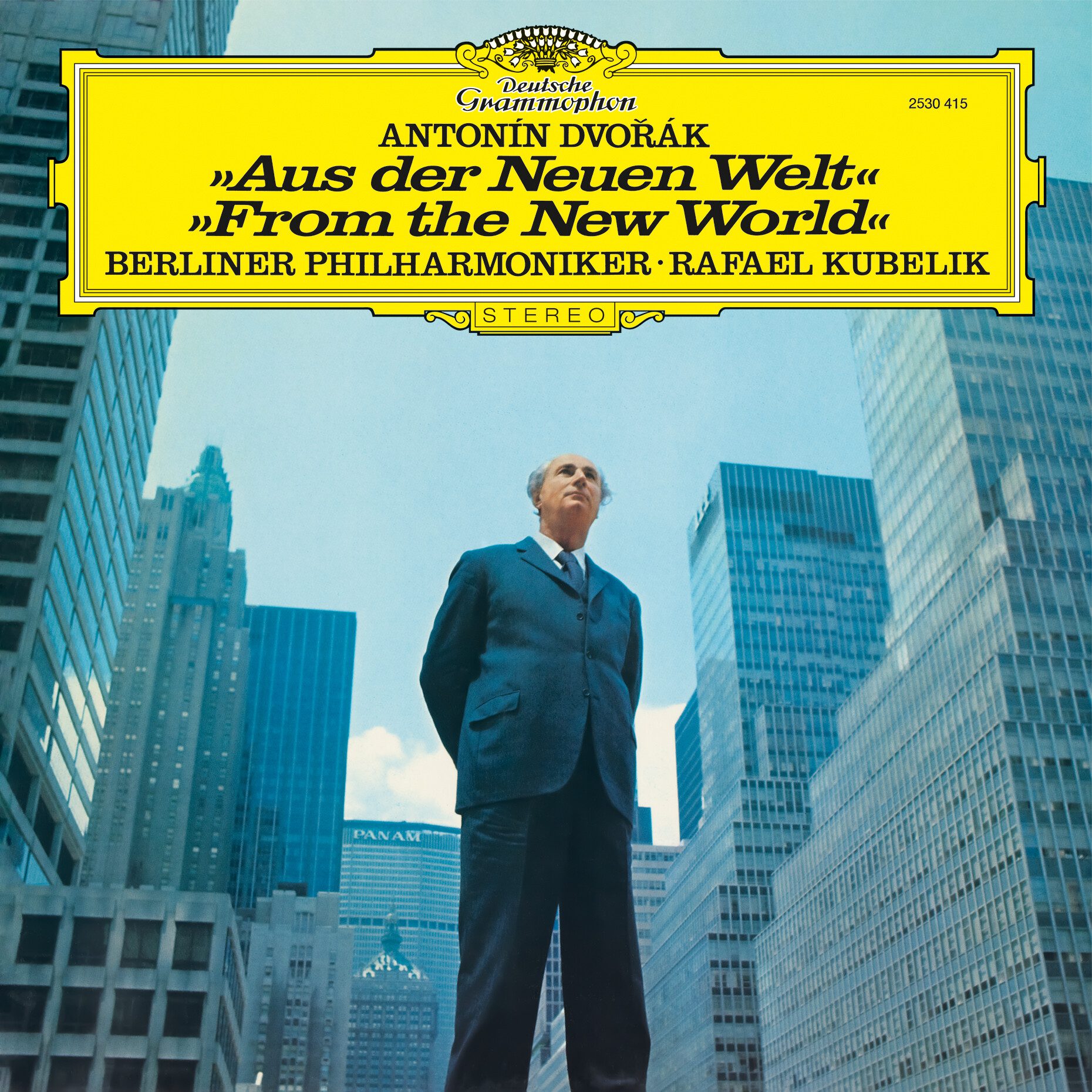
His third ‘New World’, recorded with the Berlin Philharmonic for DG, is probably his best-known performance. It was issued in 1973 as part of a boxed set of all nine Dvořák symphonies. The individual LP issue was released a year or so later, featuring a striking cover picture shot by photographer Jack Mitchell.
It depicts Kubelik seemingly walking among the skyscrapers of New York, with the Pan Am building in the background. The low angle, with the camera pointing up, makes him look like a giant, as tall as the buildings that surround him.
DG’s recording sounds very natural and well-balanced. The booklet in the original nine-LP boxed set of the Dvořák symphonies featured a picture of Kubelík conducting the Berliners in the Jesus-Christus-Kirche during a recording session, and it shows two Neumann stereo microphones in use.
There’s one above the conductor, pointing down at the strings, and a second in front of the winds – presumably to focus the instruments in the centre of the orchestra. Hans Peter Schweigmann was the Tonmeister for all of Dvořák’s symphony sessions except the 8th symphony.
Stereo mics have switchable patterns: Omni, Cardioid, and Figure 8. Figure 8 was likely chosen for the primary mic. In this arrangement, sound is picked up from both the front and behind in a figure-of-eight pattern, capturing more hall ambience than the cardioid option.
Used correctly, coincident mic capsules for left and right channels create a natural phase-coherent stereo soundstage. The New World recording was made on four-track half-inch tape in experimental quadraphonic format, with two tracks dedicated to ambience.
The four-track tape was mixed down to a two-track quarter-inch tape and used to cut the LPs. Unfortunately, this introduces an additional generation of tape noise and distortion. As with other LPs in DG’s The Original Source series, the original four-track tape was used to cut the lacquers for optimal sound quality.
In the 1960s, DG’s pressing quality set a standard that all record companies aspired to; LPs that were flat, perfectly centred, with surfaces that were smooth and silent. Sadly, the quality of pressing suffered in the early 1970s due to troubles in the Middle East, which led to a massive spike in the price of crude oil.
DG’s Original Source LPs represent a return to 1960s quality standards with near-bespoke analogue pressings that accurately convey the quality of the original master tape. The same recordings on CD sound very good, but the vinyl sounds better – freer, more open, more natural.
Kubelik does not observe the first movement exposition repeat in any of his recordings of the ‘New World’, which is a pity, but hardly a deal-breaker. Even though we have come to expect this now, not observing repeats was pretty standard in the 1960s and 1970s, though Kertesz and Rowicki (both LSO) did include the repeat.
I have always liked Kubelik’s Berlin performance of Dvořák’s ‘New World’ Symphony and haven’t heard a better one in 50 years. His shaping of the work has a natural, spontaneous feel, with orchestral playing that has plenty of bite and fire. There’s pace and drama without things sounding hard-pressed or aggressive.
Despite the refined quality of the Berliners’ playing, there is also a nice earthiness. Karajan’s famous 1964 DG recording of this symphony is impressively opulent and sophisticated. Yet Dvorak, for all his fame and celebrity, basically remained a simple countryman at heart.
Kubelik understands this, which ensures his Dvořák performances sound idiomatic and authentic. His DG set of the nine symphonies is probably his most significant achievement on record. And, even with the passage of 50 or more years, it remains a top recommendation…
More Info
| Media | LP |
|---|---|
| Label | Deutsche Grammophon |
| Contributors | Dvořák |
| Contributors | berlin philharmonic orchestra |
| Contributors | rafael kubelik |
| Contributors | hans peter schweigmann |

Back to top

By Jimmy Hughes
More articles from this author
Read Next From Music
Bugge Wesseltoft: Am Are
- Jun 30, 2026

Smetana: Má Vlast
- Jun 02, 2026

Dominique Fils-Aimé: Nameless
- May 25, 2026
Music Interview: Giles Martin
- May 13, 2026