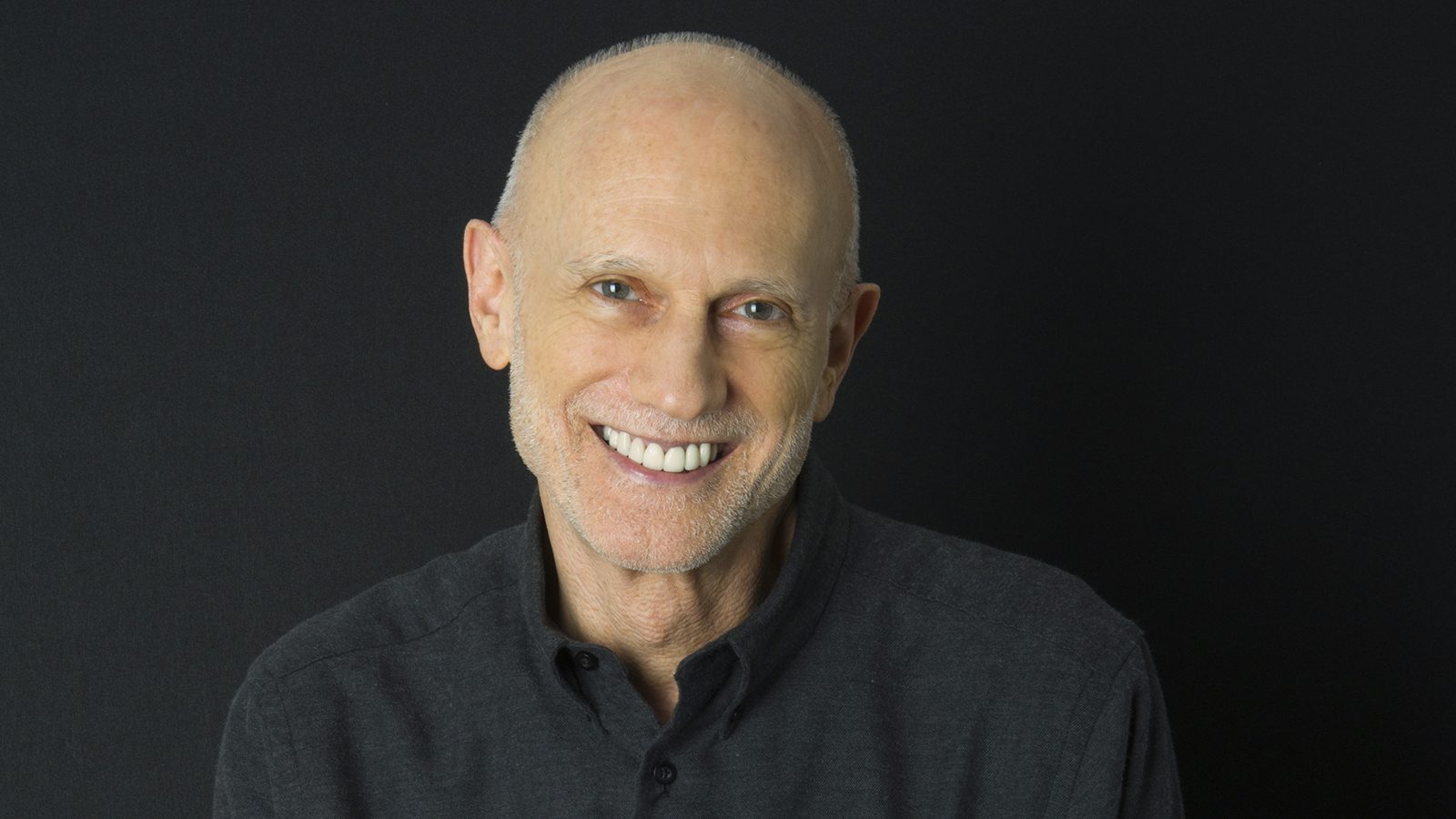
One of the true pioneers of audio cable, William E. Low – he prefers the name ‘Bill’ – founded AudioQuest in 1980. For more than 45 years, the brand has been at the forefront of audio ‘ancillary’ design and development, concentrating at first on cables, but including everything from power conditioning to Sorbothane feet… and even the occasional personal audio product, such as the hugely successful DragonFly range of USB-powered DACs.
We caught up with Bill Low to discuss the company’s history and the evolution of the Mythical Creatures line.
Tell us a bit about yourself.
I’m William E. Low… Bill Low. In 1978, after a couple of years proving myself a failure as an independent manufacturer’s representative, I happily returned to life as an appointment-only specialty audio retailer in Santa Monica, California.
At the time, there was almost no specialty audio cable. I note 1976 as the start of the visible specialty cable business in the US when the speaker company Polk introduced an imported Japanese speaker cable they called Cobra Cable.
Unlike most of the semi-copycat cables that appeared shortly afterwards (such as Discwasher’s Smog-Lifters), I did not believe that attempting to impedance-match a loudspeaker was either possible or desirable – but I initially had no better idea. However, I was fortunate to be invited to share a custom order for a highly sophisticated starting cable, which was inspired by an article by Martin Colloms and designed by Dave Gore of amplifier fame (Quatre Gain Cell DG-250).
From the development of that 435-magnet-wire-strand-per-side twisted pair in 1978 until 2012, I was the only AudioQuest designer. My greatest advantage appeared to be a combination of my lack of knowledge in electrical engineering and my natural scientific methodology. I had no knowledge that would have prevented me from mistakenly taking audio cables from a different field.
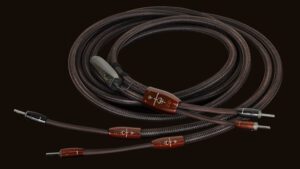
With 24 years of experience recognising the extensive empirical evidence of audible cable differences and working to manage this evidence for consistent benefits, I laid the groundwork for all AudioQuest cables, including the recently launched Brave Heart speaker cable.
I mention 2012 above because that’s the year I was finally able to hire someone who knows more than me and who also had the personality not to misapply a fact from its true context to a different application where that fact is no longer accurate or relevant. In 2012, Garth Powell, a superb designer of audio power products for 16 years at Furman, joined AudioQuest. He took the time to understand everything I was doing with cables, taught me to better optimise some of my inventions, added important technologies (ZERO-Tech and RF/ND-Tech), and has continued to help refine our cables over the subsequent 13 years.
Describe the AudioQuest development process.
There was a surge of unexpected empirical evidence and the need to push the boundaries during AudioQuest’s first few decades. While a few crucial experiments were conducted along the way – most of the improvements in the decade before Garth arrived, and since then, have resulted from ongoing, thoughtful reflection on the subject. Garth and I live, breathe and continuously contemplate the world we inhabit.
How does Brave Heart differ from its predecessors?
While there is only evolution between the previous Robin Hood and William Tell speaker cables, and their sort-of replacements Lone Ranger and Brave Heart, it would be a mistake to trivialise the multiple ways in which the new models have been further refined.
The most noticeable difference, the size of the cable, is not due to the significantly higher level of Perfect-Surface Copper+ and the lower DC resistance of the cable – although that factor certainly influences what one perceives when comparing the previous and new models.
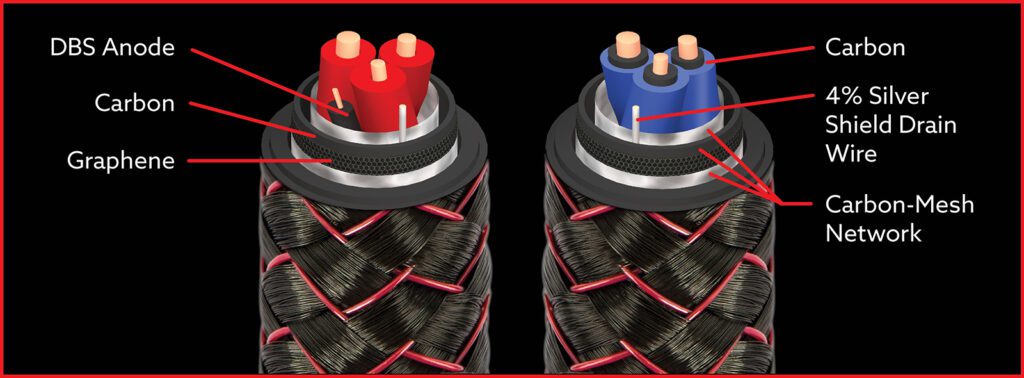
By separating the positive and negative configurations into two distinct jacketed cables, we were able to prevent the creation of an inflexible cable while using more materials to significantly enhance the Noise-Dissipation properties of the cable’s design.
The larger outer diameter allows the conductors to have thicker insulation, reducing mutual interaction. There are additional layers of Carbon-Loaded PVC insulation with a Graphene layer positioned between the layers of CPVC – creating a more effective Carbon-Based Mesh Network to dissipate RF into heat and to ‘shield’ the shield more effectively, thereby reducing RF noise that would otherwise need to be drained to Earth.
Additionally, the insulation on the positive conductors has shifted from Polyethylene (PE) to Polypropylene (PP). The difference in dielectric values is significant, and thanks to the Dielectric-Biasing already present in earlier models, the less smooth audible character of unformed PP is not problematic.
As is often the case in the real world, there are multiple variables and priorities, some conflicting with each other – but, in this instance, there is a clear benefit to using PP in the new models: the significantly higher voltage-withstand of PP allows our Permanent Molecular Optimisation process (known internally as ‘cooking’) to stress PP much more than we can stress PE – resulting in noticeably more linear behaviour at all frequencies (including RF-Noise dissipation) and less audible interference.
However, the list of what remains the same between the previous and new models is much longer and more complex than the list of what is new. And, as always with well-considered designs, it is the sum of the parts and how well they work together that determines if the product is truly worthy.
What’s next for AudioQuest?
Evolution never ceases. There will be continued refinement of most of AudioQuest’s products in the coming years – though I am particularly keen to introduce upper models of USB and subwoofer cables that will feature our patented RF Noise-Dissipation technology.
Like most of our current AC cables and our dedicated BASS models in the Folk Hero and Mythical speaker cable series, eliminating, dissipating and pulling RF off an active circuit before it can cause audible issues will lead to a lot of enjoyment and good music.
Read the AudioQuest Brave Heart loudspeaker cable review here.
Manufacturer
AudioQuest
Telephone Number (AudioQuest Europe): +31 165 541404



By Steve Dickinson
More articles from this author
Read Next From Blog
See all
Tech Talk: Joakim Juhl of OePhi
- Nov 03, 2026

Tech Talk: Masahiro Okada of Excel Sound/Hana
- Oct 21, 2026
Tech Talk: Wilfried Ehrenholz of Peak Consult
- Oct 20, 2026
Tech Talk: Spring Meng of Eversolo
- Oct 13, 2026