Before we start, a short note on pronunciation: Sinfonia is pronounced with the stress on the third syllable – sinfon’ia – and not, as I’d been saying it in my head, on the second syllable – sin’fonia. Happy to help, and you’re welcome.
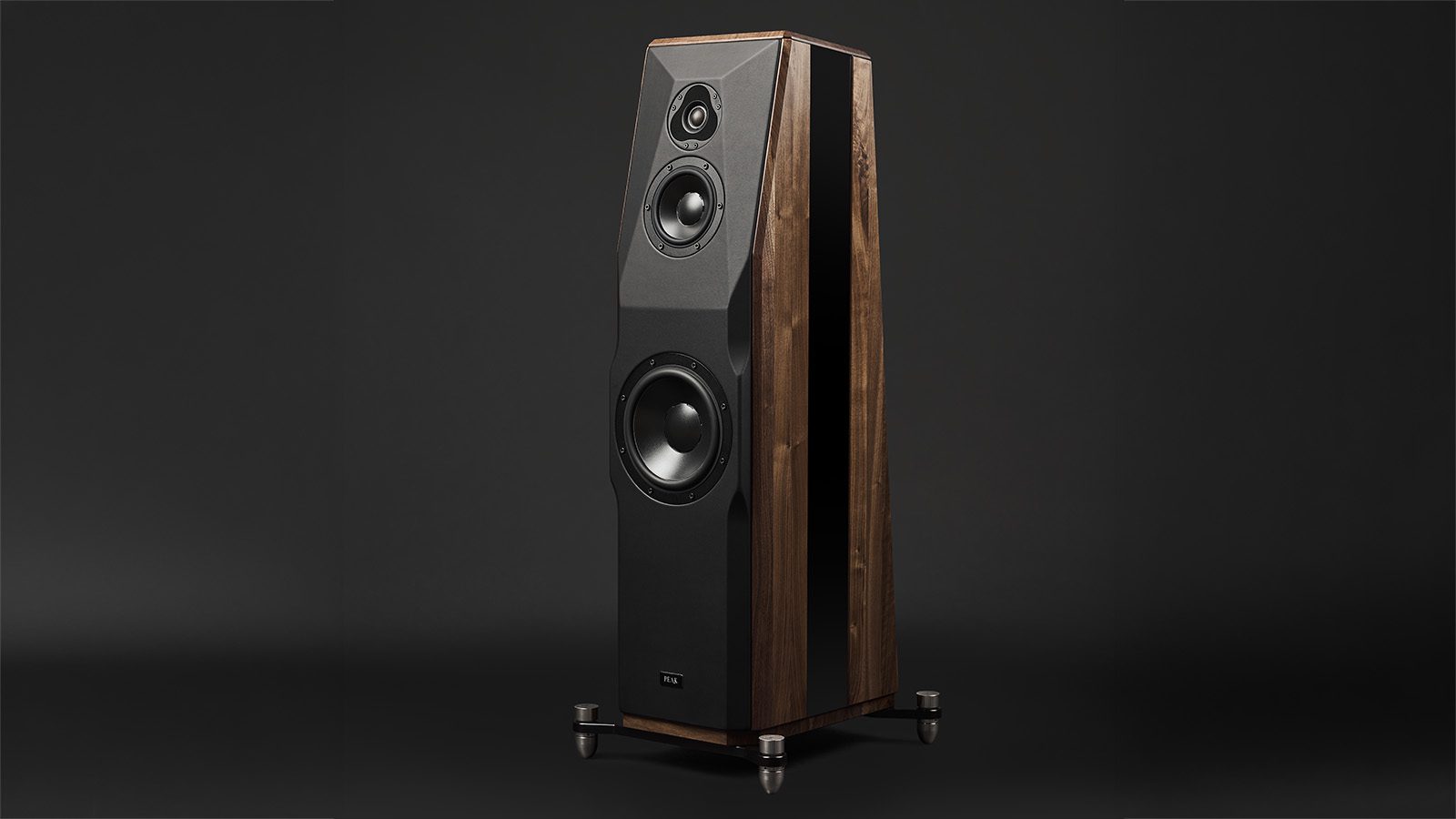
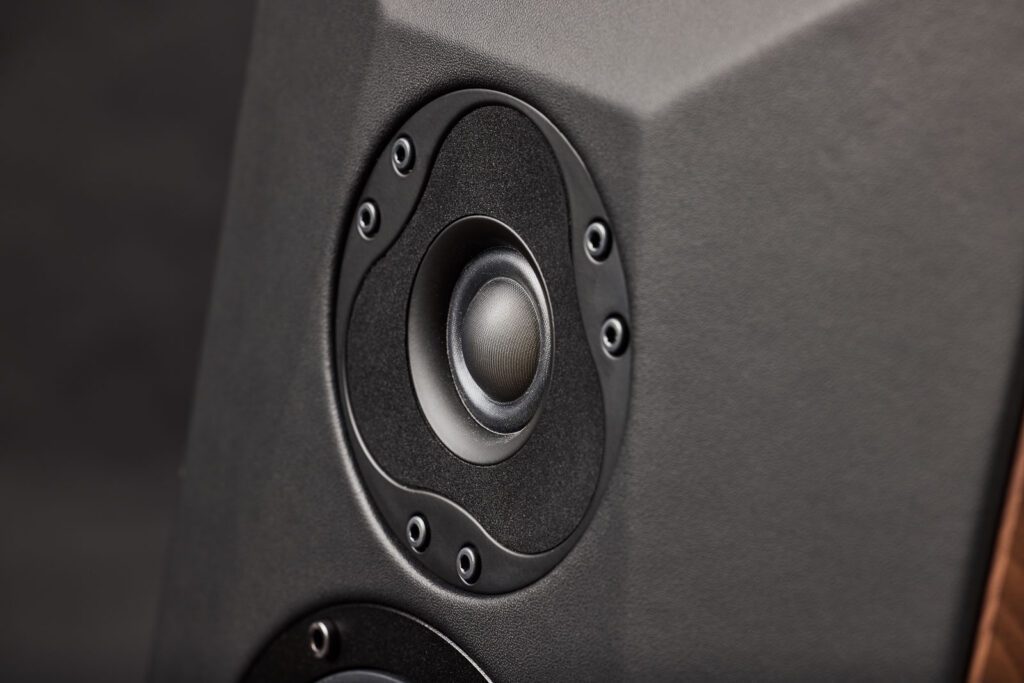
The Sinfonia is the smallest of the three-way floorstanders in Peak Consult’s now five-model lineup. It sits between the two-way Sonora, which I reviewed in Issue 240, and the El Diablo, which is similar in configuration to the Sinfonia but equipped with a pair of bass drivers in each cabinet, compared with the Sinfonia’s single unit. Above these models sit the considerably larger, heavier and more expensive SunFyre and Dragon Legacy. The Sinfonia uses a 26mm soft-dome tweeter, coupled to an 11cm midrange that has also recently undergone a substantial revision, prompted by the availability of a higher-spec, closer-tolerance midrange driver developed during the work on SunFyre. The bass unit is a single 20cm (8”) driver (Peak also notes that these dimensions are to the outer edge of the cone suspension, not the outer basket).
Hard work
A considerable amount of work goes into the detailed specification of every driver used by Peak, so it would be a disservice to describe them simply as OEM drivers built to a bespoke specification. Similarly, crossover components are all auditioned and specifically selected for the purpose. As Mike Picanza, Peak Sales and Marketing manager explains, the improved midrange driver necessitated a thorough reworking of the crossover to better exploit its superior linearity. So, the Sinfonia v2 is a somewhat different beast to the previous variant. Existing Sinfonia owners can move up to v2 spec via a return-to-factory upgrade.
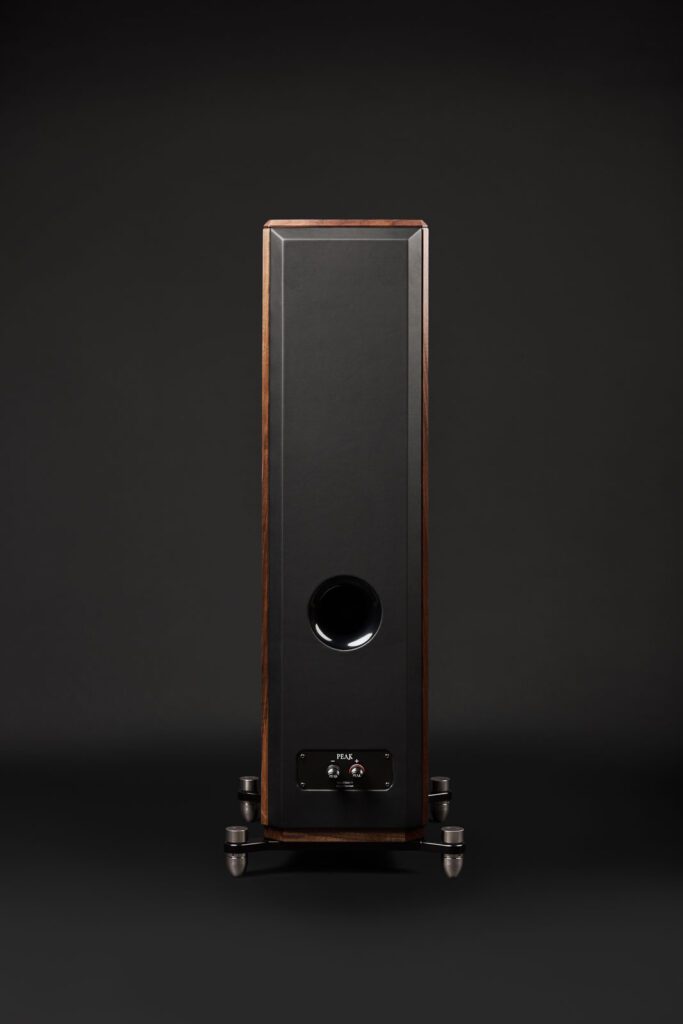
Unlike Sonora, which uses a rear-facing passive bass radiator, the other models, from Sinfonia on up, use bass-reflex loading. The Sinfonia employs a substantial rear-facing port (big enough to get your hand in), carefully designed to minimise the ‘noises off’ that have plagued many reflex designs but would be unacceptable in a loudspeaker as accomplished and expensive as Sinfonia. So, no huffing or chuffing here. Given that placement in my room necessitates the loudspeakers’ rear feet being little more than 30cm from the wall below a bay window, you can be sure that any undesirable output from the port would make itself known in this situation.
Installation
We’d been wondering how the Sinfonias might fare in this, my determinedly domestic-sized listening room, but happily set-up went smoothly and we quite quickly got them settled into the space, helped somewhat by the use of the UK distributor’s optional AcouPlex outriggers and feet, supplanting the steel and aluminium bases which arrived with the review samples. We did this partly because Peak has just redesigned the standard outriggers and feet, and the better-sounding redesign wasn’t available in time for the review.
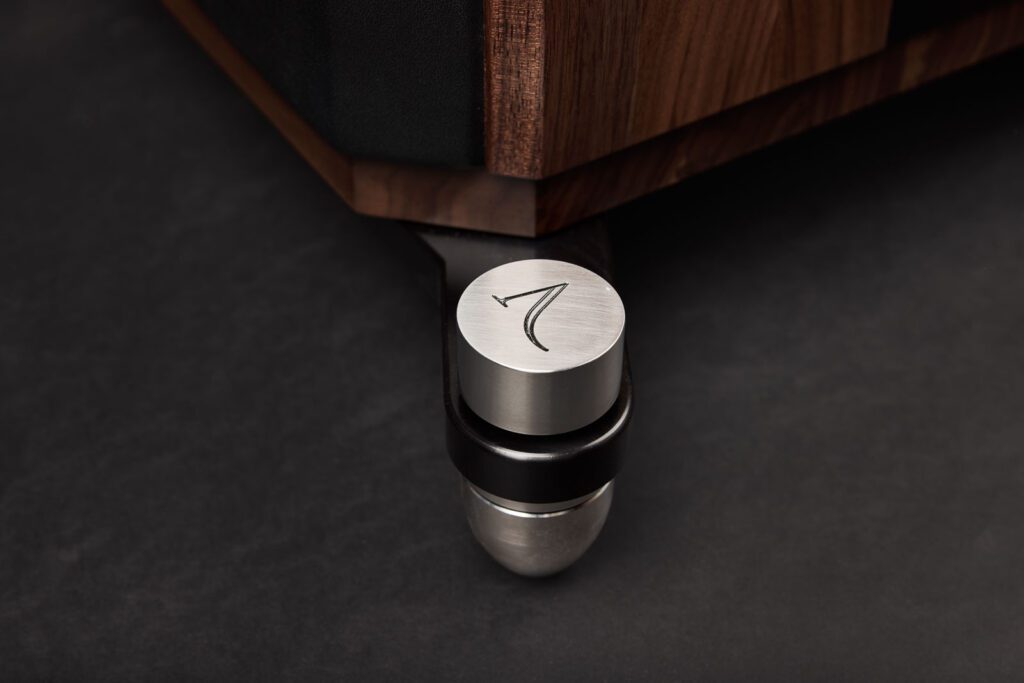
Peak’s new outriggers, especially the feet, have taken some of the lessons from experience with the previous design, including mine, which I mentioned in the Sonora review, and now incorporate various polymer and elastomer elements to better decouple the cabinet from the floor.
Construction
And it’s quite a cabinet: an internal, substantially and carefully braced box structure of 30mm HDF, bonded to an immaculately finished outer hardwood cabinet using four different adhesives in selected applications for specific aspects of the construction. The Sinfonia’s cabinet is therefore around 50mm thick and very inert. The inert cabinet approach has been a hallmark of Peak Consult designs since Per Kristofferson set the company up decades ago, and remains a foundational element in the design process, as owner Wilfried Ehrenholz explains in the Tech Talk that accompanies this review.
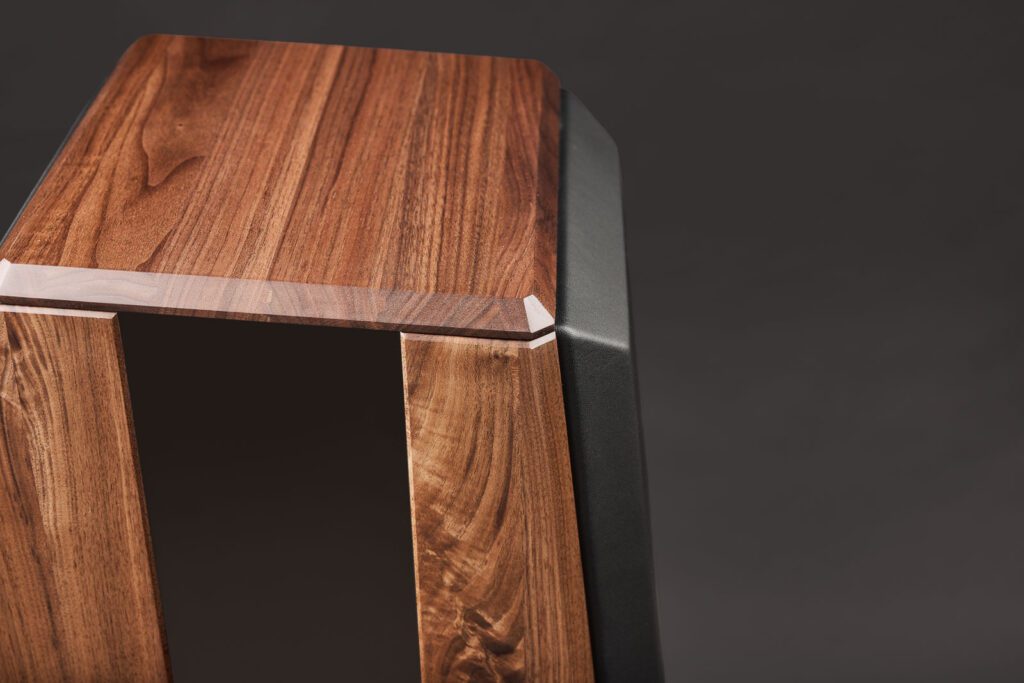
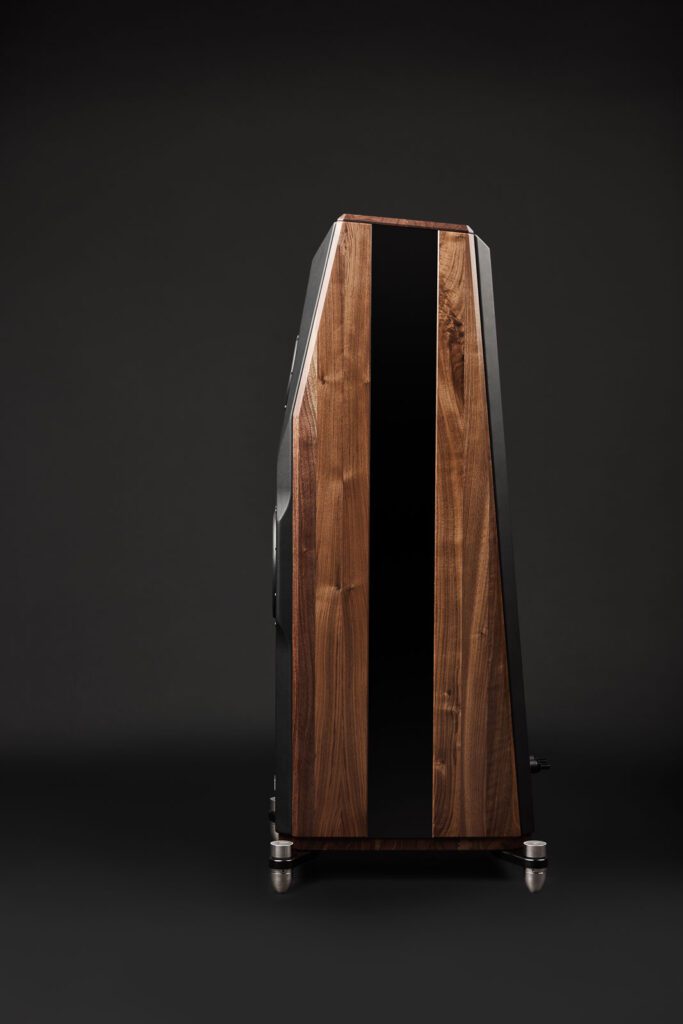
This naturally lends itself to a substantial design, especially when you factor in the substantial motors for those drive units, but that doesn’t quite prepare you for just how heavy the Sinfonias are; at 78kg each, they’re definitely a two-man lift. The design tapers via a forward-leaning rear panel and a sloping front baffle for the midrange and treble units, for time alignment. This helps reduce the visual impact of what is undoubtedly a substantial loudspeaker.
The chosen hardwoods are impeccably and beautifully finished (Peak Consult is Danish, what did you expect?). The leather trim on the front and rear faces, and the acrylic panels on the sides, help to visually break up any tendency towards slabbiness, so the Sinfonia wears its mass surprisingly lightly. The review pair came in pale Ash, a relatively new option that looks very fresh and light. Walnut and Wenge are alternatives at no cost, and for a surcharge you can have your Sinfonias in a full acrylic jacket.
Separate chamber
That unexpected extra mass takes the form of a separate chamber at the base of the cabinet, housing the crossovers. Fine sand, with its ability to damp acoustic vibrations, fills this chamber. This reduces distortions caused by microphony in the crossover components. The crossover itself is hard-wired to three separate MDF boards – no PCBs here – one each for HF, midrange, and bass (the review units are single-wired, but bi-wired terminals are a no-cost option).
As with the Sonora, and indeed all Peak models, the crossover incorporates Peak’s Linear Impedance Control technology to ensure a benign and stable amplifier load. Impedance for the Sinfonias is nominally 5Ω and doesn’t vary by more than 1Ω, which, coupled with the 89dB sensitivity, means the Sinfonia isn’t particularly demanding of your amplifier.
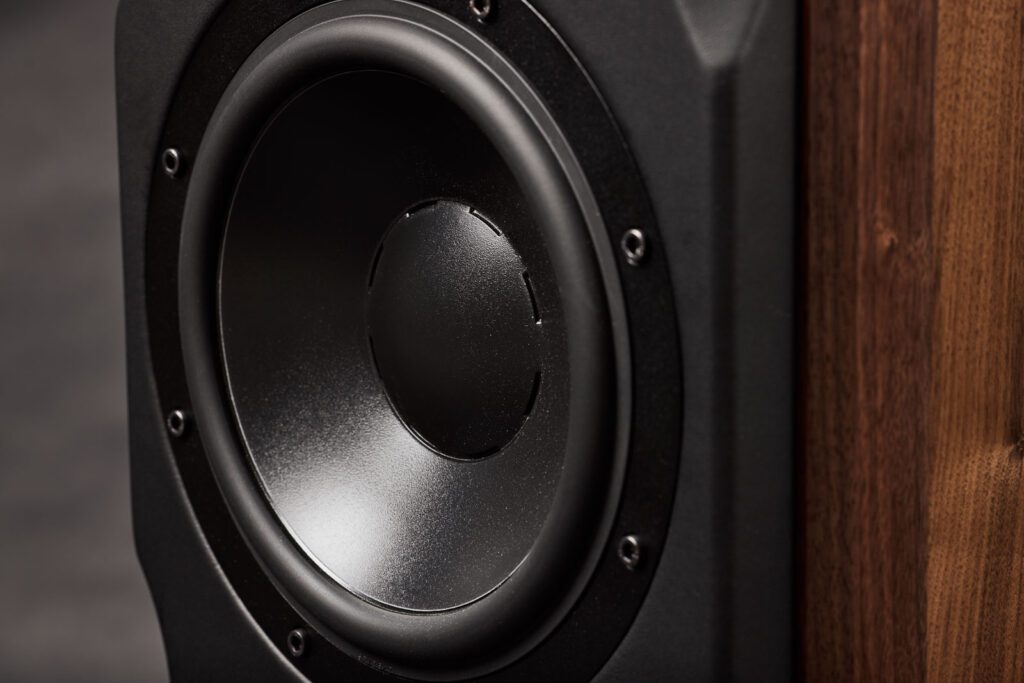
I used my Accuphase E-5000 integrated amplifier, a 250W Class AB design, and this proved to be a thoroughly musical combination, especially when paired with my DP-570 CD/SACD player. Cabling throughout was Nordost Tyr2, supplied from a Nordost QB6v3 mains block. Accuphase amplifiers provide a visual display of the set volume level, shown as a negative figure representing the attenuation from full output in dB.
Normally, I work in the -32 to -35 dB range, so it was interesting and instructive to notice that I quickly found myself setting the typical volume level about 2-3dB higher, at an indicated -29 to -32dB. Consider also that, at 89dB for 1 Watt, the Sinfonias are about 3dB more sensitive than my regular FinkTeam Kims, and I think this tells you something about the Sinfonias’ ability to deliver significant sound pressure levels without audible stress.
Scale
And this, in a nutshell, is a big part of the Sinfonia’s design objective: to take what the Sonora achieved and scale it up in a manner a two-way simply can’t achieve. The Sinfonia isn’t significantly larger than the Sonora: they’re almost identical in height; the Sinfonia is 20mm wider (to accommodate that 8” bass driver) and around 75mm (3”) deeper. But it’s a much bigger loudspeaker in so many ways. It moves air easily, drives a room, and produces a convincing portrayal of large musical forces. Conversely, it does small and intimate as well as any small stand-mount I’ve heard, partly because there’s a stillness between and around the notes, doubtless thanks to that inert cabinet and the damped crossover, but also because there’s an uncanny naturalness to everything.
As I said in my review, the Sonora is a floorstanding loudspeaker that thinks it’s a stand-mount – it disappears in the way that great small loudspeakers can. For Peak, scaling up the Sonora also meant not losing any of the important benefits of the smaller design, and the Sinfonia has managed that balance impeccably – more than one visitor chez Dickinson has commented on how well the Sinfonias disappear in the room and create a deep, wide and, above all, stable soundstage.
Polish
Arguably the most outstanding feature of the Sinfonias – and it’s a Peak lodestar – is the sheer depth and quality of tone and timbre they convey. Instruments and vocals have a naturalness about them, a realism from top to bottom that is at times quite breathtaking. All the harmonics and complexity that recreate timbre are preserved to a level I’ve rarely experienced at any price; and for the same reason, pitch is also impeccably accurate, whether it’s the bass guitar underpinning a rock concert or the wooden flute in a jazz band.
Early on in my time with the Sinfonias, I put on Pink Floyd’s The Wall [EMI], intending only to wake the system up a bit and listen as far as ‘Another Brick in the Wall part 2’ before moving on. I ended up listening to the whole album, because it was almost like hearing it for the first time. Powerful, propulsive, and hugely dynamic as you’d expect, but the real surprise was the layers of inner detail and the tunefulness of all the constituent parts.
Vocal and instrumental pitch accuracy made the harmonies and melodies fuller, richer, and more relevant than I recalled; in particular, the bass notes were so tuneful that the riffs and melodies stood out, creating the conditions for layers of complexity in the writing and performance that are usually glossed over amid all the angst and bombast. And that, in turn, made all that angst and bombast feel fresh and meaningful. In contrast, Andy Sheppard’s bamboo flute on ‘Romantic Conversations’ from Introductions in the Dark [Antilles] was playful and fun, and the rich instrumental colour from the bass, piano, marimba, and various bits of percussion contributed to a joyfulness and freshness that was captivating.
Whimsical Shostakovich
Whether it’s the lighthearted, almost whimsical Shostakovich in the Jazz Suites #1 & 2 [Brilliant Classics], or the dark and sinister Prokofiev Piano Concerto #2 [BIS], the way composers use orchestral forces is clearly set out by the Sinfonias. The orchestra is revealed as what it is: a large and powerful entity with numerous complex, moving and interlocking parts, yet capable of producing output of the most extraordinary delicacy, complexity and subtlety. In the Prokofiev, the orchestra sometimes sits like a dark cloud, defining the light without ever overshadowing the piano; the Shostakovich, by contrast, trips along busily, frivolously evoking its era. These are familiar pieces, but the Sinfonias offer fresh viewpoints into both the composition and the interpretation.
Despite their evident heft, the Sinfonias have a deftness with timing that lets you into not just the ‘what’, but also the ‘how’ and the ‘why’ of so much music. Complex jazz becomes approachable. Even dense orchestration becomes much more stratified. Mike Oldfield’s folk-influenced prog rock is a long-term favourite of mine, particularly his facility for a good tune. ‘Taurus 1’ from QE2 [Virgin] reveals layers of complexity in the writing and performance; that tunefulness isn’t just in the melody, but finds its way into the inner parts, and the melodic lines they create make it easy to follow any particular instrument like a thread woven through the piece. The level of resolution achieved by the Sinfonias isn’t just about shoving the detail at you, but about showing you how it fits into the greater whole and, crucially, why it’s there.
Smile
There is clearly far more to resolution than mere detail, and the Sinfonias make that abundantly obvious. More than once I found myself smiling in wonder at the sheer musicality of what was coming out of these remarkable loudspeakers. Music is revealed in all its multilayered complexity; lines are easy to follow, not only because of that timbre and tunefulness, but because there is space in and around the notes. That inert cabinet clearly allows the carefully chosen drivers to do exactly what they are supposed to do – a testament to the amount of work that has gone into the development. There are disappointingly few all-round great loudspeakers in this game, but I have a feeling I may just have found one.
Read more about what went into creating the Peak Consult Sinfonia here.
Technical specifications
- Type: Three-way, passive, floorstanding loudspeaker with reflex-loaded bass.
- Driver complement:
- One 26mm soft dome tweeter
- One 11cm midrange unit
- One 20cm bass unit
- All drivers are built to close tolerance, using proprietary Peak Consult specifications
- Crossover frequency: 450Hz / 3100Hz
- Frequency Response: Peak Consult declines to publish these figures, taking the view that industry measurement standards are not consistent and may mislead
- Impedance: 5Ω ±1Ω
- Sensitivity: 89dB/W/m
- Dimensions (HxWxD): 114 x 30 x 46cm
- Weight: 78kg/each
- Finishes: American Black Walnut/Wenge/Ash, with acrylic side panel inserts and leather front and rear trim; pure white or midnight black acrylic with smooth leather front trim
- Price: £42,000; €45,000; $58,900; 5% surcharge for full acrylic cabinet (special order)
Manufacturer
Peak Consult Denmark ApS
UK distributor
MusicWorks (UK) Ltd
Trending Articles
See all
By Steve Dickinson
More articles from this author

Read Next From Review
See all
Linn Majik DSM (5th Gen)
- Nov 03, 2026

OePhi Kali cable system
- Nov 03, 2026
Thiele TT01/TA01
- Oct 27, 2026
Technics SL-1200/1210G Master Edition turntable
- Oct 27, 2026