
I won’t go over old ground with Kali, OePhi’s new flagship cable system. We tested the interconnect cables and compared them to the brand’s Reference cable in Issue 249. In the Tech Talk that follows, Joakim from OePhi ably describes the process that led to Kali. This is instead about what happens when you run OePhi Kali cable from the front to the back of a system. Note that Reference isn’t ‘going away’. Instead, Kali sits at the top of the range.
Describing Kali in terms of component cables is simple. Each cable uses pure-silver conductors and connectors, spaced wider than the Reference, with cotton-damped air dielectrics, and cut to ‘transmission-line optimised’ lengths. The appearance is distinctive, featuring thin, braided white cables separated by wooden spacers along their length. Each conductor in a cable is physically isolated this way. The uniform look, combined with white wires and light wood spacers, is striking. This gives Kali a more ‘organic’ and less ‘engineering’ aesthetic. It’s the antithesis of the ‘audio python’ school of phat cable design.
Religious mash-up
As a single cable – whichever cable you choose – Kali makes it sound like you’re directly connecting those two devices. Mixing my religions for a moment (Kali being a Hindu goddess), if there’s a Zen-like state of ‘no-cable’, then Kali comes closer than most. But that’s just what happens when you replace a single interconnect or speaker cable. What happens when you don’t take the piecemeal approach? You change every cable in the system.
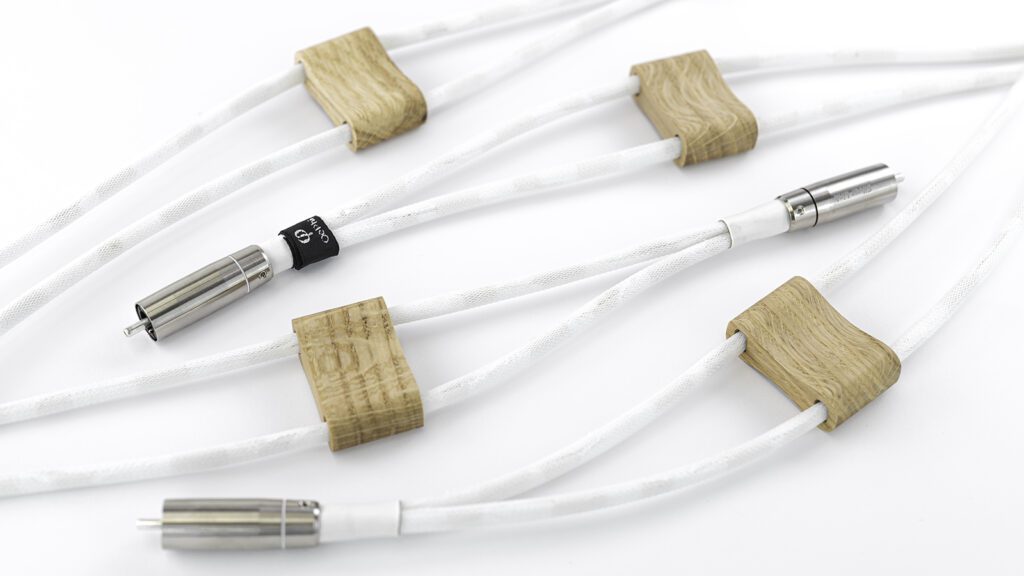
If ever there was a sonic argument for ‘the whole is greater than the sum of the parts’, it’s OePhi Kali. That ‘no-cable’ performance is revelatory in one device; it’s transformative when used throughout. There is so little sonic fingerprint between the components that the result is almost unearthly. I’ve never been fond of the term ‘time-smear’, as it sounds like bad sci-fi terminology. However, with Kali, the term becomes self-evident. Most rival cable systems have some degree of temporal blurring; a vagueness in attack and release of notes. The best cable systems address either the leading or the trailing edge, but rarely deliver the effect as the note rises and decays. OePhi’s Kali gets both right.
Snap
As a result, sounds start and stop with precision and ‘snap’. It’s the kind of sound rarely heard outside live performances. It doesn’t matter what you are playing; this becomes immediately apparent. For example, there has been some re-evaluation of Ringo Starr’s drumming in recent years. The idea of the ‘song drummer’ has grown. Starr’s drumming supported each Beatles track well, and replacing him with someone more ‘precise’ can make many great records fall apart.
With OePhi Kali, that explanation is unnecessary; just listening to that unique ‘lefty playing a right-handed drum kit’ that helped create ‘the Ringo Swing’ takes about five seconds to process. Put on ‘Come Together’ [Beatles, Let It Be, Universal 2009 Remaster], and that unique drum riff explains both what Ringo Starr did so well and how OePhi makes it so much easier to understand.
More than edge
If that leading- and trailing-edge precision were the only thing OePhi Kali excelled at, its position at the top of the cable table would already be assured. But it’s just the beginning. The cable frees sound, and once again, any time recorded with other designs reveals the difference. We often describe systems as dynamically unconstrained, letting large- and small-scale changes in a piece of music shine through without being held back by the electronics.
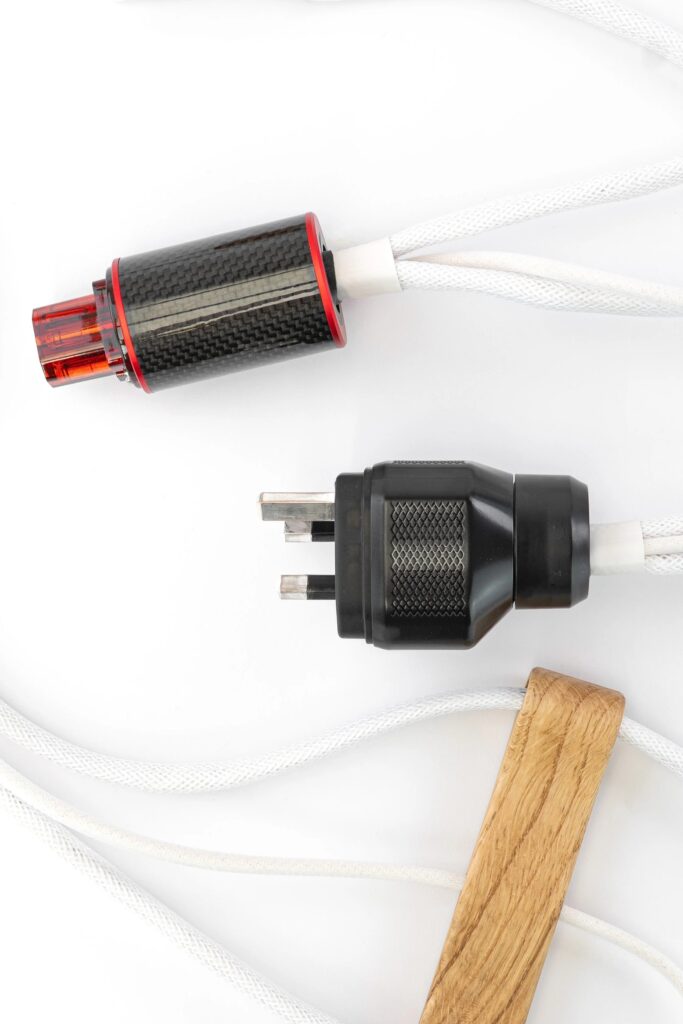
However, with Kali in place, you discover it’s more than dynamics being held back. It’s part of our nature to focus on what we know indicates difference. For dynamic-range tests, I evaluate systems using piano, classical guitar, and orchestral works. Rachmaninov’s Symphonic Dances [Zinman, Telarc] is a fine – and frequently cited – example. And yes, the system’s dynamic range was less constrained by OePhi Kali than many other top-end cable designs.
Handbrake off
However, I didn’t expect Kali to sound as if the handbrake had been released on the articulation and cohesion of the piece. Yes, that’s related to detail and is soundstage-adjacent, because Kali handles all those sonic elements expertly. But beyond that, you find yourself mesmerised by the interplay between woodwind instruments and the flow of the piece from theme to theme. This is a recording I have used for more years than I care to remember… I have played the digits out of it. It should be musically dead to me and just an exercise in checking how the dynamic range plays out. But here, I was with eyes closed, air conducting, listening to the ‘dance’ in those Symphonic Dances—something I haven’t done in decades.
That wasn’t an isolated incident. The Kali cables revealed hidden depths in the music, whether it was a track I’d played countless times or one I heard for the first time. This isn’t typical audio reviewer language. Honestly, I find it hard to describe what Kali does. It’s not just a string of superlatives, but the way it reshapes your connection with the music is profound. It’s not simply about resistance, capacitance, and inductance. Nor is it solely about rhythm, melody, and harmony. It encompasses more; not just the texture or timbre of the music, or even its structure. Not even a sense of being ‘closer’ to the music. Something more significant is at play… Kali touches the core of your relationship with the music itself.
No neat freak
Some might find Kali’s layout triggers their neat-freak OCD; if you prefer your cables arranged in tidy, regimented lines, OePhi Kali’s more free-form design may bother you. Similarly, those who equate ‘performance’ with ‘girth’ or require increasingly arcane and costly construction materials are unlikely to consider Kali at all.
For the rest of us, that name is fitting: Kali, the destroyer and liberator, who eradicates illusion to reveal the true nature of the universe. That’s how it sounds: removing those barriers to good sound, exposing the musical reality often hidden between the components. If that sounds pretentious, then it’s probably because you haven’t yet experienced what OePhi Kali does.
Read more about the development of OePhi’s Kali cables here.
Price and contact details
- Interconnect: 1.635m RCA £15,000, €17,000, $20,000/1.65m pair
- XLR: £19,000, €22,000, $25,500/1.65m pair
- Loudspeaker cables: £25,000, €28,000, $32,500/3.27m pair
- Power cords: £17,500, €20,000, $23,000/2.18m pair
Manufacturer
OePhi
UK distributor
Airt Audio
+44(0)1223 344053
Tags: CABLE SYSTEM OEPHI KALI
Trending Articles
See all
By Alan Sircom
More articles from this author
Read Next From Review
See all
Linn Majik DSM (5th Gen)
- Nov 03, 2026
Thiele TT01/TA01
- Oct 27, 2026
Technics SL-1200/1210G Master Edition turntable
- Oct 27, 2026
AudioQuest Brave Heart
- Oct 27, 2026